
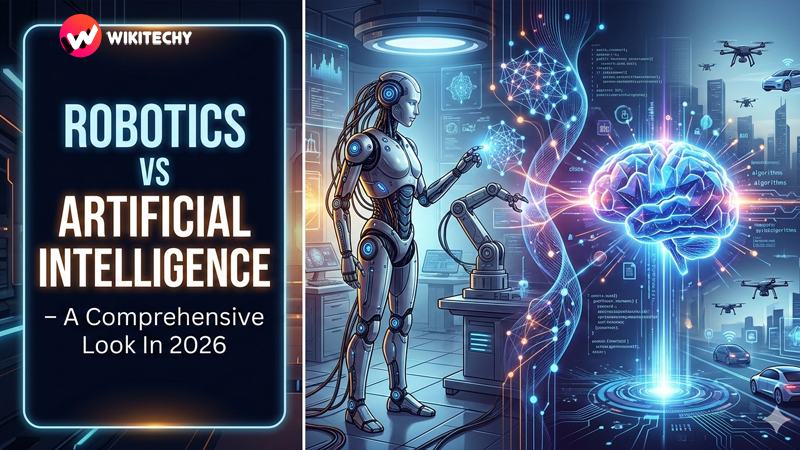
Robotics vs Artificial Intelligence – Technology is evolving faster than ever, and two terms that often appear together are Robotics and Artificial Intelligence (AI). While many people assume they are the same, they actually represent different — yet closely connected — areas of innovation.
From self-driving cars and smart assistants to automated factories and humanoid robots, robotics and AI are shaping how humans interact with machines. Understanding their differences and relationship is essential for students, developers, and tech enthusiasts preparing for the future.
This comprehensive guide explores what robotics vs artificial intelligence mean, how they differ, where they overlap, and which field offers better opportunities in the modern world.
Robotics vs Artificial Intelligence
What is Robotics?
Robotics is a branch of engineering and computer science focused on designing, building, and operating physical machines called robots. These machines are created to perform tasks automatically or semi-automatically.
Robots interact with the physical world using sensors, motors, and mechanical components. They can move, manipulate objects, and perform repetitive or dangerous tasks more efficiently than humans.
Robotics combines multiple disciplines:
- Mechanical engineering
- Electronics engineering
- Computer programming
- Control systems
- Embedded systems
Industrial robotic arms used in manufacturing plants are among the most common examples of robotics in action.
Key Characteristics of Robotics
- Involves physical machines
- Focuses on automation and movement
- Uses sensors and actuators
- Often operates in real-world environments
What is Artificial Intelligence (AI)?
Artificial Intelligence (AI) refers to the simulation of human intelligence in machines. Instead of focusing on physical hardware, AI focuses on software that enables machines to learn, reason, and make decisions.
AI systems analyze data, recognize patterns, and improve performance over time using algorithms and models.
Common AI capabilities include:
- Machine learning
- Natural language processing
- Computer vision
- Decision-making systems
- Predictive analytics
Examples include voice assistants, recommendation systems, chatbots, and fraud detection systems.
Key Characteristics of AI
- Primarily software-based
- Learns from data
- Makes intelligent decisions
- Improves through experience
Robotics vs Artificial Intelligence: Core Difference
The simplest way to understand the difference:
👉 Robotics = Physical machines
👉 Artificial Intelligence = Intelligent thinking
A robot does not necessarily need AI, and AI does not require a robot.
For example:
- A factory robot that repeats the same motion daily uses robotics but little AI.
- A recommendation algorithm on a streaming platform uses AI but no robotics.
Comparison Table: Robotics vs Artificial Intelligence
| Feature | Robotics | Artificial Intelligence |
|---|---|---|
| Nature | Physical systems | Software intelligence |
| Focus | Movement & automation | Learning & decision-making |
| Components | Sensors, motors, hardware | Algorithms, data models |
| Dependency | Can work without AI | Does not require robots |
| Goal | Perform tasks physically | Think and analyze intelligently |
| Example | Industrial robot arm | Chatbot or recommendation engine |
How Robotics and AI Work Together
The real power emerges when robotics and AI combine.
AI gives robots the ability to think, while robotics gives AI the ability to act in the real world.
AI-powered robots can:
- Recognize objects using computer vision
- Navigate environments autonomously
- Adapt to changing conditions
- Interact naturally with humans
Self-driving cars are a perfect example. Robotics controls the vehicle’s movement, while AI analyzes surroundings and makes driving decisions.
Real-World Applications
Robotics Applications
Robotics is widely used in industries requiring precision and automation.
Examples include:
- Manufacturing automation
- Surgical robots in healthcare
- Warehouse logistics systems
- Space exploration rovers
- Agricultural automation
Artificial Intelligence Applications
AI powers many digital experiences people use daily.
Examples include:
- Virtual assistants
- Image recognition systems
- Language translation tools
- Financial risk analysis
- Personalized content recommendations
Skills Required for Robotics vs AI
Although related, the skill sets differ significantly.
Robotics Skills
- Mechanical design basics
- Embedded programming
- Electronics and sensors
- Control systems
- ROS (Robot Operating System)
AI Skills
- Python programming
- Mathematics and statistics
- Machine learning algorithms
- Data analysis
- Deep learning frameworks
Students interested in hardware and engineering often prefer robotics, while those interested in data and algorithms lean toward AI.
Career Opportunities and Future Scope
Both robotics and AI are among the fastest-growing technology domains worldwide.
Robotics Careers
- Robotics Engineer
- Automation Engineer
- Mechatronics Engineer
- Robotics Technician
Industries such as manufacturing, defense, and healthcare are investing heavily in robotics automation.
AI Careers
- Machine Learning Engineer
- AI Research Scientist
- Data Scientist
- NLP Engineer
AI adoption is expanding across finance, healthcare, education, marketing, and entertainment.
AI currently shows broader adoption because software solutions scale faster, but robotics is rapidly growing alongside advancements in AI intelligence.
Advantages and Limitations
Robotics Advantages
- Performs dangerous tasks safely
- High precision and consistency
- Reduces manual labor
Limitations
- Expensive hardware
- Maintenance requirements
- Limited flexibility without AI
AI Advantages
- Learns and adapts
- Handles large data efficiently
- Improves decision-making
Limitations
- Requires massive datasets
- Ethical concerns
- Computational cost
Which One Should You Learn?
The choice depends on your interests and career goals.
Choose Robotics if you enjoy:
- Building machines
- Working with hardware
- Engineering systems
- Real-world automation
Choose Artificial Intelligence if you enjoy:
- Programming and algorithms
- Data analysis
- Problem-solving using logic
- Software innovation
Many professionals now combine both fields to build intelligent robotic systems — one of the most promising career paths of the future.
The Future: Intelligent Machines
The future of technology lies not in robotics or AI alone but in their integration. Smart factories, autonomous vehicles, healthcare assistants, and service robots will increasingly rely on AI-driven robotics.
As computing power improves and sensors become cheaper, machines will become more autonomous, adaptive, and collaborative with humans.
Robotics vs Artificial Intelligence – The next technological revolution will be driven by systems that can both think intelligently and act physically.
Conclusion
Robotics and Artificial Intelligence are distinct yet deeply interconnected technologies shaping the modern world. Robotics focuses on creating machines that interact with the physical environment, while AI enables machines to learn, reason, and make decisions.
Understanding the difference helps learners choose the right career path and appreciate how intelligent systems are built. Rather than competing fields, robotics and AI complement each other, forming the foundation of tomorrow’s intelligent automation ecosystem.
As industries continue to evolve, mastering either — or both — can open doors to some of the most exciting opportunities in technology.
Want to Learn More About Python & Artificial Intelligence ???, Kaashiv Infotech Offers Full Stack Python Course, Artificial Intelligence Course, Data Science Course & More Visit Their Website course.kaashivinfotech.com.