
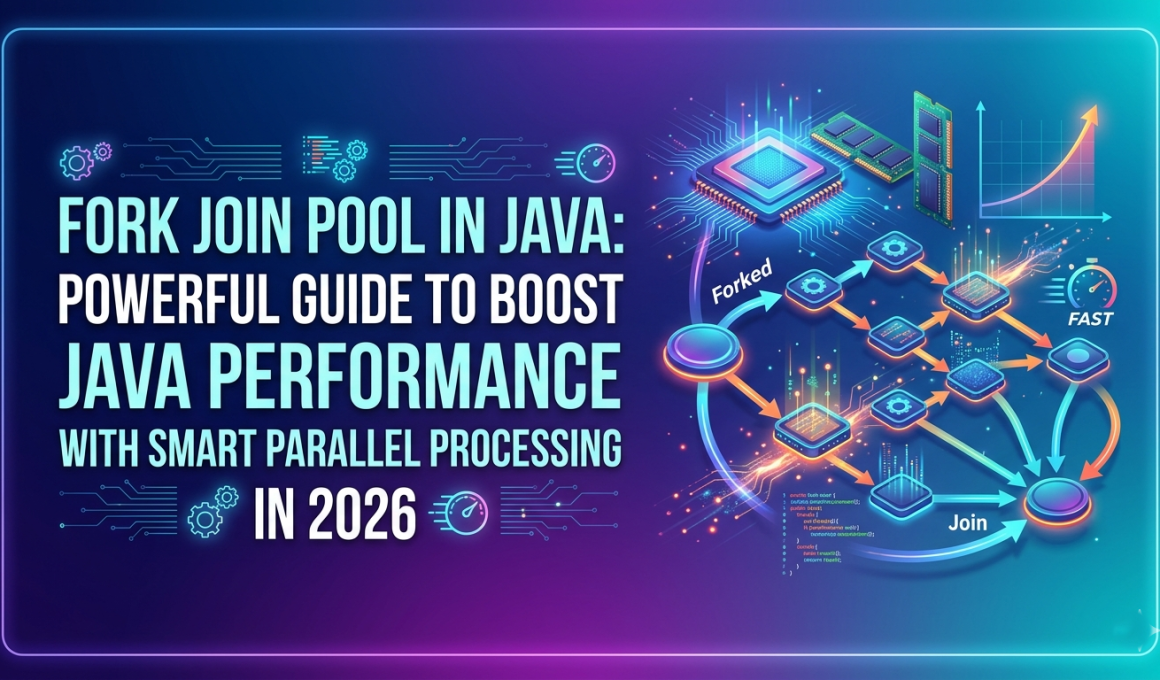
Ever stared at a progress bar that refuses to move? 😫 You know the feeling. The application hangs. The CPU fans spin up like a jet engine, yet nothing happens. For many developers, concurrency feels like a dark art. But what if you could split that massive task into tiny pieces and smash through it?
That is exactly where the fork join pool in java shines.
I remember debugging a legacy financial reporting tool early in my career. It took 45 minutes to generate a monthly summary. Single-threaded. Painful. After refactoring the core calculation logic to leverage parallel processing, that time dropped to under 8 minutes. The secret? Understanding how to wield the fork join pool in java effectively.
This guide isn’t just about code syntax. It is about career growth, performance tuning, and writing software that respects the user’s time. Let’s dive in. 👇
🤔 What Exactly is the fork join pool in java?
Think about a huge pile of leaves in your backyard. 🍂
You could rake them all yourself. It would take hours. Or, you could call in three friends. Each person takes a section, rakes their part, and then you combine the piles at the end. This is the “Divide and Conquer” strategy.
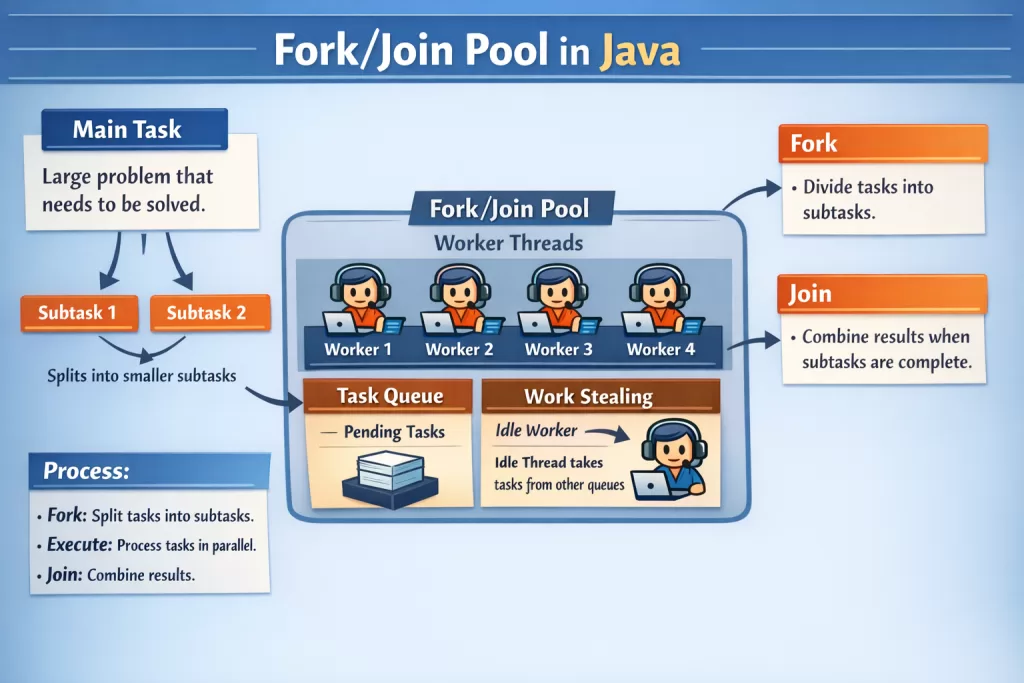
The fork join pool in java implements this strategy programmatically. It is a specialized ExecutorService designed for tasks that can be recursively broken down into smaller sub-tasks.
- Fork: Splitting a large task into smaller sub-tasks.
- Join: Waiting for sub-tasks to finish and combining their results.
Unlike standard thread pools, this framework uses a work-stealing algorithm. 🧠
Here is the magic: If one thread finishes its work early, it doesn’t sit idle. It “steals” tasks from the queue of another busy thread. This keeps every CPU core busy. Efficiency skyrockets.
💻 Complete Runnable Code Example
Theory is great. Code is better. 📝
Let’s build something real. Here is a complete class that sums a large array of numbers. This is the “Hello World” of parallel processing.
Notice how the task splits itself. That is the essence of the fork join pool in java.
import java.util.concurrent.ForkJoinPool;
import java.util.concurrent.RecursiveTask;

// 1. Define the Task
class SumArrayTask extends RecursiveTask<Long> {
    private final int[] array;
    private final int start, end;
    private static final int THRESHOLD = 1000; // Stop splitting here

    public SumArrayTask(int[] array, int start, int end) {
        this.array = array;
        this.start = start;
        this.end = end;
    }

    @Override
    protected Long compute() {
        // 2. Base Case: Task is small enough
        if (end - start <= THRESHOLD) {
            long sum = 0;
            for (int i = start; i < end; i++) {
                sum += array[i];
            }
            return sum;
        }
        // 3. Recursive Case: Split the work
        else {
            int mid = (start + end) / 2;
            SumArrayTask left = new SumArrayTask(array, start, mid);
            SumArrayTask right = new SumArrayTask(array, mid, end);

            left.fork(); // Run left asynchronously
            long rightResult = right.compute(); // Run right synchronously
            long leftResult = left.join(); // Wait for left

            return leftResult + rightResult;
        }
    }
}

// 4. Execute the Pool
public class ForkJoinDemo {
    public static void main(String[] args) {
        int[] data = new int[10_000_000];
        // Fill array with dummy data
        for(int i=0; i<data.length; i++) data[i] = 1;

        ForkJoinPool pool = new ForkJoinPool();
        SumArrayTask task = new SumArrayTask(data, 0, data.length);

        long result = pool.invoke(task);
        System.out.println("Total Sum: " + result);
    }
}
Key Takeaways from the Code:
- Threshold: Notice the
THRESHOLDconstant. Splitting forever causes overhead. Stop when the chunk is small. - Fork vs. Compute: One side forks (async), the other computes (sync). This prevents creating too many tasks at once.
- Join: You must join the result to get the value.
Struggling to understand the flow? 🤔 Hands-on practice makes perfect. Kaashiv Infotech offers Java Internships where you tackle real concurrency challenges like this under mentor guidance. Don’t just read code; write it.
📈 The Career & Performance Angle: Why Data Matters
Why should a developer care about this specific pool? Because performance equals money. 💰
In the enterprise world, latency kills conversion rates. Amazon found that every 100ms of latency cost them 1% in sales. While the fork join pool in java isn’t a silver bullet for network latency, it crushes CPU-bound tasks.
Consider these industry insights:
- Multi-core Utilization: Modern servers often have 16, 32, or even 64 cores. Single-threaded apps use less than 5% of available hardware power.
- Processing Speed: Benchmarks often show a 3x to 7x speedup on recursive tasks (like sorting large arrays or processing images) when moving from single-threaded to Fork/Join implementations on multi-core machines.
- Java Adoption: Since Java 8, parallel streams use the fork join pool in java under the hood. Understanding it means understanding how
.parallelStream()actually works.
For a career seeker, concurrency is a senior-level skill. 🎯 Junior devs write code that works. Senior devs write code that scales. Recruiters look for keywords like “Concurrency,” “Multithreading,” and “Performance Optimization” on resumes. Mastering this pool signals that you understand how the JVM handles heavy lifting.
🌍 Real-World Use Cases for the fork join pool in java
Where does this fit in the real world? It isn’t for everything. You wouldn’t use a sledgehammer to crack a nut. 🥜
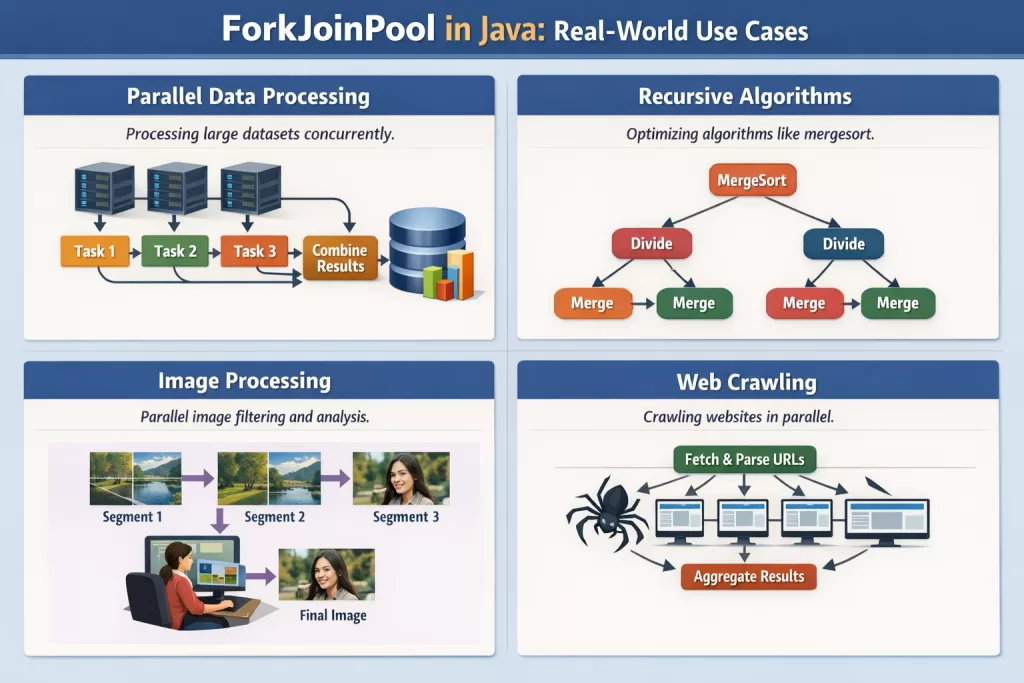
The fork join pool in java excels in specific scenarios:
- Image & Video Processing 🎥 Applying a filter to a 4K video frame is heavy. Split the frame into quadrants. Process each quadrant simultaneously. Merge the results.
- Large Data Sorting 📊 Merge Sort is a classic candidate. Split the array recursively until chunks are small enough to sort quickly.
- Financial Modeling 📉 Calculating risk across thousands of portfolios. Each portfolio calculation is independent. Perfect for forking.
- File System Searches 🔍 Scanning a directory with millions of files. Branch out into sub-directories concurrently.
When NOT to use it:
- I/O Bound Tasks: If the task waits for a database or network response, standard thread pools are often better.
- Tiny Tasks: The overhead of splitting tasks outweighs the benefit if the job takes microseconds.
⚙️ How It Works: Under the Hood
Let’s get technical without the headache.
The core class is ForkJoinPool. It manages worker threads. By default, it creates one thread per available processor core. You don’t need to manage thread lifecycles manually.
Tasks extend either:
RecursiveAction(No return value)RecursiveTask<V>(Returns a value)
Here is a conceptual look at the logic:
if (task is small enough) {
    compute directly;
} else {
    split task;
    fork sub-tasks;
    join results;
}
Notice the simplicity? 🧐
The framework handles the complexity of thread synchronization. However, developers must ensure tasks are stateless. Shared mutable state leads to race conditions. And race conditions lead to bugs that appear only in production at 3 AM. 😱
✅ Best Practices & Common Pitfalls
Experts know that power comes with responsibility. Here is how to avoid shooting yourself in the foot.
- Keep Tasks Independent: Sub-tasks should not modify shared data. Use local variables. Pass data immutably.
- Avoid Blocking: Never block a worker thread inside a Fork/Join task. If a thread waits for I/O, it cannot steal work. The whole pool stalls.
- Threshold Tuning: There is a “threshold” where you stop splitting. Too small? Overhead kills performance. Too large? You lose parallelism. Experimentation is key. 🧪
- Don’t Overuse Parallel Streams: Just because
.parallelStream()exists doesn’t mean you should use it everywhere. It uses the common fork join pool in java. If one task blocks, it affects others.
Fact Check: Did you know the common pool size defaults to Runtime.availableProcessors() - 1? That minus one keeps a core free for the main application thread. Smart, right?
🎓 Career Growth: Mastering Concurrency
Learning the fork join pool in java opens doors. 🚪
Backend Engineering roles at top tech firms heavily test concurrency concepts. System Design interviews often ask about handling heavy computation loads.
- Salary Impact: Developers with strong concurrency skills often command 15-20% higher salaries compared to peers who stick to basic CRUD operations.
- Role Evolution: This skill bridges the gap between “Application Developer” and “Performance Engineer.”
- Future Proofing: As hardware adds more cores rather than faster clock speeds, parallel programming becomes mandatory, not optional.
Empathy for the user means giving them speed. Empathy for the team means writing maintainable, efficient code.
🆚 fork join pool in java vs. ThreadPoolExecutor: The Showdown
Choosing the right tool matters. 🛠️
Imagine trying to cut a steak with a spoon. It works, but it’s messy and slow. That’s what happens when you pick the wrong thread pool. Many developers default to ThreadPoolExecutor because it’s familiar. But for recursive tasks, the fork join pool in java is the superior choice.
Here is the breakdown so you never mix them up again.
| Feature | fork join pool in java | ThreadPoolExecutor |
|---|---|---|
| Primary Goal | CPU-bound, recursive tasks | I/O-bound, independent tasks |
| Queue Strategy | Deque (Double-ended) with Work-Stealing | Standard Blocking Queue |
| Thread Behavior | Threads steal work from others | Threads wait for new tasks |
| Overhead | Higher setup, lower execution time | Lower setup, variable execution |
| Best Use Case | Sorting, Matrix Multiplication, Search | Web requests, Database calls |
Why does this distinction matter for your career? 🤔
Interviewers love asking this. It separates those who memorize definitions from those who understand system architecture. If you use a standard thread pool for heavy computation, you risk thread starvation. If you use the fork join pool in java for waiting on database responses, you waste CPU cycles.
Make the right choice. Your system’s health depends on it.
❓ FAQ: Quick Answers on the fork join pool in java
Google searches often start with questions. Let’s clear the air. 🌬️
1. Is the fork join pool in java deprecated in newer versions? No. It remains a core part of the java.util.concurrent package. In fact, it powers the parallel streams introduced in Java 8. It is stable and production-ready.
2. How many threads does the fork join pool in java create? By default, it matches the number of available processor cores minus one. This leaves one core free for the main application thread. You can override this, but defaults are usually optimal for CPU tasks.
3. Can I use the fork join pool in java for database connections? Avoid it. 🛑 Database calls are I/O bound. They involve waiting. The work-stealing algorithm shines when tasks are purely computational. For databases, stick to a cached thread pool.
4. Does the fork join pool in java work well with Virtual Threads (Project Loom)? Java 21 introduces Virtual Threads. While Virtual Threads handle I/O concurrency brilliantly, the fork join pool in java still holds the crown for heavy CPU recursion. Knowing both makes you a versatile engineer.
🎯 Conclusion
Concurrency scares people. It should. It is complex. But avoiding it limits potential.
The fork join pool in java is a powerful tool in the modern developer’s toolkit. It turns sluggish applications into responsive experiences. It turns junior developers into architects.
I started with a slow reporting tool and a lot of frustration. I ended with a faster system and a deeper understanding of the JVM. You can do the same. Don’t just write code that works. Write code that flies. ✈️
Ready to take your Java skills to the next level? 🚀
Kickstart Your Career with Kaashiv Infotech! Want hands-on experience with Java concurrency and real-world projects? Kaashiv Infotech offers specialized Java Courses and Internships designed to bridge the gap between theory and industry needs. 👉 Check out their Java Internship in Chennai Programs to get mentorship from experts and build a portfolio that stands out.
Don’t let your code stay single-threaded. Level up today! 💪