

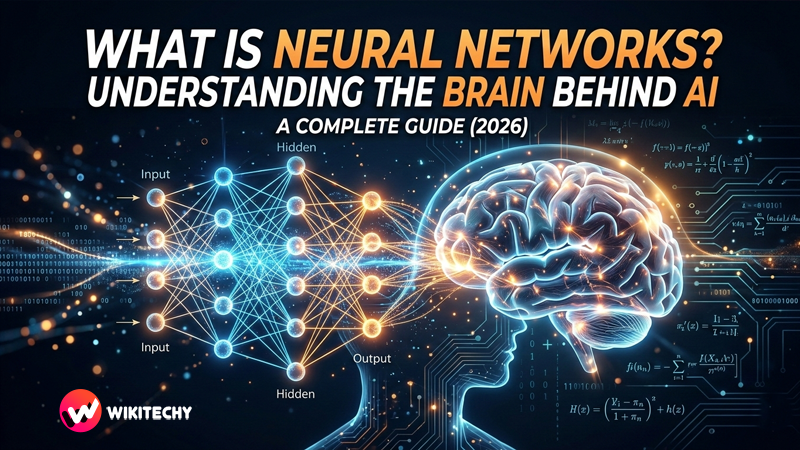
What Is Neural Networks? – Artificial Intelligence (AI) has rapidly transformed the way technology works in today’s world. From voice assistants and recommendation systems to self-driving cars and medical diagnostics, AI is everywhere. One of the most important technologies that powers modern AI systems is the Neural Network. Neural networks are designed to mimic the way the human brain processes information, enabling machines to learn patterns, recognize data, and make intelligent decisions.
In recent years, neural networks have become the backbone of many AI applications, especially in fields like image recognition, natural language processing, robotics, and predictive analytics. But what exactly is a neural network, and how does it work? In this beginner-friendly guide, we will explore neural networks in simple terms, including their structure, working principles, types, advantages, and real-world applications.
What Is Neural Networks?
A Neural Network, also known as an Artificial Neural Network (ANN), is a machine learning model inspired by the biological neural networks found in the human brain. Just as the human brain contains billions of neurons connected to each other, artificial neural networks consist of interconnected nodes that process information.
These networks are capable of learning from data. Instead of being explicitly programmed to perform a task, they learn patterns from examples. For instance, a neural network trained with thousands of cat images can eventually identify whether a new image contains a cat or not.
Neural networks are especially useful when dealing with large amounts of complex data where traditional programming methods struggle.
The Inspiration from the Human Brain
The human brain contains approximately 86 billion neurons, each connected through synapses. These neurons receive signals, process them, and pass them to other neurons. Artificial neural networks attempt to replicate this behavior in a simplified way.
In AI, neurons are represented as mathematical functions that receive input data, process it, and generate outputs. By connecting many artificial neurons together, neural networks can perform complex tasks such as speech recognition, language translation, and image classification.
Although artificial neural networks are much simpler than biological brains, they are powerful enough to solve many real-world problems.
Structure of a Neural Network
A neural network typically consists of multiple layers of nodes (neurons). These layers work together to process information and produce an output.
1. Input Layer
The input layer is the first layer of a neural network. It receives raw data from the outside world. For example:
- In image recognition, input data may be pixel values.
- In text processing, input data may be words or characters.
- In financial analysis, input data may be numbers such as stock prices.
The input layer simply passes this data to the next layer without performing complex calculations.
2. Hidden Layers
Hidden layers are the core processing units of a neural network. A neural network can have one or many hidden layers depending on the complexity of the problem.
Each neuron in a hidden layer performs three main operations:
- Receive input values
- Apply weights and bias
- Pass the result through an activation function
The purpose of hidden layers is to extract patterns and relationships from the input data.
3. Output Layer
The output layer produces the final result of the neural network. The type of output depends on the task:
- For classification tasks, the output may represent categories.
- For regression tasks, the output may represent numerical values.
- For recommendation systems, the output may represent predicted preferences.
How Neural Networks Work
Neural networks operate through a process called training. During training, the network learns patterns from large datasets. The basic working process involves the following steps:
Data Input
First, the neural network receives input data. This data is fed into the input layer and passed through the network.
Forward Propagation
The input data moves through the hidden layers, where each neuron performs mathematical operations using weights and activation functions. This process is called forward propagation.
Error Calculation
The output produced by the neural network is compared with the correct output (also called the target value). The difference between these values is called the error.
Backpropagation
To reduce this error, the neural network adjusts its weights using a technique called backpropagation. This process allows the network to learn from its mistakes and improve accuracy over time.
Model Improvement
The training process repeats many times until the neural network reaches an acceptable level of accuracy.
Key Components of Neural Networks
Understanding the core components helps explain how neural networks function effectively.
Neurons (Nodes)
Neurons are the basic units of neural networks. Each neuron receives inputs, processes them using mathematical functions, and produces an output.
Weights
Weights determine the importance of each input. During training, neural networks adjust weights to improve predictions.
Bias
Bias helps shift the output of the activation function, allowing the model to better fit the data.
Activation Functions
Activation functions determine whether a neuron should be activated or not. Some common activation functions include:
- ReLU (Rectified Linear Unit)
- Sigmoid
- Tanh
- Softmax
These functions help neural networks learn complex patterns and non-linear relationships.
Types of Neural Networks
Different types of neural networks are designed for different types of problems.
Feedforward Neural Networks
This is the simplest type of neural network where information flows in one direction—from input to output. It does not loop back.
Convolutional Neural Networks (CNN)
CNNs are commonly used for image recognition and computer vision tasks. They can automatically detect patterns such as edges, shapes, and textures in images.
Recurrent Neural Networks (RNN)
RNNs are designed for sequential data such as text, speech, and time-series data. They remember previous inputs and use them for future predictions.
Deep Neural Networks (DNN)
Deep neural networks contain multiple hidden layers. These networks are part of deep learning, which enables advanced AI systems such as language models and autonomous vehicles.
Applications of Neural Networks
Neural networks are widely used across various industries due to their powerful learning capabilities.
Image and Facial Recognition
Neural networks are used in facial recognition systems, security applications, and photo tagging features.
Voice Assistants
Virtual assistants like Siri, Alexa, and Google Assistant rely on neural networks for speech recognition and natural language processing.
Healthcare
In the medical field, neural networks help detect diseases, analyze medical images, and assist doctors in diagnosis.
Self-Driving Cars
Autonomous vehicles use neural networks to recognize objects, detect lanes, and make driving decisions.
Recommendation Systems
Platforms like Netflix, YouTube, and Amazon use neural networks to recommend movies, videos, and products based on user behavior.
Advantages of Neural Networks
Neural networks provide several benefits that make them essential in modern AI systems.
Ability to Learn Complex Patterns
Neural networks can identify hidden relationships in large datasets that traditional algorithms cannot detect.
Automation
They reduce the need for manual programming by learning directly from data.
High Accuracy
With enough training data, neural networks can achieve very high prediction accuracy.
Adaptability
They can adapt and improve when new data becomes available.
Limitations of Neural Networks
Despite their strengths, neural networks also have some limitations.
Large Data Requirement
Training neural networks often requires large datasets.
High Computational Power
Neural networks require powerful hardware such as GPUs.
Training Time
Complex neural networks may take hours or even days to train.
Black Box Problem
It can be difficult to understand how neural networks make certain decisions.
Neural Networks vs Traditional Machine Learning
Traditional machine learning algorithms rely heavily on manual feature engineering, where experts must identify important patterns in data.
Neural networks, on the other hand, can automatically discover features from raw data. This makes them more powerful for complex tasks such as image recognition and language processing.
However, traditional machine learning models may still be more efficient for smaller datasets or simpler problems.
The Future of Neural Networks
Neural networks continue to evolve rapidly as research in artificial intelligence advances. Technologies like deep learning, generative AI, and large language models are pushing the boundaries of what neural networks can achieve.
In the future, neural networks will likely play an even greater role in fields such as healthcare, robotics, climate prediction, cybersecurity, and autonomous systems. As computing power increases and datasets grow larger, neural networks will become more accurate, efficient, and widely adopted.
Conclusion
Neural networks are one of the most powerful technologies in modern artificial intelligence. Inspired by the structure of the human brain, they enable machines to learn from data, recognize patterns, and make intelligent decisions. From voice assistants and recommendation systems to medical diagnosis and self-driving cars, neural networks are transforming the way technology interacts with the world.
For beginners entering the field of AI and machine learning, understanding neural networks is an essential step. As AI continues to advance in 2026 and beyond, neural networks will remain a core component of intelligent systems and innovative technological solutions.
Want to Learn More About Python & Artificial Intelligence ???, Kaashiv Infotech Offers Full Stack Python Course, Artificial Intelligence Course, Data Science Course & More Visit Their Website course.kaashivinfotech.com.