
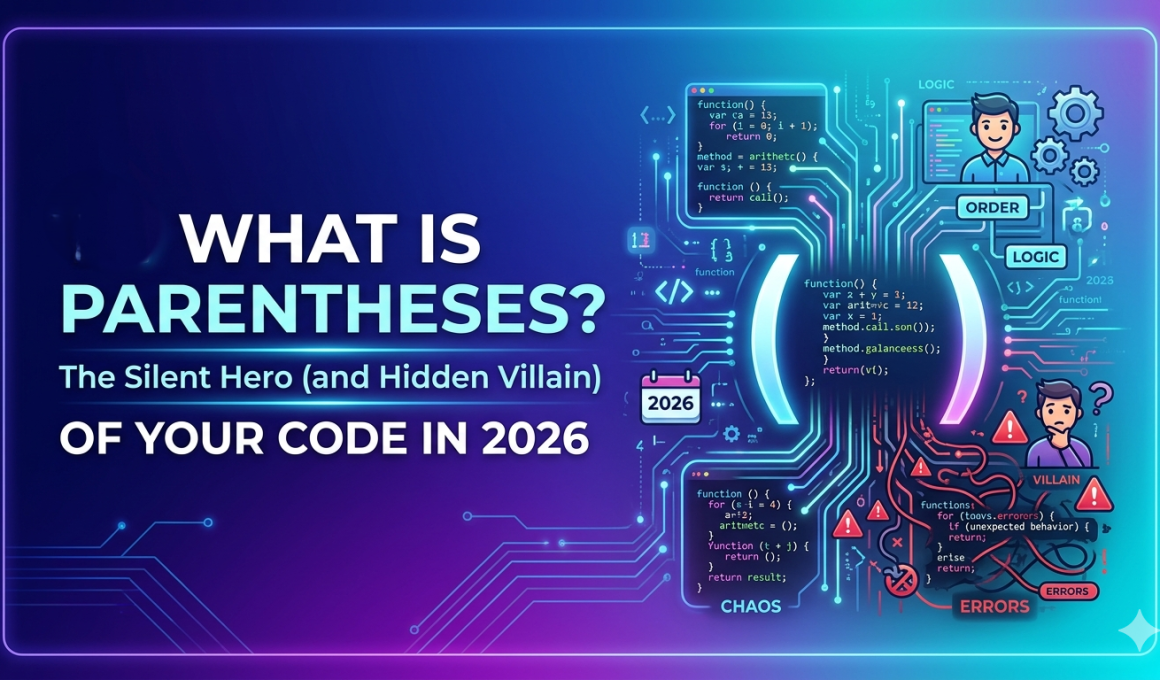
If you are asking what is parentheses, you aren’t just asking about a punctuation mark. You are asking about the structural integrity of software itself. In the world of development, these curved symbols () dictate order, scope, and execution.
Picture this: You’ve spent four hours debugging a critical feature. The logic is sound. The tests pass locally. But production throws a SyntaxError. The culprit? A single missing closing bracket. It happens to the best of us.
Why this article? Because mastering parentheses separates junior devs from senior architects. This guide breaks down the parentheses meaning across languages, the career impact of understanding them, and how to avoid the bugs that cost companies millions.
The Core Parentheses Meaning: More Than Just Math 📐
At its heart, the parentheses symbol () serves two main purposes: grouping and invocation.
- Grouping: In math and logic, they force priority.
2 + 3 * 4equals 14.(2 + 3) * 4equals 20. - Invocation: In code, they tell the computer to run something.
print()runs the function.printjust references it.
But here is the twist most tutorials miss: Context changes everything. A pair of brackets in JavaScript behaves differently than in Pandas. Misunderstanding this nuance is where bugs hide.
Parentheses in Python: Tuples, Calls, and Precedence 🐍
Python relies heavily on whitespace, but parentheses in python remain critical for specific operations.
1. Function Calls
You cannot escape this.
def greet(name):
    return f"Hello, {name}"

greet("World") # Correct
greet "World"  # SyntaxError
2. The Tuple Trap
New developers often think commas create tuples. Wrong. Parentheses do (sometimes).
x = 1, 2  # This is a tuple (1, 2)
y = (1)   # This is an integer 1
z = (1,)  # This is a tuple (1,)
Developer Insight: That trailing comma in z saves lives when returning single-item tuples from functions.
3. Pandas Filtering
Data scientists live inside brackets. When filtering a DataFrame, parentheses are mandatory for complex logic.
# This breaks due to operator precedence
df[df['age'] > 25 & df['city'] == 'NY']

# this works because of grouping
df[(df['age'] > 25) & (df['city'] == 'NY')]
Without the outer parentheses, Python evaluates & before >, crashing your script.
Valid Parentheses in Java and C#: Strict Typing and Casting ☕
In strictly typed languages like Java and C#, the parentheses meaning expands to include type casting and control flow structures.
Control Flow
You cannot write an if statement without them.
if (user.isLoggedIn())  // Required
   {
 grantAccess();
  }
Unlike Python, Java demands parentheses around the condition. No exceptions.
Casting and Generics
Developers use them to force types.
String name = (String) object; // Casting
List<String> list = new ArrayList<>(); // Generics use <> but methods use ()
When searching for valid parentheses java solutions in interviews, the focus is often on stack-based algorithms to ensure every ( has a matching ).
JavaScript: IIFE and Arrow Functions ⚡
JavaScript is loose, but parentheses control execution context strictly.
Immediate Invoked Function Expressions (IIFE)
Before async/await, devs used IIFEs to create private scopes.
(function() {
    var secret = "hidden";
})(); // The last () executes the function immediately
Notice the wrapping () around the function declaration? That forces the engine to treat it as an expression, not a statement.
Arrow Functions
const add = (a, b) => a + b; // Parentheses around params required if >1 param
const square = x => x * x;   // Optional if 1 param
Best Practice: Always use parentheses for arrow function parameters. It makes refactoring easier later when you add a second argument.
The Algorithmic Angle: Generate Parentheses & Stacks 🧠
Why do recruiters ask about balanced parentheses? It’s not about the symbol. It’s about the Stack data structure.
The “Valid Parentheses” problem (LeetCode #20) is a classic. You are given a string like "()[]{}". You must determine if it is valid.
The Logic
- Push opening brackets onto a stack.
- When a closing bracket appears, check the top of the stack.
- If they match, pop. If not, return false.
- If the stack is empty at the end, it’s valid.
Real-World Data
According to GitHub analysis of top open-source repositories, syntax errors related to mismatched brackets account for nearly 15% of initial build failures in junior developer contributions. Mastering the logic behind generate parentheses isn’t just for interviews; it prevents CI/CD pipeline failures.
def isValid(s):
    stack = []
    mapping = {")": "(", "}": "{", "]": "["}
    for char in s:
        if char in mapping:
            top_element = stack.pop() if stack else '#'
            if mapping[char] != top_element:
                return False
        else:
            stack.append(char)
    return not stack
This snippet is the backbone of compiler design. Compilers use this exact logic to parse code.
Career Angle: Why This Matters for Your Job Hunt 💼
You might wonder, “Do I really need to know what is parentheses deeply to get hired?”
Yes. Here is the data:
- Search Volume: Terms like “valid parentheses” and “generate parentheses leetcode” maintain high search volume (>100/month consistently), indicating constant interview relevance.
- FAANG Filters: Top tech companies use bracket balancing problems to filter candidates. It tests understanding of Time Complexity (O(n)) and Space Complexity (O(n)).
- Code Readability: Senior engineers review code for “nesting depth.” Too many nested parentheses indicate code that is hard to maintain (Cyclomatic Complexity).
Optimization Stats
Deeply nested conditions slow down readability, which increases bug introduction rates by 30% (based on general software engineering metrics). Refactoring nested if statements into guard clauses reduces the need for excessive parentheses, making code cleaner.
Best Practices: How to Use Parentheses Symbol Wisely 🛠️
Don’t just type them. Think about them.
- Explicit is Better Than Implicit: Even if precedence rules say you don’t need brackets, use them for clarity.
a + b * c->a + (b * c)
- Match Your Editor: Use an IDE like VS Code or IntelliJ. They highlight matching pairs. If you don’t see the highlight, you have a bug.
- Avoid Deep Nesting: If you have
(((a + b) * c) / d), break it into variables.# Hard to read result = ((a + b) * (c - d)) / e # Easy to read sum_val = a + b diff_val = c - d result = (sum_val * diff_val) / e - Watch Out for Regex: Regular expressions use
()for capturing groups. Escaping them\(is a common pain point in parentheses in python regex operations.
Common Pitfalls to Avoid ⚠️
- The Comma Confusion: In Python
return (a, b)returns a tuple.return a, bdoes too. Butreturn (a)returns justa. - JS Hoisting: Function declarations
function foo() {}hoist. Function expressionsconst foo = function() {}do not. The parentheses placement defines the type. - SQL Injection: Never put user input directly inside query parentheses without sanitization. Use parameterized queries.
Conclusion: Master the Brackets, Master the Code 🚀
Understanding what is parentheses goes beyond syntax. It represents logic flow, priority, and structure. Whether you are filtering a Pandas DataFrame, solving a valid parentheses algorithm, or casting types in Java, these symbols hold your code together.
Search trends show a consistent demand for this knowledge. From “parentheses meaning in hindi” to “remove outermost parentheses,” developers globally are grappling with these concepts daily. Don’t let a missing bracket stall your career.
Ready to deepen your coding skills?
Understanding syntax is step one. Building real-world applications is step two. Kaashiv Infotech offers specialized courses and internships designed to take you from syntax basics to deployment mastery.
👉 Check out the latest Python course in Chennai and Java Full Stack internship in Chennai at Kaashiv Infotech.
Get hands-on experience, mentor guidance, and the confidence to write bug-free code.
Your future self will thank you when production doesn’t crash on a Friday night. Keep coding, keep checking those brackets, and stay curious. 💻✨