
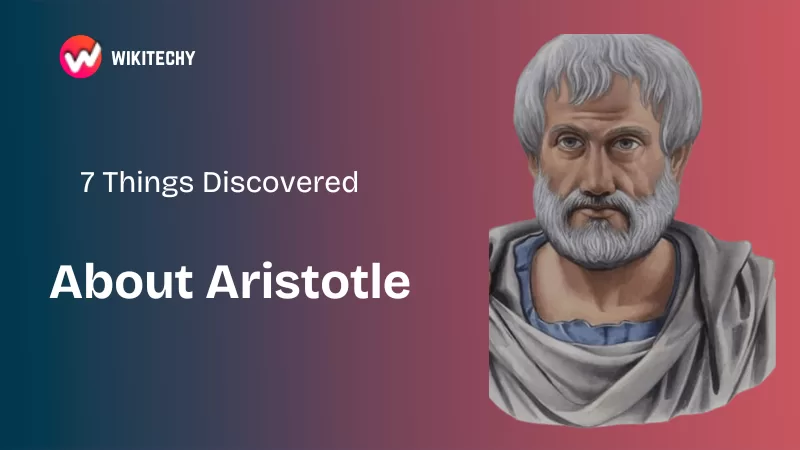
Father of Biology — Why Everyone Still Talks About Aristotle
I’ll be honest: the first time I heard someone call Aristotle the Father of Biology, I kind of shrugged it off. I mean… here was a philosopher from thousands of years ago, and we are still calling him the “father” of something as modern as biology?
But the deeper I went into his work, the more I realized something surprising — the guy wasn’t just smart. He was obsessed with understanding life the way we scroll endlessly through Google today.
So yes, Aristotle is the Father of Biology, but he’s also the father of my respect for ancient thinkers. Because, seriously… imagine studying marine animals without microscopes. Without labs. Without a smartphone to quickly check “what is this weird jellyfish thing??”
And yet, he figured out things that still show up in modern textbooks.

Who Exactly Was Aristotle?
Just in case it’s been a while since your last history class…
Aristotle was:
- A student of Plato
- A teacher of Alexander the Great
- A curious observer of everything
- An early scientist before the word “science” even existed
He lived between 384–322 BC, which means he was exploring nature at a time when most people still thought lightning was Zeus throwing a tantrum.
If you’re new to biology, you can check out a basic introduction here:
👉 Internal link suggestion: “Introduction to Biology – What Every Beginner Should Know”
👉 External link suggestion: https://www.britannica.com/biography/Aristotle

Why Do We Call Aristotle the Father of Biology?
1. He was the first to study life in a structured way
Before Aristotle, people mostly guessed how living things worked. Some explanations were magical. Some were wild imaginations. But Aristotle?
He said, “Hold my papyrus scroll,” and actually started observing.
He didn’t just describe animals; he compared them. He grouped them. He wrote about:
- their body structure
- their reproduction
- their movement
- their environment
The Father of Biology didn’t just love nature — he organized it.
2. He created the earliest classification system
This part shocked me.
When we study “classification” in schools today — kingdom, phylum, genus, and so on — we assume it’s a modern invention.
Nope!
Aristotle started it.
He divided living organisms into:
- Animals with blood
- Animals without blood
Not perfect, obviously, but considering he didn’t have magnifying glasses?
I can’t even sort my wardrobe that neatly.
This is also where our secondary keyword “Aristotle and the Father of Biology contributions” fits beautifully.
3. He studied over 500 species with his own eyes
The Father of Biology didn’t rely on second-hand notes. He went out, looked at things, dissected them, documented them, and then connected patterns.
He studied:
- octopuses
- fish
- insects
- birds
- mammals
Honestly, I can’t help but wonder — how did he convince people to let him cut open marine animals? Was that normal back then, or did people think he was weird?
(If it were today, he’d absolutely be that friend who drags us to random beaches to “observe crabs for science.”)
4. He introduced the concept of “Empirical Observation”
This is a fancy way of saying: “I saw it with my own eyes, so I know it’s true.”
Aristotle didn’t guess biology — he watched biology.
As a writer, I love this approach because it reminds me of how we learn everything:
- We observe
- We ask
- We test
- We learn
And that’s exactly why he remains the Father of Biology — he started a method we still use.
5. He explained reproduction before it was cool
Aristotle wrote about:
- how animals reproduce
- how embryos form
- how inheritance works
6. He believed nature has a purpose
One of his most emotional ideas (for me at least) was this:
“Nothing in nature exists without purpose.”
I find this comforting.
Whenever life feels messy, remembering this idea feels like telling myself, “Hey, everything is connected. Everything makes sense in the bigger picture.”
This philosophical approach sets the Father of Biology apart from just being a scientist — he saw life in life.
7. His biology books influenced science for 2,000+ years
Aristotle wrote major works like:
- History of Animals
- Parts of Animals
- Generation of Animals
These were the standard biology textbooks for centuries.
Imagine writing something today that people still study in the year 4025.
That’s the legacy of the Father of Biology — timeless and enormous.
How Aristotle Still Shows Up in Modern Biology Classrooms
Let me share a quick personal moment.
When I was studying basic biology in school, I remember seeing Aristotle’s name pop up again and again in:
- classification chapters
- evolution discussions
- embryology topics
- zoology diagrams
At first, I found it confusing — why was a philosopher in a science book?
But now it makes total sense.
Modern biology may have advanced, but its roots?
They’re ancient.
And they begin with the Father of Biology.
If you want to explore these topics deeper, try:
👉 Internal link suggestion: “Difference Between Modern Biology vs Classical Biology”
👉 External link suggestion: https://www.nature.com/
Fun Facts About Aristotle (Because Why Not?)
- He opened his own school called Lyceum — basically the Harvard of ancient times.
- His students walked around with him during classes (that’s why they were called peripatetics).
- He believed the heart—not the brain—was the center of intelligence.
(Okay, not his best theory, but sweet.)
Why Understanding the Father of Biology Matters Today
Sometimes we treat science like it’s purely modern — labs, machines, high-speed discoveries.
But learning about Aristotle reminds me that science started with curiosity.
Just pure, honest curiosity.
And if the Father of Biology could explore life with no tools, no equipment, and no internet, what’s stopping us from being curious today?
Conclusion: The Father of Biology Lives On
Aristotle wasn’t perfect, but he was passionate.
He wasn’t modern, but he was brilliant.
He wasn’t just a philosopher — he was the Father of Biology, the first person to give life a structured story.
And even after thousands of years, we’re still reading his notes. Still discussing his ideas. Still inspired by his curiosity.
want to learn more?, kaashiv infotech offers more courses, and more visit their website www.kaashivinfotech.com