

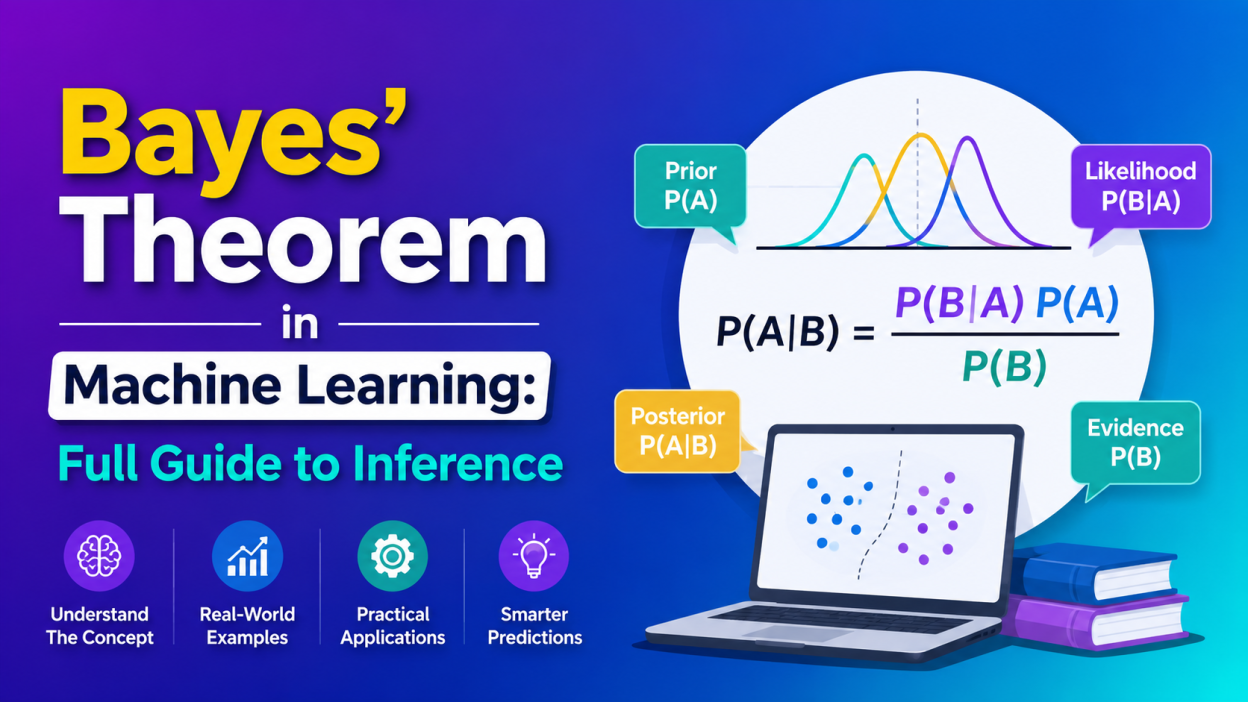
Bayes’ Theorem in Machine Learning
Bayes’ Theorem in Machine Learning is one of those topics that sounded intimidating when I first came across it. I remember looking at the formula and wondering, “Do I really need to learn all this math to understand machine learning?” The good news is that I didn’t. Once I understood the idea behind it, everything started making sense.
Bayes’ Theorem in Machine Learning is simply a mathematical way of updating a prediction whenever new information becomes available. Instead of making random guesses, machine learning models improve their predictions based on evidence. That’s exactly what makes Bayes’ Theorem so useful.
If you’re a beginner, don’t worry. In this guide, I’ll explain everything in simple words with examples that anyone can understand. 😊
🌟 Key Highlights
- Understand what Bayes’ Theorem in Machine Learning means
- Learn the simple Bayes’ Theorem formula
- Discover why probability matters in machine learning
- Explore real-world examples
- Understand prior, likelihood, evidence, and posterior probability
- Learn how Bayes’ Theorem is used in spam filtering and medical diagnosis
- Explore the advantages and limitations
- Find out why Bayesian learning is important in AI
What is Bayes’ Theorem in Machine Learning?
Bayes’ Theorem in Machine Learning is a probability rule that helps computers make better predictions after receiving new information.
Instead of saying,
Bayes’ Theorem says,
I like thinking of it as learning from experience. Every time we receive new information, our opinion changes a little. Machine learning models work in the same way.
Why is Bayes’ Theorem Important in Machine Learning?
Imagine I receive an email saying,
At first glance, it sounds exciting. But then I notice:
- The sender’s email looks strange.
- There are spelling mistakes.
- They ask for my bank details.
Immediately, I become suspicious.
Why?
Because I used new evidence to update my belief.
That’s exactly how Bayes’ Theorem in Machine Learning works.
Instead of blindly trusting data, it updates predictions whenever new evidence appears.

Understanding Probability First
Before learning Bayes’ Theorem, it’s important to understand probability.
Probability tells us how likely something is to happen.
For example,
- Probability of getting Head while tossing a coin = 50%
- Probability of rolling number 6 on a dice = 1/6
- Probability of rain tomorrow might be 70%
Machine learning uses these probabilities to make intelligent decisions.
Bayes’ Theorem Formula
The formula looks like this:
P(A|B) = [P(B|A) × P(A)] / P(B)
Don’t panic! It becomes simple once we understand each part.
Where,
- P(A|B) = Posterior Probability
- P(B|A) = Likelihood
- P(A) = Prior Probability
- P(B) = Evidence
This formula simply updates an old belief using new evidence.
Components of Bayes’ Theorem in Machine Learning

1. Prior Probability
Prior Probability is what we already believe before seeing any new information.
Example:
Suppose I know that only 5% of emails are spam.
That belief is my prior probability.
2. Likelihood
Likelihood tells us how likely the evidence is if our assumption is true.
Example:
Most spam emails contain words like:
- Free
- Winner
- Congratulations
- Offer
If an email contains these words, the likelihood of it being spam increases.
3. Evidence
Evidence is the new information we receive.
Example:
The email contains
- Free Offer
- Click Here
- Win Money
These become the evidence.
4. Posterior Probability
Posterior Probability is the updated prediction after considering the evidence.
Instead of saying,
“This email might be spam.”
The model says,
“After checking the evidence, there’s a 98% chance this email is spam.”
That’s the power of Bayes’ Theorem in Machine Learning.
Simple Real-Life Example
Imagine I wake up and see dark clouds.
Initially, I think there’s only a 30% chance of rain.
Then I notice:
- Strong winds 🌬️
- Lightning ⚡
- Thunder 🌩️
Now I update my prediction.
Instead of 30%, I now believe there’s an 80% chance of rain.
Did the weather suddenly change?
No.
Only my belief changed because I received more evidence.
This is exactly how Bayes’ Theorem in Machine Learning works.
Applications of Bayes’ Theorem in Machine Learning
1. Spam Email Detection 📧
One of the most common uses of Bayes’ Theorem in Machine Learning is filtering spam emails.
The model checks:
- Email subject
- Sender
- Keywords
- Attachments
Then it predicts whether the email is spam or genuine.
2. Medical Diagnosis 🏥
Doctors often use probability while diagnosing diseases.
Suppose a patient has:
- Fever
- Cough
- Headache
Based on symptoms and medical data, Bayes’ Theorem helps estimate the probability of a disease. It supports decision-making, though doctors also rely on clinical judgment and additional tests.
3. Recommendation Systems 🎬
Streaming platforms recommend movies by estimating what users are most likely to enjoy based on their past preferences and behavior. Bayesian methods can contribute to these predictions in some recommendation systems.
4. Fraud Detection 💳
Banks analyze transactions continuously.
If they notice:
- Unusual location
- Large transaction
- Unknown device
The probability of fraud increases.
5. Text Classification 📚
Machine learning models classify:
- News articles
- Reviews
- Customer feedback
- Social media posts
using probability.
6. Sentiment Analysis 😊
Companies analyze customer reviews.
Examples:
- Positive Review
- Negative Review
- Neutral Review
Bayesian algorithms can help classify customer opinions.
Advantages of Bayes’ Theorem in Machine Learning
1. Easy to Understand
The basic concept is straightforward once you understand probability.
2. Fast Predictions
Bayesian models can make predictions efficiently.
3. Works with Small Datasets
Some Bayesian approaches perform well even when training data is limited.
4. Continuously Updates Predictions
As new information arrives, predictions can be updated.
5. Handles Uncertainty
Instead of giving only yes/no answers, Bayesian methods express uncertainty using probabilities.
Limitations of Bayes’ Theorem in Machine Learning
1. Requires Good Data
Poor-quality data can lead to poor predictions.
2. Assumptions May Not Always Hold
Some algorithms, such as Naive Bayes, assume that features are independent. In real-world data, this assumption is often not true.
3. Probabilities Need Careful Estimation
Estimating accurate probabilities can be challenging without sufficient data.
Bayes’ Theorem vs Traditional Decision Making
| Traditional Decision | Bayes’ Theorem in Machine Learning |
|---|---|
| Fixed decision | Updates decision with new evidence |
| Doesn’t adapt easily | Learns continuously from new information |
| Less flexible | More flexible |
| Doesn’t use probability effectively | Uses probability to improve predictions |
Bayes’ Theorem and Naive Bayes
One of the most popular algorithms based on Bayes’ Theorem in Machine Learning is the Naive Bayes algorithm.
It is widely used for:
- Spam detection
- Sentiment analysis
- Text classification
- Document categorization
- Email filtering
Although Naive Bayes assumes all features are independent, it often performs surprisingly well in practice, especially for text-related tasks.
Tips to Understand Bayes’ Theorem Easily
When I first learned this topic, I stopped memorizing the formula and focused on the idea instead. That made a huge difference.
Here are a few tips that helped me:
- Think of it as updating your belief when new evidence appears.
- Start with simple examples like weather predictions or spam emails.
- Understand each part of the formula before trying numerical problems.
- Practice with real-life situations to build confidence.
- Remember that probability is about making informed decisions, not perfect predictions.
Conclusion
When I first heard about Bayes’ Theorem in Machine Learning, I assumed it was all about complex mathematics. But after spending some time with real-life examples, I realized it’s really about something we all do every day—we change our opinions when we learn something new.
That’s exactly what makes Bayes’ Theorem in Machine Learning so valuable. It helps machine learning models improve predictions by combining previous knowledge with fresh evidence. Whether it’s filtering spam emails, supporting medical diagnosis, detecting fraud, or classifying text, Bayesian methods play an important role in building intelligent systems.
If you’re just starting your machine learning journey, don’t get discouraged by the formula. Focus on the concept first, practice with everyday examples, and the math will become much easier over time. Once I understood the idea behind Bayes’ Theorem, it became one of the most interesting concepts in machine learning—and I hope it does for you too! 🚀
Kaashiv Infotech Offers, Full Stack Python Course, Data Science Course, & More, visit their website www.kaashivinfotech.com.