


Machine Learning is changing how businesses work, how apps understand users, and how companies make decisions. If you are interested in technology and enjoy solving problems, a career in Machine Learning could be worth exploring. But before choosing this path, you probably have a few questions. How much does a Machine Learning Engineer earn? What skills do you need? Is coding compulsory? And how can a beginner enter this field?
In this guide, I’ll walk you through the Machine Learning Engineer salary, career opportunities, required skills, educational qualifications, and learning roadmap in simple words. Whether you are a college student, a working professional, or someone planning a career change, this article will help you understand what to expect and where to begin.
Key Highlights of Machine Learning Engineer Careers
- Salary: Machine Learning Engineers can earn competitive salaries, depending on their experience, skills, company, and location.
- Career opportunities: Jobs are available in IT services, banking, healthcare, e-commerce, finance, and product-based companies.
- Essential skills: Python, statistics, mathematics, SQL, data handling, and Machine Learning algorithms.
- Education: A degree in computer science, engineering, mathematics, or a related field can help, although practical skills also matter.
- Beginner-friendly path: Start with Python, learn the basics of data analysis, understand Machine Learning algorithms, and build projects.
- Career growth: With experience, professionals can move into senior engineering, applied AI, research, or technical leadership roles.
- Future opportunities: Machine Learning continues to support applications such as recommendation systems, fraud detection, image recognition, and predictive analytics.
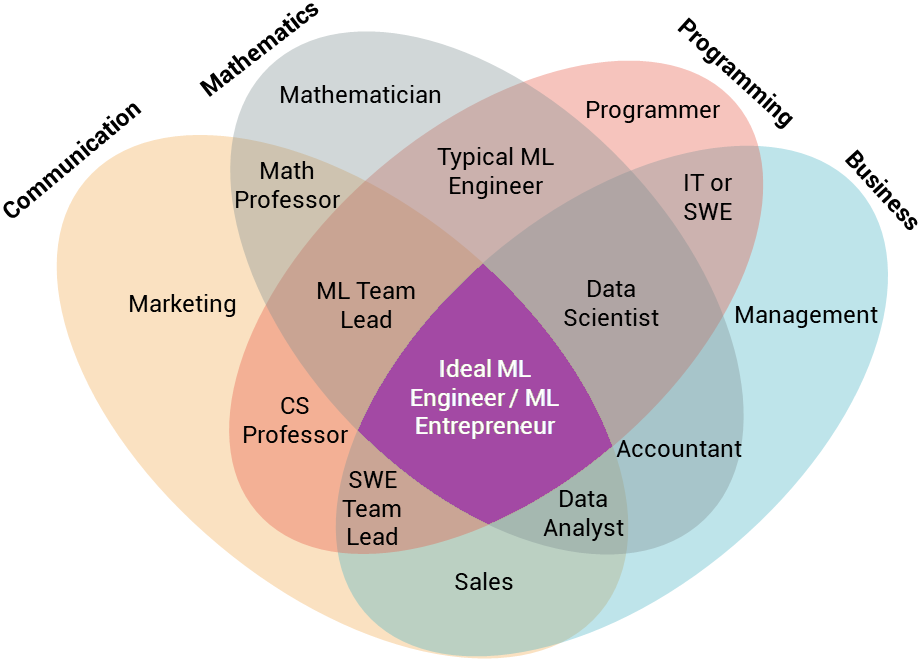
What Is a Machine Learning Engineer?
A Machine Learning Engineer is a professional who develops computer systems that learn patterns from data and use those patterns to make predictions or decisions.
Let me explain this with a familiar example.
Imagine opening an online shopping app. You search for a pair of shoes, and the app starts recommending similar products. Have you ever wondered how it knows what you might like?
A Machine Learning model can study information such as your searches, previous purchases, and product interactions to recommend relevant items.
Machine Learning Engineers help build, test, and deploy these kinds of systems. They work with data, write code, select suitable algorithms, and make sure their models perform reliably.
Some common applications of Machine Learning include:
- Healthcare: Supporting medical image analysis and risk prediction.
- Banking: Identifying potentially fraudulent transactions.
- E-commerce: Recommending products based on customer interests.
- Entertainment: Suggesting movies, music, and videos.
- Transportation: Supporting demand forecasting and route optimisation.
- Customer service: Powering chatbots and automated support tools.
Machine Learning is closely connected to Artificial Intelligence (AI), but the terms are not identical. AI is the broader field, while Machine Learning is one approach used to build systems that learn from data.
Machine Learning Engineer Salary in India in 2026
Salary is one of the first things people consider when choosing a career. The good news is that Machine Learning Engineers can earn attractive salaries, particularly when they develop strong programming, data, and deployment skills.
However, I would not suggest choosing this career based on salary alone. Your practical knowledge, experience, and ability to solve real problems will influence your opportunities.
The following figures are illustrative annual salary ranges, not verified 2026 market averages. Actual offers can fall outside these ranges.
Top 10 AI Tools for Content Creation in 2026 You Shouldn’t Miss.
| Experience level | Illustrative annual salary in India |
|---|---|
| Entry-level (0–2 years) | ₹4–10 lakh |
| Mid-level (2–5 years) | ₹10–20 lakh |
| Experienced (5–8 years) | ₹18–35 lakh |
| Senior or specialist roles | ₹30 lakh or more |
These ranges are broad estimates. Salaries vary according to the employer, city, job responsibilities, interview performance, and the depth of your skills.
For example, a beginner who understands Python but has not built any Machine Learning projects may have fewer opportunities than someone who can explain their projects, evaluate model performance, and write clean code.
Similarly, a professional working on large-scale Machine Learning systems may earn more than someone performing only basic data preparation.
Factors That Affect Machine Learning Engineer Salary
Several factors influence how much a Machine Learning Engineer earns.
1. Work experience
As you gain experience, you learn to handle complex datasets, improve model performance, solve production issues, and work with other engineering teams. These responsibilities can lead to higher pay.
2. Technical skills
Employers may value skills such as Python, SQL, statistics, Machine Learning frameworks, cloud platforms, and model deployment. The exact requirements depend on the role.
3. Company type
Large technology companies, product-based businesses, financial institutions, startups, and IT service companies may offer different salary packages. A higher package may also come with more demanding responsibilities.
4. Location
Technology hubs such as Bengaluru, Hyderabad, Chennai, Pune, and Gurugram offer Machine Learning-related opportunities. Salary differences depend on the employer and local job market.
5. Specialisation
Professionals with experience in deep learning, natural language processing, computer vision, recommendation systems, or production Machine Learning may qualify for specialised positions.
Remember that a high-paying role usually requires more than knowing a few algorithms. Employers want people who can apply their knowledge to actual business problems.
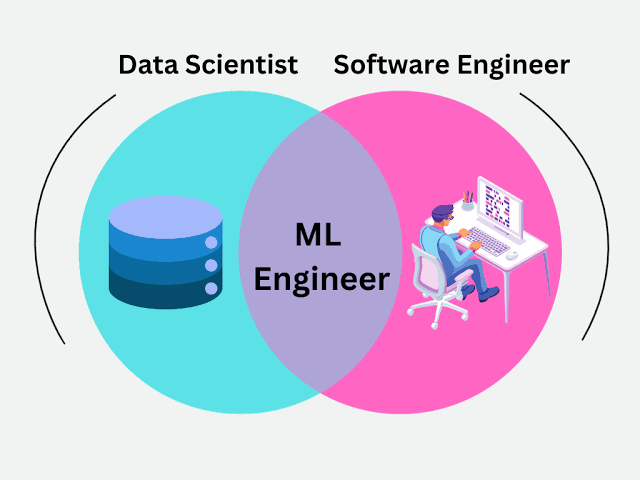
Machine Learning Engineer Salary for Freshers
Can a fresher become a Machine Learning Engineer? Yes, but getting the first job may take time because some employers prefer candidates with practical experience.
For entry-level applicants, an illustrative salary range is ₹4–10 lakh per year. This is a broad estimate rather than a guarantee, and some employers may offer less or more.
If you are starting from zero, focus on building a strong foundation instead of trying to learn every advanced topic at once.
Here is what I would prioritise:
- Learn Python programming.
- Understand basic mathematics and statistics.
- Practise SQL and data manipulation.
- Learn how Machine Learning algorithms work.
- Complete two or three practical projects.
- Upload your code and project documentation to GitHub.
- Prepare to explain your approach during interviews.
A useful beginner project could be a house-price prediction model. You would collect or use a public dataset, clean the data, train a model, evaluate its predictions, and explain what you learned.
A well-explained project gives an interviewer something concrete to discuss. It also helps you understand whether you enjoy the work itself.
Skills Required to Become a Machine Learning Engineer
You do not need to master every technology before applying for your first role. However, you should understand the core skills and gradually practise them.
1. Python Programming
Python is one of the most widely used languages in Machine Learning because it has a large collection of libraries for working with data and building models.
Start with:
- Variables and data types
- Conditions and loops
- Functions
- Lists, dictionaries, and sets
- Object-oriented programming
- File handling and exception handling
After learning the basics, explore libraries such as NumPy, pandas, Matplotlib, and scikit-learn.
2. Mathematics and Statistics
Machine Learning models use mathematical methods to identify patterns and make predictions.
You do not have to become a mathematician before starting. Begin with the concepts you will use most often:
- Mean, median, and standard deviation
- Probability
- Basic algebra
- Vectors and matrices
- Correlation
- Basic calculus concepts when studying more advanced models
Statistics is particularly useful when you need to understand whether a model is making reliable predictions.
3. SQL and Data Handling
Data is the foundation of Machine Learning. Before training a model, you often need to collect, filter, clean, and organise information.
SQL helps you retrieve data from databases. Python libraries such as pandas help you prepare that data for analysis.
For example, a bank may use transaction data to identify unusual spending patterns. An engineer must understand the data before attempting to build a fraud-detection model.
4. Machine Learning Algorithms
Once you understand Python and basic statistics, start learning the major Machine Learning approaches.
- Linear regression: Predicts numerical values, such as a house price.
- Logistic regression: Estimates the probability of a category, such as whether a transaction may be fraudulent.
- Decision trees: Make predictions through a series of decision rules.
- Random forests: Combine multiple decision trees to improve predictive performance in many situations.
- Clustering: Groups similar data points without requiring predefined labels.
- Classification: Assigns inputs to categories, such as identifying whether an email is spam.
Do not simply memorise definitions. Practise implementing the algorithms and explaining when you would use each one.
5. Machine Learning Frameworks and Tools
After learning the fundamentals, become familiar with tools used in practical projects.
- scikit-learn: Useful for traditional Machine Learning algorithms.
- TensorFlow: A framework for developing and training various machine learning models.
- PyTorch: Widely used for deep learning and research.
- Jupyter Notebook: Helps you experiment with code and visualise results.
- Git and GitHub: Help you track code changes and share projects.
You can start with scikit-learn. You do not need to learn every framework at the same time.
6. Communication and Problem-Solving
Technical knowledge is important, but you also need to explain your work.
Suppose your model predicts customer demand incorrectly. You should investigate the data, check your assumptions, compare model performance, and communicate the limitations of your results.
The ability to explain why you chose a particular approach is valuable in interviews and in day-to-day engineering work.
Artificial Intelligence vs Human Intelligence: A Deep Dive into Minds Made and Minds Born
What Does a Machine Learning Engineer Do?
A Machine Learning Engineer works on more than writing code. Their responsibilities often cover the complete process of building and maintaining a Machine Learning solution.
Here are some common tasks:
- Collecting data: Gathering useful information from databases, files, or other sources.
- Cleaning data: Handling missing values, duplicates, and incorrect information.
- Building models: Choosing algorithms that fit the problem.
- Training models: Helping a model learn patterns from example data.
- Testing performance: Checking whether the model makes accurate and useful predictions.
- Deploying models: Making a trained model available to an application or business system.
- Monitoring models: Checking for performance changes as new data becomes available.
For example, an online shopping company might want to predict which products customers will purchase next. A Machine Learning Engineer could prepare customer data, train a recommendation model, test its results, and work with software engineers to integrate it into the shopping application.
That is where programming, data analysis, and business understanding come together.
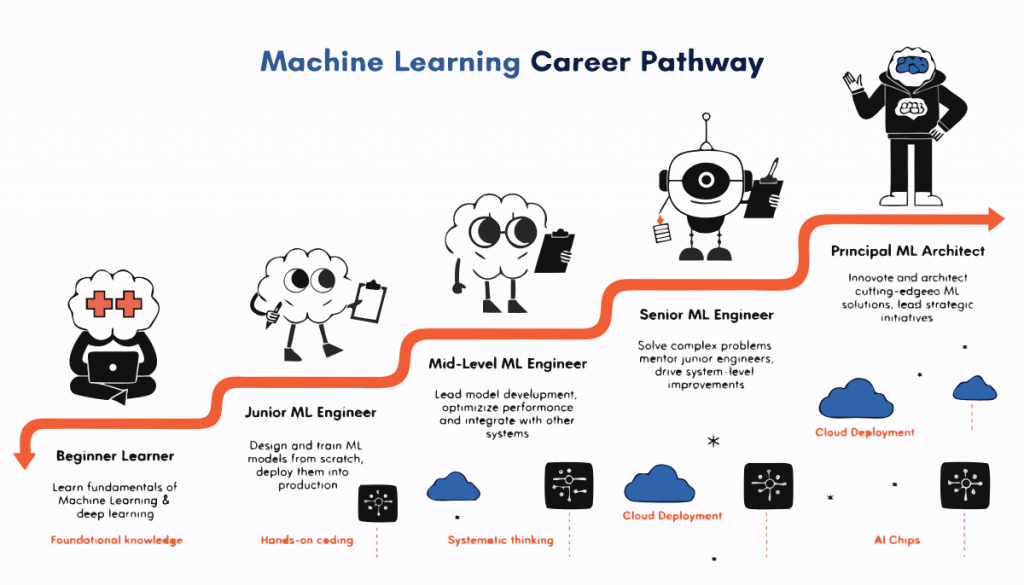
Machine Learning Engineer Career Path
One advantage of entering Machine Learning is that you can grow into different technical roles as your interests develop.
| Career stage | Typical responsibilities |
|---|---|
| Junior Machine Learning Engineer | Data preparation, basic models, testing, and debugging |
| Machine Learning Engineer | Building, evaluating, and deploying models |
| Senior Machine Learning Engineer | Designing complex systems and improving model performance |
| Machine Learning Lead | Guiding technical decisions and supporting a team |
| Machine Learning Architect | Designing large-scale Machine Learning systems |
Other possible career options include Data Scientist, AI Engineer, Deep Learning Engineer, NLP Engineer, Computer Vision Engineer, and MLOps Engineer.
These positions overlap, but their daily work differs. For example, Data Scientists often focus heavily on analysis and experimentation, while Machine Learning Engineers typically spend more time building reliable systems and putting models into production. The distinction varies between companies.
If you already have a background in software development, you may find it helpful to combine your existing programming knowledge with Machine Learning skills.
How to Become a Machine Learning Engineer: A Beginner’s Roadmap
If I were starting this journey today, I would follow a step-by-step learning plan rather than jumping directly into advanced AI tools.
Step 1: Learn Python
Begin with programming fundamentals. Write small programs, solve simple problems, and practise functions, loops, lists, dictionaries, and classes.
Do not rush through this stage. You will use Python throughout your Machine Learning journey.
Step 2: Learn SQL and Data Analysis
Learn how to retrieve information from a database and analyse it. Practise filtering records, joining tables, grouping data, and calculating totals.
Then explore pandas and NumPy to work with datasets in Python.
Step 3: Understand Statistics
Study averages, probability, distributions, correlation, and basic statistical concepts. Learn how these ideas help you understand data and evaluate predictions.
Step 4: Study Machine Learning Fundamentals
Start with supervised learning, unsupervised learning, classification, regression, and clustering.
Practise simple algorithms using scikit-learn. Learn about training data, testing data, overfitting, and evaluation metrics.
Step 5: Build Real Projects
Projects help turn theory into practical knowledge. Try these beginner-friendly ideas:
- House-price prediction: Estimate house prices using property details.
- Spam email classification: Classify messages as spam or not spam.
- Customer segmentation: Group customers based on purchasing behaviour.
- Sales forecasting: Use historical sales data to estimate future demand.
For each project, explain the problem, dataset, algorithm, evaluation method, and limitations. Publish your work on GitHub with a clear README file.
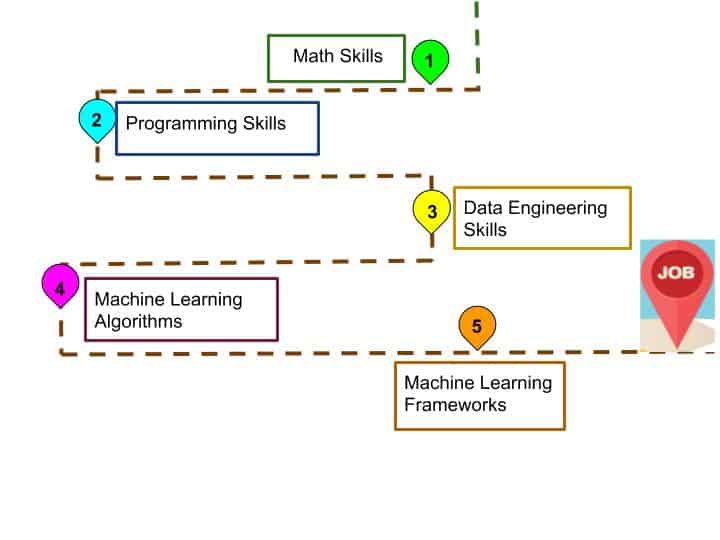
Step 6: Learn Model Deployment
After you can build and evaluate models, learn how to make them available to other applications. Explore basic APIs, Flask or FastAPI, Git, and introductory cloud deployment.
You can study Docker and MLOps tools later, once you understand the core workflow.
Step 7: Prepare for Interviews
Practise Python coding, SQL queries, statistics questions, Machine Learning concepts, and project explanations.
Interviewers may ask why you selected a particular algorithm, how you handled missing data, or how you measured performance. Understanding your own projects is much more useful than memorising answers.
I recommend starting with Python and then moving to basic data analysis. Once you are comfortable with both, Machine Learning concepts become easier to understand.
If you are publishing related career guides on your blog, you can also add internal links to your articles about Python applications, data science, artificial intelligence, and software development. These links help readers explore related topics. Replace these topic suggestions with the actual URLs of your published articles.
Is Machine Learning a Good Career Choice in 2026?
Machine Learning can be a promising career for people who enjoy programming, analysing data, and solving problems. Companies use it in areas such as fraud detection, forecasting, search, personalisation, and automation.
However, it is not a shortcut to a high salary. Beginners may need considerable time to develop the necessary skills, build projects, and prepare for technical interviews. Some entry-level positions also expect experience with data engineering, cloud platforms, or software development.
Before choosing this career, ask yourself three questions:
- Do I enjoy solving problems using code?
- Am I willing to practise mathematics and statistics?
- Can I spend time building projects instead of only watching tutorials?
If your answer is yes, start with the fundamentals and build your knowledge gradually.
You can also explore related opportunities such as Data Analyst or Junior Python Developer while continuing to learn Machine Learning. These roles may help you gain relevant experience, although their responsibilities and entry requirements differ.
Frequently Asked Questions About Machine Learning Engineer Careers
1. What is the salary of a Machine Learning Engineer in India?
Salary depends on experience, location, employer, and technical skills. As a broad, illustrative estimate, entry-level roles may offer ₹4–10 lakh per year, while experienced specialists may earn ₹30 lakh or more. These are not guaranteed or independently verified 2026 market averages.
2. Can a fresher become a Machine Learning Engineer?
Yes. Freshers can apply for suitable entry-level positions, internships, and trainee roles. Strong Python skills, an understanding of Machine Learning fundamentals, and practical projects can help demonstrate your abilities.
3. Is coding necessary for Machine Learning?
Yes, coding is important for most Machine Learning Engineer positions. Python is a good starting point because it supports data processing, model development, testing, and deployment.
4. How long does it take to learn Machine Learning?
The timeline depends on your previous knowledge and the time you can dedicate. Someone who already knows programming may progress faster than a complete beginner. Several months of consistent study can build a foundation, but becoming job-ready often requires additional practice and project experience.
5. Which programming language is best for Machine Learning?
Python is the most practical starting choice for many learners. Its libraries support data analysis, traditional Machine Learning, and deep learning. Other languages may be useful for particular applications, but beginners can focus on Python first.
6. Is Machine Learning better than Data Science?
Neither career is automatically better. Data Science often focuses on analysing data, finding insights, and running experiments. Machine Learning Engineering usually places greater emphasis on developing, deploying, and maintaining predictive models. Your choice should depend on your interests and the job requirements.
7. Does Machine Learning have a future?
Machine Learning is already used across many industries, and businesses continue to explore new applications. However, individual job opportunities and salaries depend on market demand, business needs, and the skills employers require. Learning strong programming and problem-solving fundamentals can help you adapt as technology changes.
Final Thoughts
Machine Learning offers an interesting career path for people who want to combine coding, data, and intelligent applications. The salary potential can be attractive, but your career growth will depend on the skills you develop and the problems you learn to solve.
My advice is simple: start with Python, practise SQL and statistics, learn the core Machine Learning algorithms, and build projects that demonstrate your knowledge. You do not have to learn everything in one week or understand every advanced concept immediately.
Take one step at a time. A small project that you understand completely is a better starting point than ten projects you cannot explain.
With consistent practice, patience, and a willingness to learn, you can build a foundation for a career in Machine Learning. 🚀
Want to Learn More About Python & Artificial Intelligence ?, Kaashiv Infotech Offers Full Stack Python Course, Artificial Intelligence Course, Data Science Course & More Visit Their Website course.kaashivinfotech.com.

