🧬 Bacterial Artificial Chromosomes (BAC): 7 Things You Must Know – Cloning, BAC Vectors & Real-World Uses
🧪 Bacterial Artificial Chromosomes: Why I Fell in Love With BACs
If you had told me a few years ago I’d be geeking out over bacterial artificial chromosomes, I would’ve laughed. But here I am, writing a 1,000+ word love letter to one of the most powerful tools in molecular biology.
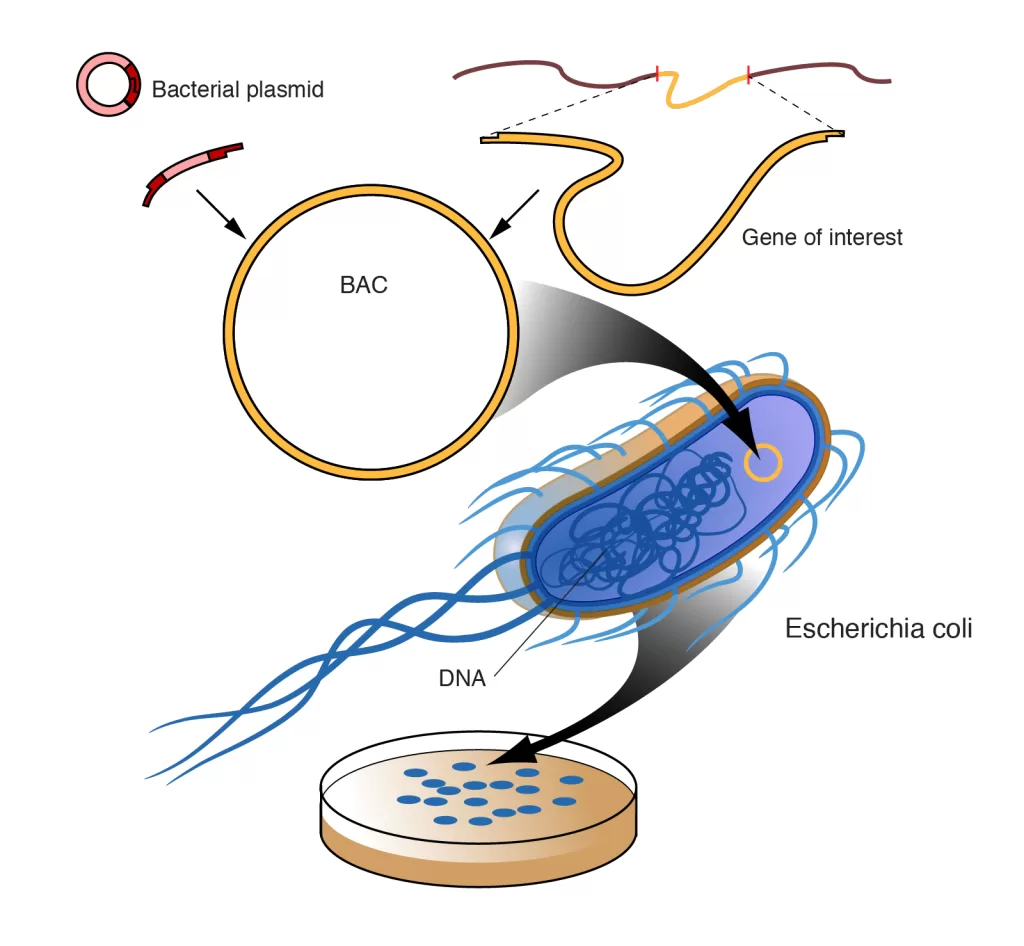
So what exactly is a bacterial artificial chromosome (or BAC)? In short, it’s a DNA construct — like a plasmid on steroids — that scientists use to clone very large pieces of DNA (up to 300,000 base pairs!). These BACs are based on a naturally occurring F-plasmid in E. coli and are modified to carry genes we want to study, replicate, or manipulate.
🧬 What Makes a BAC Special?
A bacterial artificial chromosome isn’t your typical cloning tool. Think of it as a super-sized USB drive for DNA. Here’s what makes BACs so valuable:
- 🔹 Can carry large DNA inserts (100–350 kb)
- 🔹 Maintained as single-copy plasmids = less recombination, more stability
- 🔹 Includes BAC vectors with a replication origin, antibiotic resistance marker, and partitioning genes
- 🔹 Ideal for building a BAC library — a powerful resource for genomic mapping
Back in the Human Genome Project days, researchers used BACs to divide the human genome into manageable pieces. That’s how essential BAC cloning was in mapping our entire DNA code. Pretty wild, right?
🧬 BAC Cloning Step-by-Step (It’s Not as Scary as It Sounds)

Here’s a simplified breakdown of the BAC cloning process (aka what I did during my first big lab internship):
- Isolate high-molecular-weight genomic DNA
- Digest it with restriction enzymes
- Ligate the fragments into BAC vectors
- Transform into E. coli via electroporation
- Select successful clones with antibiotics
- Screen and store the ones you want — building a BAC library
👉 Each clone holds one chunk of a genome. When you have enough clones, you essentially have the whole genome sliced up in manageable bits. This is what’s called a BAC library — and it’s a game-changer for gene mapping and functional studies.
🧠 Real-World Applications of Bacterial Artificial Chromosomes
I didn’t fully appreciate BACs until I saw how they’re used in the real world. Here’s where you’ll find them:
1. 🔬 Genome Sequencing
During the Human Genome Project, BACs were key to sequencing the human genome. Why? They can hold big inserts and are stable in bacterial cells. Learn more on NCBI’s sequencing strategies.
2. 🧫 Infectious Disease Research
Researchers create infectious clones of viruses like herpes or SARS using BACs. It lets them study viral behavior safely in the lab using cloned viral genomes.
3. 🧬 Gene Therapy & Genetic Engineering
BAC vectors help modify genes precisely, allowing scientists to create animal models or engineer crops.
4. 🧪 Functional Genomics
Scientists use BAC libraries to isolate genes, study mutations, and figure out gene functions — a major help in rare disease research.
⚖️ BAC vs PAC vs YAC vs Cosmids – What’s the Difference?
I used to get these mixed up too. Here’s a cheat sheet:
| Vector | Max Insert Size | Host Organism | Use |
| BAC | 100–350 kb | E. coli | Genome mapping, cloning |
| PAC | ~150 kb | E. coli | Similar to BAC but uses P1 elements |
| YAC | ~1,000 kb | Yeast | Huge DNA fragments but less stable |
| Cosmid | ~45 kb | E. coli | Good for medium-sized cloning |
🔍 BAC vectors hit the sweet spot: large insert capacity + stability in bacterial cells.
🛠 My Experience with BACs in the Lab
When I first worked with BAC cloning, I honestly didn’t think it would work. I messed up the electroporation more times than I can count (sorry, E. coli). But once I got my first glowing clone under UV light — it was magic. I realized: we’re literally editing life.
I remember working with a BAC library of mouse genes. Watching different DNA fragments light up with probes felt like solving a massive biological puzzle.
That experience taught me more about patience and precision than any textbook.
💡 Why BACs Still Matter in 2025
With CRISPR and synthetic biology taking over the headlines, you might think BACs are “old school.” But here’s the thing — even cutting-edge gene editing starts with solid, stable DNA templates. And that’s where BAC vectors still shine.
They’re reliable, scalable, and surprisingly elegant.
👋 Final Thoughts: BACs Deserve More Love
So yeah, I’m a fan of bacterial artificial chromosomes. They may not be flashy like CRISPR, but without them, a lot of modern biology wouldn’t be possible.
Next time someone says “plasmid,” ask if they’ve ever cloned 300kb of DNA. Then tell them about BACs. 🧬😉
Related Links