Master Every C Program For Pattern: A Complete Guide for Beginners

In a C program for pattern, we can print different types of designs like star patterns, pyramid patterns, Floyd’s triangle, Pascal’s triangle, and more. Read this article to explore various C program for pattern examples that will help you enhance your coding skills and ace your technical interviews!
Why Is C Program For Pattern So Important?
You must have heard the common question about C program for pattern in many technical interviews. Whether it’s star patterns, pyramid patterns, or triangles, these pattern programs are a favorite among interviewers.
But why? Because they test your fundamental understanding of:
- Nested Loops: How loops work inside each other.
- Logical Thinking: How to map coordinates to visual symbols.
- Space Management: How to handle alignment using blank spaces.
In this article, we’ve compiled all the essential C pattern programs in one place, making it easy for you to practice and master them. Each example comes with clear explanations and code, ensuring even beginners can understand it clearly. So, let’s boost our programming skills and get ready to ace those technical interviews!
What Is C Program For Pattern?
A C program for pattern is a script written in the C language that generates visual shapes using characters (like *), numbers, or symbols. These programs primarily use nested loops—where an outer loop typically manages the rows and an inner loop manages the columns or the content within those rows.
Writing these programs is one of the best ways to build a “programmer’s brain.” It teaches you how to break down a complex visual shape into simple mathematical instructions.
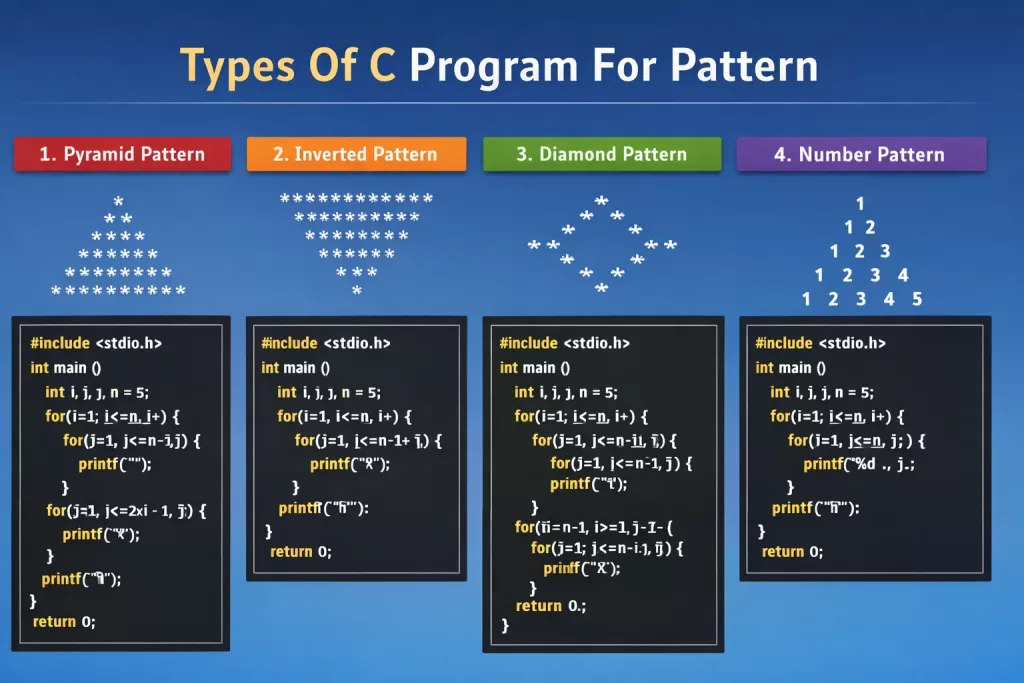
Types Of C Program For Pattern
We can use various logic structures to print different patterns. Below is a quick reference table of the patterns we will cover in this guide:
| Pattern Name | Logic Used |
|---|---|
| Right Half Pyramid | Increasing stars per row |
| Left Half Pyramid | Spaces + Increasing stars |
| Full Pyramid | Centered stars (Symmetrical) |
| Inverted Pyramids | Decreasing stars per row |
| Diamond Pattern | Combined Normal & Inverted pyramids |
| Floyd’s Triangle | Sequential natural numbers |
| Pascal’s Triangle | Binomial coefficients |
1. Right Half Pyramid Pattern
In this pattern, stars are printed in a right-angled triangle format. The number of stars increases as you move down.
Logic:
- Outer loop: Runs from 1 to
rows. - Inner loop: Runs from 1 to the current row number
i.
C#include <stdio.h>
int main() {
    int i, j, rows;
    printf("Enter the number of rows: ");
    scanf("%d", &rows);
    for (i = 1; i <= rows; ++i) {
        for (j = 1; j <= i; ++j) {
            printf("* ");
        }
        printf("\n");
    }
    return 0;
}
2. Left Half Pyramid Pattern
This pattern aligns stars to the right margin. To do this, we must print spaces before the stars.
Logic:
- Outer loop: Controls rows.
- First inner loop: Prints decreasing spaces.
- Second inner loop: Prints increasing stars.
C#include <stdio.h>
int main() {
    int i, j, rows;
    printf("Enter the number of rows: ");
    scanf("%d", &rows);
    for (i = 1; i <= rows; ++i) {
        for (j = i; j < rows; ++j) {
            printf("  ");
        }
        for (j = 1; j <= i; ++j) {
            printf("* ");
        }
        printf("\n");
    }
    return 0;
}
3. Full Pyramid Pattern
The full pyramid is the “gold standard” of C pattern programs. It requires precise space management to keep the triangle centered.
C#include <stdio.h>
int main() {
    int i, j, rows;
    printf("Enter the number of rows: ");
    scanf("%d", &rows);
    for (i = 1; i <= rows; ++i) {
        for (j = i; j < rows; ++j) {
            printf("  ");
        }
        for (j = 1; j <= (2 * i - 1); ++j) {
            printf("* ");
        }
        printf("\n");
    }
    return 0;
}
4. Inverted Right Half Pyramid Pattern
In this version, we start with the maximum number of stars and reduce them row by row.
C#include <stdio.h>
int main() {
    int i, j, rows;
    printf("Enter the number of rows: ");
    scanf("%d", &rows);
    for (i = rows; i >= 1; --i) {
        for (j = 1; j <= i; ++j) {
            printf("* ");
        }
        printf("\n");
    }
    return 0;
}
5. Inverted Left Half Pyramid Pattern
Similar to the left half pyramid, but the star count decreases while the space count increases.
C#include <stdio.h>
int main() {
    int i, j, rows;
    for (i = rows; i >= 1; --i) {
        for (j = i; j < rows; ++j) {
            printf("  ");
        }
        for (j = 1; j <= i; ++j) {
            printf("* ");
        }
        printf("\n");
    }
    return 0;
}
6. Inverted Full Pyramid Pattern
This program prints a centered triangle pointing downwards.
C#include <stdio.h>
int main() {
    int i, j, rows;
    printf("Enter number of rows: ");
    scanf("%d", &rows);
    for (i = rows; i >= 1; --i) {
        for (j = 0; j < rows - i; ++j) printf("  ");
        for (j = 1; j <= (2 * i - 1); ++j) printf("* ");
        printf("\n");
    }
    return 0;
}
7. Rhombus Pattern
A rhombus looks like a tilted square. You achieve this by adding leading spaces to a standard square block.
C#include <stdio.h>
int main() {
    int i, j, rows;
    printf("Enter rows: ");
    scanf("%d", &rows);
    for (i = 1; i <= rows; ++i) {
        for (j = i; j < rows; ++j) printf("  ");
        for (j = 1; j <= rows; ++j) printf("* ");
        printf("\n");
    }
    return 0;
}
8. Diamond Pattern
The Diamond is a combination of a Full Pyramid and an Inverted Full Pyramid.
C#include <stdio.h>
int main() {
    int i, j, rows;
    printf("Enter rows: ");
    scanf("%d", &rows);
    // Upper Part
    for (i = 1; i <= rows; i++) {
        for (j = i; j < rows; j++) printf("  ");
        for (j = 1; j <= (2 * i - 1); j++) printf("* ");
        printf("\n");
    }
    // Lower Part
    for (i = rows - 1; i >= 1; i--) {
        for (j = rows; j > i; j--) printf("  ");
        for (j = 1; j <= (2 * i - 1); j++) printf("* ");
        printf("\n");
    }
    return 0;
}
9. Hourglass Pattern
Imagine two pyramids meeting at the tips. This uses the inverted logic first, followed by the normal pyramid logic.

10. Hollow Square Pattern
This is a great logic test. You only print stars if the current position is on the boundary (first row, last row, first column, or last column).
C#include <stdio.h>
int main() {
    int i, j, size;
    printf("Enter size: ");
    scanf("%d", &size);
    for (i = 1; i <= size; ++i) {
        for (j = 1; j <= size; ++j) {
            if (i == 1 || i == size || j == 1 || j == size)
                printf("* ");
            else
                printf("  ");
        }
        printf("\n");
    }
    return 0;
}
11. Floyd’s Triangle Pattern
Floyd’s Triangle uses numbers instead of stars. It starts at 1 and keeps incrementing.
C#include <stdio.h>
int main() {
    int i, j, rows, num = 1;
    printf("Enter rows: ");
    scanf("%d", &rows);
    for (i = 1; i <= rows; ++i) {
        for (j = 1; j <= i; ++j) {
            printf("%d ", num++);
        }
        printf("\n");
    }
    return 0;
}
12. Pascal’s Triangle Pattern
This is the most advanced C program for pattern. Each number is the sum of the two numbers directly above it. Mathematically, it uses combinations (nCr).
Learn Programming with Expert Guidance
Are you looking for a perfect course to become a proficient programmer?
If these patterns seem tricky, don’t worry! Most developers start exactly where you are. To move from basic patterns to building real-world applications, structured learning is key. They offer beginner-friendly training, expert mentors, and hands-on coding labs to help you master C, C++, and Data Structures.
Become A C Programming Professional With Kaashiv Infotech
Looking to dive into the world of digital marketing and carve your path to success? Kaashiv Infotech is here for you! Our is specially C Programming course in chennai designed by industry leaders to equip you with practical skills and real-world experience that will help you set your foot in the competitive digital marketing industry.
Let’s break down our training offerings to see what makes our program stand out:
Live Industry Projects + Capstone: You’ll work on 2 real-time industry projects per internship to build a solid portfolio and enhance your learning with hands-on exposure that showcases your expertise in digital marketing, SEO, or content strategy.
Practice Exercises: Get hands-on practice with structured daily exercises that enhance your learning and help you master key concepts in content planning, creation, infographics, and search engine optimization.
Doubt Clearing Sessions: Our regular doubt sessions ensure that no question goes unanswered, giving you clarity on all concepts related to digital marketing frameworks and tools.
Kaashiv Lab for Digital Tools: Access our exclusive lab environment to practice with SEO tools, content platforms, and analytics dashboards in a supportive, guided setting.
Industry-Oriented Curriculum: Learn industry-relevant skills and techniques that are directly applicable to real-world digital marketing scenarios, from campaign planning to performance optimization.
Triple Certification: Earn three recognized credentials upon completion — an Internship Certificate, an IPT Certificate, and an Industrial Exposure Certificate — valued by employers across the digital marketing landscape.
Q&A Forum: Engage with fellow batchmates and instructors in our Q&A forum to exchange ideas, seek advice, and collaborate on content and SEO projects.
Instructor-Led Sessions: Benefit from interactive sessions led by Microsoft MVPs and Google-recognized experts who guide you every step of the way in mastering digital marketing, SEO, and content development.
Interview Opportunities: Gain access to interview opportunities, ATS-friendly resume building tools, and exclusive interview question banks tailored for digital marketing roles.
100% Job Assistance Guarantee + Kaashiv Alumni Support: We’re offering 100% job assistance along with ongoing support from our wide alumni network to help you land your dream role in digital marketing.
So what are you waiting for? Launch your career with confidence! Join the Kaashiv Infotech C Programming, C#, C++ and unlock your potential today.
Conclusion
Mastering the C program for pattern is more than just a classroom exercise. It’s about training your mind to see logic in shapes. Once you can visualize how i and j loops interact, you’ll find that complex algorithms in Data Structures become much easier to understand. Start with the Right Half Pyramid and work your way up to Pascal’s Triangle. Happy coding!
C Program For Pattern FAQs
1. What is the purpose of learning pattern programs in C?
Pattern programs help in developing problem-solving skills, improve logical thinking, and enhance understanding of nested loops and control structures. They are frequently used in technical interviews to gauge a candidate’s basic coding fluency.
2. How do nested loops work in pattern programs?
In a pattern program, the outer loop usually represents the rows (the vertical movement). The inner loop represents the columns or the characters printed within each row (the horizontal movement).
3. What is the importance of Floyd’s Triangle in C programming?
Floyd’s Triangle is a classic exercise to understand sequential number processing and loop control. It helps beginners learn how to manage a variable that persists across different iterations of a nested loop.
4. Can I print patterns using a while loop instead of a for loop?
Yes, any pattern can be printed using while or do-while loops. However, for loops are generally preferred because they keep the initialization, condition, and increment in a single line, making the code cleaner.
5. How can I make my patterns symmetrical?
Symmetry is achieved by calculating the number of leading spaces. For a pyramid of N rows, the number of spaces in the first row is usually N-1, decreasing by one for each subsequent