🚀 Data Scientist or Data Engineer: What Is the Right Career Choice in 2026?
Data Scientist vs Data Engineer.
I’ve begun with this phrase intentionally.
Because if you’re here — searching Data Scientist vs Data Engineer on Google at midnight (or during a boring lecture 😅) — you’re probably confused, curious, and a little nervous. I know that feeling well. I was there too.
I clearly remember sitting with my laptop, 20 tabs open, every article arguing with the next one. One claimed “Data Science is dead.” Another screamed “Data Engineering is the real future.” And all I wanted was a straight, honest answer.
So let me talk to you like a friend.
This article isn’t stuffed with theory or buzzwords. It’s my personal, human take on Data Scientist vs Data Engineer, what these roles actually look like in real companies, and the Data Engineer vs Data Scientist future scope — especially if you’re a fresher or someone planning a career switch.
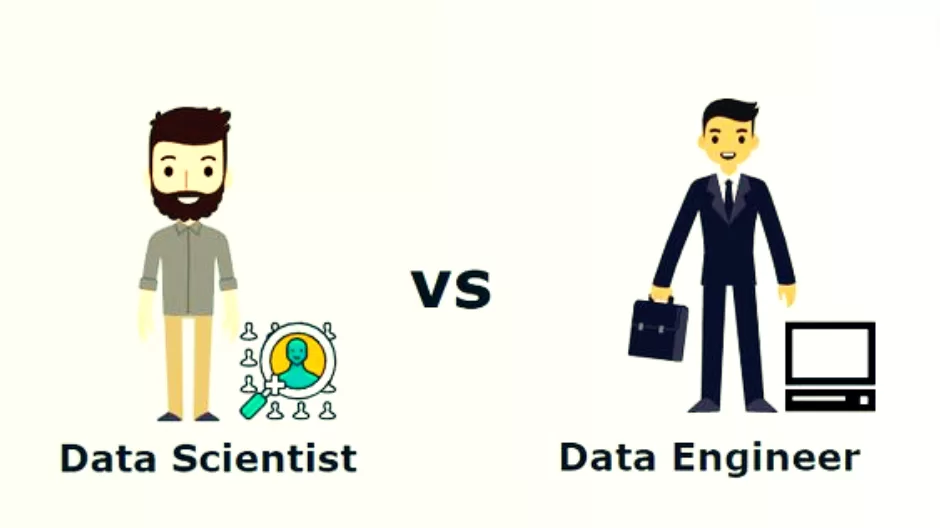
🤯 Why Data Scientist vs Data Engineer Has Everyone Lost
Here’s the real problem.
Most blogs explain Data Scientist vs Data Engineer like exam answers:
- Clean tables
- Fancy terms
- Zero soul
But real life doesn’t work that way.
In real companies:
- Data Scientists cry: “The data is dirty!” 😤
- Data Engineers complain: “They keep changing requirements!”
- Managers grumble: “Why does nothing get done on time?” 😐
And yet — both roles are equally important.
Think of it this way 🍽️
- If data were food,
- Data Engineers build the kitchen 🏗️
- Data Scientists cook the meal and decide the recipe 👨🍳
No kitchen? No food.
No recipe? No taste.
That’s the real difference.
📊 What Is Data Science?
Data Science involves getting useful insights from tonnes of data. It uses a mix of computer science, math, machine learning, and data management methods to find hidden patterns, trends, and links.
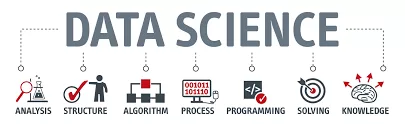
These findings can help make vital choices, boost research and new ideas, and even lead to new products and services.
I’ve seen Data Scientists spend days just trying to understand:
- Why did sales suddenly drop?
- Why are users leaving after Day 3?
- Which customers are likely to churn next month?
🔍 What Data Scientists Actually Do
On a normal day, a Data Scientist might:
- Clean messy data (yes… a lot of cleaning 😅)
- Find patterns using Python or SQL
- Build machine learning models
- Explain results to non-technical teams
- Politely argue with stakeholders about numbers
It’s a mix of math, logic, and storytelling.
If you enjoy finding meaning in chaos, Data Science can feel magical ✨
🔁 Data Science Life Cycle
This is how it usually actually goes:
- Business Problem – “We need better predictions.”
- Data Reality Check – “Oh… the data is broken.”
- Data Cleaning – 60% of the time goes here.
- EDA – Playing detective with charts and stats 🕵️♂️
- Feature Engineering – Turning raw data into signals.
- Model Building – ML, stats, trial and error.
- Evaluation – Does this even work?
- Deployment – Fingers crossed 🤞
- Monitoring – Because models age like milk 🥛
This loop never really ends.
🧠 Data Scientist Skills You Actually Need
Forget buzzwords. Here’s the honest list:
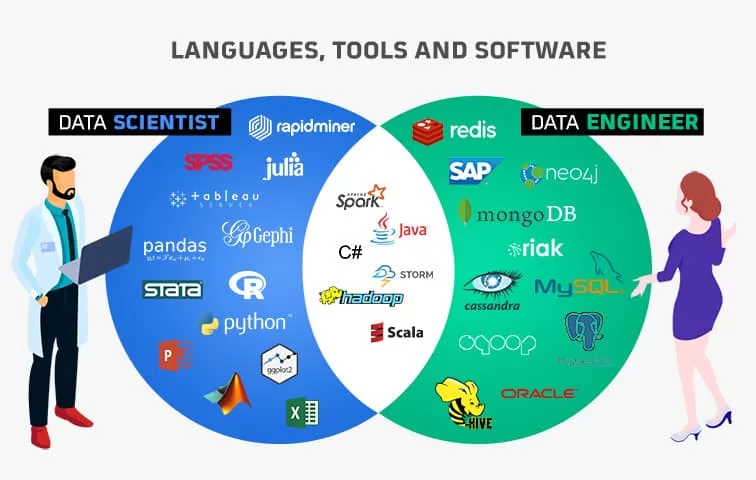
- Python & SQL (non-negotiable)
- Statistics (so you don’t fool yourself)
- Machine learning basics
- Curiosity (criminally underrated)
- Communication (this makes or breaks careers)
🧰 Tools I See Used Often
- Pandas, NumPy
- Scikit-learn
- Tableau / Power BI
- Jupyter Notebook
🛠️ What Is Data Engineering? – The Backbone Role
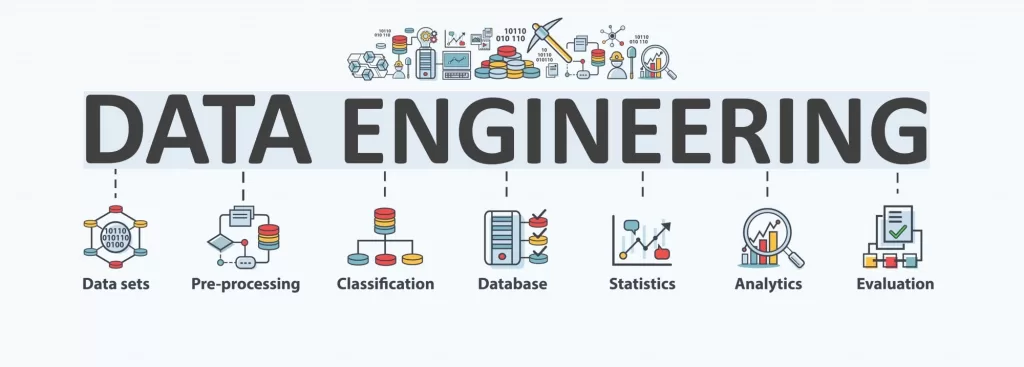
Data Engineering, in contrast, aims to put into action, assess, and keep up data structures, like data pipelines, databases, and other systems to process data.
It serves as the foundation to ensure easy access to data for various uses such as machine learning projects and automated factory production methods.
I once worked with a team where Data Scientists had brilliant ideas — but nothing worked because the pipelines kept breaking. One solid Data Engineer fixed the system, and suddenly everything started moving.
That’s power 💪
👷 A Day-to-Day Look at Data Engineers
A Data Engineer usually spends time on:
- Building data pipelines
- Handling ETL processes
- Managing databases and warehouses
- Ensuring data quality and speed
- Working with cloud platforms ☁️
If Data Science is the brain 🧠, Data Engineering is the nervous system ⚡.
🧩 Skills That Matter for Data Engineers
You’ll enjoy Data Engineering if you like:
- Writing clean, efficient code
- Thinking in systems
- Solving performance bottlenecks
🔑 Core Skills
- SQL (deeply)
- Python / Scala / Java
- Big data tools (Spark, Kafka)
- Cloud platforms (AWS, Azure, GCP)
- Data modeling
⚔️ Data Scientist vs Data Engineer: The Honest Comparison
| Aspect | Data Scientist | Data Engineer |
|---|---|---|
| Focus | Insights & models | Systems & pipelines |
| Daily Work | Analysis, ML, presentations | Coding, infra, reliability |
| Mindset | Curious & analytical | Logical & structured |
| Tools | Python, ML libs, BI tools | Spark, SQL, Airflow |
| Output | Insights & predictions | Clean, reliable data |
This table explains Data Scientist vs Data Engineer, but your personality decides the answer.
🔮 Data Engineer vs Data Scientist Future Scope
Here’s my honest take on the Data Engineer vs Data Scientist future scope:
- AI is expanding → Data Scientists are in demand 🤖
- Data volume is exploding → Data Engineers are indispensable 📈
- Companies want end-to-end ownership → Hybrid roles are rising
Looking 5–10 Years Ahead
- Cloud and real-time systems will massively boost demand for Data Engineers
- Data Scientists with engineering skills will stand out the most
If I had to bet? Both careers are safe ✅
💰 India-Focused Salary Reality
Let’s be honest — money matters.
Both roles pay well, but:
- Entry-level Data Scientists often earn slightly more
- Senior Data Engineers scale extremely well over time
The Data Engineer vs Data Scientist future scope financially is strong — skills matter more than titles.
🧭 So… Which One Should You Choose?
Choose Data Science if you:
- Love patterns and predictions
- Enjoy math and storytelling
- Like influencing business decisions
Choose Data Engineering if you:
- Love systems and structure
- Enjoy backend and infrastructure work
- Want to build things that last
And remember — Data Scientist vs Data Engineer is not a prison. You can move 🚪
🔄 Can You Switch Between Them?
Absolutely.
I’ve seen:
- Data Engineers become Data Scientists
- Data Scientists move into ML Engineering
- Hybrid profiles become almost irreplaceable
Learning never stops in data 📚
💭 Final Thoughts
If you’re still stuck choosing between Data Scientist vs Data Engineer, let me tell you this — there is no “wrong” choice here. Both paths are powerful, future-proof, and deeply valuable in 2026 and beyond. What truly matters is how you think and what excites you. If you love asking questions, finding patterns, and turning messy data into stories that influence decisions, Data Science will feel like home. If you enjoy building systems, solving structural problems, and making sure data flows smoothly at scale, Data Engineering will give you long-term satisfaction. The Data Engineer vs Data Scientist future scope looks strong for both roles, especially for those who keep learning and adapting. Start with the path that feels right today — because in the data world, careers are flexible, skills are transferable, and growth never really stops.
Related Reads: