Difference Between ERP and SAP: Ultimate Comparison Guide
One of the most common searched questions about business technology is the difference between ERP and SAP. Many people use the two terms interchangeably, but they are not synonymous. As a short definition, ERP is a type of software system; SAP is a company that lends its name to their own ERP solutions. You need to know this difference whether you are a student, IT professional or business owner who is looking to implement enterprise software.
In this article we will define ERP and SAP, review key features of both, and clarify the differences between ERP and SAP and give examples of what falls into or out of the ERP and SAP categories.
What is ERP? (Enterprise Resource Planning)

ERP means Enterprise Resource Planning. It is a software system designed to integrate and manage your key business functions. Instead of using many different applications (finance, hr, manufacturing, supply chain, sales), they are brought together in an integrated manner.
👉 Key Features of ERP:
- A centralized database offers real-time information.
- Automates tasks that require repetitive action.
- Analytics allows for better decision making.
- Improved collaboration across departments.
👉 Examples of ERP software (other than SAP):
- Oracle NetSuite
- Microsoft Dynamics 365
- Odoo
- Infor
ERP is a concept and a category of software, not a specific product.
What is SAP?
SAP as known as Systems, Applications & Products in Data Processing, is a German multinational software corporation that makes enterprise software to manage business operations and customer relations.
SAP ERP is the most prominent product which is among the most widely used ERP systems around the world. There are some recognizable names such as Coca-Cola, BMW, and Nestlé use SAP globally.
👉 Key SAP ERP Modules include:
- SAP FI (Financial Accounting)
- SAP MM (Materials Management)
- SAP SD (Sales and Distribution)
- SAP HR/HCM (Human Resources)
- SAP PP (Production Planning)
This means SAP is a vendor, and ERP is the category of software that SAP builds.
Difference Between ERP and SAP
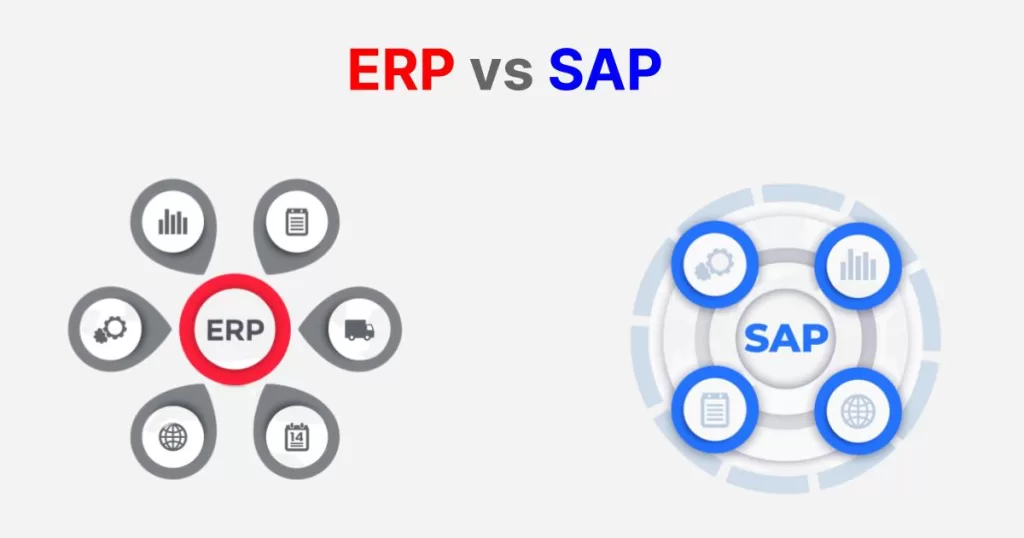
Here’s the part everyone is searching for:
| Aspect | ERP | SAP |
| Definition | A type of business software for managing operations. | A company that provides ERP software. |
| Scope | General concept, used by many vendors. | One of the top ERP vendors in the world. |
| Examples | Oracle, Microsoft Dynamics, Odoo, Infor. | SAP ERP, SAP S/4HANA. |
| Usage | Any integrated business system. | Specifically SAP’s ERP software. |
| Popularity | Widely used across industries. | Market leader in ERP solutions. |
👉 In simple terms:
ERP = The category of software.
SAP = A company that builds ERP software.
So, the difference between ERP and SAP is like the difference between “a smartphone” and “Apple iPhone.”
Why Do People Confuse ERP and SAP?
There are two main reasons:
- SAP’s dominance in ERP → Since SAP is one of the largest ERP providers, people often equate ERP with SAP.
- Terminology overlap → Many businesses use the phrase “implementing SAP ERP,” which makes it sound like SAP is ERP.
Benefits of ERP (and How SAP Fits In)
ERP systems provide businesses with several advantages:
- Efficiencies – Eliminating duplicate processes.
- Data Integrity – Single source of truth across departments.
- Scalability – Accommodating business growth.
- Decision Making – Ability to perform analytical functions in real-time.
SAP takes these benefits further with:
- Industry specific solutions (retail, automotive, manufacturing, finance).
- Global support for multinational organizations.
- Use of advanced AI, machine learning and cloud based ERP in SAP S/4HANA.
ERP vs SAP: Which One Should You Choose?
This is a very common question for businesses.
- If you are evaluating and using ERP software, you will be consulting with a variety of vendors: Oracle, SAP, Microsoft, Odoo.
- If you are looking at SAP ERP, you have been introduced to one of the largest and most effective solutions available in the market.
👉 For small businesses, lighter-weight, more affordable options are available (i.e., Odoo or Zoho)
👉 For larger-sized businesses, typically, only SAP ERP or Oracle ERP will be considered.
Real-World Examples
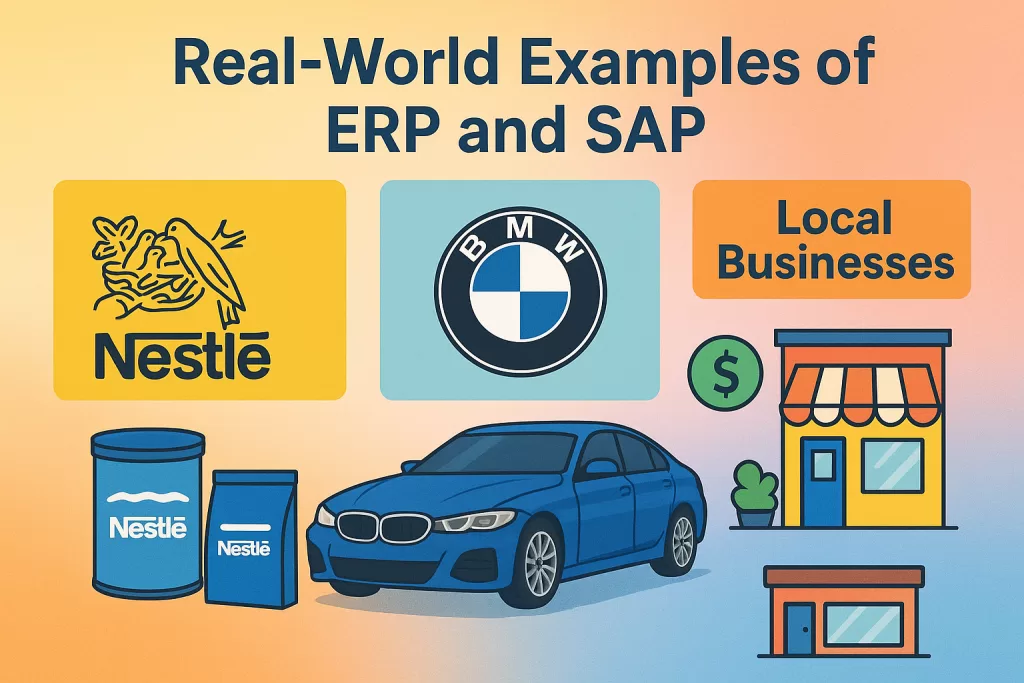
- Nestlé uses SAP ERP to manage its massive global supply chain.
- BMW uses SAP for production planning and logistics.
- Local businesses may use Odoo or Microsoft Dynamics instead of SAP because of budget and customization needs.
This shows how ERP is a broad category, and SAP is a specific solution within it.
FAQs: Difference Between ERP and SAP
Q1: Is SAP ERP?
Yes, SAP is one provider of ERP software, but ERP is a larger concept.
Q2: Can ERP exist without SAP?
For sure. There are many ERP vendors outside SAP.
Q3: Which one is better – ERP or SAP?
Trick question! ERP is a category; SAP is one option. You compare SAP with Microsoft Dynamics, Oracle, etc. not to ERP.
Conclusion
Its important to understand the difference between ERP and SAP to quell a lot of misunderstanding. An ERP is a system that handles step by step business process, while SAP is a company that manufactures software for ERP (and many other enterprise type software).
If you are a business making a decision, you are not choosing “ERP vs SAP“, instead you are choosing, “Which ERP solution provider (SAP, Oracle, Microsoft, etc.) is best for my needs?”
Understanding the difference of ERP and SAP allows you to choose a solution better suited to your needs while streamlining business processes.
Related Links