🧠 Difference Between Microcontroller and Microprocessor: Essential Facts You Must Know in 2025
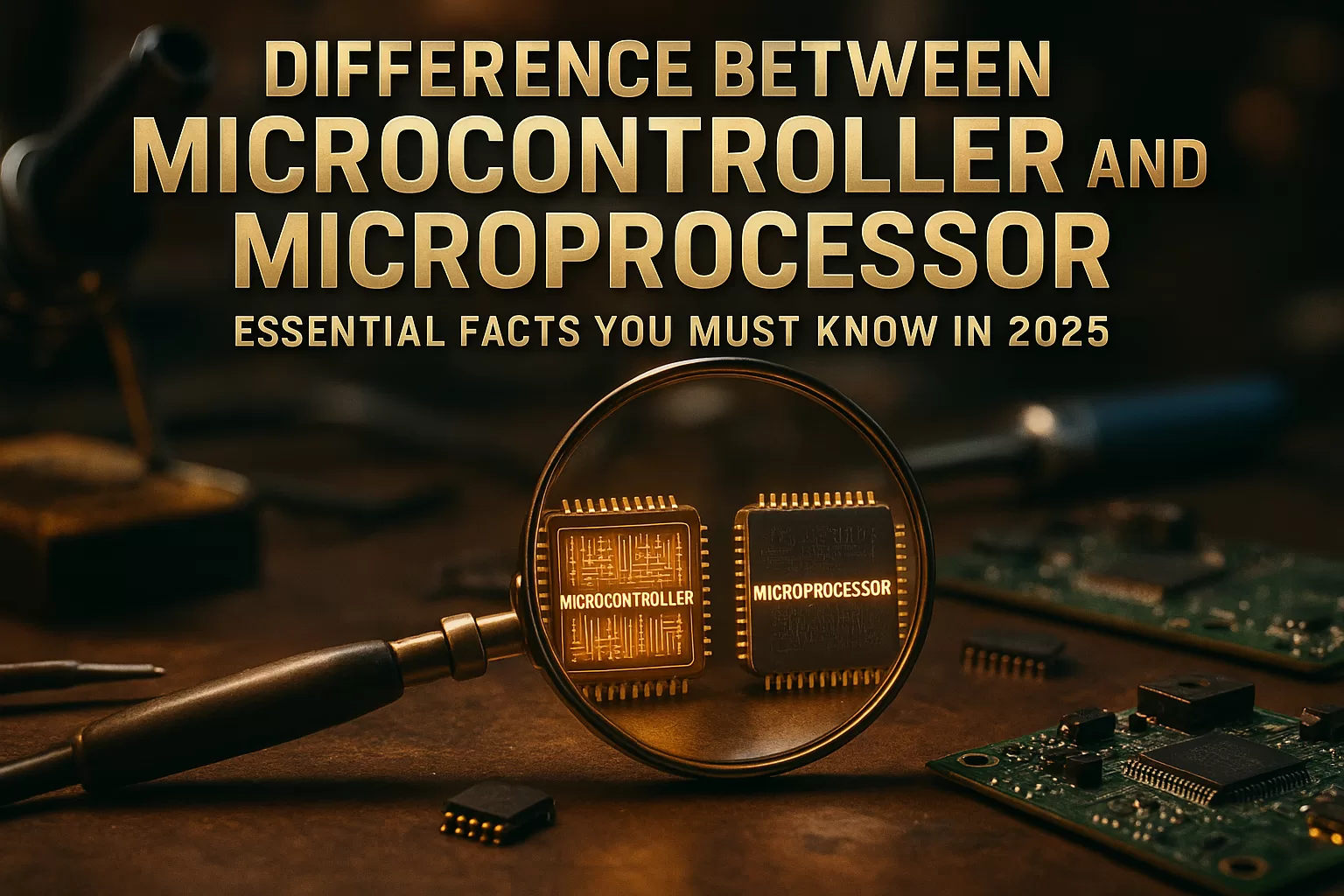
In 2025, the line between microcontroller and microprocessor is thinner than ever — yet understanding the difference is crucial for anyone learning electronics, embedded systems, or IoT.
Whether you’re tinkering with an Arduino board or studying how your laptop’s CPU works, knowing the difference between microcontroller and microprocessor helps you understand how modern devices think, compute, and control.
So, what exactly separates a microcontroller (µC) from a microprocessor (µP)?
Let’s break it down in a simple, beginner-friendly way — with examples, tables, and a touch of storytelling.
⚙️ What Is a Microprocessor?
A microprocessor is the central processing unit (CPU) of a computer — the thinking brain that performs calculations, logic operations, and decision-making.
But here’s the key: a microprocessor can’t work alone.
It needs supporting hardware like RAM, ROM, input/output interfaces, and timers to function as a complete computer system.

💡 Think of it like this:
A microprocessor is like a chef in a restaurant kitchen. The chef (processor) can cook, but without the kitchen (memory, stove, utensils), no meal can be prepared.
That’s why microprocessors are used in systems where you can afford to add these “kitchen tools” — like PCs, laptops, or smartphones.
🧩 Key Characteristics:
- Performs high-speed arithmetic and logic operations
- Handles multitasking and complex operating systems
- Requires external memory and I/O components
- Consumes more power
- Typically runs at clock speeds above 1 GHz
⚙️ Real-World Examples:
- Intel Core, AMD Ryzen, Apple M-series, ARM Cortex-A series
- Used in computers, tablets, servers, smartphones
🔩 What Is a Microcontroller?
A microcontroller is a complete mini-computer built into a single chip.
It includes the CPU, memory (RAM + ROM), I/O ports, timers, and even ADC/DAC converters — all in one place.
That means it doesn’t need much external hardware to function. Microcontrollers are designed to control specific tasks — not to run an entire operating system.
💡 Real-world analogy:
If a microprocessor is a chef who runs a big restaurant, a microcontroller is the automatic coffee machine that knows exactly how to make your latte — quickly, efficiently, and without help.
🧩 Key Characteristics:
- Self-contained: CPU + Memory + Peripherals on one chip
- Lower clock speeds (often below 100 MHz)
- Extremely power-efficient
- Designed for specific, repetitive tasks
- Inexpensive and compact
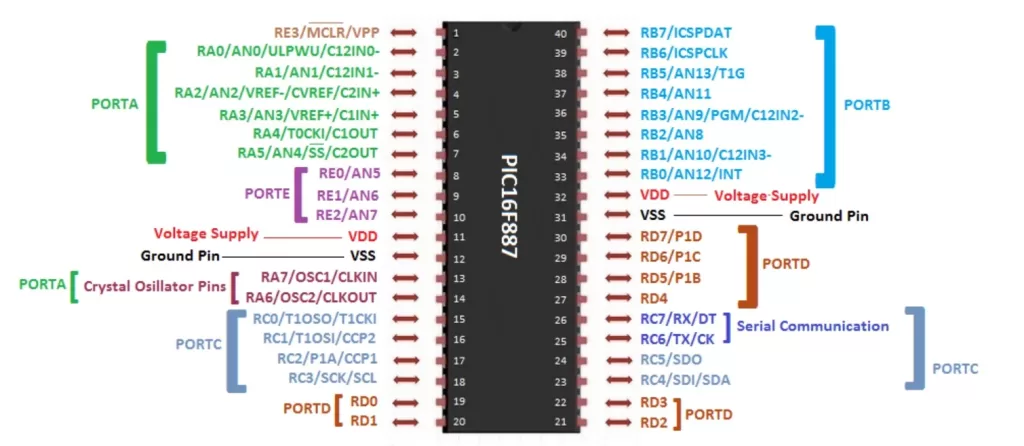
⚙️ Real-World Examples:
- Intel 8051, Arduino (ATmega328), PIC, ARM Cortex-M series, ESP32
- Used in washing machines, microwaves, drones, automotive systems, smart wearables

🧮 Evolution Over Time
Back in the 1980s and 90s, microprocessors ruled computers while microcontrollers powered simple electronic devices. But by 2025, the landscape has changed dramatically:
| Era | Microprocessors | Microcontrollers |
|---|---|---|
| 1980s | Used in desktops, mainframes | Simple appliances, toys |
| 2000s | Introduced into smartphones | Became smarter and programmable |
| 2020s | Used in AI systems, SoCs, cloud devices | Powering IoT, drones, cars, wearables |
| 2025 | AI-enabled processors, multi-core SoCs | Ultra-low-power IoT chips, AI-on-edge controllers |
Today, microcontrollers can handle lightweight AI models, and some microprocessors are compact enough to be embedded — showing how technology is merging both worlds.
🔍 Difference Between Microcontroller and Microprocessor
Here’s a full side-by-side comparison of microcontroller vs microprocessor:
| Feature | Microcontroller (µC) | Microprocessor (µP) |
|---|---|---|
| Purpose | Built for specific control-based applications | Designed for general-purpose computing |
| Architecture | CPU + RAM + ROM + I/O on a single chip | CPU only (external memory and peripherals) |
| Integration | Highly integrated | Less integrated |
| Clock Speed | < 100 MHz | > 1 GHz |
| Power Consumption | Low | High |
| Memory Type | On-chip ROM, RAM | External memory |
| System Complexity | Simple and self-contained | Complex and modular |
| Size | Compact | Larger |
| Cost | Low | High |
| Performance | Optimized for control | Optimized for computation |
| Architecture Type | Harvard (separate data & instruction buses) | Von Neumann (shared bus) |
| I/O Ports | Inbuilt | Requires external |
| Applications | IoT, embedded devices, robotics | Computers, tablets, AI systems |
| Examples | Arduino, 8051, STM32, ESP32 | Intel i7, AMD Ryzen, ARM Cortex-A |
| Programming | Often C or Assembly | C, C++, Python, OS-level coding |
🧭 Architecture Breakdown
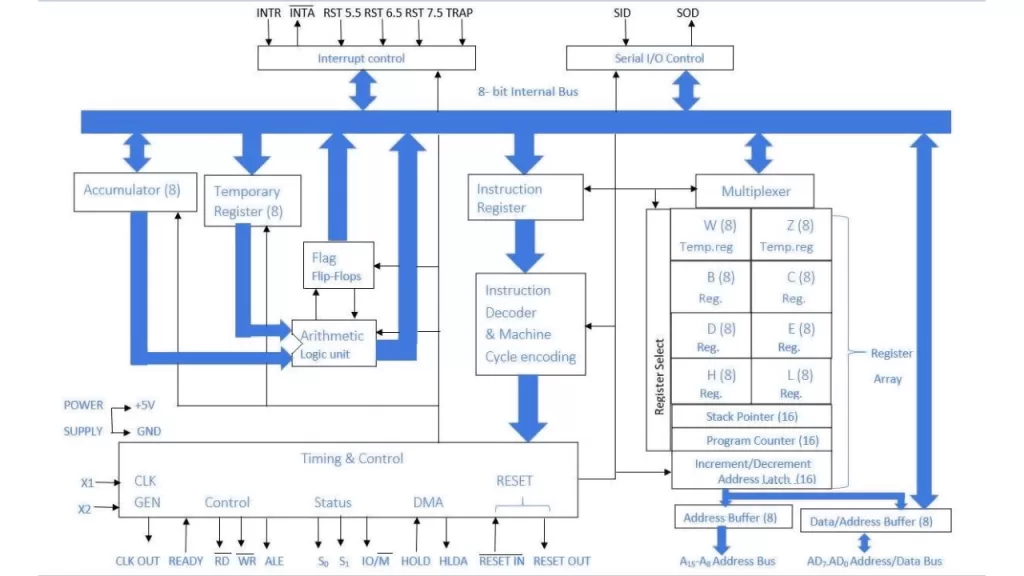
🧠 Microprocessor Architecture (Simplified)
A microprocessor mainly includes:
- ALU (Arithmetic Logic Unit) – Performs math and logic operations
- Control Unit (CU) – Directs the operation of the processor
- Registers – Fast temporary storage
- Clock Generator – Synchronizes tasks
It connects to external components through system buses for memory and I/O.
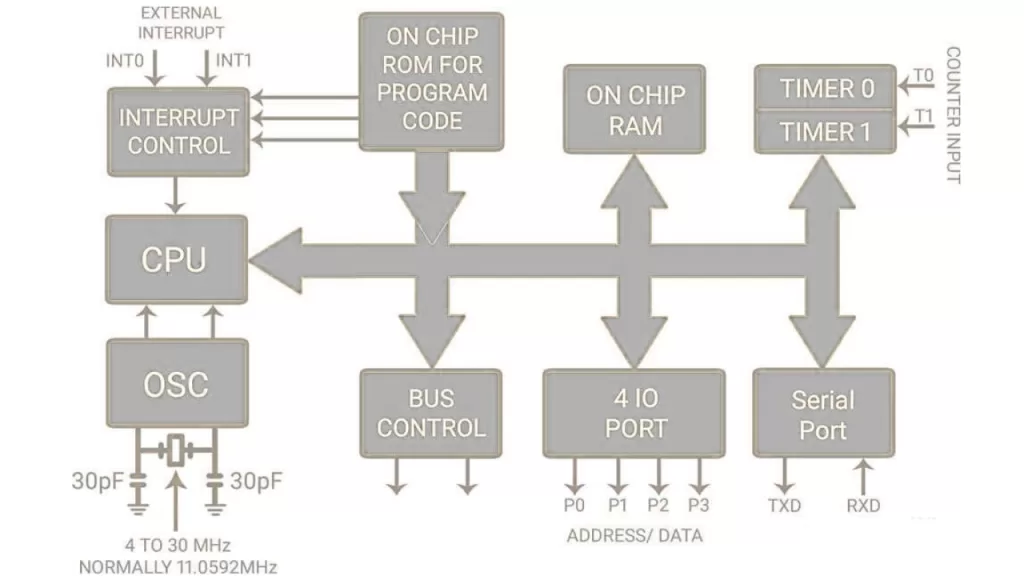
⚙️ Microcontroller Architecture
A microcontroller includes everything above plus:
- ROM/Flash Memory – Stores program code
- RAM – Temporary data storage
- Timers/Counters – For measuring intervals and controlling processes
- I/O Ports – For sensors and actuators
- ADC/DAC – Convert signals between analog and digital forms
This integration makes it ideal for compact and energy-efficient systems.
🌐 Real-World Use Cases microcontroller vs microprocessor in 2025
| Device | Uses Microcontroller | Uses Microprocessor |
|---|---|---|
| Smartwatch | To manage sensors, battery, and step counting | To handle display and connectivity |
| Washing Machine | To control motor, valves, sensors | – |
| Laptop | – | To run OS, applications |
| Car (ECU) | For engine control, airbags, climate systems | For infotainment and navigation |
| Smart Speaker | For control buttons and LED display | For voice recognition and AI processing |
| Industrial Robot | For motion control | For vision processing and planning |
💡 When to Use Which?
🔹 Choose a Microcontroller if:
- You need a low-cost, low-power, dedicated solution
- Your system runs repetitive or time-bound tasks
- Examples: IoT devices, smart sensors, home automation, wearables
🔹 Choose a Microprocessor if:
- You need high-speed, multitasking, or OS-based operations
- Your device requires complex computation or internet connectivity
- Examples: Laptops, tablets, AI edge devices, gaming consoles
🧬 The Future of microcontrollers and microprocessors: SoCs, AI Chips & Hybrid Designs
In 2025, the lines between microcontrollers and microprocessors are fading thanks to System-on-Chip (SoC) and AI accelerator technologies.
- SoCs (like Apple M3, Snapdragon 8 Gen 3) combine CPU, GPU, and even neural processors in one chip — merging µC and µP traits.
- Edge AI microcontrollers like STM32 AI and ESP32-S3 can now run small neural networks locally.
- The rise of smart cars, wearable tech, and industrial IoT has made hybrid chips more common — efficient, intelligent, and connected.
In other words, the future is not about µC vs µP, but about µC + µP working together.
🧾 Key Takeaways
| Scenario | Best Choice | Reason |
|---|---|---|
| Small embedded device | Microcontroller | Low cost, low power |
| High-performance computing | Microprocessor | Faster and more flexible |
| IoT device with sensors | Microcontroller | Built-in I/O and control |
| AI-based edge processing | Microprocessor / SoC | Handles neural workloads |
| Real-time control (e.g., robots) | Microcontroller | Deterministic timing |
❓FAQ – People Also Ask (2025 Edition)
1. What is the difference between microcontroller and microprocessor in simple words?
A microcontroller is a small computer inside devices that do one specific job. A microprocessor is a powerful CPU that runs complex software like an operating system.
2. Which is faster — microcontroller or microprocessor?
Microprocessors are much faster because they have higher clock speeds and more cores.
3. Is Raspberry Pi a microprocessor or a microcontroller?
Raspberry Pi boards use microprocessors (like ARM Cortex-A), but they can control microcontrollers (like Arduino boards) for hardware tasks.
4. Can a microcontroller run an operating system?
Some advanced microcontrollers can run lightweight RTOS (Real-Time Operating Systems), but not full OSes like Windows or Linux.
5. What’s the future of microcontrollers and microprocessors?
By 2025 and beyond, hybrid SoC and AI chips are merging both — small, efficient, and capable of running AI models at the edge.
🏁 Conclusion
Choosing between a microcontroller and a microprocessor depends on your project’s purpose.
- If you want specific control, low power, and cost efficiency — go for a microcontroller.
- If you need high-speed performance, complex operations, and OS-level multitasking — choose a microprocessor.
In simple terms:
🧩 Microcontrollers control the world around us.
⚙️ Microprocessors compute the world within us.
Together, they power the intelligent, connected world of 2025 — from smart toasters to self-driving cars.
📚 Related Reads
- What is CPU? CPU Full Form, Meaning, Functions & Parts Explained 🔍
Learn the basics of a CPU, its components, and how it works in modern computing. - What is Program Counter in CPU? Working, Importance & Real-World Facts [2025 Guide]
Understand the role of the program counter in CPU operations and why it matters in real-world devices. - CPU Processor: Everything You Need to Know in 2025
A comprehensive guide to CPU types, functions, and latest trends in 2025 computing. - What Are Input Devices? 9 Types, Real Examples & Simple Uses (Explained Like a Friend!)
Explore different types of input devices with real-world examples and easy explanations. - Difference Between RAM and ROM (With Full Form, Examples & Comparison Table – 2025)
Learn how RAM and ROM differ, their functions, and applications in modern electronics.