Difference Between REST API and RESTful API: 7 Key Points (With Interview Qs for 2025)🔥

APIs drive almost every modern app — from scrolling your Instagram feed to making UPI payments in India. They’re the silent engine behind the apps you use every day. But in interviews, the question “What’s the difference between REST API and RESTful API?” can trip up even experienced developers.
It sounds simple, yet many confuse the two. Hiring managers know this, which is why this question keeps appearing in tech interviews.
Don’t worry — you’re in the right place. By the end of this guide, you’ll clearly understand the difference between REST API vs RESTful API, see real-world examples, and get interview-ready answers that will still matter in 2025 and beyond.
✨ Key Highlights
- REST API vs RESTful API: REST API loosely follows REST principles, while RESTful API strictly implements all REST constraints.
- REST API: More flexible, often used in quick prototypes, smaller projects, and mobile apps.
- RESTful API: Strict, standardized, used in microservices, cloud-native apps, and large-scale systems.
- Use Cases: REST API = flexibility. RESTful API = scalability and consistency.
- Includes real-world examples (Twitter API, GitHub API, etc.).
- Interview Questions & Answers section for 2025 job prep.
📌 What is REST API?
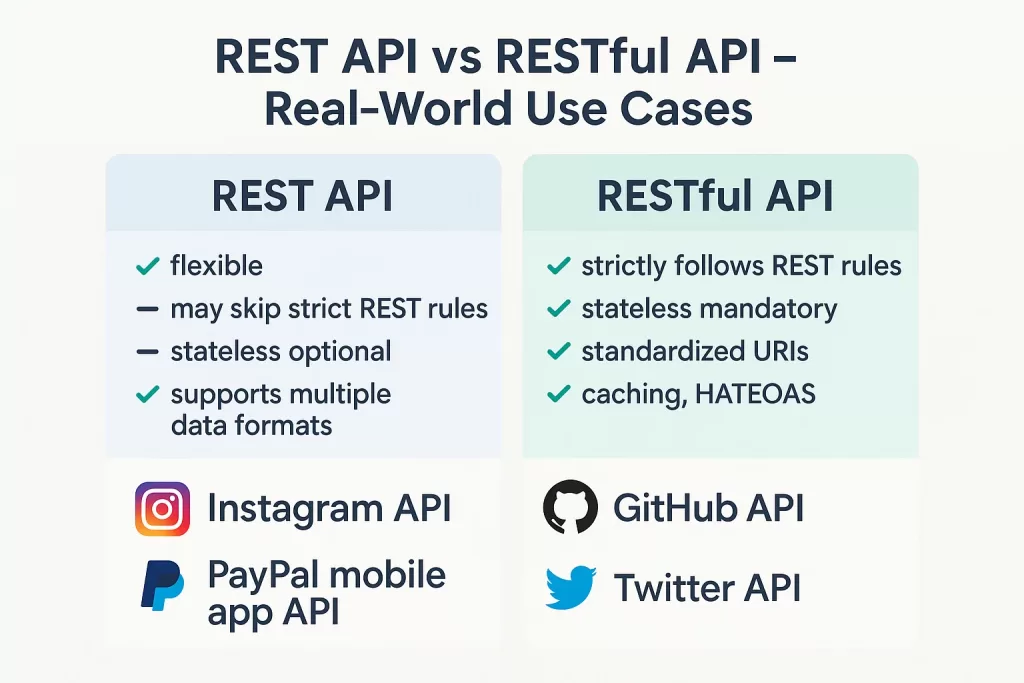
A REST API (Representational State Transfer API) is a web service that follows some principles of REST but doesn’t always implement them all. It’s often flexible, sometimes skipping strict rules depending on project needs.
👉 Example: A startup may build a REST API for their mobile app where responses are in JSON but statelessness isn’t strictly enforced.
✅ Features of REST API
- Can be stateless, but not mandatory.
- Uses standard HTTP methods:
GET,POST,PUT,DELETE. - Supports multiple data formats like JSON, XML, or even HTML.
- Easier and faster to build, offering more design freedom.
🔧 Common Use Cases
- Mobile Apps: Quick client-server communication.
- Prototypes: Faster iterations, not bound by strict REST rules.
- Basic Web Apps: CRUD-based apps with simple interactions.
📌 What is RESTful API?
A RESTful API is an API that fully adheres to all six REST architectural constraints. It doesn’t just borrow REST principles — it implements them strictly.
👉 Example: GitHub API is RESTful — it uses proper resource URIs, enforces statelessness, supports caching, and includes HATEOAS (Hypermedia links to navigate related resources).
✅ Features of RESTful API
- Strictly stateless → every request carries all necessary info.
- Follows client-server separation → UI and backend evolve independently.
- Uses a uniform interface (clear, consistent URIs and methods).
- Supports caching for better performance.
- Implements HATEOAS for discoverability.
🔧 Common Use Cases
- Microservices Architecture → Each service communicates consistently.
- Enterprise Systems → Banking, healthcare, e-commerce platforms.
- Public APIs → Twitter, Google Maps, Stripe.
⚖️ Difference Between REST API and RESTful API
Here’s a REST API vs RESTful API difference table (updated for 2025):
| Feature | REST API | RESTful API |
|---|---|---|
| Definition | Follows REST principles loosely | Fully implements all REST constraints |
| Statelessness | Optional | Mandatory |
| HTTP Methods | Uses common methods, but not always strictly | Strict usage: GET, POST, PUT, DELETE |
| Resource Identification | Flexible URIs | Standardized URIs for each resource |
| Data Format | JSON, XML, HTML, etc. | Typically JSON or XML, consistent |
| Caching | Optional | Explicit caching support |
| HATEOAS | Often skipped | Always implemented |
| Use Cases | Small apps, quick builds, prototypes | Complex apps, microservices, public APIs |
📊 When to Use REST API vs RESTful API
- Use REST API when…
- Building a quick MVP or prototype.
- Flexibility matters more than strict rules.
- Performance demands are moderate.
- Use RESTful API when…
- Building large-scale systems (e-commerce, SaaS, enterprise).
- Consistency, scalability, and caching are critical.
- Working with microservices or APIs meant for public consumption.
💡 Developer Insight: Many developers start with a REST API during the early product stage and migrate toward a RESTful API as the system grows.
🎯 REST API vs RESTful API for Interview (2025 Prep)
Here are some interview questions and answers to help you prepare:
Q1: What is the difference between REST API and RESTful API?
👉 REST API follows REST principles loosely, while RESTful API strictly implements all six REST constraints like statelessness, uniform interface, and HATEOAS.
Q2: Can an API be REST but not RESTful?
👉 Yes. For example, an API may use HTTP methods (like GET/POST) but still maintain session state on the server, making it REST but not RESTful.
Q3: Which is better for microservices: REST API or RESTful API?
👉 RESTful API. Microservices demand standardization, scalability, and caching support — all of which RESTful APIs enforce.
Q4: Give an example of a REST API and a RESTful API.
👉 A custom-built startup mobile app API might be REST (flexible rules). GitHub API and Twitter API are RESTful APIs because they strictly follow REST principles.
Q5: Why do companies prefer RESTful APIs for public services?
👉 Because RESTful APIs ensure consistency, predictability, and scalability — crucial for APIs exposed to thousands of developers worldwide.
📈 2025 Trends: REST API vs RESTful API in Modern Development
- Cloud-Native & Serverless Apps → RESTful APIs dominate due to scalability.
- AI & ML APIs → Often REST-based, but shifting toward RESTful for consistency.
- Microservices → RESTful APIs are the backbone, though GraphQL is growing fast.
💡 According to Statista, over 80% of public APIs in 2025 still rely on RESTful architecture, despite the rise of GraphQL and gRPC.
✅ Conclusion
In interviews, the key takeaway is this:
- A REST API follows REST principles loosely, offering flexibility and speed.
- A RESTful API strictly enforces all REST constraints, making it more reliable, consistent, and scalable.
For small projects or quick builds → REST API works.
For large, complex, or public-facing systems → RESTful API is the smarter choice.
So when you’re asked “What’s the difference between REST API and RESTful API?” — remember: one is flexible, the other is strict. And in 2025, recruiters want candidates who can explain not just the theory, but also the practical use cases.
📚 Related Reads
- What is the Difference Between SOAP and REST?
- What is an API?
- How to Use an API: Beginner’s Guide
- REST API vs Web API: Key Differences