What is FIFO Meaning Full Form, & Easy Examples (Beginner Guide)
Why doesn’t your printer spit out documents in a random order? Why does your online support chat connect you to the next available agent, not just any agent?
The answer is a simple, powerful principle, and understanding the FIFO meaning is the key to seeing how fairness is built directly into technology. The best part? If you’ve ever waited in a line, you’re already an expert.
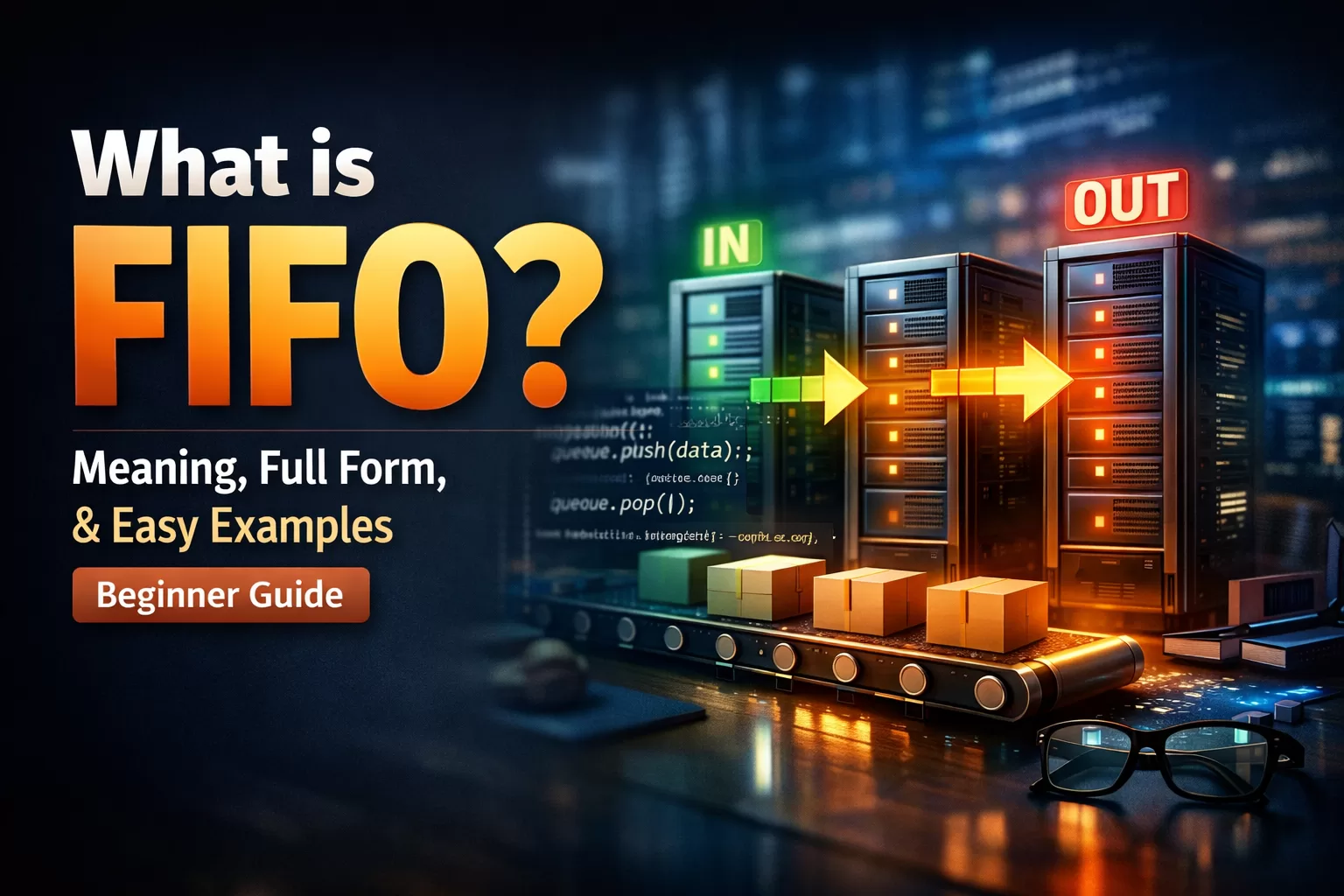
FIFO stands for First In First Out, and it’s the simple rule that brings order to chaos, both in the real world and in the code developers write every day. In this guide, we’ll break down exactly how it works, where it’s used, and why it’s a critical concept for any aspiring tech professional.
FIFO Full Form and FIFO Meaning
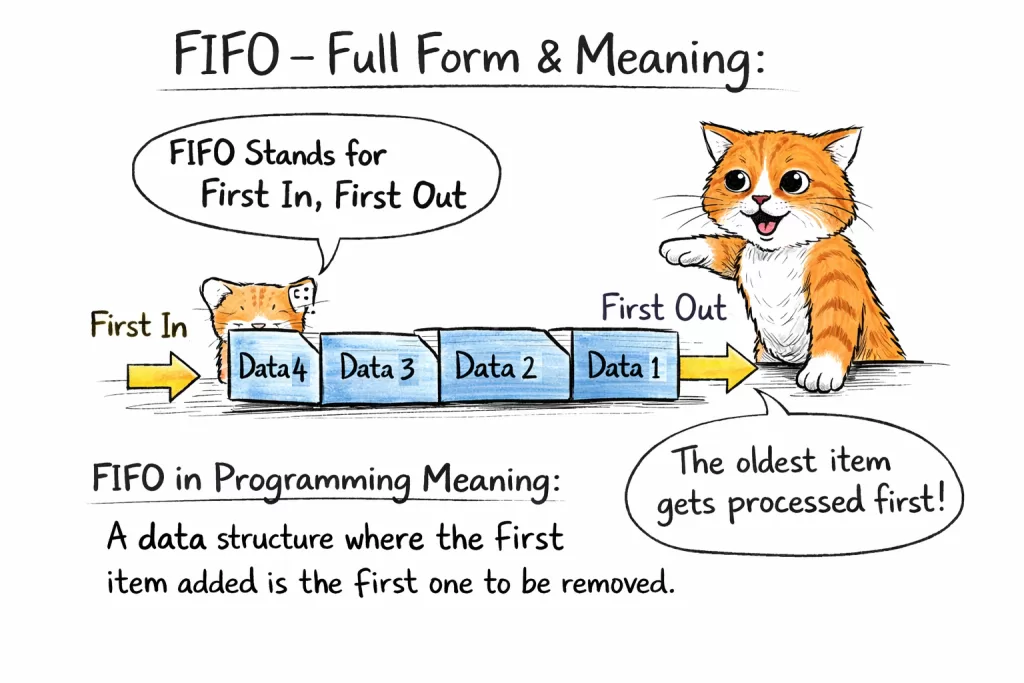
First things first, what does FIFO stand for?
FIFO is an acronym for First In First Out.
The FIFO principle states that the first item that enters a collection is the very first item to leave it. Think of it as the rule of fairness—no one skips the line. The oldest item is always processed before any newer items.
A Quick Note on Context: You might see “FIFO” used in accounting to describe a method for valuing inventory. While it shares the same name, this article focuses exclusively on the FIFO principle in Computer Science and technology.
The Best Real-World Analogy: A Checkout Line 🛒
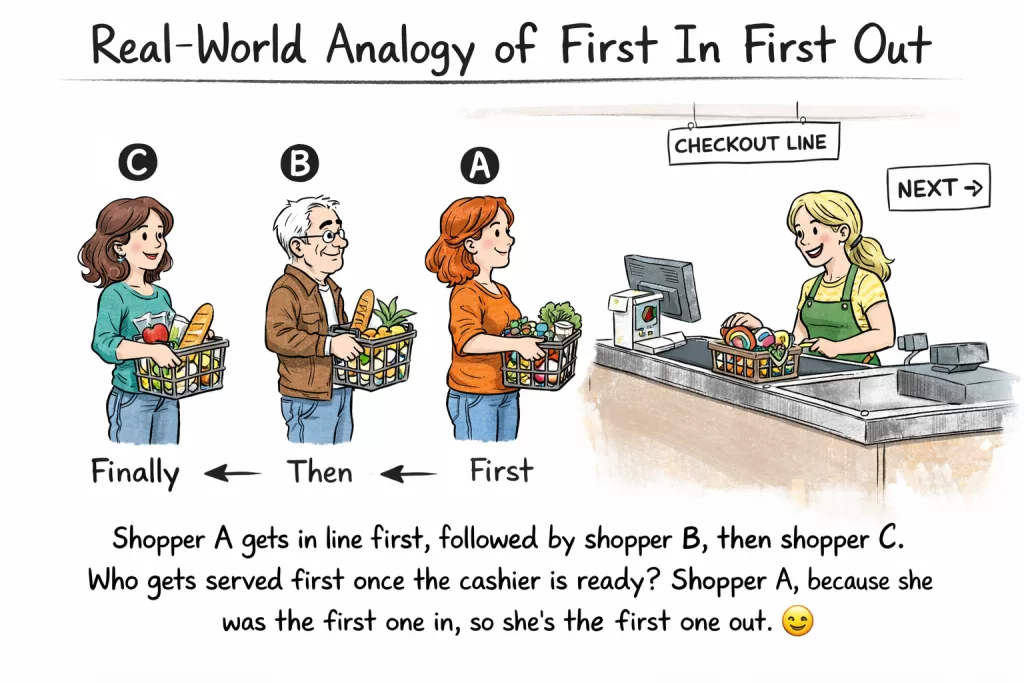
The easiest way to understand FIFO is to picture a checkout line at a grocery store.
- A shopper (let’s call her A) gets in line first.
- A second shopper (B) gets in line behind A.
- A third shopper (C) gets in line behind B.
When the cashier becomes available, who gets served first? A, of course! She was the first one in, so she is the first one out. After A is done, B gets served, and then C.
This is a perfect FIFO example in real life.
Visual Representation of FIFO method:
textA Checkout Line (Queue)<br><br> FRONT (Serving) → [ Anna ] [ Ben ] [ Chloe ] ← REAR (New entries)<br>(First In First Out) (Last-In)
The person at the front (Anna) is served first, while new people join at the rear, maintaining a clear and fair order.
FIFO Principle Explained: The Queue Data Structure
In programming, this “checkout line” concept is implemented using a Queue data structure.
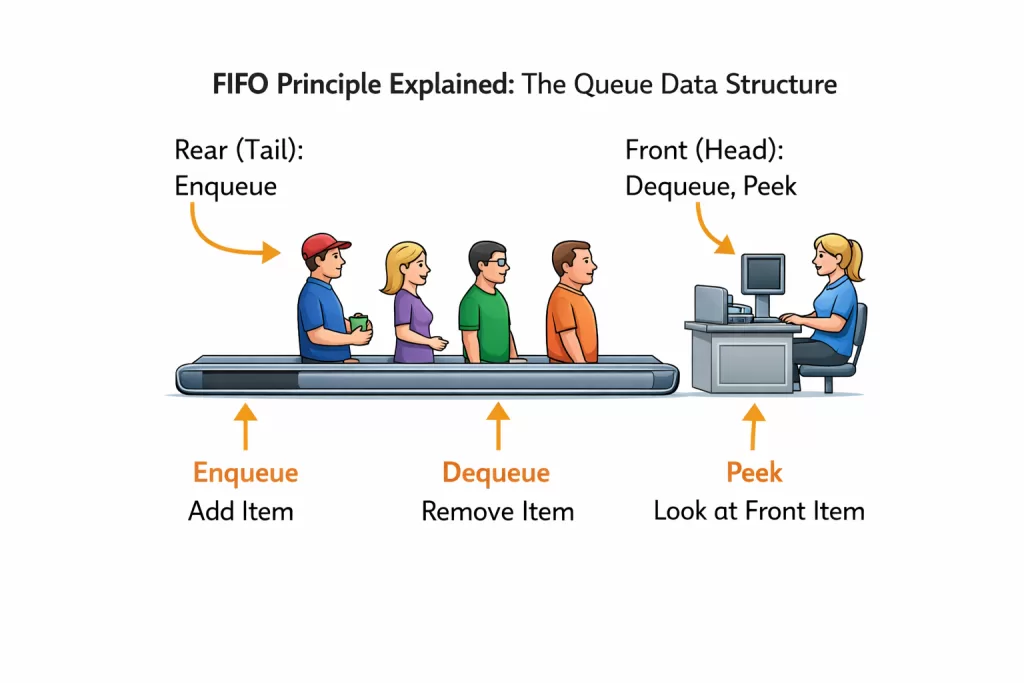
A Queue is a fundamental data structure in computer science that strictly follows the FIFO method. Unlike a Stack (which is LIFO), a Queue has two distinct ends:
- Rear (or Tail): Where new items are added.
- Front (or Head): Where old items are removed.
Programmers use specific operations to manage a Queue:
| Operation | What It Means | Analogy |
|---|---|---|
| Enqueue | Adding a new item to the rear of the Queue. | A new person joining the back of the line. |
| Dequeue | Removing the item from the front of the Queue. | The cashier serving the person at the front. |
| Peek | Looking at the front item without removing it. | Seeing who is next in line without them leaving. |
What is a Queue in Data Structures?
A Queue is a linear data structure that follows FIFO order, where elements are added at the rear and removed from the front. Its primary purpose is to hold items in a sequence while waiting for them to be processed.
For a more detailed breakdown of its implementation, check out our full guide to the Queue Data Structure.
Simple FIFO Example (Code Snippet)
Let’s see how this works with a simple Python code example. Imagine we have a printer handling documents.
Python# Our print queue starts as an empty list
print_queue = []

# Users send documents to the printer. We "enqueue" them.
print_queue.append("Document_A.pdf") # 1st item in (First-In)
print_queue.append("Document_B.jpg") # 2nd item in
print_queue.append("Document_C.docx")# 3rd item in

print(f"Current Print Queue: {print_queue}")
# Output: Current Print Queue: ['Document_A.pdf', 'Document_B.jpg', 'Document_C.docx']

# The printer is ready. It "dequeues" the first document.
# In Python, .pop(0) removes the item at the beginning of the list.
first_document = print_queue.pop(0) # First-Out

print(f"Now printing: {first_document}")
# Output: Now printing: Document_A.pdf

print(f"Remaining Print Queue: {print_queue}")
# Output: Remaining Print Queue: ['Document_B.jpg', 'Document_C.docx']

# The printer finishes and takes the next job
next_document = print_queue.pop(0)

print(f"Now printing: {next_document}")
# Output: Now printing: Document_B.jpg
Notice that Document_A.pdf was the first one added, and it was the first one printed. This is the FIFO method ensuring fairness!
Real-Life FIFO Examples: Where It’s Used in Tech
The FIFO principle is crucial for managing resources and tasks fairly in software and hardware. Here are some key examples:
1. Print Queues 🖨️
As shown in our code example, when you send multiple documents to a printer, they are added to a queue. The printer processes them in the order they were received.
Why FIFO? Because it would be chaotic and unfair if a document you sent an hour ago was printed after one you just sent.
2. Customer Support & Ticketing Systems 🎫
When you submit a support ticket to a company (e.g., through Zendesk or Jira), your request goes into a queue. Support agents typically handle tickets in the order they were created to ensure older issues are addressed first.
Why FIFO? It ensures every customer gets a response in a timely and fair manner based on when they reached out.
3. CPU Task Scheduling & Queue Memory ⚙️
Your computer’s processor (CPU) can only do one thing at a time, but it juggles hundreds of tasks. One of the simplest scheduling strategies used by operating systems follows the FIFO approach. Tasks are stored in queue-like structures in memory, following the FIFO order. This ensures that the first process to request CPU time is the first one to get it, preventing any single process from being starved of resources.
Why FIFO? It’s a simple, predictable, and fair way to ensure that all processes get their turn to run on the CPU.
4. Network Data Packets 🌐
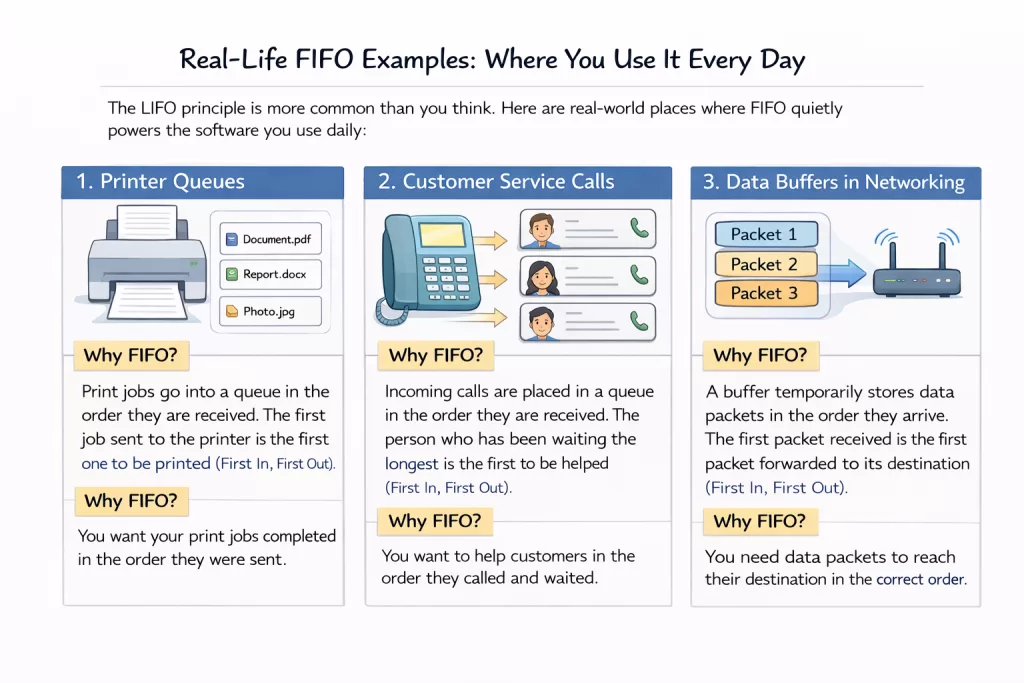
When you stream a video or browse a website, data is sent over the internet in small pieces called “packets.” Routers and switches often use FIFO queues to manage these packets, forwarding them in the order they arrive to prevent data corruption or jumbled messages.
Why FIFO? To reassemble the video or webpage correctly on your device, the packets need to be processed in their original order.
5. Breadth-First Search (BFS) Algorithm 🗺️
In data structures and algorithms, BFS is a famous technique used to explore a graph or tree (like finding the shortest path in a maze or a social network). It works by visiting all the neighbors of a point before moving to the next level, and it uses a queue to keep track of which nodes to visit next.
Why FIFO? The queue ensures that the algorithm explores the graph level by level, guaranteeing that the shortest path is found first.
FIFO vs. LIFO: A Quick Comparison
Now that you’ve mastered FIFO, how does it stack up against its opposite, LIFO? Here’s a quick cheat sheet:
| Feature | FIFO (First In First Out) | LIFO (Last-In, First-Out) |
|---|---|---|
| Order | Oldest item processed first | Newest item processed first |
| Structure | Queue | Stack |
| Analogy | A line at a store | A stack of plates |
| Use Case | Scheduling, print queues, network traffic | Undo/Redo, recursion, browser history |
Both are incredibly useful but for different problems. To see a head-to-head comparison, check out our ultimate guide on LIFO vs. FIFO.
Key Takeaways About FIFO
Let’s recap what we’ve learned about the FIFO principle:
✅ FIFO = First In First Out
✅ Best analogy: A checkout line
✅ Main data structure: Queue in Data Structure and Types of Queue
✅ Core operations: Enqueue (add to back), Dequeue (remove from front)
✅ Real-world uses: Print queues, CPU scheduling, network traffic, customer support tickets
✅ Key advantage: Ensures fairness and maintains the original order of items
Conclusion: FIFO, The Foundation of Fairness 🚀
Congratulations! You now understand FIFO—the principle of fairness that keeps our digital world organized. From printing a document to streaming a movie, FIFO is the silent hero working behind the scenes.
FIFO isn’t just a concept—it’s the foundation of fairness in computing systems.
Understanding when to use a Queue (FIFO) versus a Stack (LIFO) is a fundamental skill for any developer. It’s a question that frequently appears in technical interviews and is a building block for solving more complex problems.
Ready to put this knowledge into practice?
At Kaashiv Infotech, our Data Structures & Algorithms course is designed to take you from theory to practical mastery. We cover FIFO, LIFO, Queues, Stacks, and everything else you need to build efficient software and impress at your next interview. Plus, our internship programs provide the real-world experience to make your resume shine.
👉 Check out our Full Stack Developer Course In Chennai programs and start your journey to becoming a confident, interview-ready developer today!