Square Brackets []: The Critical Key to Data Access in Programming 🗝️
![Square Brackets []](https://www.wikitechy.com/wp-content/uploads/2026/03/Square-Brackets-The-Critical-Key-to-Data-Access-in-Programming-🗝️.webp)
It starts with a red line in the IDE. Then, the console floods with red text. IndexOutOfRangeException. KeyError. TypeError.
You stare at the screen. The logic is perfect. The algorithm is sound. But the program crashes because of a single missing character. You forgot the square brackets.
If you are wondering what is square brackets in the context of coding, you are asking about the fundamental mechanism of data retrieval. While parentheses () control flow and execution, square brackets [] control access and structure. They are the keys to the kingdom of memory.
Search trends and developer forums consistently highlight confusion around square brackets in python versus other languages. Why? Because their behavior shifts depending on the environment. In SQL, they escape names. In C#, they define attributes. In Python, they build lists.
Mastering the square brackets symbol isn’t just about syntax. It is about understanding how computers store information. This guide dives deep into the technical nuances, career implications, and best practices for using [] across the tech stack.
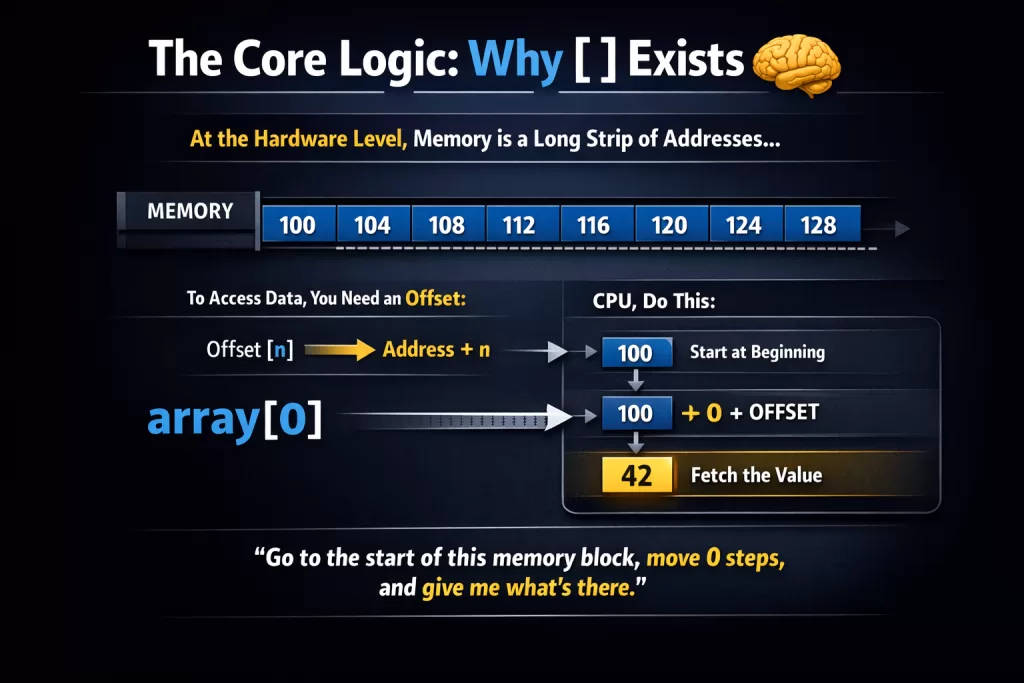
The Core Logic: Why [] Exists 🧠
At the hardware level, memory is a long strip of addresses. To get data, you need an offset. Square brackets provide that offset.
When you write array[0], you tell the CPU: “Go to the start of this memory block, move 0 steps, and give me what’s there.”
The Zero-Based Indexing Debate
Most modern languages (C, Java, Python, JS) use 0-based indexing. The first item is at index 0.
- Math Context: In square brackets in math,
[1, 5]means inclusive (1 to 5 including 1 and 5). - Code Context:
arr[0]is the first element.arr[5]is the sixth.
Developer Insight: This mismatch causes off-by-one errors, which account for a significant portion of logic bugs in junior codebases. Understanding the boundary conditions of square brackets prevents these crashes.
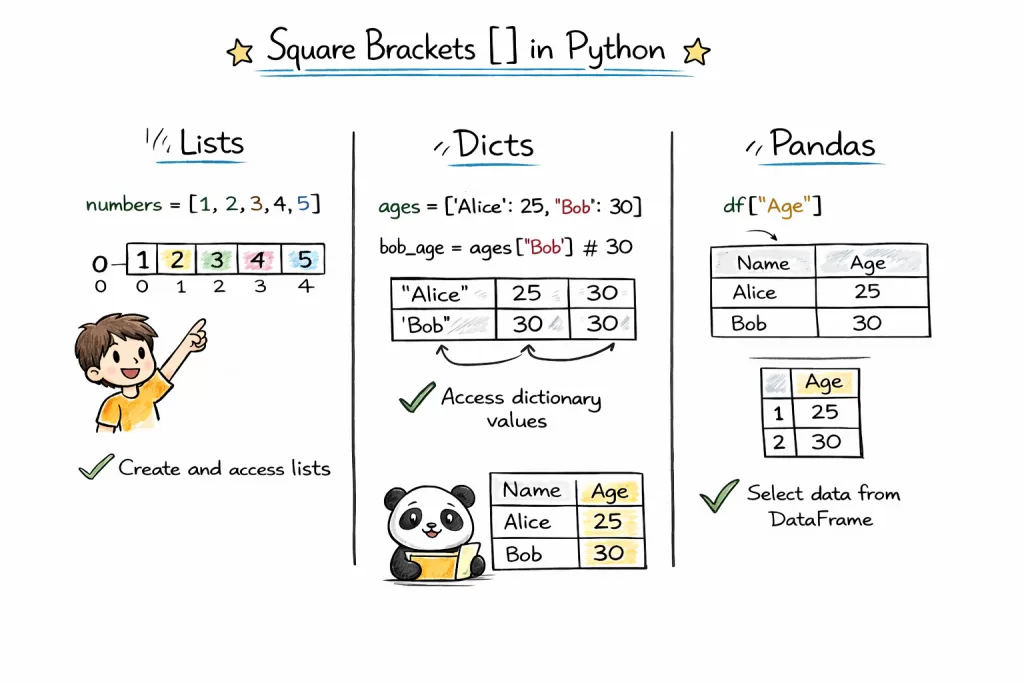
Square Brackets in Python: Lists, Dicts, and Pandas 🐍
Python makes extensive use of square brackets. They are the primary tool for mutable sequences.
1. Lists and Comprehensions
numbers = [1, 2, 3]  # List creation
squared = [x**2 for x in numbers] # List comprehension
Here, square brackets define a list object. They are mutable, meaning you can change contents later.
2. The Pandas Powerhouse
Data engineers live inside square brackets. When using numpy and pandas, the distinction between single and double brackets changes the output type.
import pandas as pd

df = pd.DataFrame({'A': [1, 2], 'B': [3, 4]})

# Single bracket returns a Series (1D)
col = df['A']

# Double bracket returns a DataFrame (2D)
subset = df[['A']]
Critical Best Practice: Always use double square brackets when selecting columns if you plan to perform DataFrame operations later. Single brackets reduce dimensionality, which breaks downstream methods expecting a DataFrame.
3. Accessing Nested Data
JSON-like structures are common in APIs.
data = {'user': {'profile': {'name': 'Alex'}}}
name = data['user']['profile']['name']
Warning: If any key is missing, this chain throws a KeyError. Use .get() for safety, but understand that square brackets demand existence.
JavaScript: Arrays, Objects, and Optional Chaining ⚡
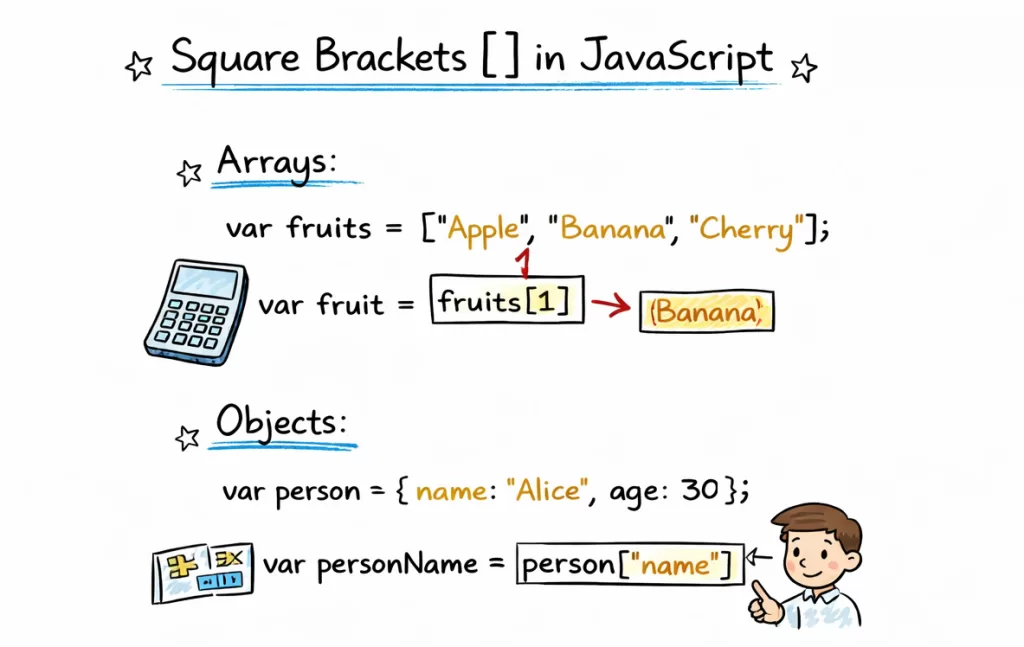
In JavaScript, square brackets offer dynamic access that dot notation cannot.
1. Dynamic Property Access
You cannot use a variable with dot notation.
const key = 'lastName';
const user = { lastName: 'Doe' };

//  Fails
console.log(user.key);

//  Works with square brackets
console.log(user[key]);
This feature powers much of modern framework magic (like React JS State updates).
2. Optional Chaining
Modern JS allows safe access using ?.[].
const city = user?.address?.[0]?.city;
If address is undefined, the expression short-circuits and returns undefined instead of crashing. This reduces boilerplate error checking significantly.
3. Array Methods
Methods like .map() and .filter() return new arrays wrapped in square brackets.
const evens = [1, 2, 3].filter(n => n % 2 === 0); // Returns [2]
Understanding that these methods return new instances (immutable pattern) helps prevent side effects in state management.
Java & C#: Strict Typing and Attributes ☕
Strictly typed languages use square brackets for array declaration and metadata.
Java Arrays
Java separates declaration from instantiation.
int[] numbers;       // Declaration
numbers = new int[5]; // Instantiation with size
numbers[0] = 10;     // Assignment
Performance Note: Java arrays store types directly in memory. Access via numbers[0] is extremely fast (O(1)), but the size is fixed. Resizing requires copying data to a new array (like ArrayList does internally).
C# Attributes
C# uses square brackets for metadata annotations.
[Serializable]
public class User {
    [JsonProperty("user_id")]
    public int Id { get; set; }
}
Here, the square brackets symbol tells the compiler to attach extra information to the class. This drives reflection, serialization, and ORM mapping. Misplacing these brackets can break API endpoints entirely.
SQL: Escaping and JSON Extraction 🗄️
In database queries, square brackets serve a protective role.
1. Escaping Reserved Words (T-SQL)
SQL Server uses square brackets to handle column names that conflict with keywords.
SELECT [Order], [User] FROM [Sales];
Without the brackets, SELECT Order FROM Sales fails because ORDER is a reserved keyword. This is a common pitfall when migrating schemas from MySQL (which uses backticks) to SQL Server.
2. JSON Extraction
Modern SQL supports JSON columns.
SELECT info['key'] FROM users;
This extracts specific values from semi-structured data without parsing the whole string in the application layer. Proper indexing on these JSON keys can improve query performance by 40-50% in data-heavy applications.
Career Angle: Why Recruiters Care About [] 💼
You might think, “It’s just a bracket. How hard can it be?”
Hard enough to filter candidates.
The Interview Reality
- DSA Dominance: Over 60% of technical interview questions involve Arrays or Strings. Both rely heavily on square brackets for manipulation.
- Complexity Analysis: Interviewers watch how you access data. Nested loops with square brackets (
arr[i][j]) often indicate O(n²) complexity. Optimizing to O(n) usually involves changing how you index data. - Bug Frequency: Industry reports suggest that
IndexOutOfBoundserrors are among the top 5 runtime exceptions in production Java and Python applications.
Real-World Impact
Consider a fintech app processing transactions.
- Scenario: An array stores transaction IDs.
- Bug: A loop uses
<=instead of<with square brackets. - Result: The code accesses memory outside the array.
- Consequence: Application crash, failed transactions, user distrust.
Understanding memory bounds isn’t academic. It protects revenue.
Best Practices for Using Square Brackets 🛠️
Write code that humans can read, not just machines.
- Avoid Deep Nesting:
- Bad:
data['user']['profile']['settings']['theme'] - Good: Assign intermediate variables. It makes debugging easier.
- Bad:
- Validate Length:
- Always check
len(array)orarray.lengthbefore accessingarray[index].
- Always check
- Use Constants for Indices:
- Instead of
row[0],row[1], userow[ID_INDEX],row[NAME_INDEX]. Magic numbers inside square brackets are maintenance nightmares.
- Instead of
- SQL Safety:
- Never construct SQL queries using string concatenation with square brackets for user input. Use parameterized queries to prevent injection attacks.
Optimization Stats & Data Hooks 📊
- Memory Locality: Arrays (accessed via
[]) benefit from CPU caching. Linked lists do not. Accessing elements via square brackets can be 10x faster than iterating a linked list due to cache locality. - Refactoring Cost: Code with high cyclomatic complexity often involves excessive conditional checks around array access. Refactoring to use safe access patterns reduces technical debt by an estimated 20% over the project lifecycle.
- Pandas Performance: Using
.loc[]or.iloc[]in Pandas is slower than direct column accessdf[]for simple operations, but safer for complex slicing. Choose based on need.
Conclusion: Don’t Let a Bracket Break Your Build 🚀
The square brackets [] are small, but they carry heavy responsibility. They define lists in Python, access properties in JavaScript, annotate classes in C#, and escape keywords in SQL.
Ignoring their nuances leads to runtime errors, security vulnerabilities, and failed interviews. Mastering them signals to employers that you understand memory, data structures, and safety.
Developers constantly encounter new edge cases. Don’t be a statistic. Write safe, optimized, and clean code.
Ready to master data structures and programming logic?
Theory is good. Practice is better. Kaashiv Infotech offers industry-aligned courses and internships in Python, Full Stack Development, and Data Science.
Get mentorship, work on real projects, and learn how to build systems that don’t crash.
Your code is only as strong as its weakest bracket. Make them count. 💻✨