The Hidden Challenges of Machine Learning: What No One Talks About
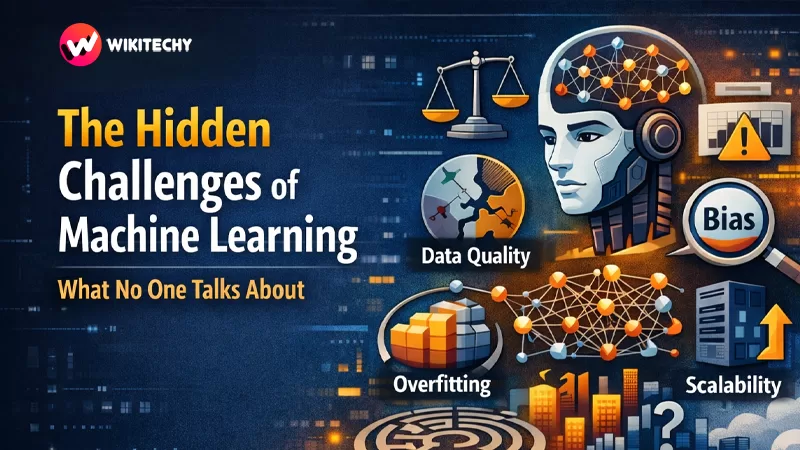
Challenges of Machine Learning – Machine Learning (ML) has become one of the most transformative technologies of the modern era. From personalized recommendations on streaming platforms to fraud detection in banking and predictive analytics in healthcare, ML is deeply embedded in our daily lives. It promises automation, efficiency, and intelligent decision-making at scale.
However, beneath this wave of innovation lies a complex and often overlooked reality. Building and deploying machine learning systems is not just about writing algorithms—it involves navigating a wide range of technical, ethical, and operational challenges. While success stories dominate headlines, the struggles behind the scenes are rarely discussed in depth.
This article explores the hidden challenges of machine learning, offering a comprehensive look at the obstacles that professionals face when turning theory into real-world solutions.
The Hidden Challenges of Machine Learning
The Illusion of Simplicity in Machine Learning
At first glance, machine learning may seem straightforward. With the availability of powerful libraries and frameworks, it is now possible to build models with just a few lines of code. Tools abstract much of the complexity, giving the impression that creating intelligent systems is easy.
In reality, these tools only simplify the surface-level implementation. The deeper challenges—such as selecting the right data, designing effective features, tuning hyperparameters, and ensuring model reliability—require significant expertise and experience. What appears simple in tutorials often becomes highly complex in real-world applications.

Data: The Foundation and the Bottleneck
Data is the backbone of machine learning, but it is also its biggest limitation. High-quality data is essential for building accurate models, yet obtaining such data is rarely easy.
Organizations often struggle with fragmented data sources, inconsistent formats, and missing values. In many cases, data is collected for operational purposes rather than analytical use, which makes it unsuitable for training ML models without extensive preprocessing.
Another major issue is labeling. Supervised learning models require labeled data, which often involves manual effort. This process can be slow, expensive, and prone to human error. In domains like healthcare or legal analysis, labeling requires domain experts, making it even more costly.
Moreover, datasets may not represent real-world diversity. A model trained on limited or biased data can produce skewed predictions, leading to unfair or inaccurate outcomes.
The Challenge of Feature Engineering
Feature engineering is one of the most critical steps in machine learning, yet it is often underestimated. Transforming raw data into meaningful input features requires deep domain knowledge and creativity.
A poorly engineered feature set can severely limit a model’s performance, regardless of how advanced the algorithm is. On the other hand, well-designed features can significantly improve accuracy even with simple models.
The challenge lies in identifying which aspects of the data are truly relevant. This process often involves trial and error, experimentation, and continuous refinement.
Model Selection and Hyperparameter Tuning
One of the fundamental challenges in machine learning is ensuring that a model generalizes well to unseen data. Overfitting occurs when a model memorizes the training data instead of learning underlying patterns. This leads to poor performance in real-world scenarios.
Underfitting, on the other hand, happens when the model is too simple to capture the complexity of the data. In such cases, it fails to perform well even on training data.
Balancing these two extremes requires careful model design, proper validation techniques, and regularization methods. Achieving this balance is often more of an art than a science.

Computational Complexity and Resource Constraints
Modern machine learning, especially deep learning, is computationally intensive. Training large models on massive datasets requires powerful hardware such as GPUs or specialized accelerators.
This creates a barrier for individuals and smaller organizations that may not have access to such resources. Even when resources are available, the cost of training and maintaining models can be significant.
Additionally, long training times can slow down experimentation and innovation. Iterating on models becomes a time-consuming process, which can hinder productivity.

Lack of Interpretability and Transparency
As machine learning models become more complex, they also become harder to interpret. Deep learning models, in particular, are often treated as “black boxes” because their decision-making processes are not easily understandable.
This lack of transparency poses serious challenges in critical domains. For example, if a model denies a loan application or predicts a medical condition, stakeholders need to understand the reasoning behind the decision.
Without interpretability, it becomes difficult to build trust, ensure accountability, and comply with regulatory requirements.
Ethical Concerns and Bias in Machine Learning
Ethical challenges in machine learning are gaining increasing attention. Models trained on biased data can perpetuate and even amplify existing inequalities.
For instance, a hiring algorithm trained on historical data may favor certain groups over others if past decisions were biased. Similarly, facial recognition systems have shown varying levels of accuracy across different demographics.
Addressing these issues requires more than just technical solutions. It involves ethical considerations, diverse datasets, and continuous monitoring to ensure fairness.

Privacy and Data Protection
Machine learning systems often rely on sensitive data, raising concerns about privacy and security. With strict data protection regulations emerging worldwide, organizations must ensure that user data is handled responsibly.
Techniques such as anonymization, encryption, and federated learning can help protect data, but they also introduce additional complexity. Balancing model performance with privacy requirements is a challenging task.
Deployment: The Real Test Begins
Building a model in a controlled environment is only the beginning. Deploying it in a real-world setting introduces a new set of challenges.
Production environments require models to handle real-time data, scale efficiently, and integrate seamlessly with existing systems. Issues such as latency, reliability, and fault tolerance become critical.
Moreover, deploying machine learning models often requires collaboration between data scientists, software engineers, and DevOps teams, which can add complexity to the process.

Model Drift and Continuous Maintenance
Machine learning models are not static. Over time, the data they rely on can change, leading to a decline in performance—a phenomenon known as model drift.
For example, user behavior, market trends, or environmental factors may evolve, making the model’s assumptions outdated. To address this, models need to be continuously monitored and retrained.
Maintaining machine learning systems is an ongoing process that requires infrastructure, automation, and consistent evaluation.
Scalability and Real-Time Processing

Scaling machine learning systems to handle large volumes of data is a significant challenge. A model that performs well on a small dataset may struggle when applied to millions of users or transactions.
Real-time applications, such as recommendation systems or fraud detection, require low-latency predictions. Achieving this level of performance demands optimized algorithms and robust infrastructure.
Balancing scalability with efficiency is a key concern for organizations deploying ML at scale.
Talent Shortage and Skill Gap
Machine learning is a multidisciplinary field that requires expertise in mathematics, statistics, programming, and domain knowledge. Finding professionals with the right skill set is not easy.
Even experienced practitioners must continuously update their knowledge due to the rapid pace of advancements in the field. This creates a persistent skill gap that organizations must address through training and development.
Integration with Business Goals

One of the most overlooked challenges is aligning machine learning projects with business objectives. Not every problem requires a machine learning solution, and implementing ML without a clear purpose can lead to wasted resources.
Organizations must ensure that their ML initiatives deliver tangible value. This involves defining clear goals, measuring performance, and continuously evaluating impact.
The Human Factor in Machine Learning
Despite its name, machine learning still relies heavily on human input. From data collection and labeling to model design and evaluation, human decisions shape every aspect of the process.
Human biases, errors, and assumptions can influence outcomes, making it important to approach ML development with awareness and responsibility.
Conclusion
Machine learning is a powerful technology with the potential to reshape industries and improve lives. However, it is not without its challenges. From data-related issues and computational demands to ethical concerns and deployment complexities, the journey of building effective ML systems is filled with obstacles.
Understanding these challenges is essential for anyone working in the field. It helps set realistic expectations, encourages responsible practices, and ultimately leads to better outcomes.
The true strength of machine learning lies not just in its capabilities, but in how well we address its limitations. By acknowledging the “other side of the coin,” we can build systems that are not only intelligent but also reliable, fair, and impactful.
Kaashiv Infotech Offers, Full Stack Python Course, Data Science Course, & More, visit their website www.kaashivinfotech.com.
Related Reads: