UCI Machine Learning Repository: The Ultimate Guide

The UCI Machine Learning Repository is one of the most well-established and widely used collections of datasets in the world of machine learning and data science. Since its origins, it has played a foundational role for learners, educators, and researchers seeking real, well-documented data to experiment with machine learning algorithms and develop new models.
📌 What Is the UCI Machine Learning Repository?
The UCI Machine Learning Repository (often simply called UCI ML Repository) is a publicly available archive of datasets that support empirical research and learning in machine learning. It is hosted by the University of California, Irvine, and makes data freely available without requiring any login or payment.
Unlike many other data sources, UCI focuses specifically on datasets suited for machine learning — meaning data that can be used for classification, regression, clustering, anomaly detection, and other core ML tasks.
📜 A Brief History
The repository started in 1987 as an FTP archive created by David Aha, a PhD student at the University of California, Irvine. What began as a small collection of datasets quickly grew into a rich resource that has been used worldwide in both academic research and practical machine learning workflows.
Over the decades, numerous contributors — including students, researchers, and librarians — have helped expand and maintain the repository. Today, the collection contains hundreds of datasets across varied domains.
🌟 Why Is It So Widely Used?
1. Rich Variety of Datasets
UCI offers data for nearly every core machine learning category:
- Classification (assigning categories to data)
- Regression (predicting continuous values)
- Clustering (grouping without predefined labels)
- Time-series and sequential tasks
- Anomaly / outlier detection
This broad coverage means that beginners and advanced users alike can find data that matches their interests and project goals.
2. Clean, Standardized Formats
Most datasets are provided in accessible formats like CSV, ARFF, or simple text files. These are compatible with common tools such as Python, R, Weka, and MATLAB, letting you spend more time learning and less time formatting.
3. Detailed Metadata

Each dataset typically comes with a metadata page describing:
- What the dataset represents
- The meaning of features (columns)
- The source and context of the data
- The intended use cases
This documentation helps users understand the data before they begin working with it, improving model design and experimentation.
4. Benchmarking Standard
Because so many studies and tutorials have used UCI datasets over the years, they serve as benchmark tasks against which new algorithms can be compared. This allows researchers to evaluate improvements relative to known standards.
5. Open and Free
There are no costs, registrations, or subscriptions required to download and use the data. This open access makes UCI a go-to educational tool for students around the world.
📊 What Kinds of Datasets Are Available?
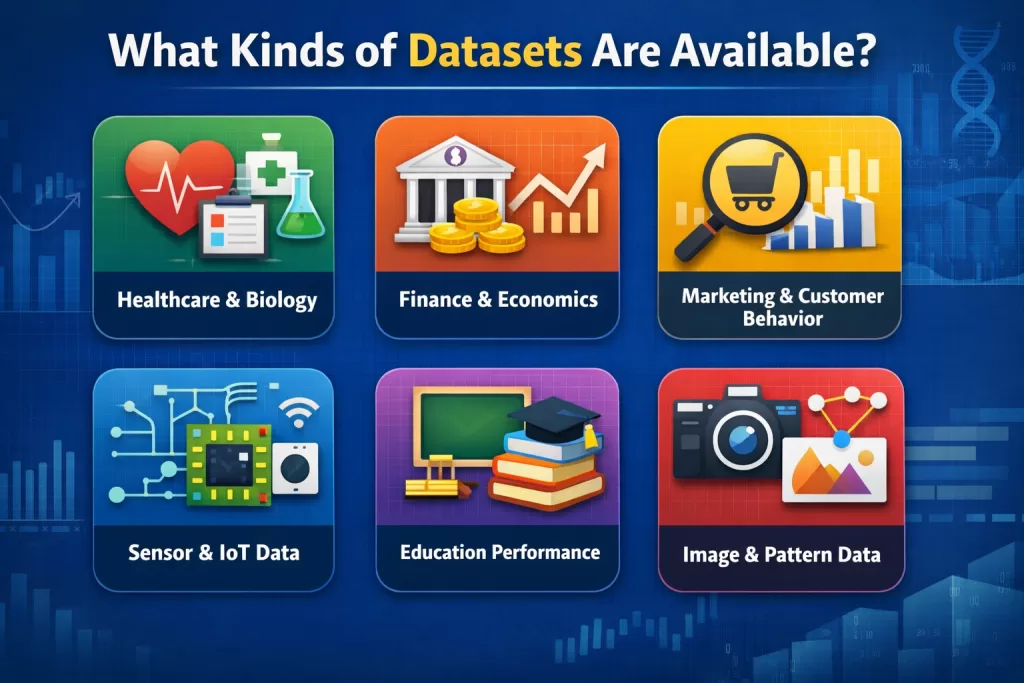
The repository spans a wide array of real-world domains such as:
- Healthcare and biology
- Finance and economics
- Marketing and customer behavior
- Sensor and IoT data
- Education performance
- Image and pattern data
Some of the most well-known datasets include:
🌼 Iris Dataset
One of the oldest and simplest classification datasets — used to predict iris flower species based on petal and sepal measurements.
👥 Adult (Census Income)
Often used for binary classification: classifying whether a person’s income exceeds a certain threshold based on demographic features.
❤️ Heart Disease
Medical data used to predict the presence or absence of cardiovascular disease.
🍷 Wine Quality
Regression and classification datasets based on chemical properties of wine samples.
These examples show how UCI combines both simple educational datasets and more complex real-world data.
🧠 How to Use the Repository

Using UCI datasets is straightforward and beginner-friendly:
Step 1: Visit the Official Website
Go to the UCI Machine Learning Repository homepage to browse available datasets.
Step 2: Search or Filter
You can search by dataset name, domain, type of task, number of features, or size. Many learners find filtering by task (e.g., classification) helpful.
Step 3: View Dataset Details
Click a dataset name to see full documentation — including attribute descriptions and recommended uses.
Step 4: Download the Data
Datasets usually come as downloadable files in CSV or ARFF format, often with accompanying documentation (like README files).
Step 5: Load and Analyze
Once downloaded, you can load the data into tools like Python (pandas), R, Weka, or MATLAB and begin exploring or building machine learning models.
🚀 Tips for Getting the Most Out of UCI
- Start small: For beginners, start with simple datasets (like Iris) before moving to larger ones.
- Review metadata: Always read the feature descriptions and dataset context to avoid misinterpretations.
- Benchmark experiments: Compare your model’s performance with known results to assess progress.
- Combine tools: Use Python, R, or Weka depending on your comfort for deeper exploration.
🔍 Limitations & Considerations

While UCI is incredibly useful, it has a few constraints:
- Mostly structured data: There’s limited support for unstructured formats like raw images or audio.
- Dataset sizes: Many datasets are small or medium in size, which might not suffice for very large deep learning tasks.
- Search experience: The browsing interface is functional but can feel dated compared to modern data platforms.
Despite these limitations, UCI remains a pillar in the machine learning ecosystem thanks to its breadth and history.
📌 Summary
The UCI Machine Learning Repository is:
✅ One of the oldest and most trusted sources of ML datasets
✅ A free, public, and well-documented archive
✅ Useful for education, research, benchmarking, and experimentation
✅ Home to datasets spanning numerous domains and task types
Whether you’re a beginner starting with classification, an educator preparing assignments, or a researcher benchmarking cutting-edge models, UCI provides a timeless collection of data to support your journey.
Conclusion
The UCI Machine Learning Repository continues to stand as one of the most trusted and influential resources in the field of machine learning. With its vast collection of well-documented datasets, open accessibility, and long-standing academic credibility, it has become a foundational tool for students, educators, researchers, and industry professionals alike. From beginner-friendly datasets like Iris to more complex real-world datasets used for benchmarking advanced algorithms, UCI offers something valuable for every stage of the learning journey.
Even in an era filled with modern data platforms and massive big-data repositories, UCI remains relevant because of its simplicity, reliability, and educational focus. It not only helps users practice building and evaluating models but also fosters experimentation and innovation. If you’re serious about learning machine learning or improving your model development skills, exploring and working with datasets from the UCI Machine Learning Repository is a powerful and practical step forward.
Kaashiv Infotech Offers, Full Stack Python Course, Data Science Course, & More, visit their website www.kaashivinfotech.com.
Related Reads: