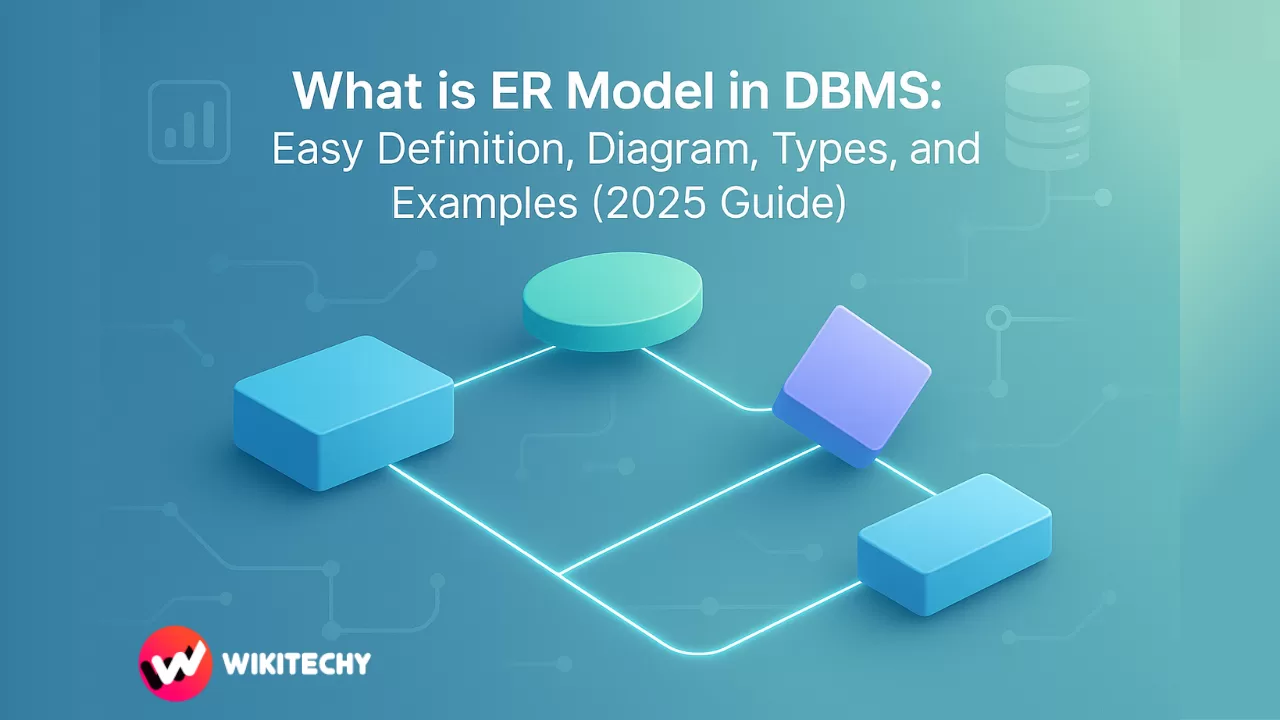
What is ER Model in DBMS: Easy Definition, Diagram, Types, and Examples (2025 Guide)
Have you ever looked at a chaotic set of client requirements or messy notes on a college project and thought, “Where do I even begin?” That’s some variation of the issue the ER Model in DBMS was developed to deal with.
Most projects never actually fail due to SQL being difficult—they failed because the design itself was broken on day 1. Gartner even has reports claiming that 70% of data migrations crash because of poor schema planning.
For this reason, the ER Model in DBMS is more than just a classroom diagram—it’s the schematic that will dictate whether or not your database scales or implodes. In this guide, we will show you not only what it is, but also why it’s important and how developers actually apply it in the real world.
🔑 Key Highlights
- The ER model in DBMS is the basis of database design and is utilized by developers, DBAs, and data engineers in every corner of the world.
- Learn what is ER Model in DBMS, its components, types, and diagrams—with real-world examples.
- Discover how strong entities, weak entities, attributes, and relationships shape your database.
- We will cover cardinality and participation constraints, enhanced or extended ER models, and discuss why those matter in the context of real-world projects.
- Practical insights + career-oriented guidance for anyone who is learning about DBMS for a potential career in software development, data science, or system design.
What is ER Model in DBMS? 🤔
If you’ve ever built an application, you know this: data is messy until you model it right. This is where the ER Model in DBMS comes in.
More simply, The purpose of an Entity–Relationship Model (ER Model) is to provide a conceptual design for databases. You don’t start building tables and writing SQL. Instead, you step back and try to conceptualize what data exists, how the data relates, why the data is being created or stored.
Think of it this way:
- Entities = the “nouns” of your system (Student, Course, Employee).
- Attributes = the details that describe them (StudentID, Name, DOB).
- Relationships = the “verbs” that link the entities together (Student enrolls in Course).
📌 Fun fact: The ER Model was first introduced by Peter Chen in 1976. Almost 50 years later, it’s still the most taught database design method in computer science courses and job interviews.
Why Should You Care About ER Diagrams in DBMS?
Here’s the truth: most of the new developers just skip or avoid this, and regret it later.
Without an ER Diagram, you might end up doing the following:
- Duplicating your data (hello, redundancy 👀).
- Missing constraints (like a student with two identical roll numbers).
- Struggle with major issues when scaling your system.
ER Diagrams make your database clean, scalable, and understandable. It’s part of the reason why companies like Netflix, Amazon, and even your college’s ERP system rely on conceptual modeling before writing queries.
💡 Pro Tip from a Developer: If you’re going into a DBMS interview, as a preliminary task on some “design a database” questions, you will often be asked to model an ER Diagram on a whiteboard.
Components and Symbols of ER Model in DBMS
When making an ER Diagram, you will be using a number of shapes. Take a quick look at what’s what.
- Rectangle → Entity
- Ellipse → Attribute
- Diamond → Relationship
- Line → Connects entities and relationships
- Double Rectangle → Weak entity
- Double Ellipse → Multivalued attribute
👉 Tip: Always label clearly. A messy ER diagram is worse than no diagram at all.

Entities and Entity Sets
You already know entities are “things.” But in DBMS:
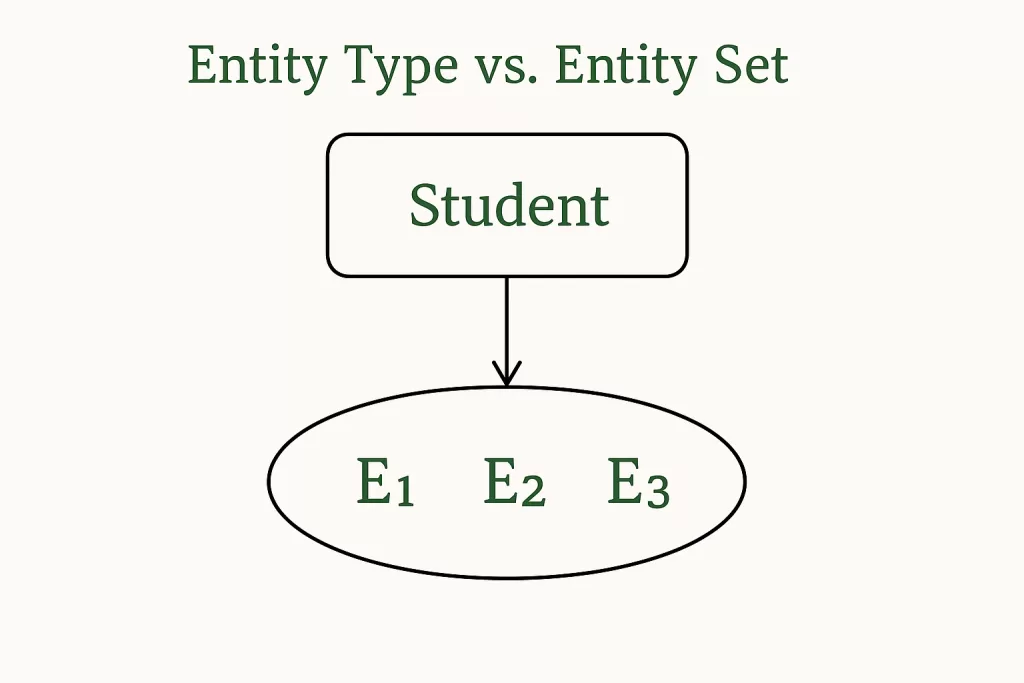
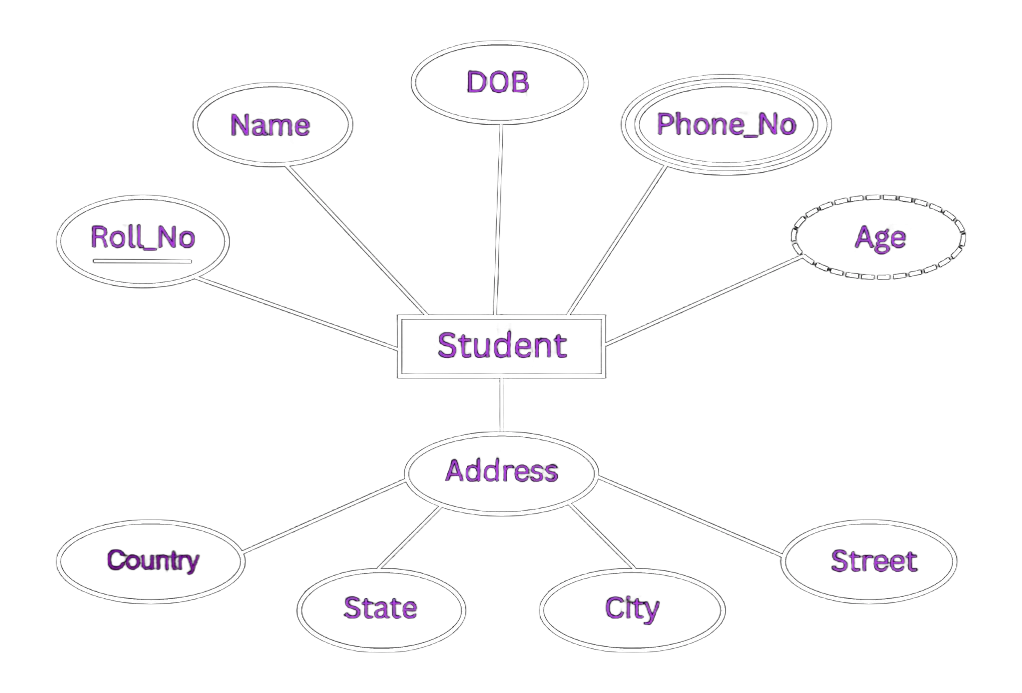
- An Entity Type defines the structure (e.g., Student has Roll_No, Name, DOB).
- An Entity Set is a group of all instances (all students in a university).
So think of Entity = Class and Entity Set = Objects in OOP. Same vibe.
Types of Entities in DBMS
- Strong Entity
- Independent, has a primary key.
- Example: Employee(EmployeeID).
- Weak Entity
- No unique identifier, depends on a strong entity.
- Example: Dependent(Name, Relation) depends on Employee.
- Weak entity types are represented by double rectangles.
👨💻 Real-world: In a payroll system, Employee is strong, Payslip may be weak because it’s tied to the employee.

Attributes in ER Model
Attributes describe entities and can have names like the following:
- Key Attribute: Unique (Roll_No).
- Composite Attribute: Breakable (Address → City, State).
- Multivalued Attribute: Can store many values (Phone Numbers).
- Derived Attribute: Calculated (Age from DOB).
💡 Best practice: Never store derived attributes unless performance demands it. Derive attributes from other attributes whenever possible. Very rarely is a derived attribute ever warranted to be stored. Storing Age separately is a classic rookie mistake because it changes every year. Store DOB instead.
Relationships in ER Model
Relationships connect entities.
Example: Student — Enrolled in → Course.
- Relationship Type → the rule (Enrolled in).
- Relationship Set → all instances (S1 in C1, S2 in C3, etc.).
Degree of Relationships
- Unary (1 Entity): Employee manages Employee.
- Binary (2 Entities): Student is enrolls in Course.
- Ternary (3 Entities): Doctor treats Patient at Hospital.
- N-ary: More than three (rare, often broken down into multiple binary).
Cardinality in ER Model
Used to establish the number of entities that can participate:
- 1:1 → A person has one passport.
- 1:N → A department has many employees.
- N:1 → Many students belong to one college.
- M:N → Students enroll in multiple courses, and courses have multiple students.
👉 Always define cardinality, or your schema will break later.
Participation Constraints
Whether or not an entity must participate is important – this means we have to distinguish between total participation and partial participation:
- Total Participation (||): Every entity participates. Example: Every student must enroll in at least one course.
- Partial Participation (|): Optional. Example: Not every employee has dependents.
Enhanced and Extended ER Model in DBMS
In the traditional ER Model we typically only demonstrate entities, relationships, and attributes.
- Enhanced ER (EER): Adds specialization, generalization, inheritance. Example: Employee → Full-time vs Contract.
- Extended ER (EERM): Adds object-oriented concepts, categories, and more advanced constraints.
These appear in advanced DBMS courses and are useful in enterprise systems.
Features of ER Model in DBMS
- Visual, intuitive, easy to explain to non-tech stakeholders.
- Converts to relational schema without headaches.
- Helps avoid redundancy and anomalies.
- DBMS-independent.
How to Draw an ER Diagram (Step by Step)
- Identify entities.
- Define relationships.
- Add attributes.
- Assign primary keys.
- Apply cardinality and constraints.
- Review for redundancy.
🛠 Tools you can use:
- Free: draw.io, Lucidchart
- Paid: ER/Studio, IBM Data Architect
Real-World ER Model Examples in DBMS
Example 1: Student–Course Database
- Student(StudentID, Name, DOB)
- Course(CourseID, Title)
- EnrolledIn(StudentID, CourseID) — Many-to-Many
Example 2: Company HR Database
- Employee(EmpID, Name, Email)
- Dependent(Name, Relation) — Weak Entity
- Department(DeptID, DeptName)
- WorksIn(Employee, Department) — One-to-Many
Advantages and Limitations of ER Model
✅ Advantages
- Clear structure.
- Easy to teach and explain.
- Maps directly to relational schema.
❌ Limitations
- Doesn’t handle time-varying data well.
- Can’t model procedures or dynamic behavior.
- Gets messy in very large systems.
❓ FAQs on ER Model in DBMS
Q1. What is ER Model in DBMS with Example?
The ER Model in DBMS is a conceptual framework that visually represents how data relates to each other in a system. It uses entities (objects), attributes (properties), and relationships (connections) to map requirements before implementation.
Example: In a university database, the Student entity connects with the Course entity through the Enrollment relationship. This helps avoid redundancy and ensures consistency before moving to relational tables.
Q2. Who Developed ER Model?
The ER Model was introduced by Peter Chen in 1976. His paper “The Entity-Relationship Model: Toward a Unified View of Data” is considered a landmark in database research. Chen’s model became the foundation for modern DBMS design, influencing how relational databases are structured even today.
Q3. Difference Between ER Model and Relational Model?
The ER Model is about conceptual design—a high-level view of entities and their relationships. It doesn’t worry about tables or SQL yet.
The Relational Model, introduced by E.F. Codd, is about implementation. It converts entities into tables, attributes into columns, and relationships into keys. Developers typically design with ER first, then map it into the relational model for execution.
Q4. What is the Enhanced ER Model in DBMS?
The Enhanced ER (EER) Model extends the basic ER model by adding advanced concepts like specialization, generalization, and aggregation. These allow you to capture inheritance and business rules more naturally. For example, an Employee entity can specialize into Manager or Engineer. EER is used in complex systems like healthcare and finance where plain ER diagrams aren’t enough.
Q5. What is the Extended ER Model in DBMS?
The Extended ER Model goes one step further by introducing features such as multi-valued attributes, composite keys, and temporal data handling. It adapts ER modeling to modern database needs like big data and NoSQL integration. Developers rely on extended models when a system must support advanced constraints or integration with non-relational formats (e.g., JSON, XML).
Final Thoughts 💭
If you’re starting in DBMS, don’t skip the ER Model in DBMS. It’s not just an academic concept—it’s the way real developers think before writing code. Companies pay more attention to engineers who can model data well because that skill saves time, reduces bugs, and scales better.
If you are new to DBMS or just starting, do not overlook the ER Model in DBMS. It is not just an academic topic; it is how real developers think before they begin writing code. Companies value engineers who can visualize and model data, because modeling data well saves development time, reduces bugs, and supports scale.
If you are studying for a DBMS exam or preparing for a job interview as a developer, ER diagrams will make you more competitive.
📖 Related Reads
- Normalization in DBMS: 1NF, 2NF, 3NF — A practical 2025 guide that dives into how to clean up redundancy and organize data efficiently, with real-life developer insights and measurable outcomes.
- Bayes Rule in Artificial Intelligence: The Beginner’s Guide to Smarter AI in 2025 — Covers why Bayes’ theorem isn’t just theory but a powerful tool in AI systems, explained with relatable analogies and developer best practices.
- Camel Case vs Pascal Case: Clear Guide for Developers in 2025 — A solid breakdown of naming conventions across languages, explaining when and why each style matters in real coding projects.
- Amazon Web Services (AWS) Explained in 2025: 7 Reasons Why AWS Cloud Still Dominates — Offers insight into key AWS services, architecture, and real-world use cases—helpful context if your database ends up powering cloud-hosted systems.