⚡ What Is Flask in Python? Discover the Game-Changing Framework Behind Fast Web Apps (2025)
The Web Needs Speed — and Python Answered with Flask
If you’ve ever wondered what is Flask in Python — and why you need it to begin with — you’re in the right place.
In a world where users abandon apps that take more than a few seconds to load, performance and simplicity are everything. Every tap on your phone triggers a thousand invisible connections — to APIs, servers, and databases. Each of those requests passes through a web framework, the invisible engine that connects users to the backend logic powering their experience.
That’s where Flask comes in.
Not all frameworks are created equal. Some are heavy-duty powerhouses (like Django), while others are designed to be lean, fast, and flexible — and that’s exactly where Flask shines.
Flask is a lightweight web framework for Python that lets developers build modern web apps, RESTful APIs, and interactive dashboards without unnecessary complexity. It’s fast, modular, and incredibly adaptable — which is why it’s trusted by startups, AI engineers, and even NASA for internal tools.
In today’s era of microservices, AI-driven APIs, and cloud-native deployment, Flask’s blend of simplicity and speed makes it one of the most important Python frameworks to master in 2025.
🔥 Key Highlights 🔍
- Understand what Flask is in Python — and how it differs from other web frameworks.
- Discover what Flask is used for — from AI APIs to data dashboards.
- Learn how to install Flask and create your first app in minutes.
- Explore how Flask powers real-world applications at scale.
- Get pro career insights on why Flask mastery boosts your developer journey.
⚙️ What Is Flask in Python? (Simple Definition + History)
Flask framework is an open-source micro web framework for Python, designed to make web development fast, simple, and scalable.
It was created by Armin Ronacher in 2010 as a fun project — but it soon evolved into one of Python’s most loved tools. The idea was simple: build a framework that gives developers all the essentials — routing, request handling, templates — and nothing they don’t need.
Unlike Django (which is full-stack), Flask follows the “micro” philosophy — you start small and add components as your app grows. That’s why it’s often called “Python’s lightweight powerhouse.”
💡 Analogy:
Think of Flask as Lego blocks — you choose what to build, how big to build, and which pieces to add. No unnecessary baggage.

🚀 Why Flask Became So Popular
Flask’s simplicity is its superpower. While other frameworks dictate structure, Flask says: “You decide.”
Here’s why developers love it:
- Minimalist by Design: You can create a working web app in under 10 lines of code.
- Flexible Architecture: No rigid rules — integrate only what your project needs.
- Massive Community Support: Thousands of plugins and extensions for authentication, databases, APIs, etc.
- Built for APIs and Microservices: Perfect for AI, IoT, and data-driven web systems.
💬 “Flask lets you start small — but scale big.”
Today, Flask is used by Netflix, Lyft, Pinterest, Reddit, and Airbnb for internal tools and APIs.

🌐 What Is Flask Used For
Flask’s magic lies in versatility. It’s not just for web pages — it’s for building the backend of the future.
Here’s where you’ll see it in action:
💻 1. RESTful APIs & Microservices
Flask’s lightweight design makes it perfect for APIs that connect apps, IoT devices, or mobile frontends.
Example: AI companies deploy their models via Flask APIs for real-time predictions.
📊 2. Data Dashboards & Analytics Tools
The Flask framework integrates easily with Pandas, NumPy, and Plotly — powering dashboards for finance, logistics, and machine learning insights.
🤖 3. Machine Learning Model Deployment
Data scientists use Flask to serve ML models trained in scikit-learn or TensorFlow, making predictions available over the web.
🧠 4. Prototyping & Startups
For startups testing ideas, Flask’s small footprint means faster builds and cheaper hosting.
🏢 5. Enterprise Automation Tools
Companies use Flask internally for HR dashboards, monitoring tools, and workflow systems.
💡 Fun fact: NASA built internal data tools with Flask to visualize mission telemetry before migrating to cloud-native dashboards.
🧩 How to Install Flask in Python (Step-by-Step)
You don’t need anything fancy — just Python and pip.
1️⃣ Install Flask:
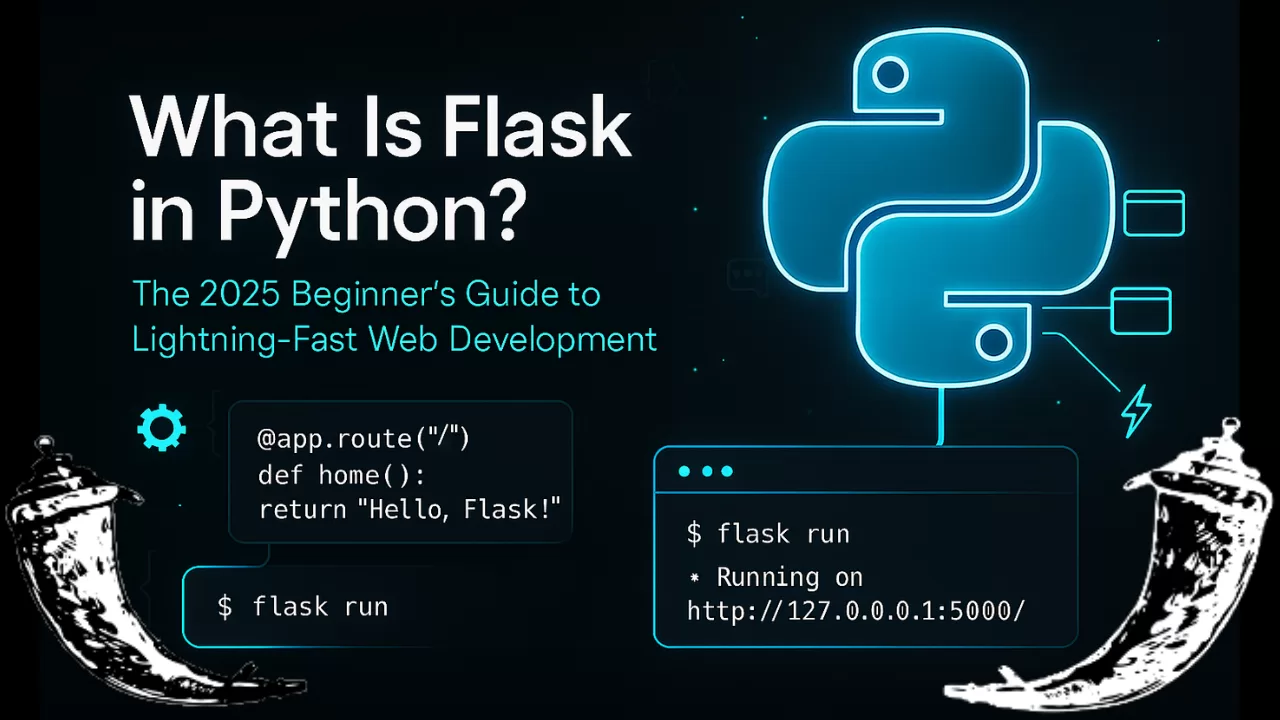
pip install Flask
2️⃣ Create a file app.py:
from flask import Flask
app = Flask(__name__)

@app.route('/')
def home():
    return "Hello, Flask World!"

if __name__ == '__main__':
    app.run(debug=True)
3️⃣ Run your app:
python app.py
4️⃣ Visit your browser:
Go to http://127.0.0.1:5000/ — you’ll see your first Flask app running! 🎉
💡 Pro tip: Flask automatically reloads your app whenever you save changes if debug=True — perfect for beginners.
🧱 Flask framework vs Django: The Battle of Python Frameworks
| Feature | Flask | Django |
|---|---|---|
| Type | Micro-framework | Full-stack framework |
| Setup | Minimal, quick | Pre-built structure |
| Flexibility | High — build your own way | Low — convention-based |
| Ideal For | APIs, prototypes, microservices | Enterprise-level apps |
| Learning Curve | Easy for beginners | Moderate |
💡 Quick summary:
Use Flask when you want flexibility and speed.
Use Django when you want structure and pre-built components.
🌍 Real-World Examples of Flask in Action
- Netflix: Uses Flask APIs for internal automation tools.
- Reddit: Early versions of Reddit’s backend used Flask before scaling up.
- Pinterest: Built internal data monitoring dashboards with Flask.
- Lyft: Uses Flask for microservices in its real-time ride-tracking architecture.
Flask proves that “small” doesn’t mean “weak.” In the right hands, it powers billion-dollar systems.
💼 Career Tip: Why Learning Flask in 2025 Is a Smart Move
If you’re starting your Python or web development career, Flask is your fast track.
Here’s why recruiters love it:
- It shows you understand backend logic, APIs, and web protocols.
- It’s used in AI deployment, full-stack development, and DevOps.
- Mastering Flask opens doors to Django, FastAPI, and cloud-native frameworks.
💬 Stat insight: According to Stack Overflow’s 2025 survey, 41% of Python web developers listed Flask as their first or second choice for new projects.
🎯 Pro insight:
Once you’ve mastered Flask, tools like FastAPI will feel natural — same philosophy, faster performance.
🧠 Flask + Python: The Power Duo
Flask framework makes Python web-ready. Python brings simplicity, readability, and AI power; Flask brings web connectivity.
Together, they’ve become the new default stack for data-driven web applications — powering dashboards, APIs, and AI endpoints that shape our everyday tech.
💡 Analogy:
If Python is the brain, Flask is the nervous system — connecting logic to the world.
🚀 Your Developer Journey Ahead
Learning Flask framework is more than just picking up another framework — it’s learning how the web actually works.
Once you understand routes, requests, and responses, you’ll have the foundation to move into:
- FastAPI (for high-performance APIs)
- Django (for full-stack apps)
- AWS or GCP deployment
- AI + Web integration projects
Every developer who’s serious about backend or AI eventually comes across Flask — it’s the perfect first step.
🧭 Conclusion: Flask — Small Framework, Massive Impact
Flask proved one thing: simplicity scales.
What started as a micro project now powers global apps, APIs, and cloud platforms.
Flask framework gives developers the freedom to build — without the restrictions of heavyweight frameworks.
It’s fast, elegant, and endlessly adaptable.
Learn Flask to create, to connect, and to control the flow of the modern web.
Because in 2025, agility is everything — and Flask is Python’s answer to it.
🔗 Related Reads
- What Is a DataFrame in Python? Pandas Power Explained with Real-World Examples (2025 Guide)
- What Does // Mean in Python? Operators in Python Explained Simply
- How to Set Up a Virtual Environment in Python: 7 Simple Steps
- NumPy and Pandas in Python: The 2025 Beginner’s Guide to Unstoppable Data Power
- Python Programming Languages: Everything You Need to Know to Get Started in 2025
- 7 Surprising Truths About Machine Learning with Python (Even Beginners Can Master It!)