
Automation testing has evolved into one of the most in-demand skills in the tech industry. In 2026, companies are no longer just looking for testers—they want professionals who can automate, optimize, and integrate testing into modern development pipelines.
If you’re serious about building a career in QA or upgrading your skill set, this in-depth guide will walk you through the 4 most effective ways to learn automation testing in 2026, along with practical strategies, tools, and a long-term roadmap.
The Evolution of Automation Testing in 2026
Software development has changed drastically over the past few years. Traditional testing approaches are no longer sufficient in a world dominated by:
- Agile development cycles
- Continuous Integration and Continuous Deployment (CI/CD)
- Cloud-native applications
- AI-driven software systems
Automation testing now plays a central role in ensuring quality while maintaining speed. Modern testers are expected to:
- Write automation scripts
- Build scalable test frameworks
- Integrate tests into CI/CD pipelines
- Use AI-powered tools for smarter testing
This shift has transformed automation testing from a “nice-to-have” skill into a core technical requirement.
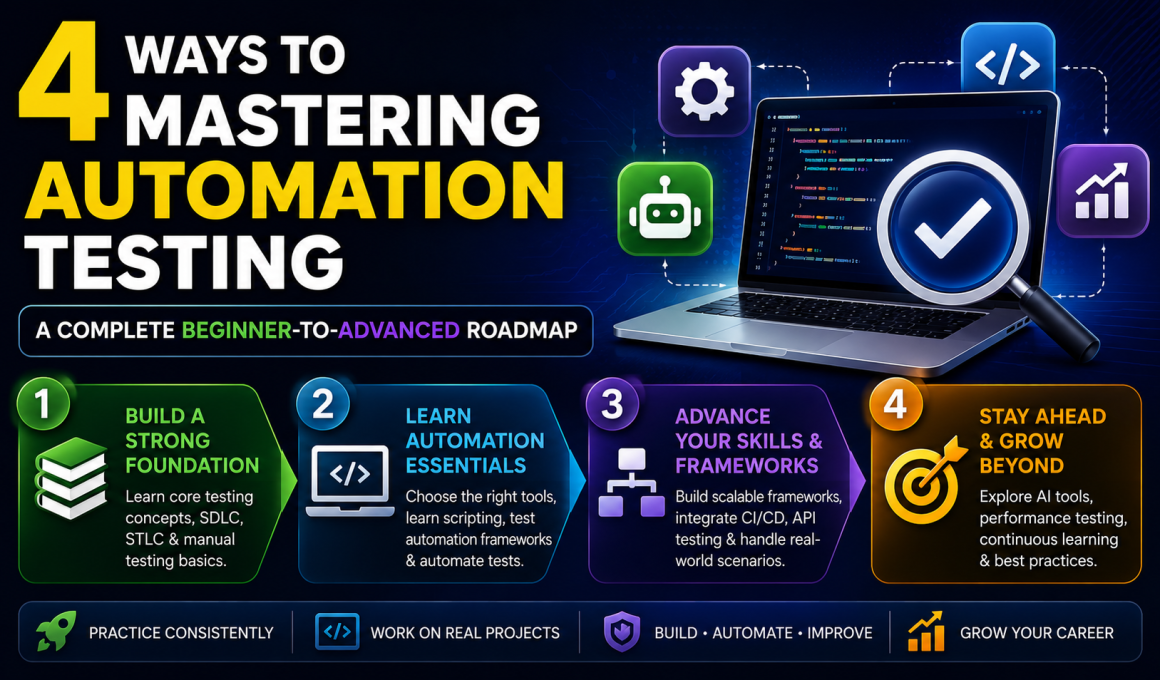
1. Build a Strong Foundation in Testing and Programming
The biggest mistake beginners make is jumping straight into tools without understanding the basics. Automation testing is not just about clicking buttons with scripts—it requires logical thinking, structured design, and programming knowledge.
Start by learning the fundamentals of software testing. Understand how testing fits into the Software Development Life Cycle (SDLC) and the Software Testing Life Cycle (STLC). Learn about different testing types such as unit testing, integration testing, system testing, regression testing, and acceptance testing.
Equally important is learning a programming language. In 2026, the most relevant languages for automation testing include Java, Python, and JavaScript. Each of these languages has strong ecosystem support and integrates well with modern automation tools.
As you begin coding, focus on:
- Writing clean and readable code
- Understanding loops, conditions, and functions
- Learning object-oriented programming concepts
- Practicing debugging techniques
A strong foundation will make everything else—tools, frameworks, and advanced concepts—much easier to learn.
2. Master One Modern Automation Tool Deeply
Once your basics are clear, the next step is to learn an automation testing tool. Instead of trying to learn multiple tools at once, focus on mastering one tool thoroughly.
Some of the most popular automation tools in 2026 include:
- Selenium (industry standard for web automation)
- Playwright (modern, fast, and powerful)
- Cypress (frontend-focused testing)
- Appium (mobile automation)
Each tool has its strengths, but what matters most is how well you understand and apply it.
When learning a tool, go beyond the basics. Practice:
- Identifying web elements using selectors
- Handling dynamic elements and waits
- Writing reusable test scripts
- Managing test data
- Running tests across multiple browsers
As you gain confidence, start exploring advanced topics like parallel testing, cross-browser testing, and performance optimization.
Mastery of a single tool will make you far more valuable than having superficial knowledge of many tools.
3. Build Real-World Projects and Automation Frameworks
Learning theory is important, but real growth happens when you apply your knowledge. Working on real-world projects is the most effective way to become job-ready in automation testing.
Start with simple projects such as automating login pages or form submissions. Gradually move on to more complex systems like e-commerce platforms or dashboard applications.
As your projects grow, focus on building structured automation frameworks. Learn and implement design patterns such as the Page Object Model (POM), which helps organize your code and improve maintainability.
Enhance your projects by adding:
- Test reporting tools (like Extent Reports)
- Logging mechanisms
- Data-driven testing approaches
- Error handling and retry mechanisms
You can also integrate API testing into your projects using tools or libraries that allow you to validate backend services.
The goal is not just to write scripts, but to create a complete automation ecosystem that resembles real industry projects.
4. Integrate CI/CD and Explore AI-Driven Testing
In 2026, automation testing is deeply connected with DevOps practices. Knowing how to integrate your tests into CI/CD pipelines is a crucial skill.
CI/CD tools such as Jenkins, GitHub Actions, and GitLab CI allow you to:
- Automatically run tests on every code change
- Detect bugs early in the development cycle
- Generate reports and alerts
- Improve collaboration between teams
Learning CI/CD will help you understand how automation fits into the bigger picture of software delivery.
At the same time, AI is transforming automation testing. Modern tools now use artificial intelligence to:
- Automatically heal broken test scripts
- Identify UI changes
- Suggest new test cases
- Optimize test execution
By learning AI-powered testing tools, you position yourself ahead of the curve. This combination of automation + AI + DevOps makes you a highly valuable professional in today’s job market.
Common Challenges and How to Overcome Them
Many learners face difficulties while learning automation testing, especially in the early stages.
One common challenge is feeling overwhelmed by the number of tools and concepts. The best way to handle this is to focus on one thing at a time and build gradually.
Another issue is lack of practice. Watching tutorials alone is not enough—you need to write code, debug errors, and experiment with different scenarios.
Debugging can also be frustrating, but it is one of the most important skills to develop. The more errors you solve, the better you become.
Finally, consistency is key. Even spending one or two hours daily can lead to significant progress over time.
A Practical Learning Roadmap for 2026
To make your learning journey smoother, here’s a structured roadmap you can follow:
Phase 1 (Month 1–2):
Focus on understanding testing fundamentals and learning a programming language.
Phase 2 (Month 3–4):
Start working with an automation tool and practice writing scripts.
Phase 3 (Month 5–6):
Build real-world projects and learn framework design.
Phase 4 (Month 7–8):
Integrate CI/CD tools and explore API testing.
Phase 5 (Beyond):
Learn AI-based testing tools and prepare for job interviews.
Future Scope of Automation Testing
The future of automation testing is extremely promising. With the rise of AI, machine learning, and cloud computing, the demand for skilled automation testers will continue to grow.
Companies are increasingly investing in:
- Test automation frameworks
- Continuous testing pipelines
- Intelligent testing systems
This means professionals who understand automation deeply will have excellent career opportunities, higher salaries, and long-term growth.
Conclusion
Automation testing in 2026 is not just about tools—it’s about building a complete skill set that combines programming, testing knowledge, real-world experience, and modern technologies.
If you take a structured approach—starting with fundamentals, mastering a tool, building projects, and learning CI/CD and AI—you can transform yourself into a highly skilled automation engineer.
The journey may take time, but with consistency and practice, you can achieve expertise and open doors to exciting career opportunities in the tech industry.
If You Want to study more about testing, kaashiv Infotech Offers, Software Testing Course, or any other course & Internship visit www.kaashivinfotech.com.