


When it comes to creating dependable and scalable systems, one idea continuously prevails simultaneously – the System Design Life Cycle (SDLC). Whether you’re an IT student, a software engineer, or a business person, it is important to know the stages of the system design life cycle to ensure that your projects do not result in excessive costs or successful failures either because of reuse or mistakes and also to ensure project success.
In this guide, we will define the system design life cycle, explain the stages of the system design life cycle, and look at some real-world examples of how organizations are using them every day.
What is the System Design Life Cycle?
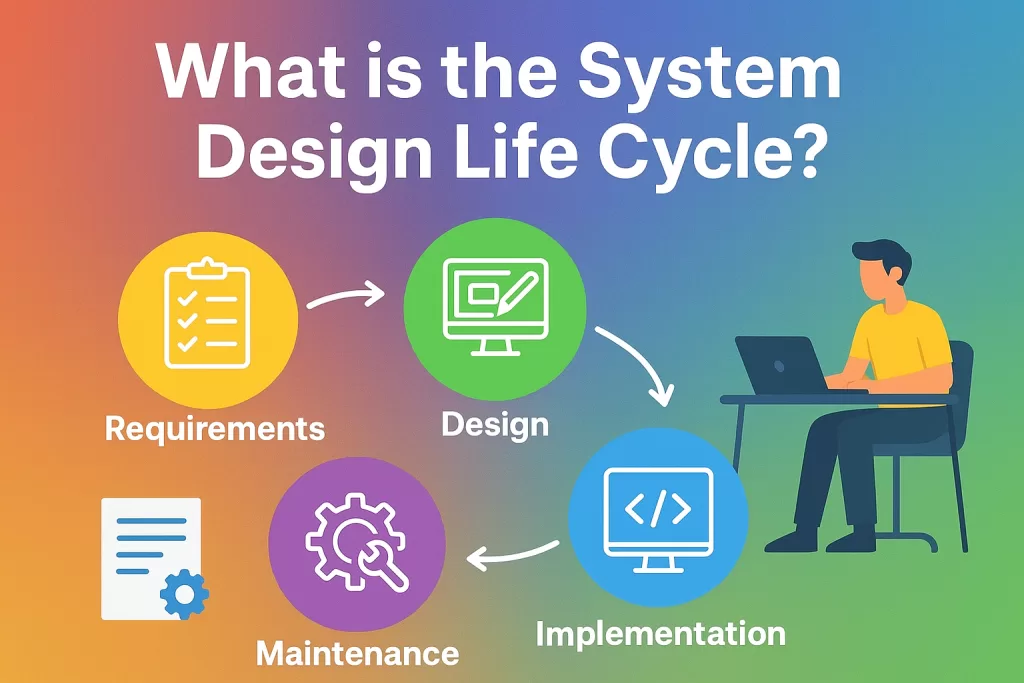
The system design life cycle is a structured approach to help teams plan, design, build, test, and deploy information systems. This differs from the system development life cycle (SDLC), which revolves around the overall project. The system design life cycle centers on how systems are designed to provide functionality, efficiency, and scalability.
A good analogy would be the early stages of constructing a house. Before you begin to build, you would have a set of design blueprints to avoid problems that could be far more expensive down the line.
Difference Between System Development Life Cycle and System Design Life Cycle
Many people confuse the terms. Here is a quick explanation:
System Development Life Cycle (SDLC): Covers the whole spectrum — from the idea phase through deployment and maintenance.
System Design Life Cycle (SDLC): Is only about the design phase — about data flow and how processes interact and how users will interact with the system.
👉 To simplify: SDLC = overall view. System Design Life Cycle = detailed design under the overall view.
Stages of the System Design/Development Life Cycle

The system design life cycle can be broken into several well-defined phases.
1. Requirement Analysis
Before any design teams compile a list of both functional and non-functional requirements.
Example: A banking app requirements may be logged in securely, money transferred, and transaction history.
2. Feasibility Study
Can this be built within budget, time and technology?
Example: To use cloud hosting (AWS/Azure) or on premises.
3. System Design (High-Level & Detailed Design)
High Level Design (HLD): Defines overall system architecture, modules, and data flow.
Low Level Design (LLD): Completing detailed components, database schema, UI, APIs.
4. Implementation / Coding
Designs are created into actual code. The developer writes modules, scripts, and services based on design documents.
5. Testing and Verification
Verifies that the system met the requirements via unit testing, integration testing, and system testing.
6. Deployment and Maintenance
Now the system is live and now monitoring it and upgrading will continue.
Importance of System Design Life Cycle
This design life cycle ensures:
- Clearness: Everyone understands what the system will do.
- Cost Savings: If requirements are wrong, better to catch and fix defects in a design rather than a system down the road.
- Scalability: System’s future-proofed in mind, during design.
- Security: Good design will build in appropriate authentication and security.
Real-Life Examples of SDLC

E-Commerce Websites (Amazon, Flipkart):
- Requirement: Handle millions of users at once.
- Design: Scalable microservices architecture.
Healthcare Management Systems:
- Requirement: Secure patient data.
- Design: HIPAA-compliant system design with encrypted databases.
Banking Applications:
- Requirement: Fraud detection.
- Design: AI-driven transaction monitoring systems.
Benefits of Following a SDLC
- Diminished project dangers
- Improves stakeholder communications
- Enhanced system quality
- Saving time and resources
Challenges in SDLC
- Mid project requirement changes
- Balancing cost and performance
- Modern digital systems present security risks
FAQs
Q1. What are the primary stages in developing any system?
The primary stages are identifying requirements, feasibility study, the design stage, the implementation stage, testing stage, and the deployment stage.
Q2. Why is it beneficial to have a defined process in system development?
A defined process can save money, reduce risk, improve communication, and result in better quality.
Q3. What is the difference between the design process and the overall process of development?
While the overall development processes, cover the complete journey from concept to maintenance, the design process involves creating an architectural design, data flow and the specifics of the design.
Final Thoughts
A system design life cycle does not represent only a technical procedure, it is step towards developing viable, dependable, and secure systems. By following the prescribed, documented steps in the life cycle, organizations are able to diminish project risks, save costs, and deliver systems that deliver on business needs.
Whether you are an IT worker or a student preparing to answer interview questions or you are a business owner making an investment in software, IT system design life cycle represents a life-long learnable skill.

![Agile Model in Software Engineering [2025]](https://www.wikitechy.com/wp-content/uploads/2025/08/Agile-Model-in-Software-Engineering-2025-380x220.webp)