

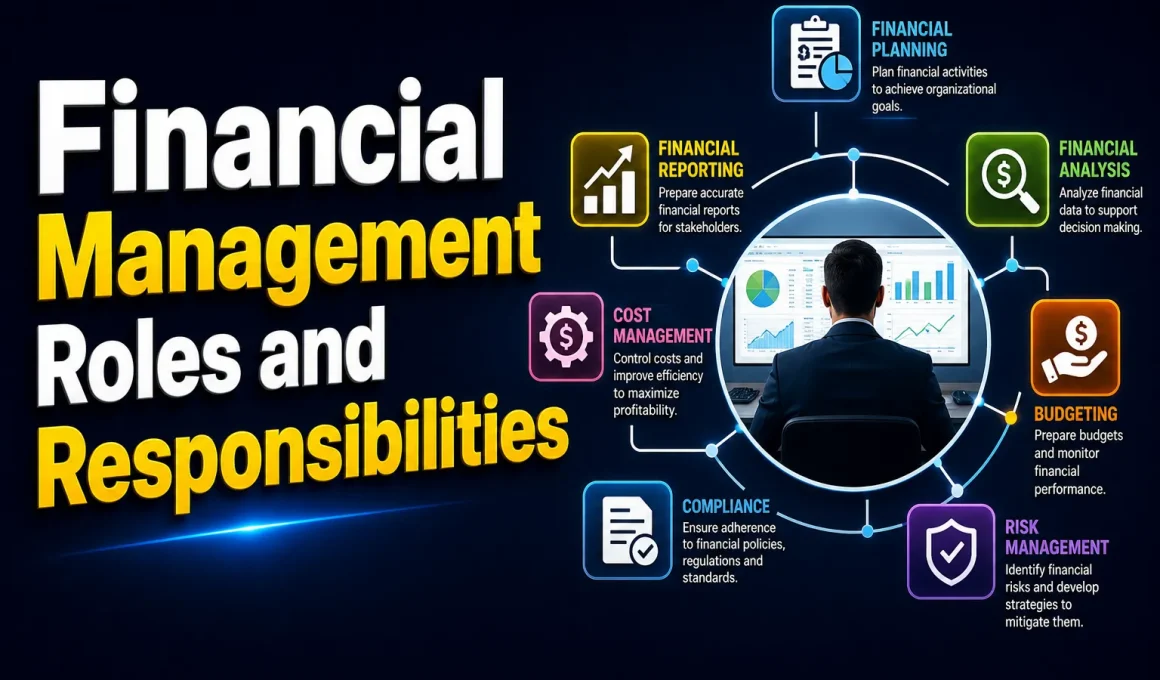
Financial managers are the backbone of an organization’s economic health. They oversee the full spectrum of money-related operations—planning ahead, making smart investment choices, deciding how to finance growth, managing risk, tracking cash flow, reporting results, and steering the business toward long-term success. In other words, financial management isn’t just about spreadsheets; it’s about ensuring stability, guiding strategic growth, and protecting value for employees, shareholders, lenders, and customers alike.
Financial Management Roles and Responsibilities: 10 Major Roles and Functions of Financial Management
In this article, we’ll explore the key financial management roles and responsibilities, with a focus on 10 major roles and functions that make financial management such a vital discipline inside businesses of every size. Whether you’re studying finance, managing a startup, or looking to understand how organizations stay on track financially, this guide offers a practical overview with clear examples.
Table of Contents
- Financial Management Roles: Key Takeaways
- Top 10 Major Financial Management Roles
- Scopes of Financial Management
- Functions of Financial Management
- Benefits of Financial Management
- FAQs
Financial Management Roles: Key Takeaways
- Financial management focuses on planning, organizing, directing, and controlling an organization’s finances to support sustainability and growth.
- Finance managers take responsibility for forecasting, investment and financing decisions, risk mitigation, cash flow and liquidity, reporting, cost control, profit improvement, strategy alignment, securing funding, and avoiding financial distress.
- The core goal is to ensure that the business uses resources efficiently while meeting short-term obligations and building long-term value for stakeholders.
Top 10 Major Financial Management Roles
Financial management roles work together as a coordinated system. Each function supports decisions that affect profitability, stability, growth, and investor confidence. Let’s walk through the 10 most essential roles and responsibilities finance professionals handle.
1. Planning and Forecasting
One of the most foundational roles in financial management is building plans and estimating how the business will perform over time. This includes creating budgets to allocate cash and resources effectively, and using historical data, trends, and market conditions to forecast future revenue, expenses, and earnings.
Financial managers create forecasts to help leadership teams set realistic goals. By anticipating challenges—such as sales slowdowns or rising costs—organizations can adjust strategies before problems spiral. Budgeting is more than just setting limits; it’s about making thoughtful, disciplined choices so every department works with clear financial boundaries and priorities.
2. Investment Decision-Making
Investment decisions determine how an organization puts its money to work—whether in new equipment, technology, product development, acquisitions, or other growth channels. Financial managers play a critical role in evaluating projects, estimating returns, comparing risks, and ensuring that capital is invested in ways that maximize shareholder and organizational value.
This responsibility involves analyzing whether an investment truly drives efficiency or revenue, as well as deciding when to scale back spending or abandon initiatives that are unlikely to perform well. Good investment decisions protect long-term value and keep management focused on profitable growth.
3. Financing Decisions
Every organization needs funds to operate, expand, and invest—and financing decisions define how a business raises and structures those funds. Finance managers work to determine the best mix of debt (loans, bonds, credit lines) and equity (shareholder funding) that helps the company grow while keeping borrowing costs and risk at reasonable levels.
Choosing financing sources requires evaluating interest rates, repayment terms, investor expectations, and the business’s ability to manage debt consistently over time. An optimal capital structure supports stability, reduces the cost of capital, and enables the firm to grow without unnecessary financial stress.
4. Risk Management
Running a business always involves uncertainty, from market swings and supply-chain disruption to inflation, currency fluctuations, or credit risk. Financial managers play a key role in identifying risks, measuring their potential impact, and applying strategies to reduce or manage them—through hedging, insurance, contractual protections, financial tools, and solid policies.
Risk management isn’t about eliminating uncertainty altogether; it’s about building resilience. When finance teams proactively manage risk, organizations can face downturns with confidence and protect operations, cash reserves, and customer commitments.
5. Cash Flow Management
Cash flow is often called the “lifeblood” of a business, and financial managers are responsible for ensuring the organization has enough cash on hand to pay bills, employees, suppliers, and lenders on time. This role includes managing working capital—how inventory, receivables, and payables interact—and handling liquidity so assets can be turned to cash quickly when needed.
A great finance team keeps the business positioned for day-to-day stability, but they also plan for healthier cash flow by improving collections, managing supplier terms, and forecasting seasonal fluctuations. As the old saying goes: profits don’t always pay the bills—cash does.
6. Financial Reporting and Analysis
Financial reporting and analysis bring clarity to an organization’s health. Financial managers prepare accurate statements (income statements, balance sheets, cash flow statements) and analyze results to measure performance, track trends, and guide decisions.
By looking at ratios—profitability, liquidity, efficiency, leverage, and return metrics—finance leaders can pinpoint strengths and weaknesses. Reporting provides transparency, builds trust with investors and lenders, and creates a shared scoreboard so everyone—leadership, departments, and stakeholders—can understand how the business is really doing.
7. Cost Control and Profit Maximization
Strong organizations don’t just chase revenue—they carefully manage costs to protect profit margins. Financial managers monitor expenses, compare actual spending to budgets, identify inefficiencies, and implement cost-saving ideas without hurting quality, customer service, or employee morale.
Profit maximization comes from a combination of higher revenue, better pricing strategy, resource efficiency, and disciplined spending. Finance teams help businesses develop strategies to improve profitability through decision analysis, product-line evaluation, and operational improvements that create real bottom-line results.
8. Strategic Planning and Performance Evaluation
Financial management connects directly with strategy. Financial managers support long-term growth by linking financial plans with business goals—such as expansion, mergers, acquisitions, market entry, and new products. They evaluate opportunities, create financial models, and help the leadership team decide where resources will create the greatest return over time.
Performance evaluation means establishing key metrics, measuring progress, and delivering actionable comparisons—actual versus expected, current versus historical, and against competitors or industry benchmarks. Variance analysis (finding and explaining the differences between plans and reality) allows the organization to learn, adjust, and get stronger over time.
9. Funding Sources
Securing funding is one of the proactive roles finance managers handle. They look for internal cash generation, investments, loans, grants, partnerships, or venture capital when needed, and they assess market conditions to judge the timing, cost, and feasibility of different funding channels.
This role involves identifying potential investors, structuring compelling proposals, negotiating terms, and making the business attractive to funding providers. Successful funding decisions ensure that growth doesn’t stall because cash is tight, and they put the organization in a position to seize opportunities at the right moment.
10. Avoid Bankruptcy
Perhaps one of the most serious responsibilities is preventing financial distress: ensuring the organization can meet obligations, maintain creditworthiness, and manage risk within safe boundaries. Finance leaders track leverage, liquidity, and cash inflow and outflow to identify warning signals early, implement strategies for reducing costs, improving margins, and making disciplined capital allocation decisions.
By managing return on investment, controlling debt, and optimizing resource use, financial managers help steer the company away from risky choices that could compromise its value. Effective risk management and steady cash flow strategy are the guardrails that keep a business healthy during tough periods and positioned for recovery when conditions improve.
Financial Management Roles and Responsibilities: 10 Major Roles and Functions of Financial Management
Scopes of Financial Management
The scope of financial management spans a broad set of activities—from financial planning and budgeting to investing, forecasting, capital acquisition, reporting, performance analysis, risk management, and regulatory compliance. This comprehensive approach ensures organizations can make informed decisions, allocate resources effectively, sustain growth, and maximize value for stakeholders across the board.
Functions of Financial Management
The functions of financial management include developing financial plans and budgets, determining optimal capital structures, securing funds, managing risks, handling cash flow and liquidity, producing accurate financial statements, analyzing performance, managing taxes, and maintaining sound corporate governance. When executed effectively, these functions strengthen stability, improve decision-making, and support long-term value creation.
Benefits of Financial Management
Financial management delivers real advantages that directly support organizational success. It provides structure for planning and control, improves investment returns through careful capital allocation, optimizes financing costs through better debt-equity decisions, manages risks to prevent losses, reduces tax burdens, aligns strategies with long-term goals, and improves transparency through clear financial reporting. All these benefits add up to stronger confidence among investors, leadership teams, and employees, helping the business thrive.
BECOME A BUSINESS INTELLIGENT,BLOCK CHAIN,POWER BI EXPERT WITH KAASHIV INFOTECH
Looking to dive into the world of Business Intelligence, Block Chain, Power BI and carve your path to success? Kaashiv Infotech is here for you! Our Comprehensive Business Intelligence, Block Chain and Power BI Training Program is specially designed by experts to equip you with practical skills and real-world experience that will help you set your foot in the competitive Business Intelligence, Block Chain and Power BI industry.
Let’s break down our training offerings to see what makes our program stand out:
Diverse Live Industry Projects + Capstone: You’ll work on 2 real-time industry projects to build a solid portfolio and enhance your learning with a capstone project that showcases your skills. Our projects are sourced from actual client requirements, giving you genuine business exposure.
Expert-Led Training Sessions: Get hands-on training with sessions led by Microsoft MVPs and Google-recognized experts who guide you every step of the way. Our instructors bring 10+ years of industry experience to every session.
Practice Exercises: Daily practice exercises enhance your learning and help you master key concepts through our exclusive Kaashiv Lab environment.
Doubt Clearing Sessions: Our regular doubt sessions ensure that no question goes unanswered, giving you clarity on all the concepts. You’ll have direct access to our expert trainers for personalized guidance.
Industry-Oriented Curriculum: Learn industry-relevant skills and techniques that are directly applicable to real-world scenarios. Our curriculum is updated quarterly based on industry trends and requirements.
Triple Certification: Earn three certificates upon completion – Internship Certificate, IPT Certificate, and Industrial Exposure Certificate – all recognized and valued by employers in the industry.
Q&A Forum: Engage with fellow participants and instructors in our dedicated Q&A forum to exchange ideas, seek advice, and collaborate on projects. Our community support continues even after course completion.
Interview Preparation: Access our exclusive interview question bank, mock interview sessions, and ATS-friendly resume tools to help you land your dream job in Business Intelligence, Block Chain and Power BI
100% Job Assistance Guarantee + Alumni Network: We’re offering 100% job assistance along with ongoing support from our extensive alumni network. Our dedicated placement team works with you until you secure your desired position.
So what are you waiting for? Launch your career with confidence! Join the Kaashiv Infotech Business Intelligence, Block Chain and Power BI Training Program and unlock your potential today.
Conclusion
Financial management roles are a foundation for organizational growth, stability, and success. From planning and forecasting to investment, financing, risk management, cash flow, reporting, strategy, funding, and avoiding financial distress, finance managers guide decisions that impact day-to-day operations and the long-term trajectory of a business. By mastering these roles and functions, organizations can make smarter choices, adapt to change with confidence, and build sustainable value—no matter how complex or uncertain the business environment becomes.
Financial Management Roles FAQs
- What are the two most important functions of financial management?
Investment decision-making and risk management are the two most critical functions. These decisions determine how capital is allocated and how an organization protects itself from uncertainty—both of which directly affect profitability and long-term growth. - What is the role of a financial manager?
A financial manager is responsible for overseeing an organization’s financial operations—planning, budgeting, investment and financing decisions, cash flow, risk management, reporting, analysis, and steering strategic growth while maintaining financial stability. - What is financial management?
Financial management is the process of planning, organizing, directing, and controlling a company’s financial resources to achieve strategic goals, maintain cash flow stability, manage risk, and maximize value for stakeholders. - Why is financial management important for a business?
It builds financial discipline and transparency, supports investment and growth decisions, manages cash flow and risk, ensures compliance, and helps stakeholders understand how the business is performing—leading to sustainable growth and resilience. - How does financial management help in decision-making?
Financial management provides data, forecasts, analysis, and performance measurements that allow leaders to compare options, evaluate risks and returns, and allocate resources toward the most promising initiatives—turning uncertainty into clearer, more confident choices.