

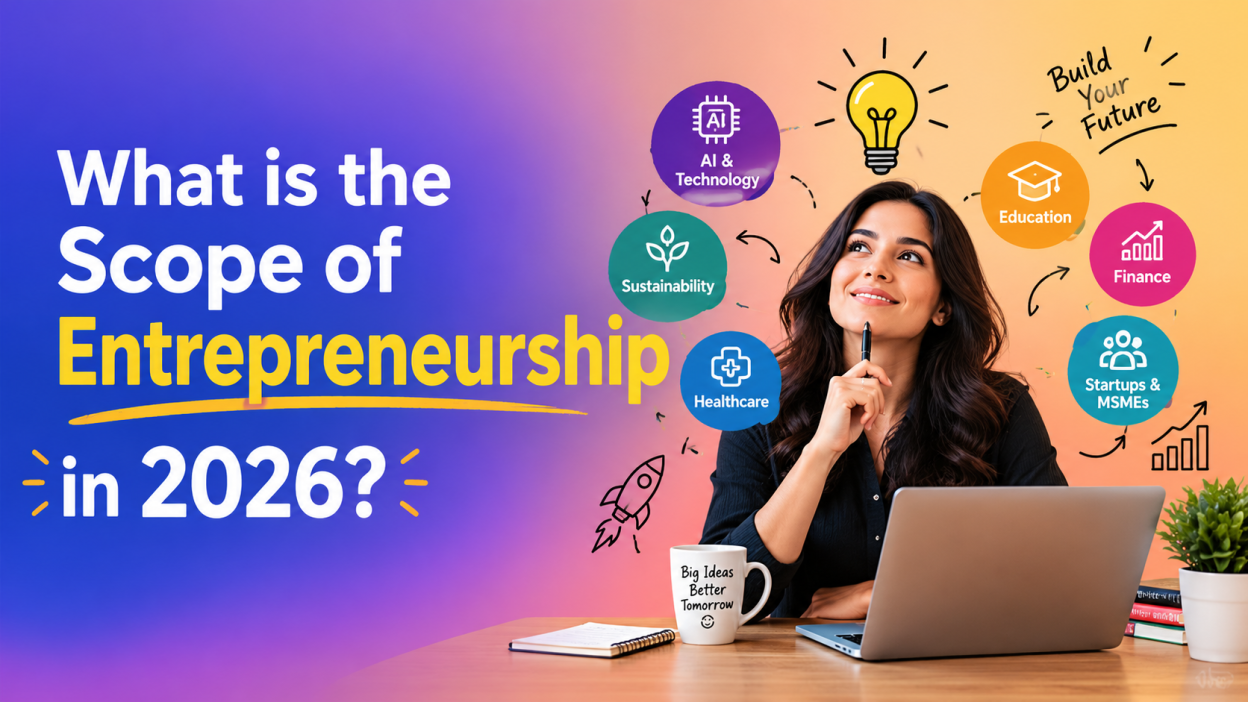
Entrepreneurship in 2026 is no longer limited to starting a traditional shop, company, or large business with a huge investment. Today, Entrepreneurship can mean building a small online business, creating an AI-powered product, offering professional services, launching a local brand, developing a software solution, or turning a simple problem into a useful business.
If you are wondering “What is the scope of Entrepreneurship in 2026?”, the short answer is: there are opportunities across technology, healthcare, education, finance, sustainability, food, manufacturing, digital services, and many other areas. But opportunity alone does not guarantee success. The real difference comes from identifying a genuine problem, understanding customers, managing money, and consistently improving the solution.
I have noticed one interesting change in the way people talk about Entrepreneurship. Earlier, many people connected entrepreneurship mainly with large companies and wealthy founders. Now, a student, freelancer, homemaker, engineer, designer, or working professional can start small and gradually build something of their own.
Key Highlights of Entrepreneurship in 2026 🚀
- Entrepreneurship is expanding beyond traditional businesses.
- AI and digital tools are lowering the cost of starting some types of businesses.
- India had more than 2 lakh DPIIT-recognised startups by 2025.
- Startup India reported 2.07 lakh DPIIT-recognised startups and 27.9 lakh+ jobs created by startups in its January 2026 report.
- Women-led entrepreneurship is becoming an important part of India’s startup ecosystem.
- MSMEs continue to play a major role in India’s economy and employment.
- Opportunities are growing in AI, digital services, healthcare, sustainability, manufacturing, education, fintech and other sectors.
- You don’t always need a massive investment to test a business idea.
- Skills such as communication, sales, financial management and technology are becoming increasingly useful for entrepreneurs.
- Government initiatives such as Startup India and MSME programmes provide different forms of support for eligible businesses.
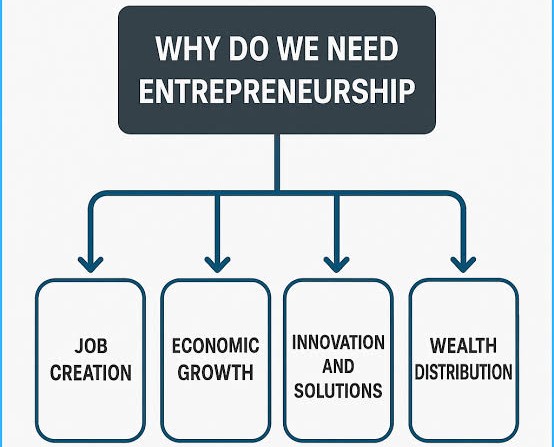
What Is Entrepreneurship?
10 Outstanding Marketing Management Case Studies from India
Before looking at the scope of Entrepreneurship in 2026, let’s make the meaning simple.
Entrepreneurship is the process of identifying an opportunity or problem and building a product, service, or business around it.
For example, imagine that many small shops in your area struggle to manage their daily accounts.
You could create a simple billing and inventory application for them.
You don’t necessarily need to build the next giant technology company. You are solving a real problem for a specific group of customers.
That’s entrepreneurship.
An entrepreneur usually works across several areas:
- Finding a problem
- Understanding customers
- Creating a solution
- Planning the business
- Managing money
- Marketing the product
- Selling to customers
- Building a team
- Handling risks
- Improving the business
This is why Entrepreneurship is not just about having an idea. An idea becomes a business only when someone actually works on it.
Scope of Entrepreneurship in 2026 🌱
The scope of Entrepreneurship in 2026 is connected strongly with technology, changing customer behaviour and the growing need for specialised products and services.
India’s startup ecosystem has expanded considerably since Startup India was launched in 2016. The Economic Survey 2025-26 notes that DPIIT-recognised startups increased from approximately 500 in 2016 to more than 2 lakh by 2025. It also points to innovation across areas such as biotechnology, Artificial Intelligence, digital services and sustainability.
That gives us a useful picture: entrepreneurship isn’t concentrated in one industry.
It is spreading.
1. Technology Entrepreneurship 💻
Technology continues to create new possibilities for entrepreneurs.
A small team can now develop:
- Mobile applications
- SaaS products
- Websites
- Automation tools
- Cybersecurity services
- AI applications
- Cloud-based services
- Developer tools
- Business software
For example, instead of creating a general-purpose application for everyone, an entrepreneur could develop a simple software solution specifically for small clinics, schools, restaurants, or local businesses.
That narrow focus can make it easier to understand the customer.
2. AI Entrepreneurship 🤖
One of the biggest changes in Entrepreneurship in 2026 is the increasing accessibility of Artificial Intelligence.
AI can support businesses with:
- Customer support
- Content creation
- Data analysis
- Document processing
- Business automation
- Personalisation
- Marketing
- Software development
- Research
The Economic Survey 2025-26 specifically identifies the evolution of India’s AI ecosystem as an important area of development.
But there is an important lesson here.
Simply adding “AI” to a business idea doesn’t make it a good business.
I would first ask:
What problem am I solving?
Then:
Can AI solve that problem faster, cheaper, or more effectively?
That approach is much more practical than starting with technology and searching for a problem later.
3. Digital Entrepreneurship 📱
You don’t necessarily need a physical office to start a business.
Digital entrepreneurship can include:
- Freelancing
- Online education
- Digital marketing
- Web development
- Graphic design
- Video editing
- Content creation
- E-commerce
- Consulting
- Online coaching
- Software services
For example, a web developer can initially work alone, take projects from small businesses, build a portfolio and later create an agency.
This is one reason digital entrepreneurship has become accessible to people with specialised skills.
4. Healthcare Entrepreneurship 🏥
Healthcare is another area with opportunities for Entrepreneurship.
Entrepreneurs can work on:
- Healthcare software
- Medical devices
- Health-tech platforms
- Appointment management
- Medical documentation
- Elder-care services
- Diagnostic technology
- Healthcare logistics
- Wellness services
Healthcare entrepreneurship also requires extra care because regulations, privacy, safety and professional standards can be important depending on the business.
So this isn’t an area where we should simply rush from idea to launch.
Research matters.
5. Education Entrepreneurship 📚
Education has changed dramatically because of online learning.
Entrepreneurs can build businesses around:
- Online courses
- Skill training
- Coding education
- Career guidance
- Language learning
- Test preparation
- Corporate training
- Educational software
- Learning management platforms
A person who has strong knowledge in a specific subject can start with a small workshop or course and gradually develop a larger education business.
This is a good example of how Entrepreneurship can start from an individual’s existing knowledge.
6. Green and Sustainable Entrepreneurship 🌱
Environmental challenges are also creating opportunities for businesses.
Possible areas include:
- Renewable energy
- Waste management
- Recycling
- Sustainable packaging
- Electric mobility
- Energy efficiency
- Water management
- Sustainable agriculture
The Economic Survey 2025-26 identifies sustainability-oriented solutions among the areas where innovation activity is expanding.
The important point is that sustainability should not simply be a marketing word. A business needs to solve a genuine environmental or economic problem.
7. MSME Entrepreneurship
When we discuss Entrepreneurship in India, we should not focus only on venture-backed startups.
Millions of entrepreneurs operate through micro, small and medium enterprises.
According to the Ministry of MSME’s 2025-26 annual report, the MSME sector contributes around 31.1% of India’s GDP and more than 48.5% of exports.
That means Entrepreneurship isn’t only about unicorns.
A manufacturing unit, repair service, food business, consulting firm, retail business or local technology company can also be entrepreneurship.
8. Women Entrepreneurship 👩💼
Best SEO Tools in 2025: 10 Game-Changing Tools for Higher Rankings!
Women are playing an increasingly visible role in India’s entrepreneurial ecosystem.
Startup India’s January 2026 report listed 99,000+ women-led startups, describing this as significant growth since 2017.
Women entrepreneurs are building businesses across:
- Fashion
- Food
- Education
- Technology
- Healthcare
- Beauty and wellness
- E-commerce
- Professional services
- Manufacturing
The opportunity isn’t limited to metropolitan cities either. Startup India’s current state-policy information says that all 36 States and Union Territories have at least one DPIIT-recognised startup, while 653 districts host at least one DPIIT-recognised startup.
Entrepreneurship Opportunities in 2026
If you’re searching specifically for entrepreneurship opportunities in 2026, here are some areas worth researching:
| Area | Example Opportunity |
|---|---|
| AI | AI automation services |
| Software | SaaS applications |
| Education | Skill-based online training |
| Healthcare | Healthcare technology |
| E-commerce | Niche online brands |
| Cybersecurity | Security services for small businesses |
| Digital Marketing | Marketing for local companies |
| Sustainability | Recycling and eco-friendly products |
| Food | Specialised food brands |
| Manufacturing | Small-scale specialised products |
| Finance | Financial technology services |
| Agriculture | Agri-tech solutions |
These aren’t guaranteed business successes. They are areas where changing technology and customer needs can create opportunities.
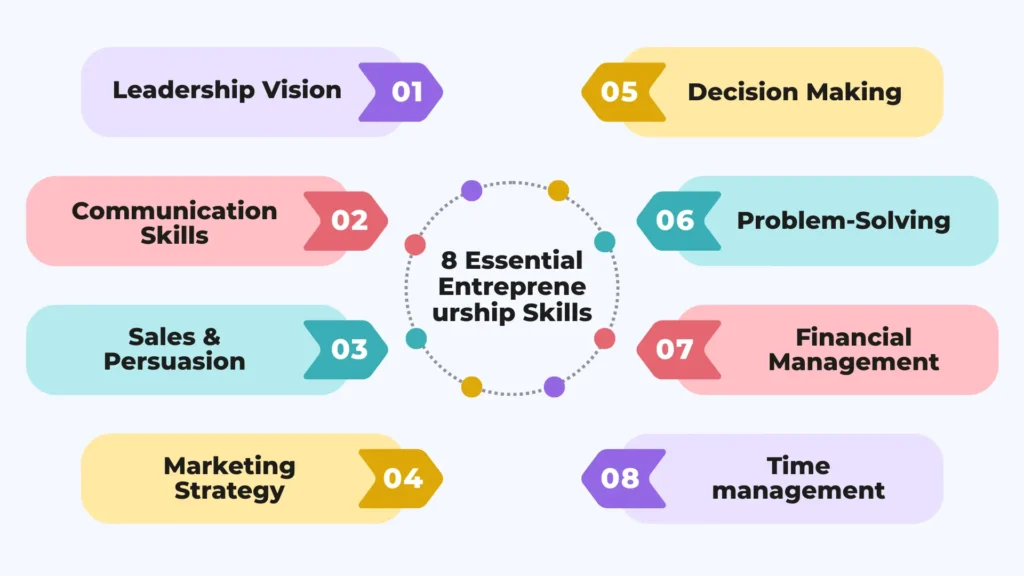
What Skills Do Entrepreneurs Need in 2026?
Having a business idea is only the beginning.
I would focus on developing these entrepreneurial skills:
1. Communication
You need to explain your product clearly.
If you cannot explain what your business does in simple words, customers may struggle to understand it.
2. Sales
This is a big one.
Many beginners spend months developing a product but avoid selling it.
A business needs customers.
3. Financial Management
You should understand:
- Revenue
- Expenses
- Profit
- Cash flow
- Pricing
- Investment
- Taxes
You don’t have to become an accountant, but you should understand what is happening with your money.
4. Problem-Solving
Entrepreneurship is basically a long series of problems.
A customer complains.
A supplier delays an order.
An advertisement doesn’t work.
A product has a technical issue.
You need to keep solving.
5. Technology
Even non-technical entrepreneurs benefit from understanding basic digital tools.
For technology entrepreneurs, deeper skills in programming, cloud computing, AI, cybersecurity or data can create additional opportunities.
6. Adaptability
Markets change.
Customer expectations change.
Technology changes.
The business model that works today may need modification tomorrow.
Is Entrepreneurship Easy in 2026?
No.
And I think it is important to say this honestly.
Social media sometimes makes entrepreneurship look like this:
Idea → Instagram post → customers → huge income.
Real life is usually messier.
You may spend weeks trying to find your first customer.
You may change your product.
You may make mistakes with pricing.
You may discover that customers don’t want the feature you spent months building.
That’s normal.
The scope of Entrepreneurship is growing, but competition is also real. Access to digital tools can reduce some barriers to starting a business, but it doesn’t remove the need for market research, customer understanding, financial discipline and execution.
Government Support for Entrepreneurship in India 🇮🇳
India has several programmes designed to support startups and small businesses.
The Startup India initiative provides information and access related to startup recognition, government programmes, funding support, incubation and other ecosystem resources. Its current portal also notes that DPIIT startup-recognition rules were updated in 2026; eligible startups can have turnover below ₹200 crore, while the threshold is ₹300 crore for DeepTech startups, subject to the applicable criteria.
For people exploring micro-enterprises and self-employment, the Prime Minister’s Employment Generation Programme (PMEGP) is another government initiative focused on creating employment through new self-employment ventures and micro-enterprises.
For MSME-related information and programmes, the Ministry of MSME provides official resources.
How to Start Entrepreneurship as a Beginner
If I were starting from zero, I wouldn’t begin by registering a company immediately.
I would follow a simple process.
Step 1: Find a Problem
Look around you.
What do people complain about repeatedly?
Step 2: Talk to Potential Customers
Don’t assume that people will buy your idea.
Ask them.
Listen carefully.
Step 3: Create a Small Solution
Build the simplest useful version.
This could be:
- A service
- A basic website
- A prototype
- A small product
- A consultation
- A simple digital tool
Step 4: Test It
Get your first few users.
Their feedback is more useful than endless guessing.
Step 5: Improve
Fix what doesn’t work.
Keep what does.
Step 6: Learn Business Basics
Understand pricing, marketing, accounting and customer acquisition.
Step 7: Scale Carefully
Once you see genuine demand, think about hiring, investment, technology and expansion.
Future Scope of Entrepreneurship 🚀
Looking ahead, Entrepreneurship is likely to remain connected with major changes in technology and society.
Some areas I would keep an eye on include:
- Artificial Intelligence
- Automation
- Cybersecurity
- Climate technology
- Healthcare technology
- Electric mobility
- Digital education
- Financial technology
- Space technology
- Biotechnology
- Agriculture technology
- Local digital businesses
But the most interesting opportunities may not always come from completely new industries.
Sometimes the opportunity is sitting inside an old problem.
A small business owner still needs better accounting.
A school still needs better communication.
A clinic still needs better administration.
A manufacturer still wants to reduce waste.
A customer still wants faster service.
That’s where entrepreneurship becomes practical.
Final Thoughts on the Scope of Entrepreneurship in 2026
So, what is the scope of Entrepreneurship in 2026?
It covers much more than simply launching a startup.
The growth of India’s startup ecosystem, the scale of MSMEs, the availability of digital tools, the development of AI, and the increasing focus on innovation are creating different paths for people who want to build businesses.
But I would remember one thing:
Entrepreneurship is not about chasing every new trend. It’s about solving a problem that people genuinely care about.
You don’t need to begin with a million-dollar idea.
Start with one problem.
Talk to one customer.
Build one small solution.
Learn from the result.
Then take the next step.
That is how Entrepreneurship becomes more than an attractive word. It becomes something you actually practise. 🚀
Want to learn More about Marketing Management Kaashiv Infotech Offers Digital Marketing Course & More, Visit www.kaashivinfotech.com

