

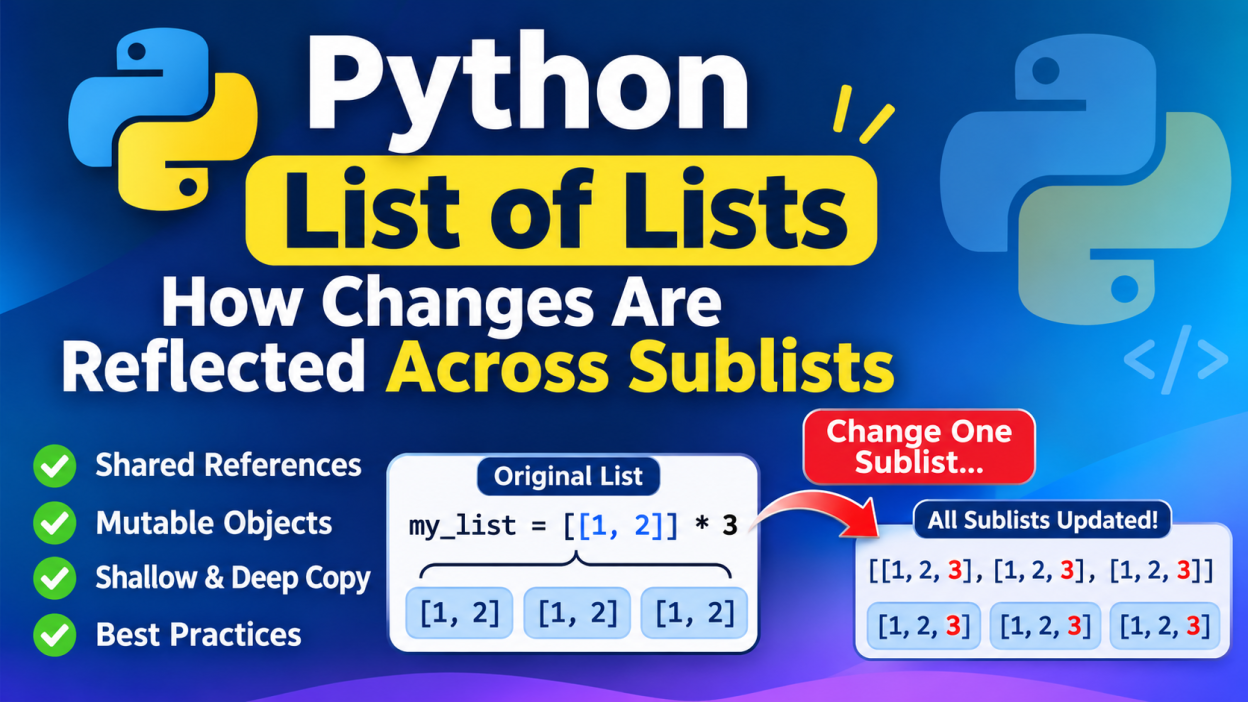
Python List of Lists – Python provides several data structures to store and manage collections of data. One commonly used structure is a list of lists, which allows developers to store multiple lists inside a single parent list. It is useful for handling tables, matrices, student records, and other structured information.
However, Python has an interesting behavior when working with nested lists. Sometimes, changing one sublist unexpectedly changes other sublists as well. This happens because of shared references and object mutability.
Understanding how changes are reflected across sublists is important for avoiding unexpected results in Python programs. In this article, we will explore why this happens, how references work, common examples, and different ways to prevent this issue.
What Is a List of Lists in Python?

A list of lists is a nested data structure in which each element of the main list is another list. It allows developers to organize related information in rows and columns.
For example:
students = [ ["John", 85], ["David", 90], ["Emma", 95]]print(students)Output:
[['John', 85], ['David', 90], ['Emma', 95]]Here, the students variable contains three inner lists. Each inner list stores a student’s name and mark.
Developers can access individual elements using multiple indexes.
print(students[0][0])print(students[1][1])Output:
John
90
This structure makes it easier to manage and access related data.
Why Do Changes Reflect Across Sublists?
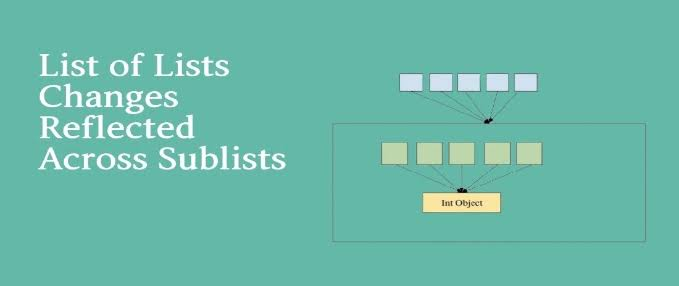
Python lists are mutable objects, which means their contents can be modified after creation. When multiple positions in a parent list refer to the same inner list, modifying that inner list affects every position that references it.
Consider the following example:
my_list = [[1, 2]] * 3print(my_list)Output:
[[1, 2], [1, 2], [1, 2]]At first glance, this looks like three separate lists. However, Python creates one inner list and repeats its reference three times.
Now, modify the first sublist:
my_list[0].append(3)print(my_list)Output:
[[1, 2, 3], [1, 2, 3], [1, 2, 3]]All three sublists are updated because they point to the same list object.
This behavior is known as shared referencing.
Understanding the Difference Between Shared and Independent Sublists
To understand this behavior more clearly, consider another example:
a = [10, 20]b = ab.append(30)print("List A:", a)print("List B:", b)Output:
List A: [10, 20, 30]
List B: [10, 20, 30]
Here, assigning b = a does not create a new list. Both variables refer to the same list object.
The same concept applies when multiple sublists share one reference.
How to Avoid Changes Across Sublists
There are several ways to prevent unwanted changes in nested lists.
Using List Comprehension
List comprehension is one of the simplest ways to create independent inner lists.
my_list = [[1, 2] for i in range(3)]my_list[0].append(3)print(my_list)Output:
[[1, 2, 3], [1, 2], [1, 2]]In this example, Python creates a new inner list during every iteration. Therefore, modifying one sublist does not affect the others.
Using the Copy Module
Python provides a built-in copy module that supports shallow copying and deep copying.
For nested lists, deep copying is useful because it creates independent copies of nested objects.
import copyoriginal = [[1, 2], [3, 4]]new_list = copy.deepcopy(original)new_list[0].append(5)print("Original:", original)print("New List:", new_list)Output:
Original: [[1, 2], [3, 4]]
New List: [[1, 2, 5], [3, 4]]
Here, changes made to new_list do not affect the original list.
Using List Slicing
List slicing can create a separate copy of each inner list when the structure has one level of nesting.
original = [[10, 20], [30, 40]]new_list = [row[:] for row in original]new_list[0].append(50)print("Original:", original)print("New List:", new_list)Output:
Original: [[10, 20], [30, 40]]
New List: [[10, 20, 50], [30, 40]]
This method creates new inner lists instead of sharing the original references.
Difference Between Shallow Copy and Deep Copy
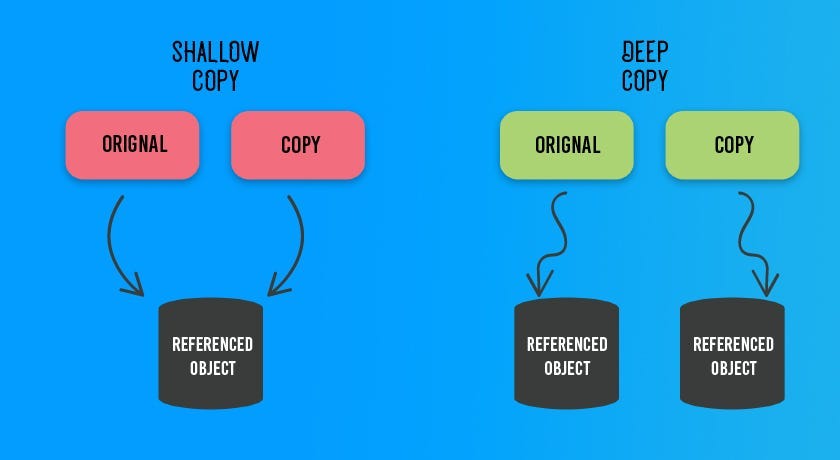
Python supports two important copying techniques. Understanding their differences helps developers choose the correct method.
| Feature | Shallow Copy | Deep Copy |
|---|---|---|
| Outer list | Creates a new list | Creates a new list |
| Inner lists | Shares references | Creates independent copies |
| Nested changes | May affect original | Do not affect original |
| Method | copy.copy() | copy.deepcopy() |
| Performance | Generally faster | May take more time |
A shallow copy is suitable when you only need to separate the outer list. A deep copy is better when you need complete independence between nested objects. thinkpy+1
Common Applications of List of Lists in Python
List of lists is widely used in different programming situations.
Matrix Operations: Developers use nested lists to represent mathematical matrices and perform addition, subtraction, and multiplication.
Student Records: A nested list can store student names, marks, and other academic details.
Game Development: Two-dimensional lists are useful for representing game boards, grids, and maps.
Data Processing: Developers use nested lists to organize tabular information before processing or analyzing it.
Image Processing: Pixel information can be represented using nested lists, where each inner list stores pixel values.
Best Practices for Working with Nested Lists
Follow these practices to avoid unexpected behavior:
- Avoid using
[[0] * 3] * 3when creating independent matrix rows. - Use list comprehension to create separate inner lists.
- Use
copy.deepcopy()when copying deeply nested mutable structures. - Understand the difference between assignment and copying.
- Use the
id()function to check whether two variables reference the same object. - Test nested list modifications before using them in larger applications.
Conclusion
Python list of lists is a useful data structure for organizing complex information. However, shared references can create unexpected results when multiple sublists point to the same list object. This commonly happens when using the multiplication operator to initialize nested lists.
Understanding mutability, object references, shallow copying, and deep copying helps developers avoid these problems. Using list comprehension or the copy.deepcopy() method allows developers to create independent nested lists whenever required.
By understanding how Python handles list references, beginners and experienced programmers can write cleaner, more reliable, and error-free Python applications.
Want to Learn More About Python & Artificial Intelligence ???, Kaashiv Infotech Offers Full Stack Python Course, Artificial Intelligence Course, Data Science Course & More Visit Their Website course.kaashivinfotech.com.