

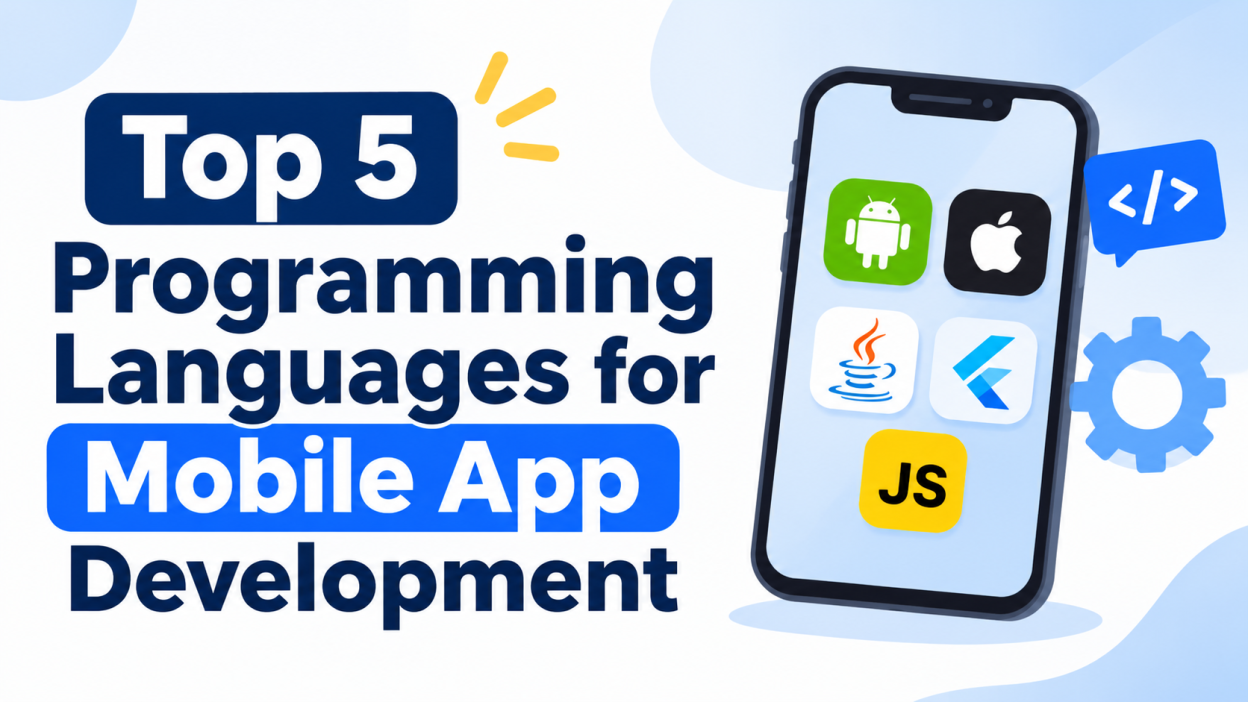
Mobile applications have become an important part of everyday life. From online shopping and banking to education, entertainment, and healthcare, mobile apps help people complete different tasks quickly and easily. As the demand for mobile applications continues to grow, businesses are looking for skilled developers who can create secure, user-friendly, and high-performance applications.
Choosing the right programming language is one of the most important steps in mobile app development. Different programming languages offer different features, development environments, and advantages. Some are designed specifically for Android or iOS, while others support cross-platform development, allowing developers to build applications for multiple operating systems using a single codebase.
For beginners interested in mobile app development, learning the right programming language can create several career opportunities. In this article, we will explore the top five programming languages for mobile app development, their features, advantages, and common uses.
1. Kotlin

Best for: Android Application Development
Kotlin is a modern, statically typed programming language widely used for Android application development. It was developed by JetBrains and officially supported by Google for Android development.
Kotlin is designed to make programming easier by reducing unnecessary code and improving application reliability. It works smoothly with Java, allowing developers to use existing Java libraries and frameworks.
Key Features of Kotlin
- Simple Syntax: Kotlin requires less code compared to Java for many common programming tasks.
- Java Compatibility: Developers can use Java libraries and existing Java code.
- Null Safety: Helps reduce common null-related programming errors.
- Coroutines: Supports asynchronous programming and background tasks.
- Android Support: Integrates with Android Studio and modern Android development tools.
Advantages of Kotlin
Kotlin improves developer productivity and makes applications easier to maintain. Its concise syntax helps beginners understand programming concepts more easily. It also provides strong support for modern Android development.
Common Uses
- Android mobile applications
- Banking and financial applications
- E-commerce applications
- Productivity applications
- Enterprise mobile solutions
2. Swift

Best for: iOS and Apple Application Development
Swift is a powerful programming language developed by Apple for building applications across its platforms, including iOS, iPadOS, macOS, watchOS, and tvOS.
It was introduced in 2014 to provide a modern alternative to Objective-C. Swift focuses on performance, safety, and developer productivity. It is commonly used with Xcode, Apple’s official integrated development environment.
Key Features of Swift
- Easy-to-Read Syntax: Provides clean and understandable programming structures.
- High Performance: Designed for efficient application execution.
- Type Safety: Helps developers identify errors during development.
- Automatic Memory Management: Uses Automatic Reference Counting (ARC).
- Modern Development Support: Works with SwiftUI for building user interfaces.
Advantages of Swift
Swift helps developers create responsive and secure Apple applications. Its modern features reduce programming errors and improve code readability. Developers can also use SwiftUI to build interfaces with a declarative programming approach.
Common Uses
- iPhone applications
- iPad applications
- Apple Watch applications
- Mac desktop applications
- Apple ecosystem services
3. Java
Best for: Android and Enterprise Application Development
Java is one of the most popular programming languages used in software development. It is an object-oriented, class-based language known for its portability, reliability, and extensive development ecosystem.
Java has been widely used for Android application development. Although Kotlin is now Google’s preferred language for Android development, Java remains useful because many existing Android applications, libraries, and enterprise systems are built using it.
Key Features of Java
- Platform Independence: Java applications can run on systems with a compatible Java Virtual Machine.
- Object-Oriented Programming: Supports classes, objects, inheritance, and polymorphism.
- Strong Security: Provides features that support secure application development.
- Multithreading: Allows multiple tasks to run concurrently.
- Large Community: Offers extensive documentation, libraries, and development resources.
Advantages of Java
Java is suitable for developing large-scale applications that require stability and maintainability. Its extensive ecosystem makes it easier for developers to find solutions to common development problems.
Common Uses
- Android applications
- Enterprise mobile applications
- Banking applications
- Business management systems
- Backend services for mobile applications
4. Dart

Best for: Cross-Platform Mobile Application Development
Dart is an open-source, object-oriented programming language developed by Google. It is mainly used with the Flutter framework to build applications for Android, iOS, web, and desktop platforms.
One of Dart’s biggest advantages is that developers can create applications for multiple platforms using a single codebase. This reduces development time and makes application maintenance easier.
Key Features of Dart
- Hot Reload: Allows developers to see code changes quickly without restarting the entire application.
- Cross-Platform Support: Supports Android, iOS, web, and desktop application development through Flutter.
- Fast Performance: Supports compilation into native machine code for mobile applications.
- Easy Syntax: Provides a familiar programming structure for developers with experience in Java or JavaScript.
- Rich UI Development: Offers access to Flutter widgets for creating attractive application interfaces.
Advantages of Dart
Dart is useful for developers who want to build applications for multiple platforms without maintaining completely separate codebases. Its integration with Flutter makes it suitable for creating interactive user interfaces and modern mobile applications.
Common Uses
- E-commerce applications
- Food delivery applications
- Social media applications
- Educational applications
- Business and productivity applications
5. JavaScript

Best for: Cross-Platform and Hybrid Mobile Applications
JavaScript is one of the most widely used programming languages in web development. It is also an important technology for mobile app development through frameworks such as React Native and Ionic.
With React Native, developers can use JavaScript and React concepts to build applications for Android and iOS. This approach allows developers with web development experience to move into mobile application development.
Key Features of JavaScript
- Cross-Platform Development: Supports mobile application development for multiple operating systems through suitable frameworks.
- Large Ecosystem: Provides access to numerous libraries, packages, and development tools.
- Reusable Components: React Native allows developers to create reusable UI components.
- Fast Development: Features such as Fast Refresh help developers quickly test code changes.
- Community Support: Offers extensive learning resources and developer communities.
Advantages of JavaScript
JavaScript is a good choice for developers who already understand HTML, CSS, and web development. It allows them to expand their skills into mobile application development without starting with an entirely different programming language.
Common Uses
- Social networking applications
- Shopping applications
- Messaging applications
- Business applications
- Cross-platform mobile solutions
Comparison of the Top 5 Mobile App Development Languages
The following table provides a quick comparison of the five programming languages and their development applications.
| Programming Language | Main Platform | Popular Framework / Tool |
|---|---|---|
| Kotlin | Android | Android SDK, Jetpack Compose |
| Swift | iOS | SwiftUI, UIKit |
| Java | Android | Android SDK |
| Dart | Android and iOS | Flutter |
| JavaScript | Android and iOS | React Native |
These languages support different development approaches. Kotlin and Swift are commonly used for native development, while Dart and JavaScript are popular choices for cross-platform development.
How to Choose the Right Programming Language for App Development?
Choosing a programming language depends on your application requirements, development experience, and target audience. Consider the following factors before selecting a language.
1. Target Platform: If you want to develop Android applications, Kotlin is a strong choice. For iOS applications, Swift is recommended.
2. Development Budget: If you want to develop an application for both Android and iOS, cross-platform technologies such as Flutter and React Native can reduce duplicated development work.
3. Performance Requirements: Consider native development for applications that require advanced device integration or demanding graphics.
4. Learning Difficulty: Beginners can start with JavaScript, Kotlin, or Dart based on their career goals and existing programming knowledge.
5. Career Opportunities: Explore job requirements and industry demand before choosing a programming language. Practical knowledge, projects, and problem-solving skills are equally important.
Career Opportunities in Mobile App Development
Learning mobile app development programming languages can help developers explore different career paths in the IT industry. As businesses continue investing in mobile technology, skilled developers are needed to create and maintain applications.
Some popular career opportunities include:
- Android Developer: Develops applications for Android smartphones and tablets using Kotlin or Java.
- iOS Developer: Creates applications for Apple devices using Swift.
- Flutter Developer: Builds cross-platform applications using Dart and Flutter.
- React Native Developer: Develops Android and iOS applications using JavaScript and React Native.
- Mobile Application Developer: Designs, develops, tests, and maintains mobile applications.
To improve career opportunities, beginners should build practical projects such as weather applications, expense trackers, shopping applications, and student management systems.
Conclusion
Mobile app development offers exciting opportunities for beginners and experienced developers. Kotlin, Swift, Java, Dart, and JavaScript are five useful programming languages for building modern mobile applications.
Each language has its own advantages and development environment. Kotlin is suitable for Android development, Swift is ideal for Apple applications, Java supports existing Android projects, Dart works with Flutter, and JavaScript supports cross-platform development through React Native.
Before choosing a language, understand your career goals and application requirements. Start with the fundamentals, practise coding regularly, and develop real-world projects to become a skilled mobile application developer.
Want to Learn More About Java ?, Kaashiv Infotech Offers, Full Stack Java Course, Java Course, Data Science Course, Internships & More, Visit Their Website www.kaashivinfotech.com.