

A binary tree in python is one of the most important data structures in computer science. It is commonly used in programming, searching, sorting, database systems, file management, and algorithm development. Understanding binary trees helps developers solve complex problems efficiently and organize data in a structured way.
Python provides a simple and flexible way to implement binary trees using classes and objects. In this article, we will learn what a binary tree is, how it works, its types, basic operations, and how to implement a binary tree using Python with practical examples.
What Is a Binary Tree?
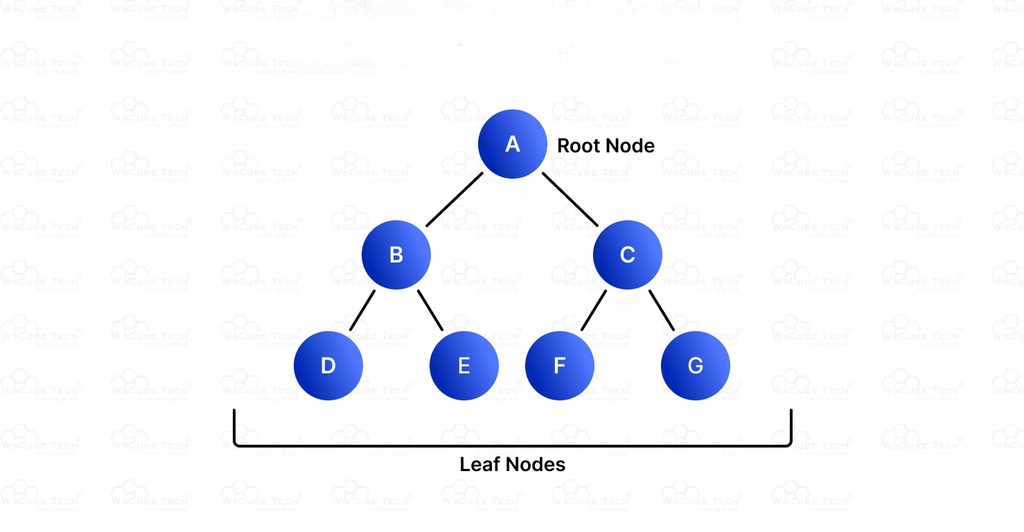
A binary tree is a hierarchical data structure in which each node can have a maximum of two child nodes. These child nodes are commonly called the left child and the right child.
Each node contains data and references to its child nodes. The first node in a binary tree is called the root node. Nodes that do not have any children are called leaf nodes.
Binary trees are different from arrays and linked lists because they store data in a hierarchical structure rather than a linear sequence.
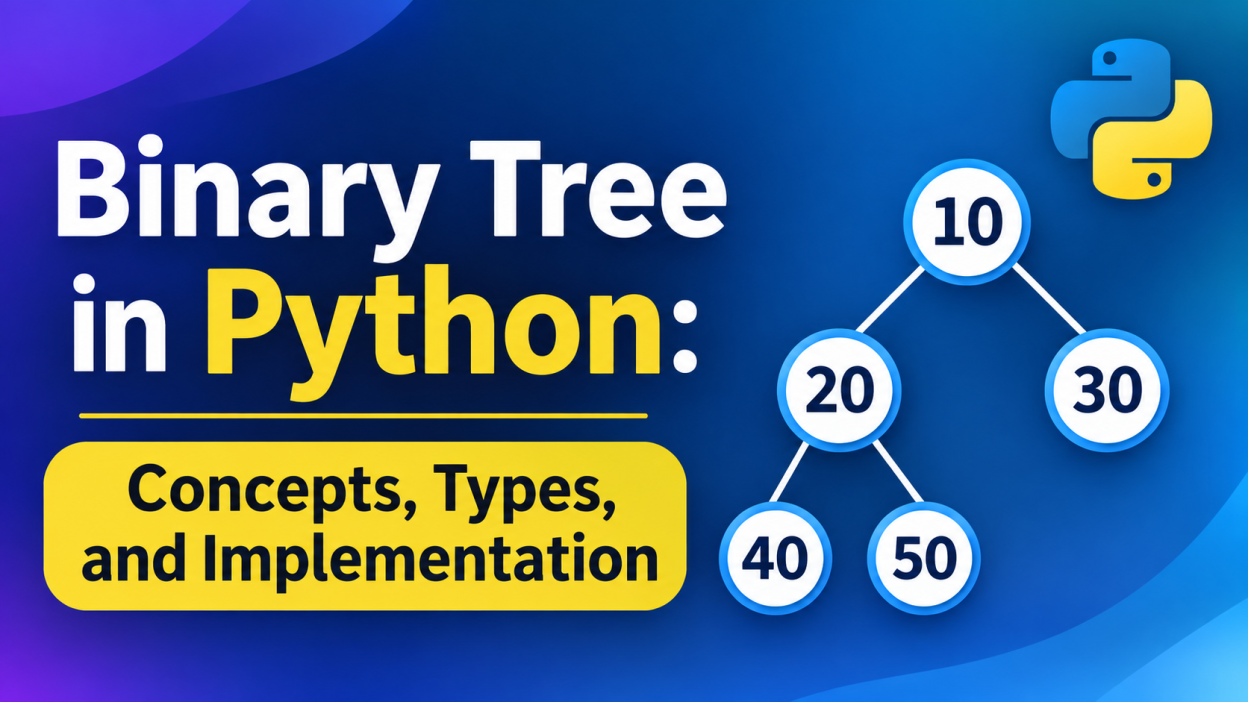
For example, a binary tree containing the values 10, 20, 30, 40, and 50 can be represented as a hierarchical structure.
In this structure:
- 10 is the root node.
- 20 is the left child of 10.
- 30 is the right child of 10.
- 40 and 50 are leaf nodes.
- 10 is the parent node of 20 and 30.
Each node can have zero, one, or two children.
Important Terminologies in Binary Tree
Understanding binary tree terminology makes it easier to work with tree-based algorithms.
Root: The topmost node in a tree. It does not have a parent.
Node: An individual element that stores data and links to other nodes.
Parent: A node that has one or more child nodes.
Child: A node connected directly below another node.
Leaf Node: A node that does not have any children.
Edge: The connection between two nodes.
Depth: The number of edges from the root node to a particular node.
Height: The maximum number of edges along the longest path from a node to a leaf.
Subtree: A smaller tree formed from a node and its descendants.
Types of Binary Trees
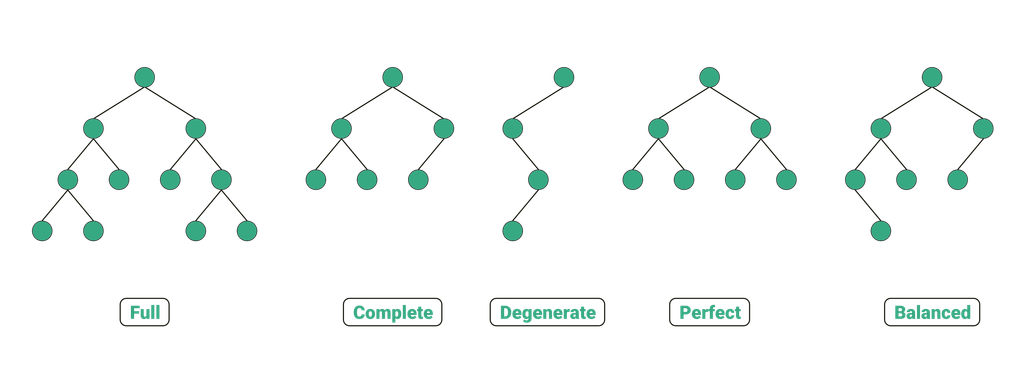
Binary trees can be classified into different types based on their structure.
1. Full Binary Tree
A full binary tree is a tree in which every node has either zero or two children. No node has only one child.
2. Complete Binary Tree
A complete binary tree has all levels completely filled except possibly the last level. The last level nodes are arranged from left to right without gaps.
3. Perfect Binary Tree
A perfect binary tree has all internal nodes with two children, and all leaf nodes are located at the same level.
4. Balanced Binary Tree
A balanced binary tree maintains a relatively equal height between its left and right subtrees. This helps improve searching and insertion performance.
5. Skewed Binary Tree
A skewed binary tree has nodes arranged mostly or entirely on one side. It can be left-skewed or right-skewed and may behave similarly to a linked list.
How to Implement a Binary Tree Using Python
Python allows us to implement a binary tree using a class. Each node contains three components: data, a reference to the left child, and a reference to the right child.
We can create a Node class to represent each element in the binary tree.
Step 1: Create a Node Class
class Node: def __init__(self, data): self.data = data self.left = None self.right = NoneIn this code:
datastores the value of the node.leftstores the reference to the left child.rightstores the reference to the right child.Noneindicates that the node does not have a child.
Step 2: Create Binary Tree Nodes
Now, we can create multiple nodes and connect them to form a binary tree.
root = Node(10)root.left = Node(20)root.right = Node(30)root.left.left = Node(40)root.left.right = Node(50)The above code creates a binary tree with 10 as the root node. The nodes 20 and 30 are connected to the root as left and right children. The nodes 40 and 50 are children of node 20.
Step 3: Display Binary Tree Values
We can access the values of the nodes using their references.
print("Root:", root.data)print("Left Child:", root.left.data)print("Right Child:", root.right.data)print("Left-Left Child:", root.left.left.data)print("Left-Right Child:", root.left.right.data)Output:
Root: 10
Left Child: 20
Right Child: 30
Left-Left Child: 40
Left-Right Child: 50
This demonstrates how Python objects can be connected to create a hierarchical data structure.
Binary Tree Traversal in Python
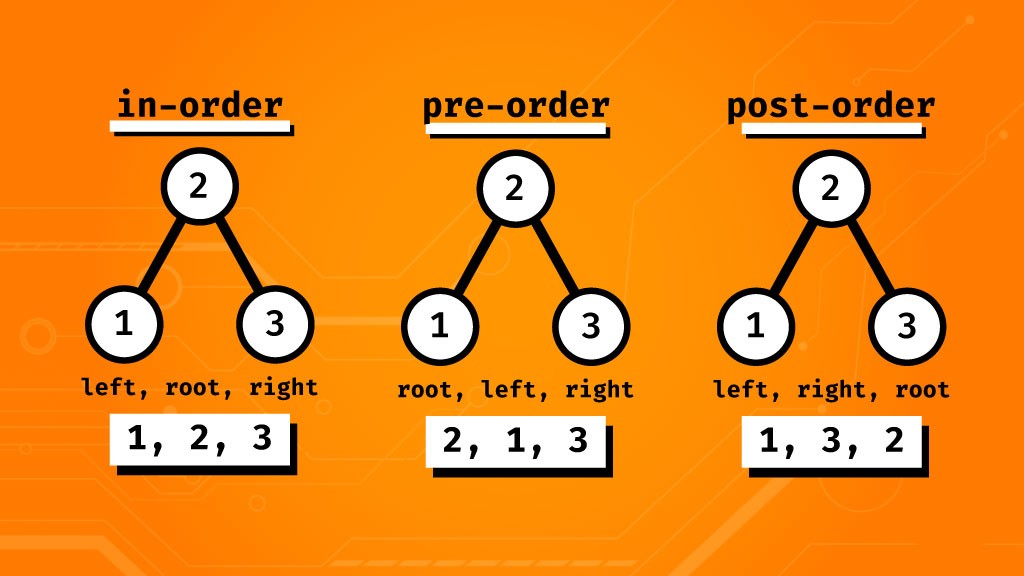
Traversal is the process of visiting every node in a tree in a particular order. The most common traversal techniques are inorder, preorder, postorder, and level-order traversal.
1. Inorder Traversal
In inorder traversal, nodes are visited in the following order:
Left → Root → Right
def inorder(root): if root: inorder(root.left) print(root.data, end=" ") inorder(root.right)inorder(root)Output:
40 20 50 10 30Inorder traversal is especially useful in Binary Search Trees because it produces values in sorted order.
2. Preorder Traversal
Preorder traversal visits nodes in the following order:
Root → Left → Right
def preorder(root): if root: print(root.data, end=" ") preorder(root.left) preorder(root.right)preorder(root)Output:
10 20 40 50 30Preorder traversal is useful for copying trees and generating tree representations.
3. Postorder Traversal
Postorder traversal visits nodes in the following order:
Left → Right → Root
def postorder(root): if root: postorder(root.left) postorder(root.right) print(root.data, end=" ")postorder(root)Output:
40 50 20 30 10Postorder traversal is useful when deleting trees or evaluating expression trees.
4. Level-Order Traversal
Level-order traversal visits nodes level by level, from left to right. It commonly uses a queue.
from collections import dequedef level_order(root): if root is None: return queue = deque([root]) while queue: node = queue.popleft() print(node.data, end=" ") if node.left: queue.append(node.left) if node.right: queue.append(node.right)level_order(root)Output:
10 20 30 40 50This method is useful when processing nodes based on their distance from the root.
Advantages of Binary Trees
Binary trees offer several advantages in programming and data management.
- Efficient searching: Binary Search Trees can search for elements efficiently when the tree is balanced.
- Hierarchical organization: They represent parent-child relationships naturally.
- Flexible memory allocation: Nodes can be created dynamically without allocating a fixed-size memory block.
- Efficient insertion and deletion: Tree-based structures can insert or remove elements without shifting other elements as in arrays.
- Supports multiple algorithms: Binary trees are useful for searching, sorting, traversal, and mathematical expression evaluation.
Time Complexity of Binary Tree Operations
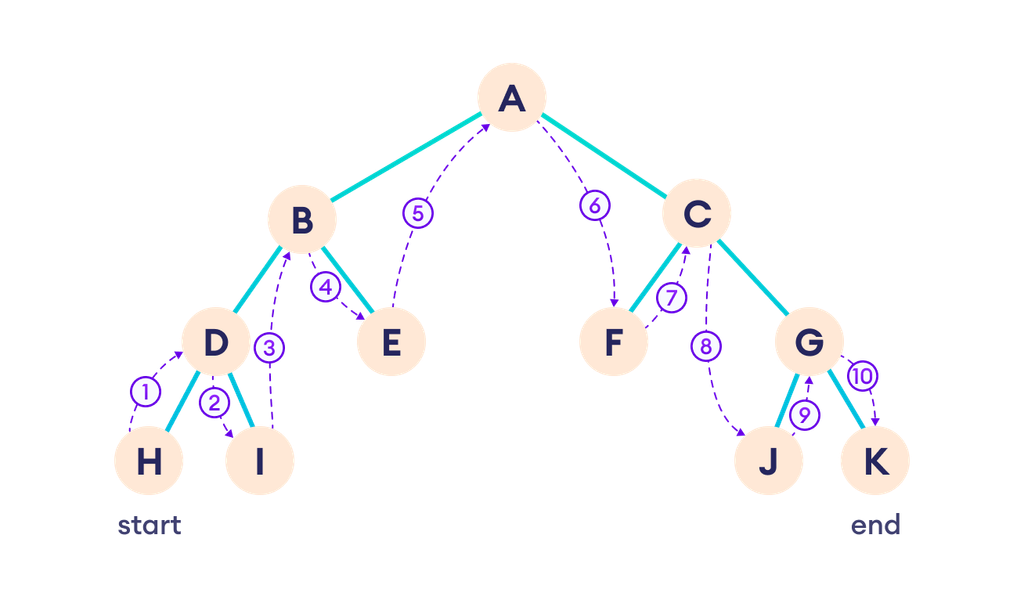
The performance of binary tree operations depends on the tree structure and the algorithm being used.
| Operation | Average (Balanced BST) | Worst Case |
|---|---|---|
| Search | O(log n) | O(n) |
| Insertion | O(log n) | O(n) |
| Deletion | O(log n) | O(n) |
| Traversal | O(n) | O(n) |
A balanced tree reduces the height of the tree, making searching, insertion, and deletion more efficient. In a skewed tree, these operations may take linear time because the tree behaves like a linked list.
Applications of Binary Trees
Binary trees are widely used in different areas of software development.
Searching and Sorting: Binary Search Trees help organize data and perform efficient search operations.
Database Indexing: Tree-based structures are used in database indexing to support efficient retrieval of information.
Expression Evaluation: Binary trees represent mathematical expressions such as addition, subtraction, multiplication, and division.
Compiler Development: Expression trees help compilers analyze and process mathematical and logical expressions.
File Systems: Hierarchical structures are used to represent directories, files, and their relationships.
Artificial Intelligence: Decision trees help machine learning algorithms make decisions based on conditions and input features.
Conclusion
Binary trees are fundamental data structures that help developers organize data in a hierarchical manner. Each node can have a maximum of two children, making binary trees useful for searching, sorting, traversal, and many other programming operations.
Python makes binary tree implementation simple using classes, objects, and recursive functions. By learning node creation, tree construction, and traversal methods such as inorder, preorder, postorder, and level-order, beginners can develop a strong understanding of tree-based data structures.
Binary trees are also the foundation for advanced structures such as Binary Search Trees, AVL Trees, Heaps, and other tree-based algorithms. Learning binary trees using Python is an important step toward improving problem-solving skills and preparing for data structure and algorithm interviews.
Want to Learn More About Python & Artificial Intelligence ???, Kaashiv Infotech Offers Full Stack Python Course, Artificial Intelligence Course, Data Science Course & More Visit Their Website course.kaashivinfotech.com.