Best Java Frameworks for Scalable Web Development in 2026
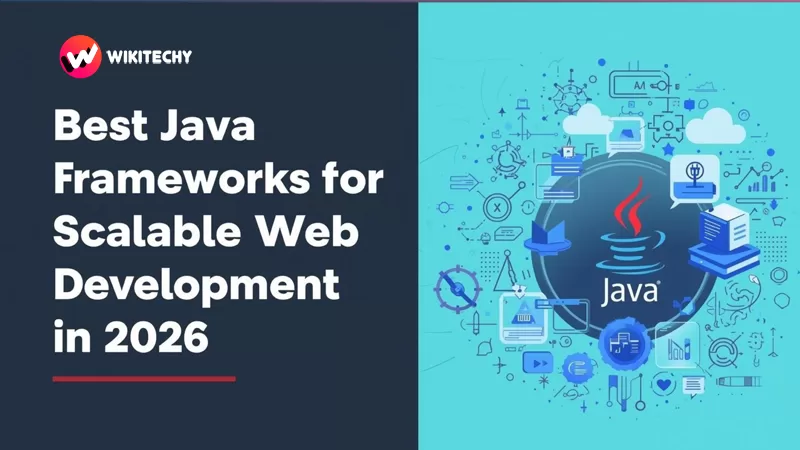
Java Frameworks – In today’s digital landscape, scalability is essential for handling growing users, data, and performance demands. Java remains a top choice due to its stability and powerful ecosystem. Let’s explore the best Java frameworks built for scalable web development.
🔝 Top Java Frameworks for Scalable Web Development
🔹 1. Spring Boot – The Backbone of Enterprise Applications
🔍 Overview
Spring Boot simplifies Java development by providing auto-configuration and ready-to-use components.
It eliminates complex setup and allows developers to build applications quickly.
It is widely used for enterprise-grade scalable systems.
⭐ Key Features:
- Auto-configuration and starter dependencies
- Embedded servers like Tomcat and Jetty
- Microservices support via Spring Cloud
- Strong security integration
🚀 Scalability Advantages:
Supports distributed systems, load balancing, and cloud deployment. Ideal for large-scale applications with heavy traffic.
🔹 2. Quarkus – Designed for Kubernetes & Cloud
🔍 Overview
Quarkus is a cloud-native Java framework optimized for containers and Kubernetes environments.
It provides extremely fast startup times and low memory usage.
It is designed for modern microservices architectures.
⭐ Key Features:
- Native image support with GraalVM
- Fast boot time
- Kubernetes and Docker ready
- Reactive programming support
🚀 Scalability Advantages:
Optimized for cloud environments, reducing infrastructure costs while improving performance.
🔹 3. Micronaut – High Performance with Low Overhead
🔍 Overview
Micronaut is a lightweight framework built for high-performance applications.
It uses compile-time dependency injection instead of runtime reflection.
This results in faster execution and reduced memory usage.
⭐ Key Features:
- No reflection
- Fast startup
- Low memory consumption
- Cloud-ready integrations
🚀 Scalability Advantages:
Perfect for microservices and serverless apps requiring speed and efficiency.
🔹 4. Jakarta EE – Enterprise-Grade Standard

🔍 Overview
Jakarta EE provides a standardized platform for enterprise Java development.
It includes specifications for security, persistence, and web services.
It is widely used in large and mission-critical systems.
⭐ Key Features:
- JPA, CDI, and Servlets
- Vendor-neutral architecture
- Strong security standards
🚀 Scalability Advantages:
Ensures reliability and scalability in enterprise environments like banking and telecom.
🔹 5. Dropwizard – Minimalist & Production-Ready
🔍 Overview
Dropwizard is a lightweight framework for building RESTful web services.
It combines essential libraries into a single package.
It simplifies development with minimal configuration.
⭐ Key Features:
- Built-in metrics
- Simple setup
- REST-focused architecture
- Fast deployment
🚀 Scalability Advantages:
Great for small, scalable services with low overhead.
🔹 6. Play Framework – Reactive and High Performance
🔍 Overview
Play Framework uses a reactive, non-blocking architecture.
It is designed to handle high concurrency efficiently.
It supports both Java and Scala development.
⭐ Key Features:
- Asynchronous processing
- Stateless architecture
- Hot reloading
- High throughput
🚀 Scalability Advantages:
Ideal for real-time applications with large user bases.
🔹 7. Helidon – Lightweight Microservices Framework
🔍 Overview
Helidon is a modern framework designed for microservices development.
It offers both reactive and MicroProfile-based models.
It is lightweight and optimized for cloud deployment.
⭐ Key Features:
- Reactive support
- Fast startup
- Kubernetes integration
- Lightweight runtime
🚀 Scalability Advantages:
Perfect for distributed systems and containerized applications.
🔹 8. Vaadin – Full-Stack Java Framework
🔍 Overview
Vaadin enables full-stack development using only Java.
It handles UI rendering on the server side.
It simplifies frontend and backend integration.
⭐ Key Features:
- Server-driven UI
- Rich components
- Rapid development
- Backend integration
🚀 Scalability Advantages:
Best suited for internal tools and business applications.
🔹 9. JHipster – Rapid Development Platform

🔍 Overview
JHipster is a development platform for generating full-stack applications.
It combines Java backend with modern frontend frameworks.
It accelerates development with pre-configured setups.
⭐ Key Features:
- Code generation
- Microservices support
- Angular/React integration
- DevOps tools
🚀 Scalability Advantages:
Speeds up building scalable applications with minimal effort.
🏁 Conclusion
Choosing the right Java frameworks depends on your scalability needs:
- 🏆 Spring Boot → Best overall
- ⚡ Quarkus & Micronaut → Best for cloud-native apps
- 🏢 Jakarta EE → Best for enterprise systems
- 🚀 Others → Specialized use cases
Java continues to evolve, making it a powerful choice for building highly scalable modern web applications.
Want to Learn More About Java ?, Kaashiv Infotech Offers, Full Stack Java Course, Java Course, Data Science Course, Internships & More, Visit Their Website www.kaashivinfotech.com.
Related Reads: