BFSI Meaning: Full Form, Scope, Jobs, Salary and Career Guide
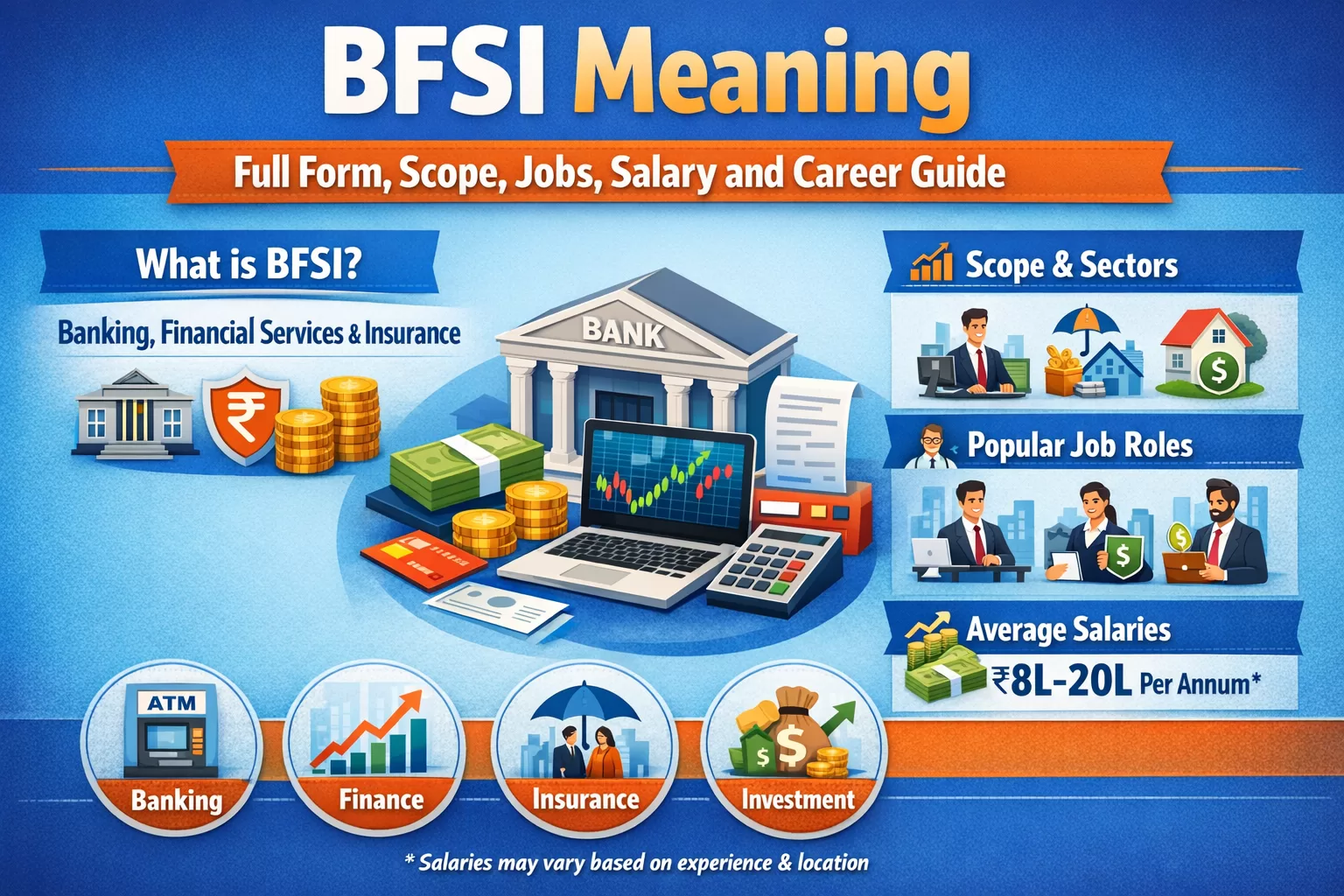
Discover BFSI meaning, full form, sector scope, job opportunities, skills, and salary details in this simple and complete guide.
The term BFSI is very common in the world of banking, finance, and insurance. If you are a student, job seeker, business owner, or simply curious about financial industries, understanding bfsi meaning can be very helpful.
In simple words, BFSI stands for Banking, Financial Services, and Insurance. These three sectors are deeply connected and together form one of the most important pillars of a country’s economy. From opening a bank account and getting a loan to investing money or buying health insurance, BFSI touches almost every part of our daily lives.
Today, the BFSI sector is growing faster than ever. Thanks to technology, mobile banking, digital payments, online insurance, and fintech innovations, this industry has become more modern, accessible, and full of opportunities.
If you enjoy reading simple tech and career guides like this, you can also explore more useful articles on Wikitechy.
What is the Full Form of BFSI?
The full form of BFSI is:
Banking, Financial Services, and Insurance
It is a collective term used to describe industries that deal with:
- Managing money
- Providing loans and credit
- Handling investments
- Offering financial advice
- Protecting people and businesses through insurance
These sectors work together to support individuals, companies, and even governments.
BFSI Meaning Explained in Simple Words
If you are wondering about the exact bfsi meaning, here is the easiest explanation:
BFSI refers to all organizations and services involved in banking, finance, and insurance.
This includes:
- Banks
- NBFCs
- Fintech companies
- Insurance firms
- Mutual fund companies
- Investment firms
- Payment service providers
In everyday life, BFSI helps people save money, transfer funds, take loans, invest for the future, and stay protected from risks.
So, whenever you use internet banking, apply for a credit card, invest in mutual funds, or buy health insurance, you are already using BFSI services.
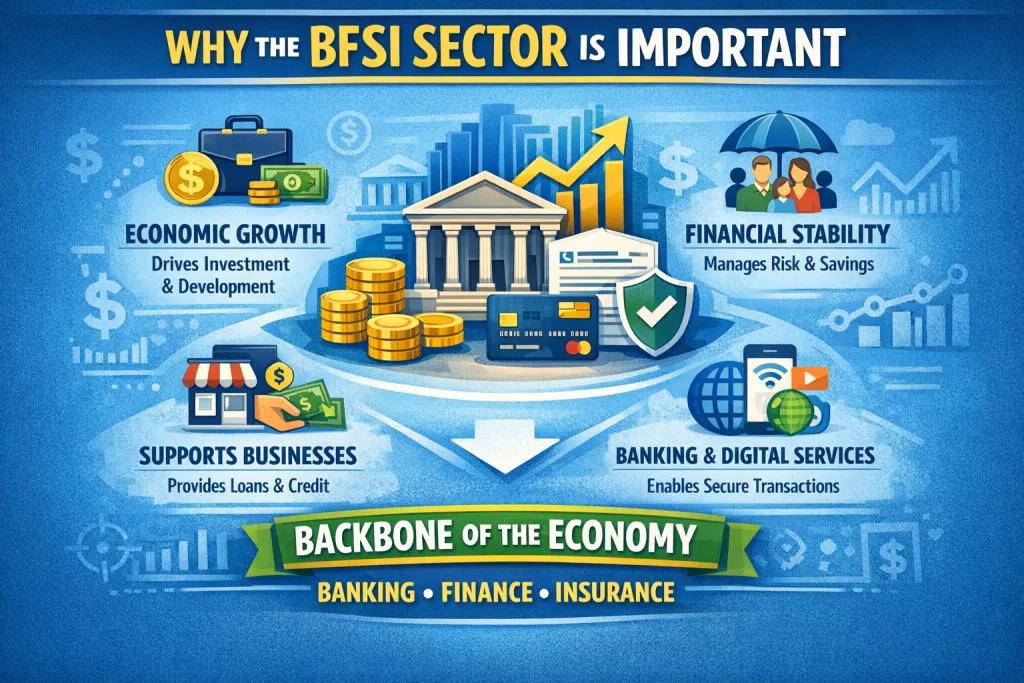
Why the BFSI Sector is Important
The BFSI sector plays a major role in the growth and stability of an economy. It keeps the financial system running smoothly and supports both personal and business financial needs.
Key reasons why BFSI is important:
- It enables safe money deposits and withdrawals
- It provides loans for education, homes, and businesses
- It promotes savings and investments
- It offers insurance against financial loss
- It supports digital transactions and cashless payments
- It helps businesses grow through funding and financial planning
Without BFSI, managing money and protecting financial interests would be extremely difficult.
For readers who want to understand how technology influences major industries, the resources available on Wikitechy can be a great starting point.
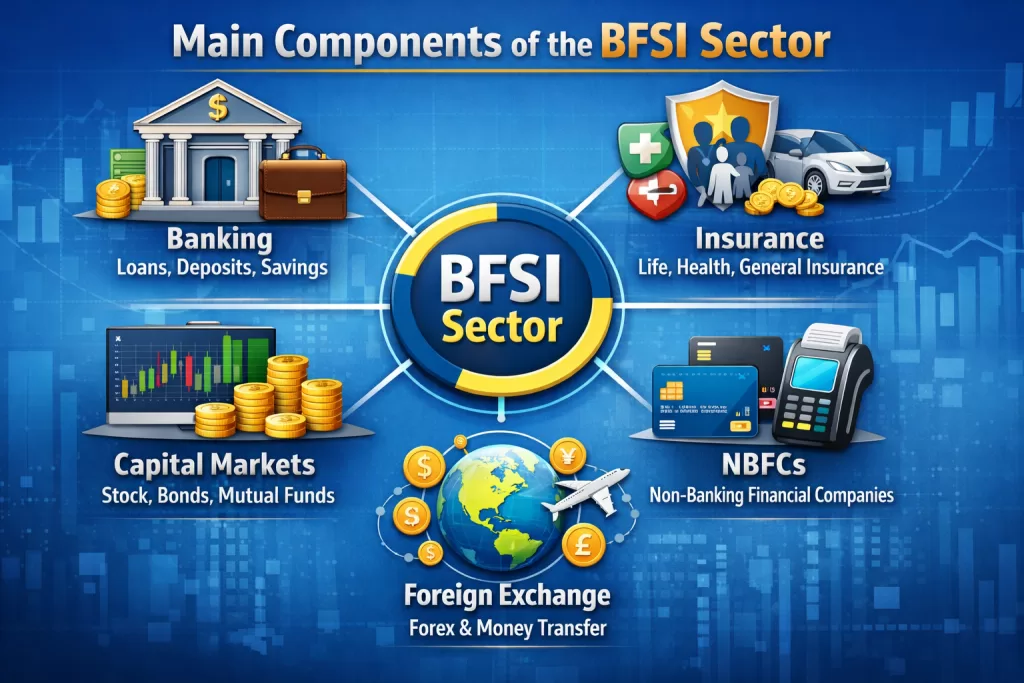
Main Components of the BFSI Sector
To fully understand bfsi meaning, it is important to know the three major parts of this sector.
1. Banking
Banking is the first and most familiar part of BFSI. Banks provide a wide range of services to individuals and businesses.
Banking services include:
- Savings and current accounts
- Fixed deposits
- Personal loans
- Home loans
- Education loans
- Debit and credit cards
- Fund transfers
- KYC verification
- ATM and online banking services
Banks are the foundation of the financial system because they help people store, borrow, and transfer money safely.
For official banking awareness and customer information in India, you can visit the Reserve Bank of India (RBI).
2. Financial Services
Financial services cover many activities related to investment, asset management, advisory, and wealth creation.
Examples of financial services:
- Mutual funds
- Stock broking
- Investment banking
- Financial planning
- Wealth management
- Asset management
- Credit services
- Payment solutions
- Advisory services
This part of BFSI helps people and businesses make better financial decisions and grow their money over time.
To learn more about how India’s securities and investment markets are regulated, you can refer to the SEBI official website.
3. Insurance
Insurance is the risk protection part of the BFSI sector. It provides financial security against unexpected losses.
Types of insurance services:
- Life insurance
- Health insurance
- Vehicle insurance
- Travel insurance
- Property insurance
- Business insurance
- General insurance
Insurance companies protect people and businesses from financial uncertainty, which makes them an essential part of BFSI.
For trusted information about insurance regulations in India, visit the IRDAI website.
BFSI Full Form in Banking
Many people search for the BFSI full form in banking because the term is widely used in the banking industry.
In banking, BFSI still means Banking, Financial Services, and Insurance. It refers to the larger ecosystem in which banks operate along with financial institutions and insurance providers.
Banks are a major part of BFSI, but they do not work alone. Modern banking often overlaps with financial products and insurance services. For example:
- A bank may offer insurance policies
- Banks may sell mutual funds
- Financial apps may provide banking and lending services
- Insurance companies may partner with banks for policy distribution
This is why the term BFSI is used so often.
If you like industry explainers like this, browse more educational content on Wikitechy.
What Comes Under the BFSI Domain?
The BFSI domain is broad and includes many organizations and roles. It is not limited to traditional banks only.
The BFSI domain includes:
- Public sector banks
- Private banks
- Cooperative banks
- NBFCs
- Fintech startups
- Insurance companies
- Credit card companies
- Mutual fund houses
- Investment firms
- Loan providers
- Payment gateways
- Wealth management companies
Because of this wide scope, the BFSI sector offers many career paths and business opportunities.
Benefits of the BFSI Sector
The BFSI industry is one of the most attractive sectors for career growth and economic development.
Major benefits of the BFSI sector:
- Strong and stable industry
- High employment opportunities
- Good growth for freshers and experienced professionals
- Multiple job roles available
- Increasing demand due to digital transformation
- Scope for career switching and internal growth
- Opportunities in both sales and non-sales roles
One of the biggest advantages of BFSI is that it welcomes people from different educational backgrounds. Whether someone has studied commerce, management, finance, economics, or even general graduation, there are many opportunities available.
Career Opportunities in the BFSI Sector
If you are exploring jobs in this field, understanding bfsi meaning can open the door to many possibilities.
The BFSI sector offers a wide range of job profiles across banking, finance, and insurance.
Popular job roles in BFSI:
- Retail Banking Executive
- Corporate Banking Associate
- KYC Verification Officer
- Relationship Manager
- Account Manager
- Payment Solutions Executive
- Loan Processing Associate
- Onboarding Associate
- Insurance Advisor
- Mutual Fund Agent
- Credit Analyst
- Stock Broker
- Investment Banking Analyst
- Merchant Support Executive
- Customer Service Executive
There are also many entry-level jobs for freshers, especially in sales, operations, support, and customer handling roles.
You can also check useful career and technical guides on Wikitechy to improve your knowledge and job readiness.

Skills Required for BFSI Jobs
To succeed in BFSI, you need a mix of technical knowledge and soft skills. The good thing is that you do not need to be perfect from day one. With learning and practice, anyone can build a strong career in this sector.
Important skills for BFSI careers:
- Communication skills
- Financial knowledge
- Analytical thinking
- Problem-solving ability
- Time management
- Adaptability
- Customer handling
- Sales and marketing skills
- Attention to detail
- Self-management
- Organizing skills
- Effective listening
If you are applying for banking or financial jobs, having basic knowledge of financial products, compliance, customer service, and digital tools can be very useful.
BFSI Salary for Different Roles
Salaries in the BFSI sector depend on experience, job role, location, company, and qualifications. Entry-level salaries are usually decent, and growth can be fast for skilled professionals.
Average entry-level salary range in BFSI:
| Job Role | Minimum Qualification | Salary Per Annum |
|---|---|---|
| Business Correspondent / Facilitator | 10th Pass | Rs. 4,00,000 to Rs. 10,00,000 |
| Debt Recovery Agent | High School | Rs. 2,00,000 to Rs. 4,00,000 |
| Credit Processing Associate | Bachelor’s Degree | Rs. 3,00,000 to Rs. 5,00,000 |
| Microfinance Executive | Bachelor’s Degree | Rs. 2,00,000 to Rs. 4,00,000 |
| Insurance Agent | High School / Diploma | Rs. 2,00,000 to Rs. 4,00,000 |
| Mutual Fund Agent | High School / Diploma | Rs. 2,00,000 to Rs. 4,00,000 |
| Accounts Executive / Assistant | Bachelor’s Degree | Rs. 2,00,000 to Rs. 4,00,000 |
Important note:
These salary figures are approximate and may vary depending on:
- City
- Employer
- Work experience
- Certifications
- Performance
- Sales targets
With experience, professionals in BFSI can earn very attractive salary packages.
How Technology is Changing the BFSI Industry
Technology has transformed the BFSI sector in a major way. In the past, banking and insurance services were mostly offline. Today, many services are available instantly through websites and mobile apps.
Key technological changes in BFSI:
- Online banking
- Mobile wallets
- UPI payments
- Digital lending
- Robo-advisory
- AI-based fraud detection
- Insurance tech platforms
- Chatbots for customer support
- Paperless KYC
- Cloud-based financial solutions
This digital shift has created new job opportunities not only in finance but also in IT and software development.
To understand the broader impact of digital payments and fintech growth, you may also explore reports from the National Payments Corporation of India (NPCI).
BFSI in Software and IT
In the software and technology world, BFSI refers to digital solutions made specifically for the banking, financial services, and insurance industries.
Examples of BFSI software solutions:
- Core banking systems
- Loan management software
- Payment gateways
- Fraud detection systems
- Financial analytics platforms
- Insurance claim systems
- Mobile banking apps
- Compliance and KYC tools
Tech professionals working in this domain help financial institutions become faster, more secure, and more customer-friendly.
For more simple technical articles and digital industry explainers, visit Wikitechy.
Why BFSI is a Good Career Choice
Many people choose BFSI because it offers both stability and growth. It is a sector where hard work, communication, and continuous learning can take you a long way.
Reasons to choose a career in BFSI:
- Growing industry
- Large number of job openings
- Scope for promotions
- Strong salary growth
- Opportunities in urban and rural areas
- Exposure to real-world financial systems
- Suitable for freshers and experienced candidates
Whether you want to work in a bank branch, a fintech startup, an insurance company, or an investment firm, BFSI has something for everyone.
Conclusion
Understanding bfsi meaning is important because this sector affects almost every part of our financial lives. The full form of BFSI is Banking, Financial Services, and Insurance, and together these industries create a strong financial ecosystem for individuals, businesses, and governments.
From savings accounts and loans to investments and insurance coverage, BFSI offers essential services that support economic growth and financial security. It is also one of the most promising career fields today, offering a wide variety of job roles, salary growth, and long-term opportunities.
As technology continues to reshape banking and finance, the BFSI sector will only become bigger and more dynamic. So if you are planning your career, starting a financial journey, or simply learning about modern industries, knowing the true bfsi meaning is a great place to begin.
For more informative articles, career guides, and tech-related content, don’t forget to explore Wikitechy.
FAQs on BFSI Meaning
What is the meaning of BFSI?
BFSI means Banking, Financial Services, and Insurance. It refers to industries that provide banking, investment, credit, and insurance-related services.
What does BFSI stand for in banking?
In banking, BFSI stands for Banking, Financial Services, and Insurance. It represents the larger financial ecosystem in which banks operate.
What are the main components of the BFSI sector?
The BFSI sector has three main components:
Banking, Financial Services, Insurance
What comes under the BFSI domain?
The BFSI domain includes banks, NBFCs, fintech companies, insurance firms, mutual fund companies, stock brokers, and payment service providers.
Is BFSI a good career option?
Yes, BFSI is a strong career option because it offers job stability, growth opportunities, decent salaries, and many roles for freshers and experienced professionals.