

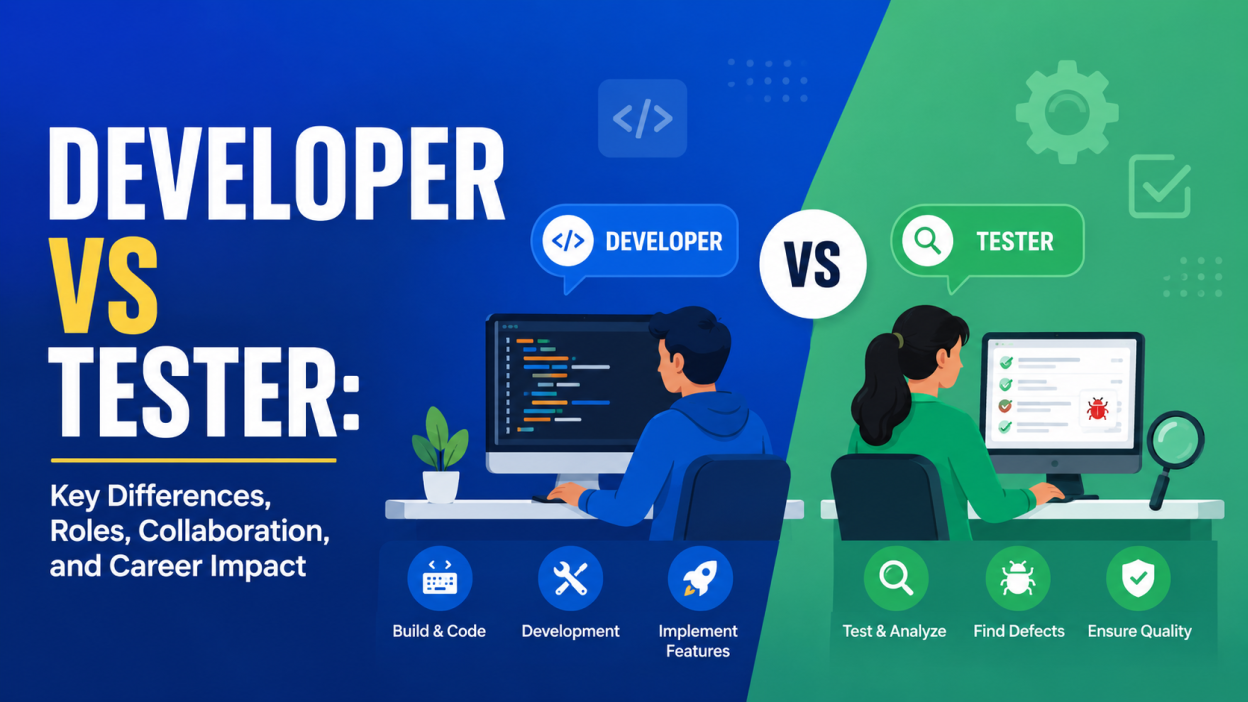
Software development is not only about writing code. Behind every reliable website, mobile application, or enterprise platform, multiple professionals work together to build, test, improve, and maintain the product. Among the most important roles are software developer vs tester.
Developers focus primarily on creating and improving software, while testers examine the software from different perspectives to identify defects, usability problems, and unexpected behavior. However, modern Agile and DevOps practices have made the relationship between these roles much more collaborative. Developers are increasingly involved in testing, while testers often need programming and automation skills.
So, what exactly is the difference between a developer and a tester? What are their responsibilities, skills, tools, and career opportunities? More importantly, how do they work together to deliver better software?
Let’s explore everything you need to know.
What Does a Software Developer Do?

A software developer is responsible for designing, building, maintaining, and improving software applications. Developers transform business requirements and ideas into functional software using programming languages, frameworks, databases, and development tools.
Depending on their specialization, developers may work on frontend interfaces, backend systems, mobile applications, databases, cloud platforms, or full-stack applications.
Key Responsibilities of Developers
A developer’s responsibilities commonly include:
- Understanding project requirements
- Designing software solutions
- Writing and maintaining code
- Developing new features
- Debugging application problems
- Performing unit testing
- Optimizing application performance
- Reviewing code
- Managing source code with version-control systems
- Working with testers and other team members
- Fixing defects identified during testing
- Maintaining and updating existing applications
Developers need strong programming knowledge and problem-solving abilities. Popular programming languages include Java, Python, JavaScript, C#, and C++.
Modern developers also work with technologies such as Git, APIs, databases, cloud platforms, containers, and CI/CD pipelines.
What Does a Software Tester Do?
A software tester or QA professional evaluates software to determine whether it meets functional and quality expectations. Instead of focusing primarily on building features, testers focus on finding situations where the software does not behave as expected.
Testing can include manual testing, automation testing, functional testing, regression testing, performance testing, API testing, usability testing, and other specialized approaches.
Key Responsibilities of Testers
Testers typically:
- Analyze software requirements
- Create test scenarios and test cases
- Execute manual and automated tests
- Identify and document defects
- Reproduce reported problems
- Perform regression testing
- Validate fixes
- Test different user workflows
- Check application usability
- Verify requirements
- Prepare test reports
- Collaborate with developers to resolve defects
A tester needs curiosity, analytical thinking, attention to detail, communication skills, and an understanding of how users interact with software.
Automation testers additionally require programming knowledge and experience with testing frameworks and tools.
Developer vs Tester: Key Differences
Although developers and testers work toward the same business goal, their responsibilities and perspectives are different.
| Factor | Developer | Tester |
|---|---|---|
| Primary Focus | Building software | Evaluating software quality |
| Main Objective | Create functional features | Find defects and validate behavior |
| Mindset | Build and solve | Analyze and challenge |
| Main Output | Source code and features | Test results and defect reports |
| Common Skills | Programming, algorithms, architecture | Testing, analysis, automation |
| Testing | Unit and developer-level testing | Functional, regression, system and other testing |
| Common Tools | IDEs, Git, Docker, frameworks | Selenium, Postman, Jira, test frameworks |
| Success Measure | Reliable feature implementation | Effective defect detection and quality validation |
The simplest way to understand the difference is this:
Developers build the product. Testers challenge the product to make sure it works correctly.
However, this does not mean developers are unconcerned about quality or testers simply wait for developers to finish coding. Modern software teams increasingly share quality responsibilities throughout development.
Developer and Tester Collaboration

The relationship between developers and testers should not be viewed as a competition.
A developer might say, “This feature works correctly.”
A tester might respond, “It works for this scenario, but what happens when the user does something unexpected?”
Both perspectives are valuable.
Effective collaboration allows teams to discover problems earlier, reduce unnecessary rework, improve communication, and deliver more reliable applications. Early collaboration can also reduce the gap between development completion and testing readiness.
1. Requirement Discussion
Testing should begin before the final code is written.
Testers can participate in requirement discussions and identify unclear requirements, missing scenarios, or potential usability problems.
For example, if a requirement says:
“Users should be able to reset their password.”
A tester may ask:
- What happens if the email address is invalid?
- What if the reset link expires?
- Can the same link be used twice?
- What happens if the user enters an incorrect password?
- What security restrictions should apply?
These questions can help developers understand the complete requirement before implementation.
2. Development and Unit Testing
Developers write code and generally perform unit-level checks to verify individual components.
For example, a developer building a login system might test whether the authentication function correctly handles valid credentials.
3. Functional Testing
After the feature becomes available for testing, testers evaluate the complete functionality.
They may test successful login, incorrect passwords, empty fields, account lockouts, session behavior, and other scenarios.
4. Bug Reporting and Fixing
When testers discover a defect, they document the issue with relevant information such as:
- Steps to reproduce
- Expected result
- Actual result
- Environment
- Screenshots or logs
- Severity and priority
Developers investigate the issue, identify the root cause, implement a fix, and return the feature for verification.
5. Regression Testing
After a bug is fixed, testers need to verify the fix and make sure the change has not broken another part of the application.
This is particularly important for large applications where one code change can affect multiple features.
Why Developer-Tester Collaboration Matters
Strong collaboration can have a significant impact on the software development lifecycle.
Better Software Quality
Developers understand implementation details, while testers approach the application from a validation and user perspective. Combining both perspectives can improve overall quality.
Faster Bug Detection
When testers participate early, potential problems can be identified before they become expensive to fix.
Reduced Rework
Clear communication between developers and testers reduces misunderstandings and prevents teams from repeatedly revisiting the same requirements.
Better User Experience
Testers do more than search for technical defects. They can also identify confusing workflows, inconsistent interfaces, and usability problems that may affect users.
Faster Releases
Automation, continuous testing, and collaboration can help teams receive faster feedback during development and support frequent software releases.
Common Challenges Between Developers and Testers
Despite working toward the same goal, disagreements can occur.
Different Priorities
Developers may focus on implementing features and meeting delivery deadlines, while testers may focus on discovering as many risks as possible.
Communication Gaps
A poorly written bug report can make it difficult for a developer to reproduce the issue. Similarly, developers may not always provide enough information about a feature.
“Works on My Machine”
A developer may successfully run a feature in one environment while the tester encounters a problem in another.
Differences in operating systems, browsers, databases, configurations, or dependencies can cause such situations.
Time Pressure
When release deadlines are tight, testing time may be reduced. This can increase the risk of unresolved defects reaching production.
Misunderstanding the Tester’s Role
Testing is sometimes incorrectly viewed as simply clicking buttons and reporting bugs. Professional testing requires analytical thinking, planning, technical knowledge, risk analysis, and strong communication.
Tools Used by Developers and Testers
Technology plays an important role in collaboration.
Developer Tools
Developers commonly use:
- Visual Studio Code
- IntelliJ IDEA
- Eclipse
- Git
- GitHub
- Docker
- Postman
- Programming frameworks
- CI/CD platforms
Testing Tools
Testers may work with:
- Selenium
- Playwright
- Cypress
- Postman
- JUnit
- TestNG
- Appium
- Jira
- Jenkins
The exact toolset depends on the project, technology stack, testing strategy, and team.

Automation Is Changing Both Roles
The traditional boundary between developers and testers is becoming less rigid.
Automation testing requires testers to understand programming, frameworks, APIs, databases, and CI/CD environments. At the same time, developers are increasingly expected to write unit tests and contribute to automated quality checks.
This has contributed to the growth of roles such as SDET (Software Development Engineer in Test), which combines software development and testing expertise.
AI is also changing development and testing workflows. AI-powered tools can assist with code generation, test-case creation, test maintenance, debugging, and identifying potential issues. However, human judgment remains important for understanding requirements, business risks, user expectations, and complex application behavior.
Developer or Tester: Which Career Should You Choose?
The right career depends on your interests and strengths.
Choose software development if you enjoy:
- Programming
- Building applications
- Problem-solving
- Designing software
- Learning programming languages
- Creating new features
Choose software testing if you enjoy:
- Finding problems
- Analyzing requirements
- Thinking about edge cases
- Understanding user behavior
- Quality assurance
- Manual or automated testing
If you enjoy both programming and quality engineering, an automation testing or SDET career can be an excellent option.
Neither career should be considered automatically better. Both are important parts of modern software engineering teams, and career growth depends heavily on technical skills, experience, specialization, and continuous learning.
Best Practices for Developer-Tester Collaboration
Organizations can improve collaboration by following a few practical approaches.
Involve testers early: Testers should participate in requirement and planning discussions instead of entering the process only after development is complete.
Communicate clearly: Developers and testers should use clear technical language and provide sufficient information when discussing defects.
Automate repetitive testing: Automation can reduce repetitive manual work and provide faster feedback.
Share knowledge: Developers can learn testing concepts, while testers can improve their programming and technical skills.
Use common tracking tools: Platforms such as Jira and shared communication systems make it easier to track requirements, defects, and progress.
Focus on the product, not blame: A defect should be treated as a product problem rather than an opportunity to blame an individual.
Conclusion
The debate between developer vs tester should not be about deciding which role is more important. Developers and testers perform different but complementary responsibilities.
Developers transform requirements into working software, while testers evaluate that software from functional, technical, and user perspectives. When both teams communicate effectively and collaborate throughout the software development lifecycle, they can identify problems earlier, reduce rework, improve user experience, and deliver higher-quality products.
Modern Agile, DevOps, automation, and AI-driven development are also bringing these roles closer together. Developers are becoming more involved in testing, while testers are developing stronger programming and automation capabilities.
Ultimately, the strongest software teams are not those where developers and testers work separately. They are teams where both roles work together with one shared goal: building reliable, secure, and user-friendly software.
If You Want to study Software Testing Course, or any other course & Internship visit www.kaashivinfotech.com