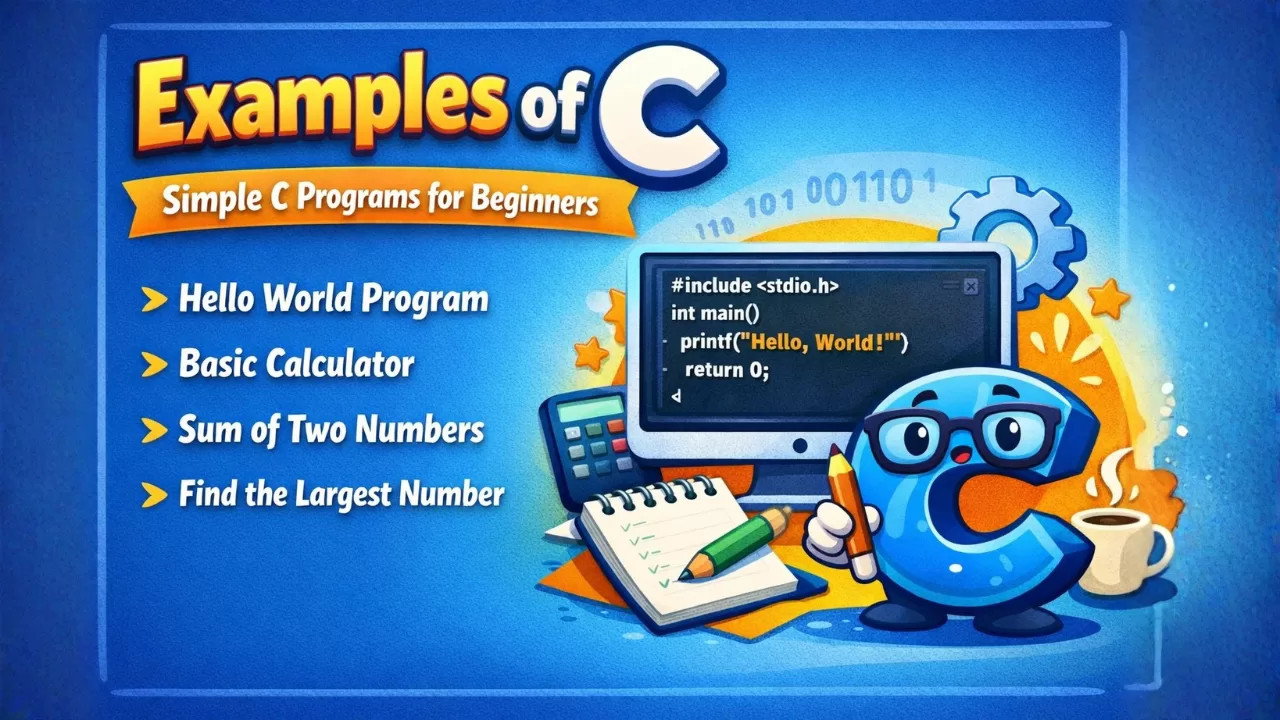
Examples of C: Simple C Programs for Beginners
Are you new to programming and feeling a bit lost? You are not alone. Many people find it hard to go from theory to code. This is where simple C examples come in. They help you understand concepts and see real results.
Examples of C: Simple C Programs for Beginners
In this guide we share simple C programs to help you learn faster. Whether you need to do math use loops or check conditions these C examples cover what you need to know. We include explanations, working code and expected outputs so you can check your understanding right away.
Why Start with Basic C Programs?
Before you dive into algorithms or advanced data structures it is essential to build a strong foundation. Basic C programs help beginners understand the structure, syntax and logical flow needed to write working software.
When you practice code you get confident in how the computer processes instructions. You learn how variables store data how operators do calculations and how the main() function works as the starting point. Without mastering these basics tackling topics like arrays, pointers or recursion becomes much harder. By practicing these examples you are essentially training your brain to think like a programmer.
Basic Programs in C
Let’s start with some code. These sections have C program examples that almost every student needs to master.
Example: Print “Hello, World!”
Every journey begins with a step. In programming that step is usually printing text to the screen. This program shows the structure of any C application.
C#include <stdio.h>

int main() {
   printf("Hello, World!");
   return 0;
}
Explanation:
- #include <stdio.h>: This line brings in the Standard Input/Output library. Without it your computer wouldn’t know how to read or print data.
- main(): This is the command center. Every C program starts here.
- printf(): This sends the text inside the quotes to your console.
- return 0;: This tells the operating system that the program ended successfully.
Example: Add Two Numbers
Once you know how to print the next logical step is calculation. This basic C program code takes user input does math and shows the result.
C#include <stdio.h>

int main() {
   int a, b, sum;

   printf("Enter two numbers: ");
   scanf("%d %d", &a, &b);

   sum = a + b;

   printf("Sum = %d", sum);

   return 0;
}
What You Learn Here:
- Variables (int): How to reserve memory spaces for numbers.
- Input Handling (scanf): How to let the user interact with your program.
- Arithmetic: The basics of addition and storing the result back into a variable.
This simple operation teaches you the Input → Process → Output cycle used in almost every software project.
Simple C Programs for Beginners
Moving beyond math we look at decision-making. Real-world software often needs to make choices like checking if a login ID is valid or if a number is even. These simple C programs focus on logic.
Example: Check If a Number Is Even or Odd
One of the common tasks in early programming is using conditional statements. This simple C program shows how if-else blocks work.
C#include <stdio.h>

int main() {
   int num;

   printf("Enter a number: ");
   scanf("%d", &num);

   if (num % 2 == 0) {
      printf("%d is Even", num);
   } else {
      printf("%d is Odd", num);
   }

   return 0;
}
Output Example:
textEnter a number: 7
7 is Odd
Why This Helps Beginners:
- Modulus Operator (%): You learn how to find remainders, which is key for parity checks.
- Conditional Logic: Understanding that code can branch based on truth values.
- Verification: Seeing the output match your expectation builds confidence in debugging.
Other Simple C Codes for Practice
To truly solidify your knowledge you need to practice iteration. Try these exercises:
- Print Numbers From 1 to 10: Teaches you the for loop structure.
- Print Alphabets From A to Z: Introduces character handling and ASCII values.
- Find Square of a Number: Reinforces multiplication and variable usage.
C Programs for Beginners: Advanced Basics
Once you are comfortable with the basics you can tackle more complex logic involving geometry, finance and comparison.
Examples of C: Simple C Programs for Beginners
Beginner C Programs List
If you are preparing for exams having a list of must-know programs helps. Here are three critical ones to master:
- Program to Find Maximum of Two Numbers: Uses if-else to compare values.
- Program to Check Positive or Negative: Extends the logic to handle zero as a case.
- Calculate Area of a Rectangle: Requires floating-point numbers (float) for precision.
C Programming Basics Program
Let’s look at a real-world calculation. Calculating interest is a common task in business software. Here is a C programming basics program that calculates Simple Interest.
C#include <stdio.h>

int main() {
   float p, r, t, si;

   printf("Enter principal, rate and time: ");
   scanf("%f %f %f", &p, &r, &t);

   si = (p * r * t) / 100;

   printf("Simple Interest = %.2f", si);

   return 0;
}
What You Learn:
- Float Variables: Using %.2f ensures the output shows two decimal places.
- Formulas: Translating math equations into code.
C Program Examples for Practice
To move from a beginner to a coder you must solve problems independently. The following C program examples introduce algorithms that require thought.
Some C Programs for Practice
- Sum of First N Natural Numbers: Uses a loop to accumulate a total.
- Reverse a Number: Requires manipulation inside a while loop.
- Count Digits in a Number: Tests your ability to strip digits one by one.
C Program Exercises
Ready to test your skills? Here are three exercises that appear frequently in college assignments and interviews.
Exercise 1: Factorial of a Number
C// Calculates n! Using a loop
// Concept: Accumulation in multiplication
Exercise 2: Palindrome Checker
C// Reverses the number and compares it to the original
// Concept: String logic applied to integers
Exercise 3: Greatest Among Three Numbers
C// Compares a > b AND a > c
// Concept: Nested conditions
These C program exercises force you to debug and refine your logic, which is vital for career readiness.
Understanding C Language Keywords
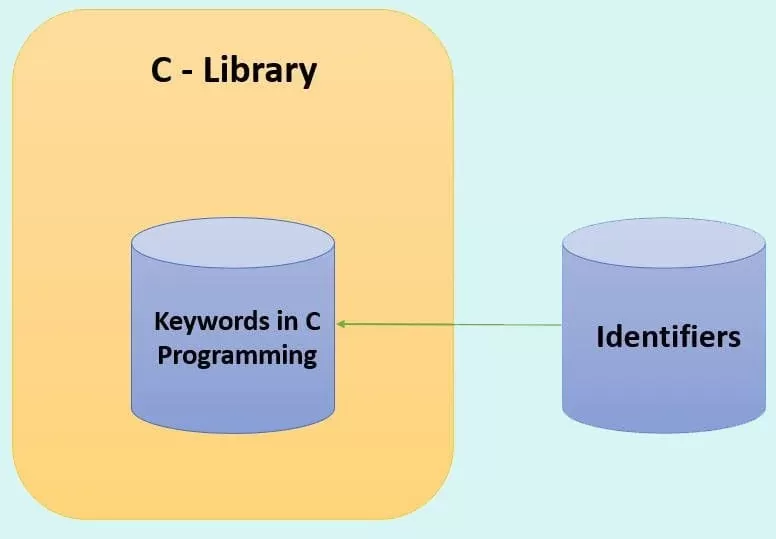
Part of writing code is knowing the rules. C language keywords are reserved words you cannot change.
List of Keywords in C
Understanding the list of keywords in C prevents compilation errors.
- Data Type Keywords: int, float, double, char, void.
- Storage Class Keywords: auto, extern, register, static.
- Control Flow Keywords: if, else, switch, case, default, for, while.
- Type Modifiers: short, long, signed, unsigned.
C Programming Examples With Output
Visual feedback is powerful. Seeing the C programming examples allows you to visualize how your code executes line-by-line.
Why See the Output?
When you run C programming examples you verify two things:
- Syntax Accuracy: Did the compiler accept the code?
- Logic Accuracy: Does the output match the result?
PDF Resources for Offline Study
We offer C Programming Examples PDF. This resource includes:
- Code snippets.
- Step-by-step solutions.
- Visual diagrams explaining logic flow.
C Codes & Code Examples for Daily Practice
Consistency is key. Regularly reviewing C codes and code examples keeps your memory sharp.
C Language Codes for Beginners
Below are code patterns you should memorize or reference often:
- Square of a Number: Essential for math apps.
- Swap Two Numbers: Demonstrates the need for storage.
- Fahrenheit to Celsius: Shows formula implementation in code.
Why Practice C Programming Examples?
Many students ask, “Is practice really necessary?” The answer is yes. There are reasons why practicing these C examples is beneficial.
Benefits of Practicing C Programming Examples
- Strengthens Core Concepts: You really understand how variables work when you practice.
- Improves Debugging Skills: When your program crashes you learn to read error messages and fix it.
- Builds Problem-Solving Skills: Coding is like solving puzzles; practice makes you faster.
- Interview Preparation: Most technical interviews start with C programs on a whiteboard.
Quick Reminder for Students
Don’t rush. Start with things like printing text. Then add inputs and logic. If you try to build something on day one you’ll get frustrated. Stick to C examples that match your skill level.
Become A C,C# andC++ Developer With Kaashiv Infotech
Looking to dive into the world of software development and carve your path to success? Kaashiv Infotech is here for you! Our specialized Inplant Training (IPT) and certification programs are specially designed by industry experts to equip you with practical C,,C# and C++ skills and real-world experience that will help you set your foot in the competitive tech industry.
Let’s break down our course offerings to see what makes our course stand out
Live Industry Projects + Capstone: You’ll work on 2 real-time industry projects per internship to build a solid portfolio and enhance your learning with a capstone project that showcases your C/C#/C++ development expertise.
Practice Exercises: Get hands-on practice with daily coding drills tailored to C, C#, and C++ that enhance your learning and help you master core programming concepts, memory management, and OOP principles.
Doubt Clearing Sessions: Our regular doubt-clearing sessions ensure that no question goes unanswered, giving you clarity on complex algorithms, debugging, and system architecture.
Kaashiv Coding Lab: Access our exclusive development labs for uninterrupted practice and polish your C skills in a structured, supportive environment.
Industry-Oriented Curriculum: Learn modern, industry-relevant C# development techniques and frameworks that are directly applicable to real-world software engineering scenarios.
Triple Certification Credential: Earn Kaashiv’s prestigious Triple Certification upon completion—Internship Certificate, IPT Certificate, and Industrial Exposure Certificate—recognized and highly valued by employers in the tech industry.
Q&A Forum: Engage with fellow trainees and mentors in our collaborative Q&A forum to exchange ideas, debug code, seek advice, and collaborate on development challenges.
Expert-Led Sessions by Industry Leaders: Benefit from interactive training led by Microsoft MVPs and Google-recognized experts who guide you every step of the way through your C++ learning journey.
Interview Opportunities: Gain access to curated interview opportunities, targeted career guidance, and exclusive interview question banks to help you land your dream job in software development.
100% Job Assistance Guarantee + Kaashiv Alumni Support: We’re offering 100% job assistance along with ongoing career support, ATS-friendly resume tools, and access to our expansive alumni network.
Conclusion
Mastering C Examples is not about memorizing code; it’s about understanding the logic. By working through C program examples exploring simple C programs and doing exercises you develop the mindset for software development.
Every expert coder started with “Hello, World!”. Simple programs. Use these resources download the C Programming Examples With Output PDF and keep coding. The more you practice, the better you get. Welcome to C programming. Happy Coding!
Frequently Asked Questions (FAQs)
1. What is the purpose of practicing C programming examples?
The purpose of practicing C programming examples is to improve problem-solving, logic building and code understanding. Practicing C examples teaches syntax, control flow, memory handling and debugging. Regular practice helps you write your programs confidently and prepares you for technical interviews and real-world development with C programming examples.
2. What is a simple C program example?
A simple C program example is code that does a task without complex libraries. Common examples include printing “Hello World”, adding two numbers or checking if a number is odd/even. These are ideal for understanding input/output and basic logic in C.
3. Where can I find C programming examples with output?
You can find C programming examples with output in our guide. Additionally wikitechy.com offers PDFs with verified code snippets and their outputs for offline study of C programming examples.
4. How can beginners practice C programs effectively?
Beginners should start with syntax, compile and run the code often and modify variables to see how outputs change with C programming examples. Reading code, writing code and debugging errors is the effective learning loop for C programming.
5. Can I modify C programs to create new programs?
Yes, you can! Modifying C programming examples is the best way to learn. For instance, you can take the “Add Two Numbers” program and turn it into a “Subtract Two Numbers” program by changing the operator and variable names in C programming examples.