🧮 Float and Double in Programming: Meaning, Size, Range, and Key Differences in 2025
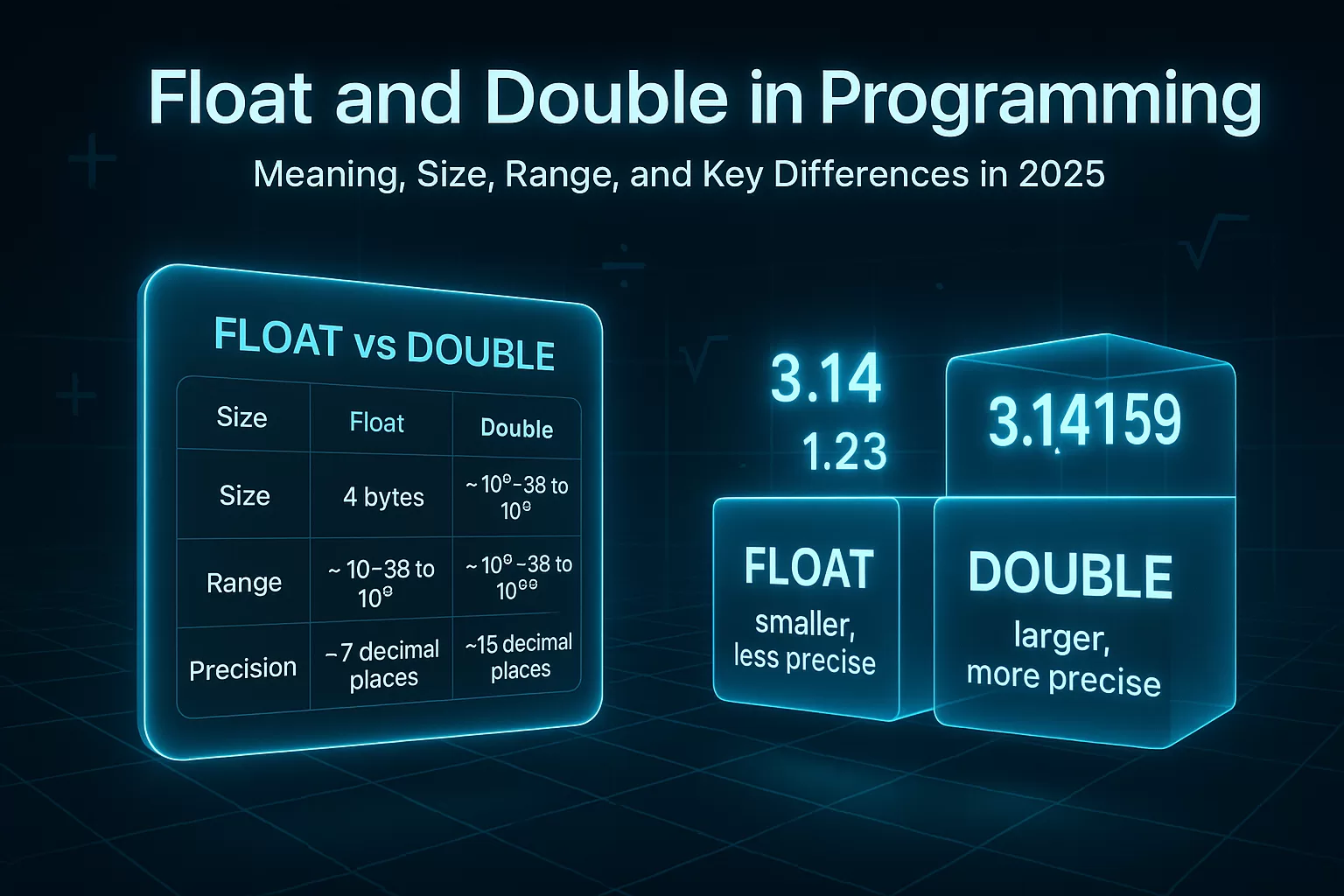
Every programmer eventually faces the same fork in the road: The choice between float and doubleI. Do I use float, or do I use double? At first glance, they look almost identical. Both store decimals. Both handle fractions. Both are called “floating-point numbers.”
But here’s the catch: the difference between float and double is not just academic. It can decide whether a banking system rounds off your savings incorrectly, whether a video game runs at 120 FPS or lags, or whether an AI model gives stable predictions.
Think of float as a lightweight backpack—fast, compact, but with less room. Double, on the other hand, is the heavy-duty travel bag—slower, but it carries way more details. Knowing when to use which makes you not just a coder, but a smarter engineer.
In this guide, you’ll learn the meaning, size, range, and key differences of float and double in programming (C, Java, Python, C++)—with real-world use cases, code snippets, and conversion tricks that matter in 2025.
🔑 Key Highlights
- The difference between float and double decides how much accuracy your program delivers.
- Float = 32-bit, 6–7 digits precision. Double = 64-bit, 15–16 digits precision.
- Use float in gaming, graphics, or embedded systems where speed and memory matter.
- Use double in finance, AI, or scientific research where precision matters.
- Learn the float and double difference in C, Java, Python, and C++ with real-world code examples.
- Conversion tricks included: string to float in Python, float to int in Java, string to double in Java.
- Updated for 2025 with fresh developer insights and best practices.
🔹 What is Float? (with examples)
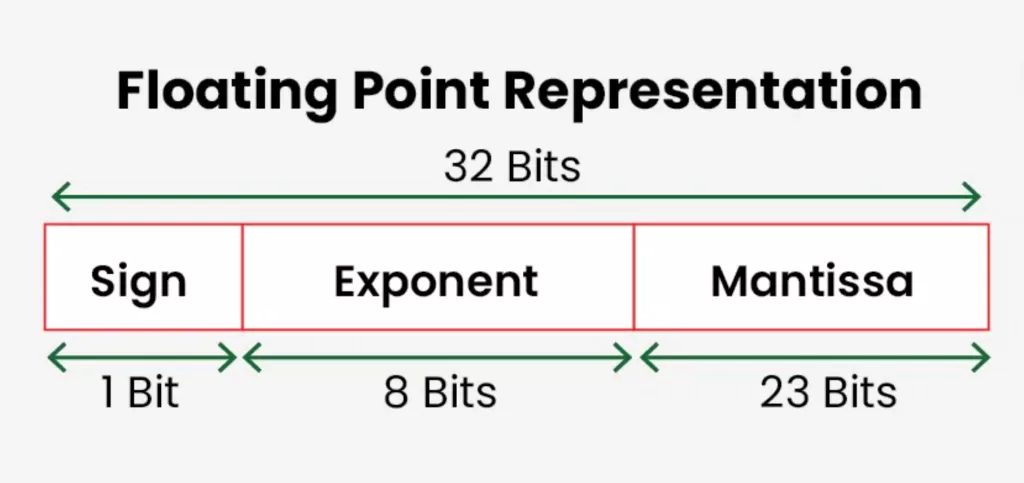
A float (short for floating-point number) is a 32-bit single-precision data type. It can represent up to 6–7 decimal digits accurately.
In simple terms: it’s fast, light, and works well when you don’t need extreme precision.
📌 Examples of Float in Different Languages:
- C →
float pi = 3.14f; - Java →
float temperature = 98.6f; - Python →
float(3.14)(though Python’s float is actually double precision under the hood). - SQL →
FLOAT(7)to store decimal values in databases.
💡 Real-world use case: Game developers often choose floats to handle 3D graphics. Why? Because they need speed over extreme precision. Imagine rendering 1 million polygons per second—every byte saved counts.
👉 Best practice: Use float when:
- You’re building games, graphics engines, or IoT apps.
- You need less memory.
- You can tolerate a slight loss of precision.
🔹 What is Double? (with examples)
A double is the bigger sibling of float. It’s a 64-bit double-precision floating-point type that can represent up to 15–16 decimal digits accurately. That’s more than double the precision of float.
📌 Examples of Double in Different Languages:
- C →
double interestRate = 6.75234; - Java →
double gdp = 3.289E12; - Python →
float(3.14159)but stored as a double behind the scenes. - C++ →
double velocity = 299792458.0;
💡 Real-world use case: Think about banking applications. If a float rounds off 0.0001 cents in millions of transactions, you could lose—or worse, misreport—millions of dollars. That’s why fintech and scientific computing rely on double.
👉 Best practice: Choose double when:
- You’re working with financial data, AI models, or research calculations.
- Precision errors could lead to serious consequences.
- Memory and performance trade-offs are acceptable.

🔹 Size of Float and Double in Programming
Let’s clear this up with some data:
📊 Sizes Across Languages:
- C / C++ → Float = 4 bytes, Double = 8 bytes
- Java → Float = 32-bit, Double = 64-bit (standardized by JVM)
- Python → Only has float, but it’s implemented as 64-bit double precision
- SQL → FLOAT precision varies, DOUBLE = higher precision
💡 Range:
- Float can represent values roughly from 1.4 × 10⁻³⁸ to 3.4 × 10³⁸
- Double extends that massively: 4.9 × 10⁻³²⁴ to 1.8 × 10³⁰⁸
👉 Think about it like this:
- A float can measure the distance between two cities.
- A double can measure the distance between galaxies 🌌.

🔹 The Real Difference Between Float and Double (with examples)
Now let’s cut to the chase: what’s the difference between float and double?
Here’s a side-by-side view:
| Feature | Float | Double |
|---|---|---|
| Size | 32-bit (4 bytes) | 64-bit (8 bytes) |
| Precision | ~7 digits | ~15 digits |
| Performance | Faster, less memory | Slightly slower, more memory |
| Range | 10⁻³⁸ to 10³⁸ | 10⁻³²⁴ to 10³⁰⁸ |
| Use case | Games, IoT, graphics | Finance, AI, simulations |
📌 Example in Java:
float f = 1.1234567f;
double d = 1.123456789012345;

System.out.println("Float: " + f);   // Output: 1.1234567
System.out.println("Double: " + d); // Output: 1.123456789012345
👉 You can see the float cuts off digits after ~7 places, while the double keeps going strong up to ~15 places.
💡 Developer insight: Many companies learned this the hard way. NASA once lost a Mars orbiter because of numeric calculation mismatches. Precision matters.
🔹 Difference Between Float and Double in C & C++
C and C++ are where most beginners first meet float and double. But even seasoned programmers sometimes confuse the default behavior.
- In C/C++:
float temp = 23.45f;→ takes 4 bytes (32-bit).double pi = 3.141592653589793;→ takes 8 bytes (64-bit).- By default, decimals are treated as
double. That’s why you often see thefsuffix in float.
📌 Example in C++:
#include <iostream>
using namespace std;

int main() {
    float f = 1.1234567f;
    double d = 1.123456789012345;

    cout << "Float: " << f << endl;
    cout << "Double: " << d << endl;
    return 0;
}
💡 Best practice in C/C++:
- Use float when you’re working with large arrays of numbers (like 3D graphics or simulations). Saves memory.
- Use double when precision is king, like in cryptography, financial algorithms, or physics engines.
👉 Many game engines (like Unity and Unreal) optimize with float because graphics need speed. But scientific libraries like MATLAB, NumPy, and CERN simulations go with double.
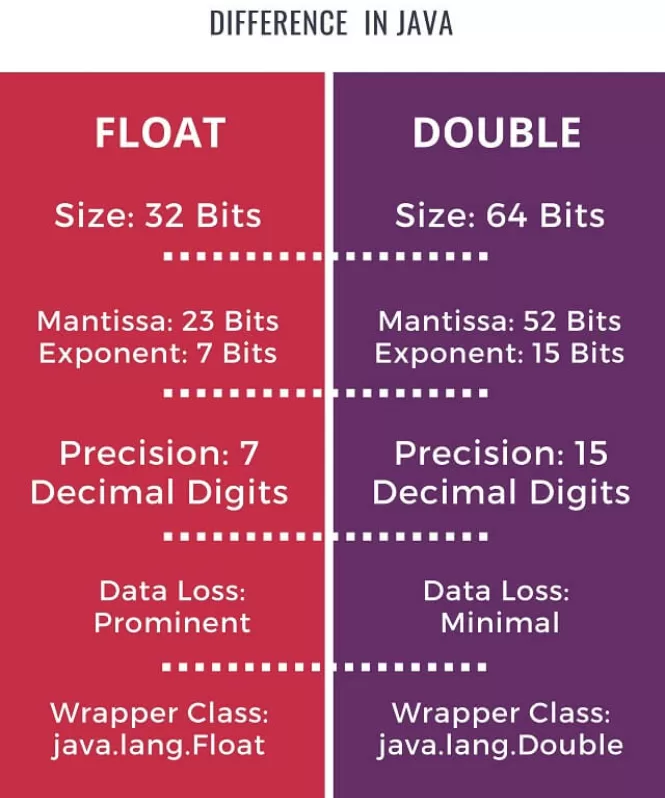
🔹 Difference Between Float and Double in Java
Java keeps things simple—but strict.
float= 32-bit IEEE 754 single precisiondouble= 64-bit IEEE 754 double precision
📌 Example in Java:
class Test {
    public static void main(String[] args) {
        float f = 1.234567f;
        double d = 1.23456789012345;

        System.out.println("Float: " + f);
        System.out.println("Double: " + d);
    }
}
📝 Output:
- Float → 1.234567
- Double → 1.23456789012345
👉 Notice how the double keeps more digits intact.
💡 Best practice in Java:
- Use float when dealing with graphics, Android game dev, or IoT sensors.
- Use double for financial calculations, AI/ML, or data analytics.
📊 Fun fact: According to Oracle docs, double is the default for decimals in Java. If you type 3.14, it’s a double unless you append f.
🔹 Difference Between Float and Double in Python
Here’s the twist: Python doesn’t really have a float vs. double split.
- In Python, float = 64-bit double precision under the hood.
- That means
floatin Python behaves more likedoublein Java or C++.
📌 Example in Python:
x = 1.123456789012345
y = 1.12345678901234567890

print("x:", x)
print("y:", y)
📝 Output:
- Both will print with ~15–16 digits of precision.
💡 Developer insight:
- When you see
floatin Python, think double. - For extreme precision (like in cryptography or very large datasets), use Python’s
decimalorfractionsmodule.
👉 That’s why in data science and AI, Python rarely faces precision issues—it uses double-precision by default.
🔹 Conversions: Float ↔ Int, String ↔ Float/Double
Data doesn’t always arrive in the right format. Sometimes you read numbers from a CSV file, a database, or even user input. That’s where conversions step in.
🔸 In Python
- String → Float
val = "123.45"
num = float(val)
print(num)   # 123.45
- Float → Int (truncates, doesn’t round!)
x = 45.99
print(int(x))   # 45
👉 Best practice: Use round() when you need proper rounding, not truncation.
🔸 In Java
- String → Double
String s = "456.78";
double d = Double.parseDouble(s);
- Float → Int
float f = 12.99f;
int i = (int) f;   // Explicit cast required
👉 Best practice: Always validate user input before parsing—bad input throws NumberFormatException.
🔸 In C/C++
- String → Float/Double
#include <iostream>
#include <cstdlib>
using namespace std;

int main() {
    string s = "789.12";
    float f = stof(s);
    double d = stod(s);
    cout << f << " " << d;
}
👉 Best practice: Watch out for locale issues (commas vs dots in decimals).
🔹 Common Mistakes with Float and Double
Even pro developers stumble here. Floats and doubles are approximate, not exact.
- Equality checks
print(0.1 + 0.2 == 0.3) # False 😲
- Why? Because internally, 0.1 and 0.2 can’t be represented exactly in binary.
- Fix → Use a tolerance check:
abs((0.1 + 0.2) - 0.3) < 1e-9
- Rounding errors in finance
- Using float/double for money is dangerous.
- Always use BigDecimal (Java) or decimal (Python) for currency.
- Overflow/underflow
- Very large/small numbers can turn into
infor0. - Example:
1e308 * 10in Python results ininf.
👉 Lesson: Floats/doubles are great for approximation (physics, ML, graphics), but not for exact values (finance, IDs, crypto).
🔹 When to Use Float vs. Double in Real-World Projects
Choosing between float and double isn’t about syntax—it’s about trade-offs.
- Game Development 🎮
- Use
float→ Lighter memory footprint, faster computations. - Most 3D engines (Unity, Unreal) rely on float because rendering millions of objects with double slows everything down.
- Use
- Finance & Banking 💰
- Use
doubleor better, decimal. - Accuracy is more important than speed when calculating salaries, interest rates, or stock trades.
- Use
- Data Science & AI 🤖
- Python’s default float (64-bit double) works fine.
- In deep learning (TensorFlow, PyTorch),
float32is preferred for GPU optimization.
- IoT & Embedded Systems 📡
- Floats often win here—memory is limited, and sensors don’t need 15 decimal places.
👉 Rule of thumb:
- Speed and memory → go with float.
- Accuracy and precision → go with double.
🔹 Comparison Table: Float vs. Double
Here’s a quick cheat sheet you can bookmark:
| Feature | Float | Double |
|---|---|---|
| Size (C/Java) | 4 bytes (32-bit) | 8 bytes (64-bit) |
| Precision | ~6–7 decimal digits | ~15–16 decimal digits |
| Default Type | Float literal needs f | Decimal numbers default to double |
| Memory Usage | Lower | Higher |
| Performance | Faster in memory-bound tasks | Slower but more accurate |
| Use Cases | Graphics, games, IoT, embedded systems | Finance, AI, data science, simulations |
👉 Developer insight: Don’t memorize this table for interviews—understand the trade-off between speed vs. precision. That’s what hiring managers look for.
🔹 FAQs on Float and Double in Programming
❓ What is the difference between float and double?
Float uses 32 bits (~7 digits precision). Double uses 64 bits (~15 digits precision). Double is more accurate but uses more memory.
❓ What is float in Python?
In Python, float is implemented as double precision (64-bit). So it’s essentially a double.
❓ What is the size of float and double in Java?
- Float → 32-bit (4 bytes)
- Double → 64-bit (8 bytes)
❓ What is the difference between float and double in C?
- Float = 4 bytes, ~7 digits
- Double = 8 bytes, ~15 digits
- Precision and default type differ.
❓ When should I use float instead of double?
Use float when memory and performance matter more than extreme accuracy (e.g., graphics, game dev). Use double when accuracy matters more (finance, analytics, ML).
❓ Can float and double cause errors?
Yes—rounding errors and precision loss are common. Always use tolerance checks in comparisons and avoid them for money calculations.
🔹 Conclusion: Why Float and Double Still Matter in 2025
Floats and doubles may seem old-school, but they’re still at the heart of modern computing. From your gaming graphics card running float32 shaders to Wall Street’s trading systems relying on double precision, these data types decide speed, accuracy, and even cost.
💡 Career tip: If you’re preparing for coding interviews, expect questions like:
- “What is the difference between float and double in Java?”
- “How many bytes does a float take in C?”
- “Why shouldn’t you use float for financial data?”
Mastering these isn’t about syntax—it’s about showing you can make practical, performance-driven decisions as a developer.
👉 Next time you’re writing code, pause and ask: Do I need speed, or do I need precision? That choice between float and double could define the success of your project.
✨ Key Highlights (for quick scan readers):
- Float = 32-bit (~7 digits), Double = 64-bit (~15 digits)
- Python’s float is actually a double under the hood
- Game dev, IoT → float | Finance, AI, Data Science → double
- Beware of rounding errors and equality checks
- Mastering float vs. double is a common interview topic in 2025
📖 Related Reads
- 🏗️ Design Patterns in C# & Java (2025 Guide) – With Code Examples, UML & Best Practices
- 🔢 Java Prime Number Program: 4 Ways to Simplify Programming in Java, Easily
- ✨ What is Armstrong Number? Definition, Formula, Examples, and Programs Explained
- ➗ What are Rational Numbers – Definition, Examples, Types, Properties & FAQs Explained
- 🎲 Random Number Generator Explained: How Computers Pick Numbers (With Python, Java & Excel Examples)
- 🔮 Number 108 Is Everywhere… Even If You’ve Never Noticed 🚀