GNU Full Form (2025 Guide): Meaning, Tools, Careers & Why It Still Matters

If you’ve spent any time in programming forums, Linux tutorials, or even cloud job listings, you’ve probably stumbled upon the mysterious three letters: GNU. It shows up in compilers, licenses, debuggers, and even accounting tools. Yet most beginners don’t know What is GNU full form, and why does it keep showing up everywhere in tech?
Here’s the twist: without GNU, there would be no Linux, no Android, no GCC compiler — basically no modern internet as we know it. Google, Amazon, Microsoft? Their clouds lean on it every single day.
And here’s where it gets personal:
In 2025, over 30% of cloud and DevOps job postings explicitly demand GNU/Linux skills. Skip it, and you’re quietly locking yourself out of some of the highest-paying roles in infrastructure, DevOps, and data science.
So the real question isn’t just what those three letters stand for…
👉 It’s why this acronym has become the invisible backbone of modern computing — and why your career might depend on it.
🔑 Key Highlights
- GNU full form = “GNU’s Not Unix” – a recursive acronym coined in 1983.
- GNU gave birth to the modern open-source movement and underpins Linux servers, cloud, and AI tools.
- 96% of the world’s top servers run on GNU/Linux.
- Careers in GNU/Linux, GCC, and open-source are booming in 2025, with average salaries of ₹7–12 LPA in India and $90,000+ in the U.S.
- Tools like GCC, GDB, Octave, and GIMP stand out for their versatility and cost savings.
- The GNU GPL license is still the most influential open-source license globally.
GNU Full Form in Computer Science 💻
- Full form of GNU = GNU’s Not Unix.
- Coined in 1983 by Richard Stallman to emphasize that GNU was like Unix but free.
- Built to fight proprietary lock-in — Unix systems then cost millions and restricted freedom.
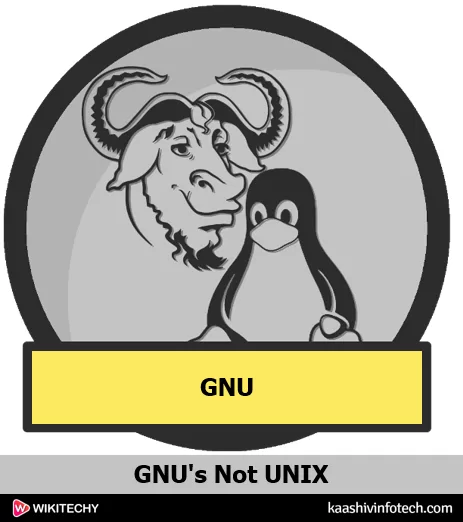
What is GNU and Why It Exists
GNU was created because software freedom was being eroded. In the early ’80s, most operating systems (like AT&T’s Unix) were expensive, closed, and legally restricted. Stallman wanted programmers to retain control over their tools.
That’s why GNU matters: it gave us freedom of use, study, modification, and sharing. Those values power today’s open-source giants like Linux, Kubernetes, Docker, and TensorFlow.
A Quick History of GNU 📜
- 1983: Richard Stallman announces GNU Project.
- 1985: Free Software Foundation (FSF) established.
- 1991: Linus Torvalds releases Linux kernel. Combined with GNU → GNU/Linux.
- 2000s–Now: GNU tools like GCC, GDB, and GPL licensing become standards.
💡 Why it happened: Without GNU, the computing industry would have stayed locked under proprietary Unix vendors like Sun Microsystems and AT&T. GNU broke the monopoly and democratized software.

Real-World Impact: Where GNU Stands Out 🌍
- Servers & Cloud (Market Share)
- 96.3% of the world’s top servers run on GNU/Linux (W3Techs, 2024).
- AWS, Google Cloud, and Azure all use GNU tools.
- Supercomputers
- 100% of the world’s top 500 supercomputers run GNU/Linux.
- Scientific Computing
- Universities save millions by using GNU Octave instead of MATLAB.
- Creative Tools
- GIMP (GNU Image Manipulation Program) is used by photographers, designers, and NGOs that can’t afford Adobe’s pricing.
- India Spotlight: GNU Khata
- Free accounting software adopted by NGOs and SMEs.
- Reduces dependency on costly ERP solutions.
👉 What makes GNU stand out? Its cost savings, flexibility, and global adoption. Unlike proprietary tools, GNU ensures no vendor lock-in.
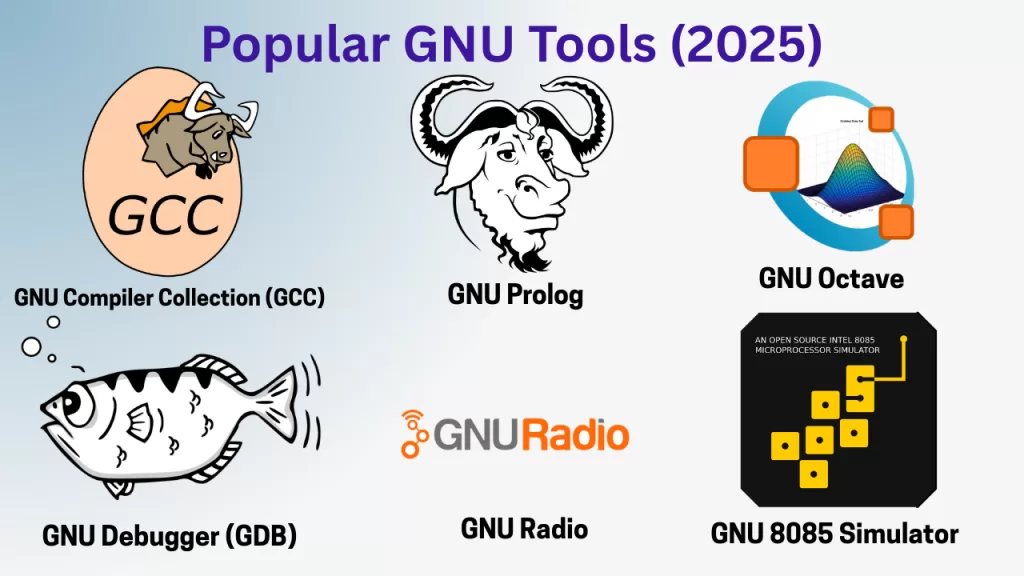
Popular GNU Tools Developers Rely On ⚙️
- GNU Compiler Collection (GCC) → backbone of programming in C/C++.
- GNU Debugger (GDB) → essential for tracing bugs.
- GNU Octave → free MATLAB alternative for engineers.
- GNU Prolog → logic programming.
- GNU Radio → powers research in wireless networks.
- GNU 8085 Simulator → popular in Indian colleges for microprocessor learning.
GNU General Public License (GPL) 🔒
The GNU GPL license ensures software remains free. If you modify GNU-licensed code, you must also release it under the same license.
That’s why companies like Red Hat, Canonical (Ubuntu), and Debian thrive — they build services around GNU while keeping the code open.
Today, 70%+ of open-source projects adopt GPL or similar licenses.
Career Opportunities with GNU in 2025 💼
1. Job Roles That Need GNU Skills
- Linux System Administrator
- Cloud & DevOps Engineer
- Embedded Systems Developer
- Data Scientist (GNU Octave, GCC-based environments)
- Open-Source Software Engineer
2. Salary Trends
- India: ₹7–12 LPA (average for GNU/Linux admins), up to ₹25 LPA for senior DevOps with GNU/Linux.
- US: $90,000–$140,000 (Linux & open-source engineers).
- Europe: €60,000–€100,000.
👉 According to Naukri & LinkedIn India (2025), demand for Linux/GNU skills grew 22% year-over-year, especially in fintech, telecom, and cloud sectors.
3. Career Best Practices
- Learn GCC & GDB → builds low-level programming expertise.
- Master GNU/Linux CLI → a must for cloud & DevOps interviews.
- Contribute to open-source GNU projects → boosts resume & networking.
💡 Developer insight: Recruiters often test for basic GNU/Linux commands and debugging knowledge, even in software roles that aren’t purely system-level.

FAQs on GNU Full Form ❓
Q1: What is the full form of GNU in computer?
A: GNU’s Not Unix, a free OS project.
Q2: What is GNU vs Linux?
A: GNU = tools & philosophy, Linux = kernel. Together = GNU/Linux.
Q3: Is GNU still relevant in 2025?
A: Yes — it powers 96% of servers, all supercomputers, and cloud platforms.
Q4: What is GNU Khata?
A: An Indian open-source accounting tool.
Q5: What is GNU GPL license?
A: A license ensuring software freedom.
Conclusion 🎯
The GNU full form may sound like a clever acronym, but its impact is massive. From supercomputers to your smartphone, GNU quietly runs the world.
GNU/Linux isn’t just a tool — it’s a career multiplier. Companies everywhere need people who understand GCC, GDB, Linux servers, and open-source licensing.
Ignore GNU, and you risk being outdated. Learn it, and you’ll stay relevant in a job market where open-source isn’t a choice — it’s the default.
🐃 The wildebeest logo isn’t just a mascot. It’s a reminder that freedom, adaptability, and resilience still win in tech.
Related Reads
- GCC Full Form (GNU Compiler Collection) – A clear breakdown of what GCC stands for, its evolution, and why it’s a cornerstone of the GNU toolchain.
- What Is GDB? – An introductory tutorial on GDB, the GNU Debugger, explaining how to debug C/C++ programs step-by-step.
- Basic Linux Interview Questions & Answers – A solid primer covering essential Linux concepts like Bash, kernel vs. shell, and more—great for interview prep.
- Linux Training in Chennai – KaaShiv InfoTech – Details of a practical, instructor-led Linux course in Chennai; ideal if you’re looking to upskill with structured training.