Journey Mapping in Design Thinking: The Complete In-Depth Guide
Design thinking is centered around one powerful idea — deeply understanding people before designing solutions. Yet many teams rush into wireframes and features without truly understanding the full experience users go through.
Journey mapping prevents that mistake.
It provides a structured way to visualize how users interact with a product or service over time — not just what they do, but what they think, feel, struggle with, and expect. When done correctly, journey mapping transforms abstract user research into clear, actionable insights that guide better design decisions.
This comprehensive guide explores journey mapping in depth — what it is, why it matters, how to do it properly, and the important things you must focus on to make it effective.
What Is Journey Mapping in Design Thinking?

Journey mapping is a visual storytelling method used to capture the complete experience a user has while achieving a specific goal. Instead of focusing only on screens or features, it examines the entire lifecycle of interaction — from initial awareness to long-term engagement.
In design thinking, journey mapping plays a critical role during the Empathize and Define phases. It bridges the gap between raw research and meaningful design strategy.
A journey map typically illustrates:
- The user persona
- The stages of interaction
- User actions at each stage
- Thoughts and emotions
- Pain points
- Opportunities for improvement
However, what makes journey mapping powerful is not the diagram itself — it is the insights that emerge from understanding emotional patterns and friction moments across the experience.
Why Journey Mapping Is Essential in Design Thinking
Many organizations rely heavily on analytics dashboards. While data can show where users drop off or disengage, it rarely explains why.
Journey mapping fills that gap.
It builds empathy by encouraging teams to step into the user’s perspective. Instead of asking, “Why aren’t users completing this flow?” the question becomes, “What is the user experiencing at this moment?”
It also aligns cross-functional teams. Product managers, designers, marketers, and developers often view problems from different angles. A shared journey map creates a unified understanding of user reality.
Most importantly, it reveals innovation opportunities. Pain points identified in journey maps often lead to breakthrough improvements because they uncover hidden friction and unmet needs.
Core Structure of a Journey Map
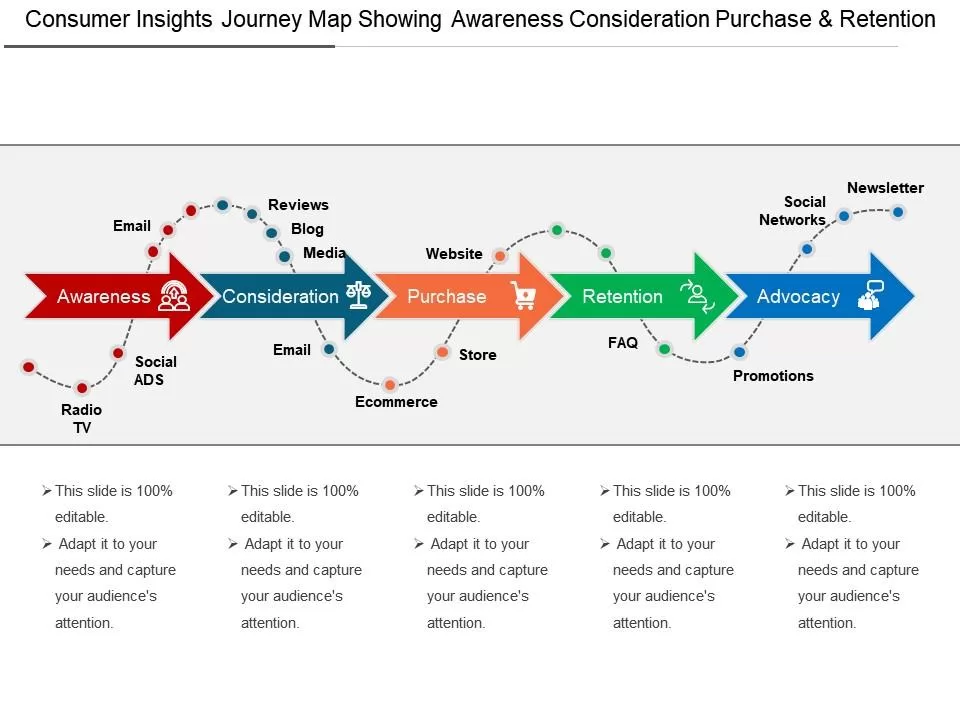
A journey map usually follows a chronological structure. It moves through stages that represent shifts in user mindset and activity.
Below is a typical representation of journey stages.
While most journeys include phases such as awareness, consideration, decision, onboarding, usage, and retention, the exact structure depends on your context. A mobile app, a SaaS product, and a physical retail service will each have different journey characteristics.
The key is to structure stages around meaningful shifts in user intent rather than internal business processes.
The Complete Step-by-Step Process to Create a Powerful Journey Map
Creating a journey map is not just about drawing boxes and arrows. It is a research-driven, collaborative, and iterative exercise.
Define a Clear Scope
Before mapping anything, define exactly what you are mapping. A journey map must focus on a specific persona and a specific goal. If you attempt to map every possible scenario, the result becomes vague and unusable.
For example, instead of mapping “User experience of our platform,” define something like: “First-time user completing course enrollment on our learning app.”
Clarity of scope ensures depth of insight.
Ground Everything in Real User Research
One of the most important things to do in journey mapping is base it on real data.
Interview users. Observe their behavior. Study feedback. Analyze support complaints. Look at session recordings. Examine drop-off analytics.
Journey mapping built on assumptions is storytelling. Journey mapping built on research is strategy.
The more qualitative insights you gather, the more emotionally accurate your journey map becomes.
Identify Meaningful Journey Stages
Break the experience into stages that represent mental and behavioral shifts. A stage is not just a technical step; it reflects a change in user intention.
For example, awareness is different from evaluation. Evaluation is different from commitment. Commitment is different from first use.
Each stage should represent a distinct psychological moment in the user’s journey.
Document User Actions in Detail
At each stage, write down what the user actually does. Be precise rather than general.
Instead of saying “User signs up,” describe the sequence of events. Does the user compare pricing? Search for reviews? Read FAQs? Hesitate before entering payment details?
Detail reveals friction. Vagueness hides it.
Capture Thoughts and Emotional States
This is where journey mapping becomes powerful.
For each stage, ask what the user might be thinking. Are they excited? Skeptical? Confused? Overwhelmed? Hopeful?
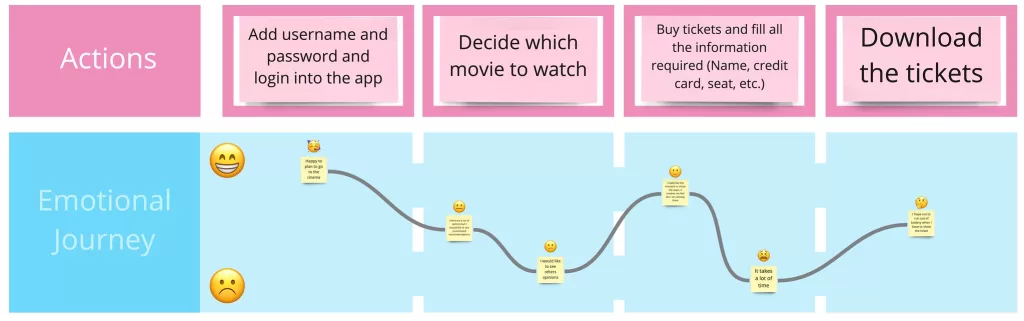
Plotting emotional highs and lows helps identify moments that require attention.
Below is a common way emotional journeys are visualized.
An emotional curve highlights friction points clearly. When you see emotional dips, you know improvement is needed. When you see peaks, you understand what delights users and can replicate that success.

Identify Pain Points With Evidence
Pain points should not be guesses. They must be validated through research.
Common friction areas include:
Confusing navigation.
Too many form fields.
Unclear pricing.
Delayed response times.
Lack of trust signals.
Overwhelming onboarding steps.
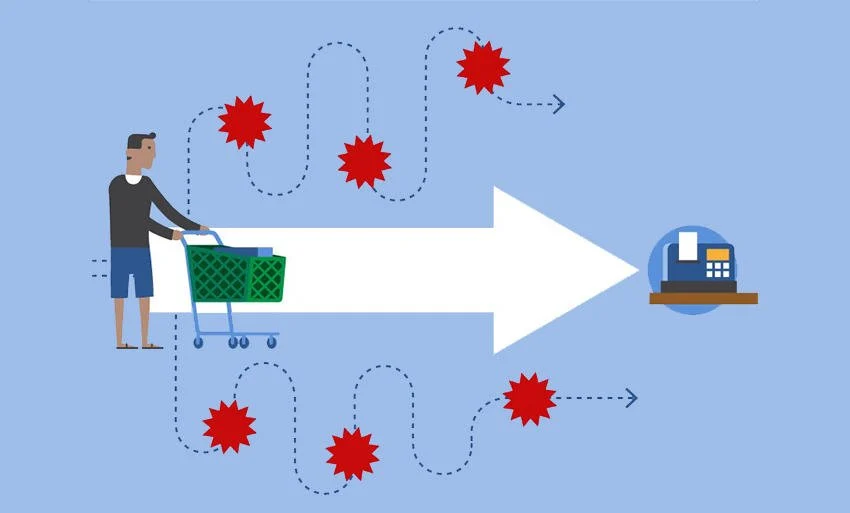
But rather than listing them abstractly, attach them to specific moments in the journey. Context gives meaning.
Turn Pain Points Into Opportunities
The most important thing to do after identifying pain points is to convert them into action-oriented opportunities.
If users feel anxious before making payment, consider adding social proof, testimonials, or transparent refund policies.
If onboarding feels overwhelming, consider progressive disclosure or guided walkthroughs.
A journey map should always lead to strategic design decisions. If it doesn’t, it becomes decorative rather than functional.
Collaborate Across Teams
Journey mapping works best as a collaborative exercise. Involving designers alone limits perspective.
When product managers, developers, marketing teams, and support staff contribute, the map becomes richer. Support teams often reveal emotional frustrations. Marketing teams understand expectation gaps. Developers identify technical constraints.
Collaboration ensures realism and alignment.
Validate and Iterate
A journey map is not a one-time artifact. As products evolve and user behaviors change, the map must evolve too.
Test your assumptions. Share the map with stakeholders. Conduct usability testing. Refine it regularly.
Treat it as a living strategic tool rather than a static presentation slide.
Important Things You Must Do for Effective Journey Mapping
One of the biggest mistakes teams make is treating journey mapping as a workshop exercise rather than an ongoing design asset.
Always focus on one persona at a time. Combining multiple user types in one map creates confusion.
Ensure emotional insights are included. Without emotions, the map becomes a process diagram, not a journey.
Avoid internal bias. Do not project your understanding of the product onto users.
Connect insights to measurable outcomes. For example, if friction exists during checkout, link that to conversion rate impact.
Keep the map clear and readable. Complexity does not equal sophistication.
Common Mistakes to Avoid
Some journey maps fail because they are created without research. Others fail because they attempt to capture too many scenarios in a single visualization.
Another common issue is focusing only on digital touchpoints and ignoring offline or contextual factors. For example, a user might discuss your product with friends before purchasing. That moment matters.
Also, avoid using journey maps merely as presentation material. If they do not inform design priorities or backlog decisions, they lose value.
Real-World Application Example
Imagine an online learning platform.
During mapping, the team discovers that users feel motivated during course exploration but overwhelmed during enrollment due to too many options and unclear pricing tiers.
By simplifying the pricing page and introducing guided recommendations, enrollment rates improve significantly.
This insight would not have emerged purely from analytics. It required understanding emotional hesitation.
That is the power of journey mapping.
How Journey Mapping Strengthens the Entire Design Thinking Process
Journey mapping connects empathy with execution.
It informs ideation by revealing where innovation is needed. It guides prototyping by highlighting critical friction moments. It improves testing by focusing on emotional impact rather than just usability metrics.
Most importantly, it ensures that design solutions are grounded in real human experiences rather than internal assumptions.
Conclusion
Journey mapping in design thinking is not just a visualization technique. It is a strategic empathy tool.
When done properly, it helps teams see beyond screens and features. It reveals emotional patterns, exposes friction, and uncovers opportunities for meaningful innovation.
The important things to do are simple but powerful: define a clear scope, rely on real research, capture emotional depth, collaborate across teams, and continuously refine your insights.
Design thinking succeeds when we truly understand the journey — not just the destination.
- Want to learn more, Kaashiv Infotech Offers, UI UX Course, Front End Development Course, Full Stack Development Course & More, Visit Their Website www.kaashivinfotech.com.
Related Reads: