Linear Regression in Machine Learning [Beginner’s Guide 2025] 🚀

Why Linear Regression Still Matters in 2025
When people hear machine learning, they often think of self-driving cars, voice assistants, or AI predicting stock prices. But here’s the truth: even those advanced systems are built on fundamentals. And one of the most important fundamentals is linear regression in machine learning.
If you’ve ever tried to guess a student’s score from their study hours, or estimate house prices from size and location, you were already thinking in terms of linear regression.
It’s one of the oldest algorithms in the ML playbook. Yet, in 2025, it’s still the best starting point for building intuition and solving real-world problems.
✨ Key Highlights
- Understand what is linear regression in plain English.
- Learn the linear regression formula and see how the linear regression equation works step by step.
- Explore simple linear regression with examples from real life.
- Discover how linear regression in data science powers predictions in finance, healthcare, and business.
- Get hands-on with a linear regression in Python demo (using scikit-learn).
- Learn best practices and common mistakes beginners make.
🔹 What is Linear Regression?
So, what is linear regression?
At its core, it’s about drawing the straightest possible line through your data points. Not just any line, but the one that minimizes errors between predicted and actual values.
👉 Example developers often use in training sessions:
- Hours studied → Exam score
- Square footage → House price
That line isn’t random. It’s calculated mathematically, and the equation it gives you is your linear regression model.
Here’s why it’s still king:
- Transparency: Unlike black-box neural networks, you can explain exactly why the model made a prediction.
- Speed: Works with small datasets and doesn’t need GPUs.
- Universality: From economics to biology, the logic stays the same.
💡 Developer insight: Many senior data scientists advise juniors to start every project with linear regression. Why? Because if a simple regression can’t show at least some relationship between variables, chances are your data won’t magically become useful with a deep learning model.

🔹 The Linear Regression Formula & Equation
The heart of regression is its equation. And if you’ve sat through high school math, this will look familiar:
y = m × x + b
Where:
- y → Predicted outcome (exam score, house price, sales revenue).
- x → Input variable (study hours, house size, ad spend).
- m (slope): Rate of change. Every additional unit of x changes y by m.
- b (intercept): The starting point, where the line crosses y-axis (when x = 0).
👉 Real-world example:
A study by Zillow found that each extra bedroom adds an average of $45,000 to house value in the U.S. That’s slope (m) in action.

The simplicity of the linear regression formula makes it not just a mathematical tool, but a business decision tool. Executives don’t want black-box predictions — they want interpretable equations they can trust.
🔹 Simple Linear Regression in Machine Learning
Now, let’s talk about simple linear regression in machine learning — the most stripped-down form. One independent variable, one dependent variable. That’s it.
✅ Examples you can relate to:
- Predicting salary based on years of experience.
- Predicting crop yield based on rainfall.
- Predicting calories burned from minutes of exercise.
Best practice developers use: Start simple. Why? Because it shows you whether the independent variable even matters. If your regression line is flat, the variable has no predictive power — and you save time before building complex models.
👉 Case study: A marketing team tested whether ad spend actually correlated with sales. A simple regression revealed that after $10,000/month in ads, sales flatlined. Instead of throwing money into ads blindly, they reallocated budget into customer loyalty programs. That’s regression saving millions.

🔹 Linear Regression Example
Let’s make this concrete. Imagine a company that wants to know: If we increase ad spend, will revenue go up proportionally?
Here’s their dataset:
| Ad Spend ($1000) | Sales Revenue ($1000) |
|---|---|
| 1 | 5 |
| 2 | 9 |
| 3 | 14 |
| 4 | 20 |
Plot this on a graph, and you’ll notice the points form almost a straight line. That line? That’s your linear regression model.
👉 Why it matters:
- Executives can quickly see that every extra $1,000 in ads returns ~$5,000 in sales.
- If the slope changes (say sales plateau), you instantly know when ad spend stops being effective.
💡 Developer takeaway: Don’t just build the model. Visualize it. A simple scatter plot + regression line can make more impact in a boardroom than a fancy deep learning dashboard.
🔹 Linear Regression in Data Science & Statistics
In statistics, linear regression dates back to the 19th century, when Sir Francis Galton studied the relationship between parents’ and children’s heights.
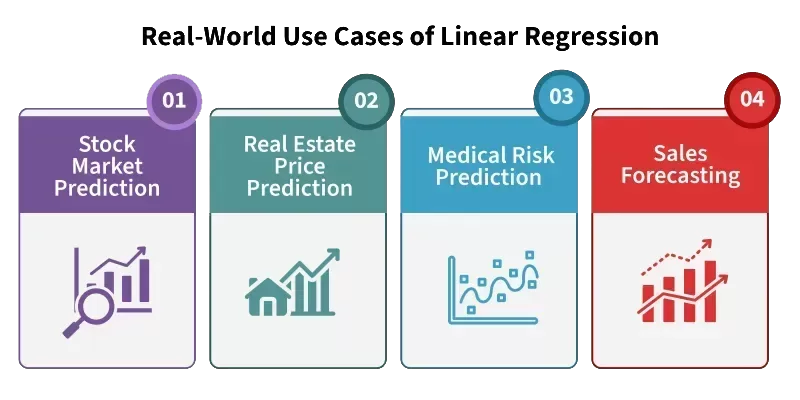
In data science, it’s the foundation of supervised learning. Think of it as the “Hello World” of predictive modeling. Whether you’re predicting:
- Credit risk (will this borrower default?),
- Electricity usage (how much will a city consume next week?),
- Disease spread (will cases rise or fall?),
…the baseline often starts with linear regression in data science.
Why best practice says “start here”:
- It’s explainable — stakeholders understand slopes and intercepts.
- It’s fast — no GPUs needed.
- It’s diagnostic — shows whether the data is even worth more advanced methods.
👉 Fun fact: A 2022 Kaggle survey showed that 52% of data scientists still use regression models in production — despite the hype around neural networks.
🔹 How Linear Regression Works
Here’s the typical flow a data scientist follows:
- Collect data → Hours studied, exam scores.
- Plot the data → Scatter points on a graph.
- Fit a line → Use least squares to minimize the difference between predictions and reality.
- Predict new values → Apply the equation to new inputs.
That’s it. No magic. Just math.
👉 Why this matters in 2025: In an era where AI models are criticized for being black boxes, regression offers transparency. Stakeholders can see exactly how predictions are made.

🔹 Quick Python Demo (Scikit-learn)
Here’s how you’d code a simple linear regression in machine learning using Scikit-learn:
from sklearn.linear_model import LinearRegression
import numpy as np

# Example: Hours studied vs. Exam score
X = np.array([1, 2, 3, 4, 5]).reshape(-1, 1)
y = np.array([40, 50, 60, 65, 70])

model = LinearRegression()
model.fit(X, y)

print("Slope (m):", model.coef_[0])
print("Intercept (b):", model.intercept_)
print("Predicted score for 6 hours:", model.predict([[6]])[0])
👉 Output:
If slope = 6 and intercept = 35, then 6 hours of study = 71 predicted exam score.
💡 Why this is a best practice: Developers often run a quick regression script before committing to heavier models. It validates whether a dataset has predictive potential.
🔹 Best Practices & Tips 🎯
If you’re a data scientist or aspiring ML engineer, here are ground rules:
- Always visualize first. Scatter plots reveal trends and outliers faster than any equation.
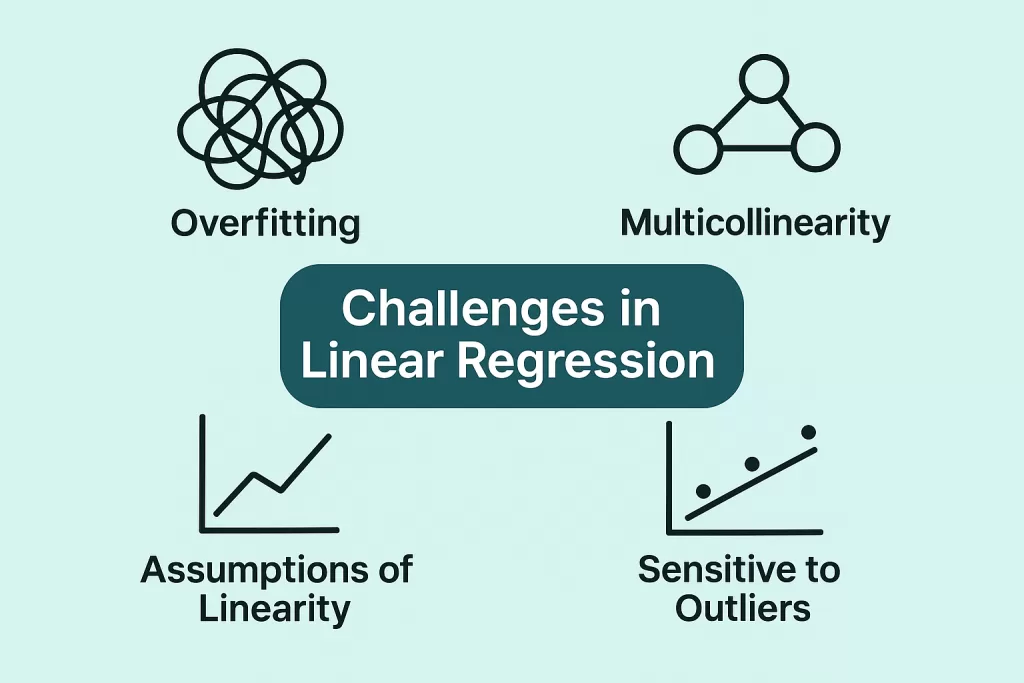
- Check outliers. One rogue data point can bend your regression line completely. A business decision based on outlier-driven slope = disaster.
- Don’t overcomplicate. Try simple regression before adding more variables. Many datasets don’t benefit from complexity.
- Add domain context. Regression without business/domain knowledge = useless. Predicting house prices without considering location will fail every time.
👉 Real-world story: A fintech startup ignored outlier detection in credit risk modeling. One extreme borrower profile skewed their slope, leading to underestimation of default risk. Result: $2M in bad loans. They later fixed it with outlier handling — but regression had already given them the warning signs.
🔹 Conclusion
Linear regression in machine learning may sound simple, but it remains the backbone of predictive analytics in 2025. From finance to healthcare, from marketing to education — industries still rely on it because, well it works.
Linear regression in machine learning is more than a classroom topic — it’s the foundation of how companies forecast sales, predict health outcomes, and optimize marketing campaigns. By learning the linear regression formula, equation, and simple use cases, you now hold one of the most important building blocks in data science.
This isn’t about memorizing math — it’s about developing the mindset to connect data with decisions. Every top data scientist started here, and so can you.
👉 If you’re ready to go further, check out Part 2: Advanced Linear Regression in Machine Learning — where you’ll uncover gradient descent, multiple regression, and techniques professionals use to fine-tune models in the real world. 🚀
🔗 Related Reads You’ll Love
- 📘 Machine Learning Algorithms: A Complete Guide for Beginners
- 🤖 5 Types of Machine Learning – The Beginner’s Friendly Guide
- 🐍 7 Surprising Truths About Machine Learning with Python (Even Beginners Can Master It!)
- 🧠 Who Is Alan Turing? 7 Mind-Blowing Facts About the Man Who Invented Modern Computing
- 📊 AI vs ML vs Data Science: What Should You Learn in 2025?
- 🌳 What Is a Decision Tree in Machine Learning? Step-by-Step Guide You’ll Actually Understand