🚀 Linked List in C: The Complete Beginner-to-Pro Guide (with Real Use Cases in 2025)

Why “Linked List in C” Still Matters in 2025
If you’re preparing for coding interviews, system design rounds, or just brushing up on the basics, you’ll come across Linked List in C more than once. In fact, according to HackerRank’s 2024 report, nearly 65% of technical interviews for software engineers still include at least one data structure question, and linked lists are in the top 5 most common ones.
Why? Because linked lists test how well you understand memory management, pointers, and algorithmic thinking—skills that go way beyond just passing an interview.
Think about this: the entire Undo/Redo feature in Microsoft Word or music playlists in Spotify rely on linked list logic. And if you’re aiming to build a career in backend development, embedded systems, or low-level programming, mastering the Linked List in C is non-negotiable.
Here’s the kicker → Arrays may look cleaner, but they’re rigid. Linked lists? They bend, stretch, and adapt to the real world—just like your career should.
🔑 Key Highlights of This Guide
- What is Linked List in C? Explained with simple examples.
- Types of Linked List in C → Singly, Doubly, Circular (with real-world use cases).
- Representation in C → How nodes and pointers come together.
- Comparison with Arrays → When to use what (with a cheat sheet table).
- Career Angle → Why interviewers love linked list questions and how to crack them.
1. What is a Linked List in C?
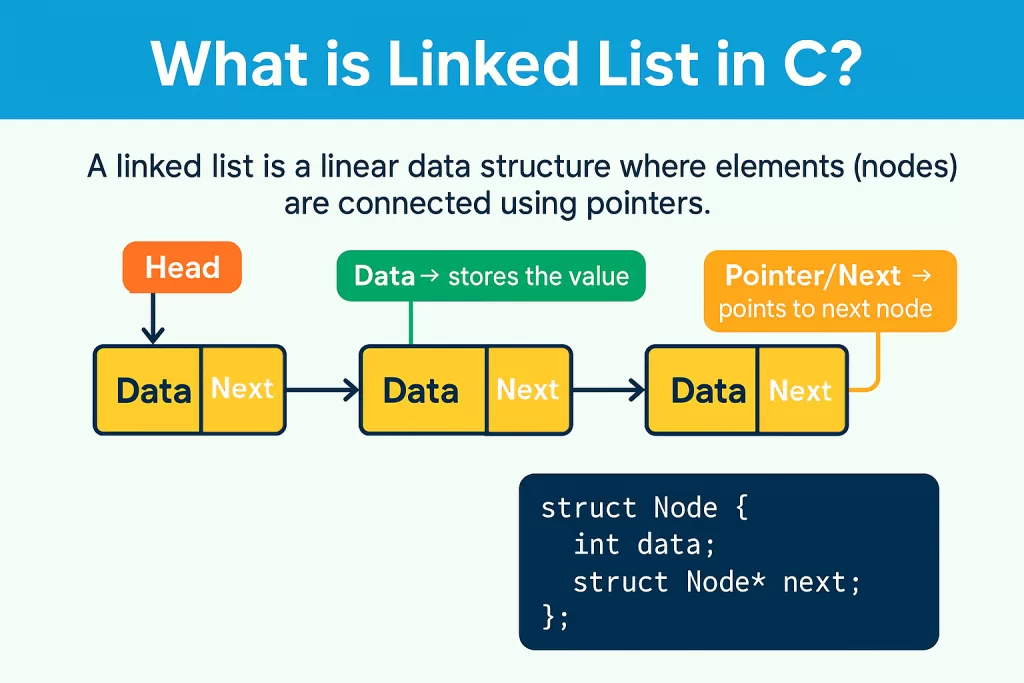
A linked list in C is a linear data structure where each element, called a node, contains two parts:
- Data (the actual value)
- Pointer (an address that points to the next node)
Instead of storing elements in contiguous memory like arrays, linked lists scatter nodes across memory and stitch them together with pointers.
Imagine you’re running an e-commerce site, and your product catalog is changing daily. With arrays, resizing requires expensive memory reallocation. With a linked list, you just create or delete nodes as needed. That’s why dynamic data handling in memory management, compilers, and real-time systems is often powered by linked lists.
2. Representation of Linked List in C
To make this concrete, here’s the simplest C structure for a linked list node:
struct Node {
    int data;
    struct Node* next;
};
data→ stores the value.next→ points to the next node in the list.
And the head pointer always points to the first node. If the head is NULL, the list is empty.
👉 Think of it like a treasure map: the head is your starting clue, and each next pointer takes you closer to the next chest until you hit the end.
3. Why Learn Linked List in C Instead of Just Arrays?
This is the big question every developer asks:
- Arrays are simple. Why complicate life with pointers?
- Can’t Python’s lists or Java’s ArrayList solve the same problem?
Here’s the reality: Arrays and linked lists serve different purposes.
| Feature | Array | Linked List |
|---|---|---|
| Memory | Contiguous | Scattered |
| Insertion/Deletion | O(n) | O(1) (if you know the node) |
| Access (Indexing) | O(1) | O(n) |
| Cache Friendly | Yes | No |
| Resizing | Expensive | Easy |
👉 In interviews, recruiters want to see if you know when to choose one over the other. For example:
- Use arrays for fast lookups (like accessing the 50th student in a roll list).
- Use linked lists for dynamic data (like maintaining an undo stack in an editor).
4. Types of Linked List in C
Not all linked lists are the same. The Linked List in C comes in three main flavors, and each has its own career relevance. Each of these plays a different role in real-world applications and interviews. Let’s break them down one by one.
4.1 Singly Linked List in C
So, what is a singly linked list in data structure?
A singly linked list in C is a chain of nodes where each node contains:
- Data
- Pointer to the next node
Simply put. Each node points only to the next node.
Here’s the basic structure:
struct Node {
   int data;
   struct Node* next;
};
Use case:
- Implementing stacks and queues in memory-sensitive applications.
- Useful in job scheduling systems where tasks run in sequence.
- Dynamic memory allocation where arrays fail.
Best Practice 💡: Always initialize next pointers to NULL when creating nodes. Uninitialized pointers are the root cause of nasty runtime bugs in C.
👉 Singly linked list program in C often starts with operations like insertion, deletion, traversal, and searching.
Career Tip 🎯
Interviewers often ask: “Reverse a singly linked list in C” or “Write a singly linked list algorithm to find the middle element.” Practicing these makes you interview-ready.
4.2 Doubly Linked List in C
A doubly linked list in C has nodes with three fields:
- Data
- Pointer to the next node
- Pointer to the previous node
A doubly linked list adds a prev pointer along with next.
struct Node {
   int data;
   struct Node* prev;
   struct Node* next;
};
👉 This allows traversal both forward and backward, unlike a singly list.
Key Programs:
- Insertion in doubly linked list (at beginning, end, or in between).
- Deletion in doubly linked list with efficient pointer adjustments.
- Reverse a doubly linked list (popular coding challenge).
Use case:
- Browser history navigation (back and forward).
- Music apps where you can skip forward and backward in a playlist.
- Text editors’ undo/redo functionality.
Insight: While doubly linked lists allow easy bidirectional traversal, they also consume more memory. Interviewers may throw this tradeoff at you—be ready to defend your choice.
4.3 Circular Linked List in C
Finally, what is circular linked list in data structure?
In a circular linked list in C, the last node’s pointer connects back to the first node, forming a circle.
Two variations exist:
- Singly Circular Linked List (only forward link)
- Doubly Circular Linked List (forward + backward links, but circular)
Program Example:
// Circular singly linked list node
struct Node {
   int data;
   struct Node* next; // last node points back to head
};
Key Programs in C:
- Circular linked list program in C → Insertion at end, deletion, traversal.
- Circular linked list algorithm → Detect cycles, manage round-robin tasks.
Use case:
- Round-robin scheduling in operating systems.
- Multiplayer games where players take turns cyclically.
- Real-time applications like buffering data in embedded systems.
Pro Tip: Circular lists are powerful but tricky. Always check termination conditions carefully to avoid infinite loops.
Career Insight: Many candidates forget about advantages of circular linked list in scheduling. Recruiters love to test whether you can spot that a circular linked list can be used to implement a queue efficiently.

4.4 Difference Between Singly Linked List and Doubly Linked List
This is one of the most searched interview questions. Here’s a quick table:
| Feature | Singly Linked List | Doubly Linked List |
|---|---|---|
| Pointers | One (next) | Two (prev, next) |
| Traversal | Only forward | Forward & backward |
| Memory | Less | More |
| Reversal | Harder | Easier |
| Use Cases | Queues, Stacks | Browser history, Undo/Redo |
👉 Remember: Interviewers often frame it as “difference between singly linked list and doubly linked list in C”, so be ready with practical use cases, not just definitions.
5. Linked List Algorithms in C
When students ask “what is linked list algorithm in C?”, what they really mean is how do you perform core operations like traversal, insertion, deletion, searching, and reversal using algorithms. These are not just academic—they show up in coding interviews, system design, and even competitive programming.
🔑 Common Linked List Algorithms in C
- Traversal Algorithm
void traverse(struct Node* head) { struct Node* temp = head; while (temp != NULL) { printf("%d ", temp->data); temp = temp->next; } }📌 Used to display all elements of a linked list.
Interview twist: Count nodes or detect cycle while traversing. - Insertion Algorithm
- At beginning → O(1)
- At end → O(n) for singly, O(1) for doubly with tail pointer
void insertAtBeginning(struct Node** head, int data) { struct Node* newNode = (struct Node*)malloc(sizeof(struct Node)); newNode->data = data; newNode->next = *head; *head = newNode; } - Deletion Algorithm
Deleting a node when only pointer to it is given is a classic FAANG question.void deleteNode(struct Node** head, int key) { struct Node* temp = *head, *prev = NULL; if (temp != NULL && temp->data == key) { *head = temp->next; free(temp); return; } while (temp != NULL && temp->data != key) { prev = temp; temp = temp->next; } if (temp == NULL) return; prev->next = temp->next; free(temp); } - Reverse Linked List Algorithm (Most asked in interviews)
- Iterative: O(n) time, O(1) space.
- Recursive: Elegant, but uses stack space.
struct Node* reverse(struct Node* head) { struct Node* prev = NULL, *curr = head, *next = NULL; while (curr != NULL) { next = curr->next; curr->next = prev; prev = curr; curr = next; } return prev; }
💡 Career Tip: At least 3 out of 10 data structure interview questions involve a linked list algorithm—be it reversal, cycle detection (Floyd’s algorithm), or merging two sorted lists.
6. Stack and Queue Using Linked List in C
When arrays fall short because of fixed size, linked lists shine. That’s why recruiters often ask: “How do you implement a stack or queue using a linked list in C?”
Stack Using Linked List in C
A stack follows LIFO (Last In First Out). With a linked list, insertion and deletion happen at the head for O(1) efficiency.
struct Node* top = NULL;

void push(int data) {
    struct Node* newNode = (struct Node*)malloc(sizeof(struct Node));
    newNode->data = data;
    newNode->next = top;
    top = newNode;
}

int pop() {
    if (top == NULL) return -1;
    int val = top->data;
    struct Node* temp = top;
    top = top->next;
    free(temp);
    return val;
}
👉 Stack implementation using linked list in C is more flexible than arrays because size can grow dynamically.
Queue Using Linked List in C
A queue follows FIFO (First In First Out). Here, insertion happens at the rear, deletion at the front.
struct Node* front = NULL;
struct Node* rear = NULL;

void enqueue(int data) {
    struct Node* newNode = (struct Node*)malloc(sizeof(struct Node));
    newNode->data = data;
    newNode->next = NULL;
    if (rear == NULL) {
        front = rear = newNode;
        return;
    }
    rear->next = newNode;
    rear = newNode;
}

int dequeue() {
    if (front == NULL) return -1;
    int val = front->data;
    struct Node* temp = front;
    front = front->next;
    if (front == NULL) rear = NULL;
    free(temp);
    return val;
}
💡 Best Practice: Use a circular linked list for queues in production systems—it avoids special cases when the queue becomes empty.
7. Array vs Linked List in C (Comparison)
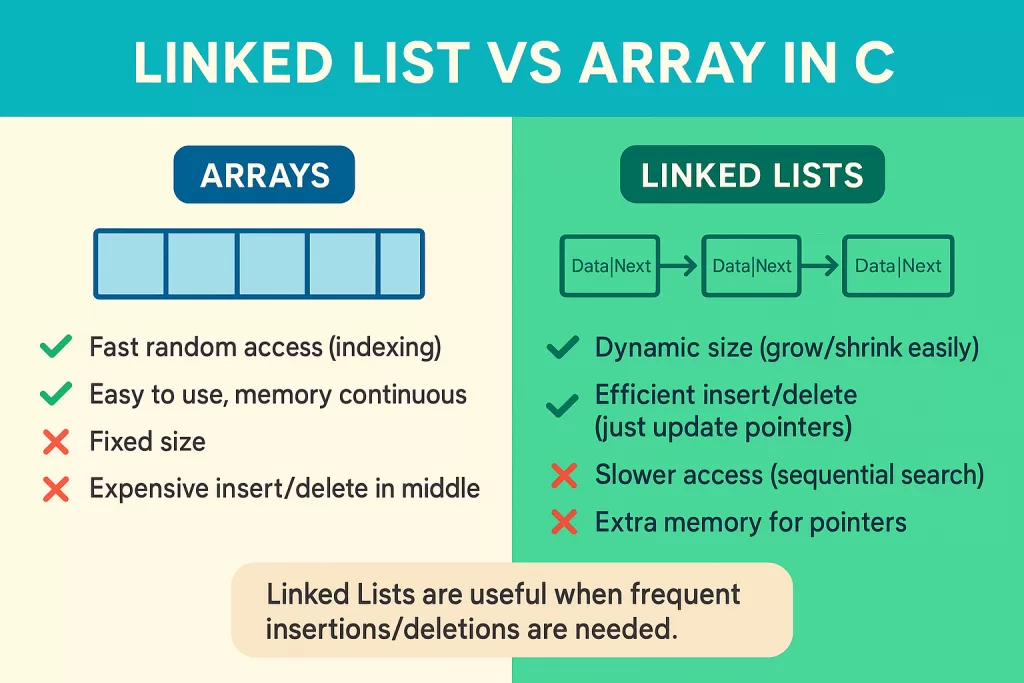
Students often wonder: “Should I use an array or a linked list in C?” The answer depends on the situation.
Here’s the array vs linked list in C comparison table that every developer should memorize:
| Feature | Array in C | Linked List in C |
|---|---|---|
| Memory allocation | Static (fixed size) | Dynamic (grows/shrinks) |
| Access time | O(1) (direct indexing) | O(n) (sequential search) |
| Insertion/Deletion | Expensive (shifting needed) | Efficient at head/tail |
| Cache locality | Better (continuous memory) | Poor (scattered nodes) |
| Implementation | Easier | More complex |
Real-World Examples:
- Use arrays for lookup-heavy tasks (like storing student IDs).
- Use linked lists for dynamic operations (like music playlists, undo operations, OS memory allocation).
👉 Remember, many interviewers ask: difference between array and linked list in data structure—be ready with both technical and practical comparisons.
8. Applications of Linked List
So, why learn linked lists at all in 2025 when dynamic arrays like std::vector (C++) exist? Because under the hood, linked lists power many real-world systems.
📌 Top Applications of Linked List
- Dynamic Memory Management
- Operating systems often manage memory blocks using linked lists.
- Stacks and Queues Implementation
- From compilers to job schedulers, many systems rely on stack using linked list in C or queue using linked list in C.
- Polynomial Addition Using Linked List in C
- Polynomial equations can be represented as linked lists where each node stores coefficient and power.
- Undo/Redo Operations
- Text editors and IDEs use doubly linked lists to manage user actions.
- Round-Robin Scheduling
- Circular linked list in C is perfect for CPU scheduling where processes are executed in a loop.
- Real-Time Gaming
- Multiplayer games sometimes use circular linked lists for player turns.
- Hash Chaining in Data Structures
- Collision handling in hash tables often uses linked lists.
💡 Career Angle: In coding interviews, when asked about applications of linked list in C, don’t just say “queues and stacks.” Give a real-world example—like “Operating systems use circular linked lists for scheduling because it avoids dead ends.” That’s how you stand out.
9. Advantages and Disadvantages of Linked List
If you’ve made it this far, you already know that linked lists are powerful—but they’re not a silver bullet. In real-world software engineering, knowing when not to use them is just as important.
✅ Advantages of Linked List
- Dynamic size: You don’t need to declare size upfront. Perfect for applications like music playlists or task managers that grow unpredictably.
- Efficient insertions/deletions: Adding/removing at the beginning or middle of a list is O(1), unlike arrays where shifting is needed.
- Memory utilization: They can use scattered memory blocks, which is a lifesaver in systems with fragmented memory.
- Foundation of advanced structures: Stacks, queues, graphs, hash tables, and adjacency lists often rely on linked lists.
❌ Disadvantages of Linked List
- No random access: Accessing the 10th element requires walking through the first nine nodes. That’s O(n).
- Extra memory overhead: Every node needs extra space for pointers.
- Cache unfriendly: Arrays are stored contiguously and benefit from CPU caching. Linked lists don’t.
- Pointer complexity: A single pointer error can break the chain, leading to bugs and crashes.
- Not always faster: For lookups, arrays usually outperform linked lists.
💡 Rule of thumb: Use linked lists when you need frequent insertions/deletions. Use arrays when you need fast lookups.
10. Linked List Interview Questions in C
Linked lists are one of the top 5 most asked topics in coding interviews. Recruiters love them because they test pointers, memory management, and algorithmic thinking.
Here’s a quick set of popular interview questions on linked list in C:
- Basic Level
- What is a linked list in C?
- Difference between array and linked list in C.
- What is singly linked list vs doubly linked list vs circular linked list?
- Write a program for insertion and deletion in a singly linked list in C.
- Intermediate Level
- Reverse a singly linked list (iterative and recursive).
- Detect a loop in a linked list (Floyd’s Cycle Detection algorithm).
- Implement stack using linked list in C.
- Implement queue using linked list in C.
- Advanced Level
- Merge two sorted linked lists.
- Find the middle element of a linked list in one traversal.
- Remove duplicates from an unsorted linked list.
- Why is doubly linked list preferred for implementing undo/redo operations?
👉 Pro Career Insight: When answering these, don’t just code. Explain why you chose a particular algorithm. Interviewers are testing thought process, not just syntax.
11. FAQ on Linked List in C
Beginners often stumble on certain terms. Here’s a complementary FAQ to clear things up:
Q1. What is a “node” in a linked list?
A node is the building block of a linked list. It usually has two parts:
- Data (actual information)
- Pointer (reference to the next node)
Q2. What is the difference between singly, doubly, and circular linked list?
- Singly linked list in C → One pointer per node (next).
- Doubly linked list in C → Two pointers per node (next & prev).
- Circular linked list in C → Last node points back to the first node.
Q3. Why does accessing elements in linked list take O(n)?
Because unlike arrays, you can’t jump directly to the 5th or 10th element. You must traverse sequentially from the head.
Q4. What is “self-referential structure” in C?
It’s a struct that contains a pointer to the same struct type. Example:
struct Node {
   int data;
   struct Node* next;
};
Q5. Is linked list faster than arrays?
Not always. Linked lists are better for dynamic insertions/deletions, but arrays beat them for random access and cache performance.
Q6. Can you free a linked list in C?
Yes. Use a loop to traverse and free() every node to avoid memory leaks.
12. Conclusion
Learning linked list in C is like learning to drive a manual car 🚗. You may not use it daily in modern programming (where STL containers or dynamic arrays exist), but it sharpens your fundamentals and makes you a better driver when you finally switch to an automatic.
From singly linked list in C to doubly and circular linked lists, you’ve seen how this data structure powers stacks, queues, schedulers, and even compilers. You’ve also seen its pitfalls—slow lookups, pointer complexity—but that’s what makes it such a favorite in coding interviews.
👉 If you’re preparing for a career in software engineering, don’t just memorize code. Implement it, debug pointer issues, and understand when to use arrays vs linked lists. The clarity you gain here will carry over to trees, graphs, and beyond.
In short: master linked lists now, and you’ll thank yourself later in your career. 🚀
🔗 Related Reads
If you found this Linked List in C Guide helpful, you’ll love these other deep-dive resources that strengthen your C and Data Structures knowledge:
- 🔥 Pointers in C Explained (2025 Guide with Real Examples & Best Practices)
- 🧮 Sum of Absolute Differences in Arrays – 2025 Guide with Examples & Code
- 💡 Float and Double in Programming: Meaning, Size, Range, and Key Differences in 2025
- 🔥 Logical Operators in C (AND, OR, NOT) with Real Examples You’ll Actually Use
- 🖨️ Format Specifiers in C – List, Examples & printf/scanf Guide (2025)
- 🧠 Bit Fields in C: 7 Must-Know Uses, Syntax, and Real-Life Examples
- 🌳 Trees in Data Structures Explained: 5 Must-Know Types, Traversals & a FREE Cheat Sheet






![Square Brackets []](https://www.wikitechy.com/wp-content/uploads/2026/03/Square-Brackets-The-Critical-Key-to-Data-Access-in-Programming-🗝️-380x220.webp)