Problem Solving Agents in Artificial Intelligence: A Complete In-Depth Guide for Beginners in 2026
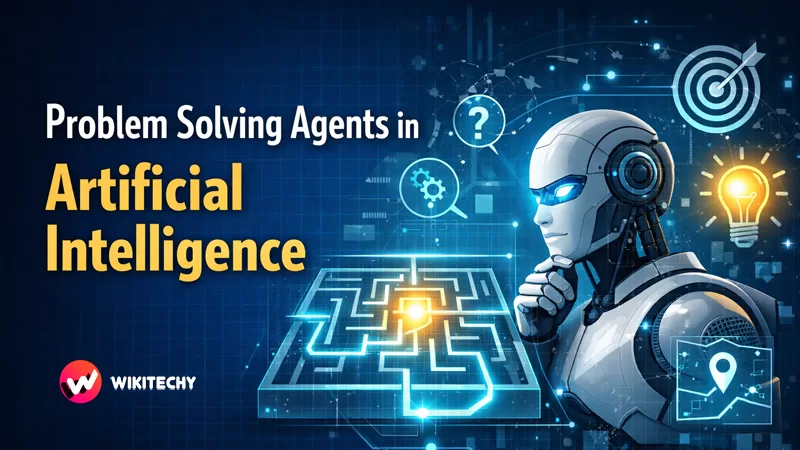
Problem Solving Agents in AI – Artificial Intelligence (AI) is no longer just a futuristic concept—it is deeply embedded in our everyday lives. From recommendation systems and voice assistants to autonomous vehicles and intelligent robots, AI systems are continuously making decisions on our behalf. One of the most important concepts behind such intelligent behavior is the problem-solving agent.
Problem-solving agents form the backbone of many AI applications. They are designed to think logically, evaluate multiple possibilities, and choose the best course of action to achieve a goal. This comprehensive guide will help you understand problem-solving agents from the ground up, making it perfect for beginners in 2026.
Problem Solving Agents in AI
Understanding Intelligent Agents in AI

Before diving into problem-solving agents, it’s important to understand what an intelligent agent is.
An intelligent agent is any system that:
- Perceives its environment through sensors
- Processes the information
- Acts upon the environment using actuators
Examples include:
- A robot navigating a warehouse
- A chatbot responding to queries
- A self-driving car making driving decisions
Among these, problem-solving agents are a special category that focuses on finding solutions through reasoning and planning.
What is a Problem Solving Agent?
A problem-solving agent is an intelligent agent that decides what to do by:
- Identifying a goal
- Formulating a problem
- Searching for possible solutions
- Executing the best solution
Unlike reactive agents that respond instantly, problem-solving agents think ahead. They simulate different possibilities before acting, which makes them highly effective in complex environments.
Real-Life Example to Understand Better
Imagine you are trying to travel from one city to another using a navigation app.
- Initial State: Your current location
- Goal State: Your destination
- Actions: Possible routes you can take
- Path Cost: Time, fuel, or distance
The system evaluates multiple routes and suggests the best one. This is exactly how a problem-solving agent works.
Core Components of a Problem Solving Agent

To function effectively, a problem-solving agent relies on several key components:
1. Initial State
This defines where the agent begins. It is the starting condition of the problem.
2. State Space
This includes all possible states the agent can move through while solving the problem.
3. Actions (Operators)
Actions define how the agent can move from one state to another.
4. Transition Model
This describes the outcome of applying an action to a state.
5. Goal Test
A method to determine whether the current state satisfies the goal.
6. Path Cost Function
This evaluates how efficient a path is (e.g., shortest distance, least time).
The Working Process of Problem Solving Agents
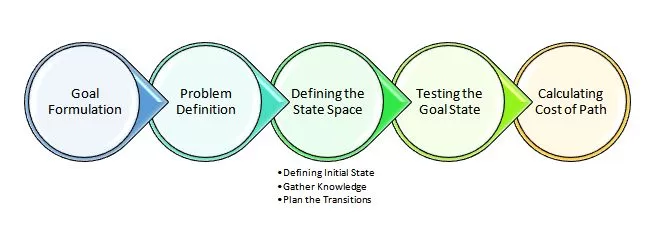
Problem-solving agents follow a structured workflow:
Step 1: Goal Formulation
The agent identifies what it needs to achieve.
Step 2: Problem Formulation
The agent converts the goal into a formal problem with defined states and actions.
Step 3: Search
It explores different sequences of actions to reach the goal.
Step 4: Solution Execution
The best path is selected and executed step-by-step.
Step 5: Monitoring (Optional Advanced Step)
Some advanced agents monitor progress and adjust decisions dynamically.
Types of Problem Solving Agents
Problem-solving agents can be categorized into different types based on their intelligence and approach:
1. Simple Problem Solving Agents
- Work in fully observable environments
- Assume complete knowledge
- Solve straightforward problems
2. Goal-Based Agents
- Focus on achieving specific goals
- Evaluate multiple paths before acting
3. Utility-Based Agents
- Choose actions based on utility (satisfaction level)
- Aim for the best possible outcome, not just any solution
4. Learning Agents
- Improve performance over time
- Learn from past experiences
- Adapt to changing environments
Search Strategies in Problem Solving Agents

Search is the heart of problem-solving agents. It determines how efficiently a solution can be found.
Uninformed Search (Blind Search)
These methods do not use additional knowledge:
- Breadth-First Search (BFS): Explores level by level
- Depth-First Search (DFS): Explores deep paths first
- Uniform Cost Search: Considers path cost
Pros:
- Simple to implement
- Guaranteed solutions (in some cases)
Cons:
- Can be slow and memory-intensive
Informed Search (Heuristic Search)
These methods use domain knowledge:
- Greedy Best-First Search: Chooses the most promising path
- A* Algorithm: Combines cost and heuristic
Pros:
- Faster and more efficient
- Reduces search space
Cons:
- Requires good heuristics
- May not always guarantee optimality
Problem Representation in AI

A well-defined problem is crucial for success. A problem must include:
- A clear initial state
- A well-defined goal state
- A set of valid actions
- A measurable cost function
Poor problem representation can lead to inefficient or incorrect solutions.
Real-World Applications of Problem Solving Agents
Problem-solving agents are widely used across industries:
1. Navigation and Route Planning
Used in GPS systems to find optimal routes.
2. Game Playing AI
Chess, puzzles, and strategy games rely heavily on search-based agents.
3. Robotics
Robots plan actions to complete tasks like object handling or navigation.
4. Healthcare Systems
Assist in diagnosis and treatment planning.
5. Automated Scheduling
Used in airlines, manufacturing, and logistics.
6. Virtual Assistants
Analyze user queries and decide appropriate responses.
Advantages of Problem Solving Agents
- Capable of handling complex decision-making
- Provide optimal or near-optimal solutions
- Flexible and adaptable to various domains
- Improve efficiency in automation

Limitations and Challenges
Despite their capabilities, problem-solving agents face challenges:
- High computational complexity
- Large memory requirements
- Difficulty in dynamic or unpredictable environments
- Dependence on accurate models and heuristics
Problem Solving Agents vs Reactive Agents
| Feature | Problem Solving Agents | Reactive Agents |
|---|---|---|
| Decision Style | Planning-based | Immediate response |
| Complexity | High | Low |
| Flexibility | High | Limited |
| Use Case | Complex tasks | Simple environments |
Future Trends in Problem Solving Agents (2026 and Beyond)
The future of problem-solving agents looks promising with rapid AI advancements:
- Integration with Machine Learning for smarter decision-making
- Real-time adaptive systems for dynamic environments
- Autonomous vehicles with advanced planning capabilities
- Human-like reasoning systems in virtual assistants
- Hybrid agents combining learning and reasoning
These innovations will make AI systems more intelligent, efficient, and capable of solving real-world challenges.
Tips for Beginners Learning Problem Solving Agents
- Start with basic search algorithms like BFS and DFS
- Practice problems like puzzles and pathfinding
- Learn heuristic design for better performance
- Implement algorithms in Python or Java
- Explore real-world case studies
Conclusion
Problem-solving agents are a fundamental pillar of Artificial Intelligence. They enable machines to think logically, plan effectively, and solve complex problems step by step. By understanding how these agents work—from problem formulation to search strategies—you gain a strong foundation in AI.
As we move further into 2026, mastering problem-solving agents will not only enhance your understanding of AI but also open doors to exciting opportunities in technology, research, and innovation.
Want to Learn More About Python & Artificial Intelligence ???, Kaashiv Infotech Offers Full Stack Python Course, Artificial Intelligence Course, Data Science Course & More Visit Their Website course.kaashivinfotech.com.
Related Reads: