Software Testing Process: A Complete Guide to Ensuring Quality
In terms of how to build quality software, the software testing process, or testing process, is as critical as the coding process. In terms of good developers, errors will happen regardless of the level of good. The value of a product is important but what is really important is how defects are found, how they are reported and how defects are remediated prior to release.
In this article, we will explore the testing process in the software testing process, describe each milestone of the journey, and provide suggestions to support the entire testing process regardless of whether your software is a small app, or part of a large enterprise system.
🔎 What is the Software Testing Process?
The software testing process is a standardized approach to evaluation of a software application to ensure it meets quality standards. It will contain the steps of planning, developing test cases, executing test cases, logging defects, retesting and reporting test results.
Simply, it is a process or roadmap which establishes defect free, user friendly and reliable software applications.
👉Think of a recipe from a chef, it does not matter how good your ingredients are, the dish will not be correct unless the right process is followed.
🌀 Why is the Testing Process in Software Testing Important?
Neglecting or fast-tracking the testing process is akin to neglecting a safety check before flying an airplane. The ramifications can be disastrous. A well-planned and executed as the appropriate testing process in Software Testing can help to ensure the following:
- Identify bugs early → cheaper and more effective.
- Quality assurance → promotes trust in the customer.
- Less rework → less time spent fixing stuff, the developers should have done earlier.
- Compliance & Security → comply with the standard of the industry.
- User Satisfaction → helps deliver good software quickly that works.
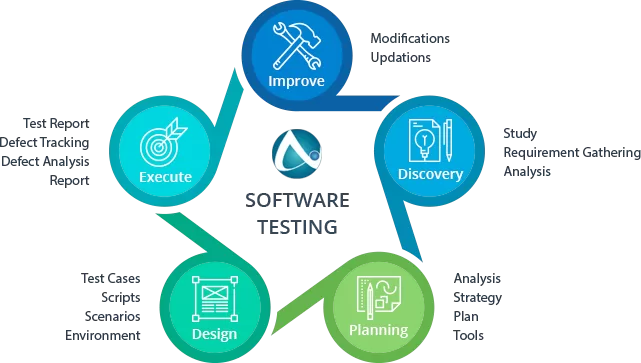
📌 Phases of the Software Testing Process
The software testing process normally follows the Software Testing Life Cycle (STLC) with the following phases:

Requirements Analysis
Before a single test case is written, testers will look at software requirements to see what they will need to test.
Example: If you are building an e-commerce app, you will likely see requirements for login authentication, search for products, add to cart, and a payment gateway.
Goal: Identify which requirements are testable and clarify any concerns with stakeholders.
Test Planning
This stage focuses on the overall strategy. Test leads or managers for the software project define what action will be tested, how to test them, resource(s) required, tool(s) used, and deadlines.
Example: deciding whether to use manual testing to validate UI or if they will use an automated script for regression testing.
Goal: Develop a test plan document that details every aspect and can act as a roadmap when testing starts.
Test Case / Test Script Design
During this stage, testers will write test cases and test scripts. Each test case has three more details which will consider your input, action, and expected output.
Example: Login Test Case → Enter valid name and password → Expected Result: User redirected to dashboard.
Goal: cover positive use cases, and negative use cases.
Test Environment Setup
A test environment is setup that will mimic a real-life scenario.
Example: Setup browsers, mobile devices, servers, or cloud environments to mimic end user conditions.
Goal: Make sure the environment is stable so the results are accurate.
Test Execution
Here is where the rubber meets the road. Testers conduct the tests and record results.
Example: Clicking through screens in the app, running automated regression suites, and logging fails.
Goal is to find defects, confirm expected behavior, and confirm requirements.
Defect Reporting & Tracking
Once defects are discovered, they are reported to an Issue/Defect Management tool (for example: Jira, Bugzilla, Azure DevOps).
Each defect report contains steps to reproduce, severity, screen shots, logs, etc.
The goal is to ensure developers can resolve issues in a timely manner, and that the documentation is detailed enough to explain what is wrong.
Defect Retesting & Regression Testing
Testers then retest the defects once they are fixed. After confirmations of fixes, the testers perform regression tests to ensure that no new fixes have broken existing functionality.
The goal is to ensure software remains stable throughout the life of the software with every version release.
Test Closure
At the end, the testers review overall execution, create the test summary report, and provide recommendations and lessons learned.
The goal is to enable continued improvement in future testing cycles.
⚖️ Manual Testing vs Automation Testing in the Process

However, both manual testing and automation testing are essential components of the Software Testing process, gaining valuable insight from both types of testing.
- Manual Testing: Exploratory, Usability, One-time-use cases.
- Automation Testing: iteration, performance, regression, functionality.
👉 Combination Testing is typically best.
🌍 Real-Life Example of a Software Testing Process
Imagine a banking app:
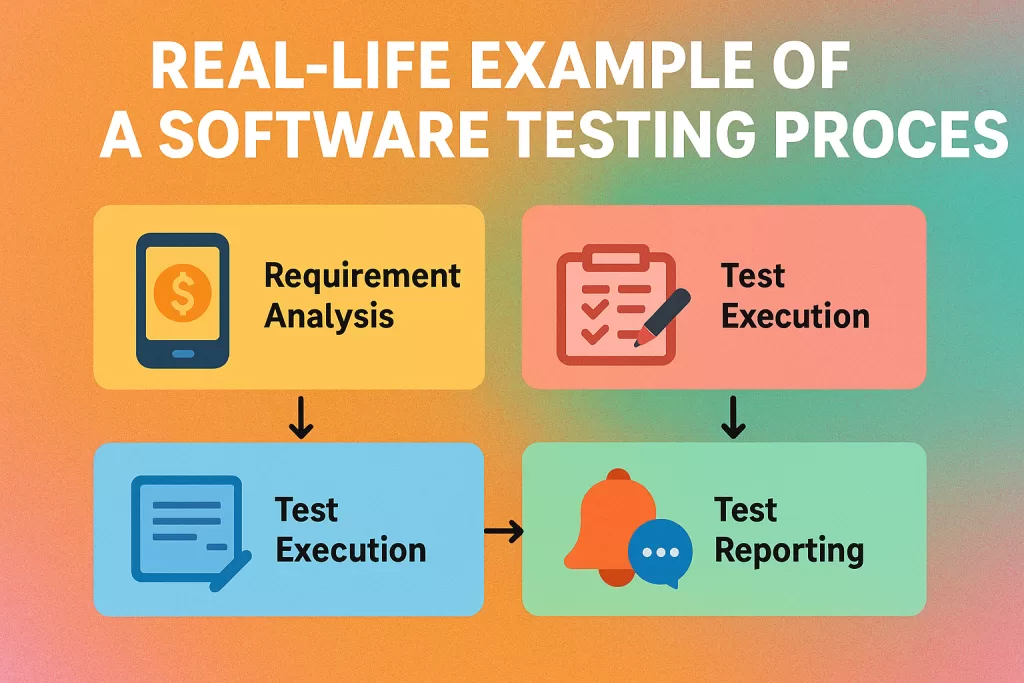
- Requirement Analysis: Must support fund transfers, bill payments, and transaction history.
- Test Planning: Define roles, tools, and timelines.
- Test Cases: Fund transfer with valid amount → Success; Fund transfer with insufficient balance → Error message.
- Execution: Run test cases on web + mobile.
- Defects Logged: Payment fails on low network connectivity.
- Retesting: Fix verified.
- Closure: Test report submitted → App released.
✅ Best Practices in the Software Testing Process
- Testing early (Shift Left Testing).
- Creating a combination of manual + automated testing.
- Keeping test cases & plans up to date with changes in requirements.
- Prioritize defect based on severity and impact.
- Metrics can include defect density, test coverage, and test pass rate.
❓ FAQs on the Software Testing Process
Q1: What is the difference between STLC and QA in general?
STLC (Software Testing Life Cycle) is a defined set of phases, while QA can be broader and include improvement in process, audits, compliance etc.
Q2: Is the same approach used in Agile and Waterfall?
No. Agile testing includes constant testing in ongoing short sprints, while Waterfall is more linear through a series of steps.
Q3: Is everything can be automated?
No. Automation will help with repetitive tests and regression tests, but exploratory, usability and design validation will always need someone to test it.
Q4: How do teams prioritize testing?
Testers evaluate and prioritize first in areas where there is risk, business impact and an expectation defects will be found in those areas.
Q5: What tools are commonly used in most QA activities?
Most popular tools include – Selenium, JUnit, TestNG, Jira, Bugzilla, Postman, Jenkins.
🎯 Conclusion
The software testing process is the foundation of quality in software. From analyzing requirements to executing tests to closing reports, each step of the process gives you confidence that what you are producing is reliable, secure and easy to use.
Whether you are a junior QA member or you lead a large test team, mastering the software testing process is essential to producing world-class applications.
👉 Note: Software is produced by code – trust is produced by testing.
Related Links