🧠 TensorFlow in Python: The 2025 Ultimate Deep Learning Guide You’ll Fall in Love With

🧠 What Is TensorFlow in Python in 2025
If you’re exploring TensorFlow in Python for the first time, here’s the truth — most beginners think TensorFlow is just another deep learning library. But in reality, it’s the AI engine that powers everything from Google Search and YouTube recommendations to self-driving cars, chatbots, and even robotic surgery systems.
Think of the Python AI ecosystem as a human body:
- NumPy is the brain’s raw mathematical power 💡
- Pandas is the memory that organizes and stores information 🧾
- SciPy is the analytical reasoning 🧮
- TensorFlow is the intelligence itself — it learns, predicts, and evolves 🤖
By the end of this guide, you’ll understand not just what TensorFlow is, but also how it became the backbone of modern AI and deep learning, and how learning it in 2025 can unlock a powerful career path in data science or AI engineering.
Key Highlights:
- TensorFlow is Google’s open-source deep learning and machine learning framework.
- It lets developers create neural networks for image, speech, and text understanding.
- Used by Google, Tesla, OpenAI, NASA, Netflix, and thousands of startups worldwide.
- It’s written in C++ and CUDA, with easy-to-use Python APIs on top.
- Works seamlessly across CPUs, GPUs, and TPUs (Tensor Processing Units).
- TensorFlow 2.x integrates tightly with Keras, making deep learning simpler than ever.
- In 2025, over 80% of AI and ML job postings mention TensorFlow or PyTorch skills.
🌍 Why TensorFlow Is a Game-Changer in 2025
Let’s face it — without TensorFlow, Python wouldn’t have become the global language of AI.
From chatbots like ChatGPT to autonomous vehicles, medical imaging, voice assistants, and predictive finance, TensorFlow quietly powers the algorithms shaping modern life.
Here’s a crazy fact:
In 2025, TensorFlow is estimated to be used in over 60% of production-level AI systems (source: Stack Overflow Developer Survey 2025).
Why? Because TensorFlow is built for both research and deployment.
It helps data scientists experiment quickly — and then push those same models into production with just a few lines of code.
If NumPy gives you data, TensorFlow gives it intelligence.
If you want to grow from a “Python coder” to a machine learning creator, TensorFlow is your bridge.

🧩 What Is TensorFlow in Python?
TensorFlow is an open-source machine learning and deep learning library developed by the Google Brain Team in 2015. It enables developers and researchers to build data-driven models that can learn from experience — mimicking how the human brain works using neural networks.
In simpler words:
NumPy handles the numbers. TensorFlow makes them learn.
TensorFlow supports a wide range of AI capabilities:
🔹 Deep Neural Networks (DNNs)
🔹 Convolutional Neural Networks (CNNs) — for image & vision tasks
🔹 Recurrent Neural Networks (RNNs) & LSTMs — for text & sequences
🔹 Transformers — for NLP and chatbots
🔹 Reinforcement Learning — for decision-making AI
🔹 Transfer Learning — reusing pre-trained models
TensorFlow lets you train, evaluate, and deploy machine learning models efficiently — whether you’re working on a Raspberry Pi, a GPU server, or a production cloud pipeline.
⚙️ Installing TensorFlow
Getting started with TensorFlow in Python is straightforward.
✅ Using pip
pip install tensorflow
Verify installation:
import tensorflow as tf
print(tf.__version__)
💡 Pro Tip: Install it inside a virtual environment or use Anaconda, which helps avoid version conflicts and comes with most data libraries preloaded.
✅ Using Anaconda
conda install -c conda-forge tensorflow
TensorFlow requires:
- Python 3.8 or higher
- pip 22.0+
- Optional: CUDA toolkit (for GPU acceleration)
Once installed, you’re ready to build your first deep learning model. 🚀
🧠 The TensorFlow Ecosystem — What’s Inside
TensorFlow isn’t just one library — it’s a universe of interconnected tools designed for every stage of the AI pipeline.
| Submodule | Purpose |
|---|---|
| tf.keras | High-level API for building & training neural networks easily |
| tf.data | Efficient input pipelines for large datasets |
| tf.lite | Deploy models on mobile & IoT devices |
| tf.js | Run TensorFlow models directly in web browsers |
| tf.hub | Access and reuse pre-trained models |
| tf.model_optimization | Compress models for faster inference |
| tf.distribute | Multi-GPU/TPU distributed training |
| TensorBoard | Visualization tool for tracking metrics and model graphs |
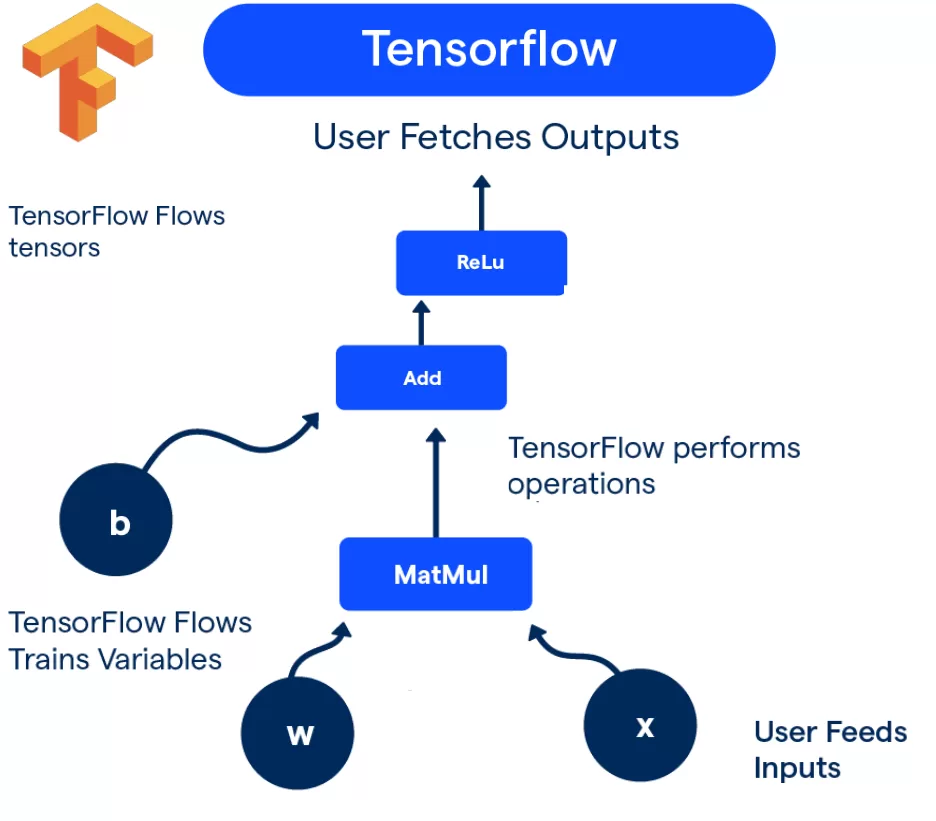
💡 Fun fact: TensorFlow was named after “tensors” (multidimensional arrays) and “flow” (the computational flow graph that processes them).
In short, TensorFlow helps your model flow intelligence through tensors.
⚔️ TensorFlow vs PyTorch — The 2025 Showdown
When it comes to deep learning, two frameworks dominate the world — TensorFlow and PyTorch. Let’s break down their strengths in 2025.
| Feature | TensorFlow | PyTorch |
|---|---|---|
| Backed By | Meta (Facebook) | |
| Ease of Use | High (Keras integration) | Very High (Pythonic) |
| Performance | Excellent with XLA compiler | Excellent (Dynamic Graphs) |
| Visualization | ✅ TensorBoard | ❌ Limited |
| Deployment | ✅ TF Lite, TF Serving, TF.js | ⚠️ Requires extra setup |
| Ecosystem Maturity | ⭐⭐⭐⭐⭐ | ⭐⭐⭐⭐ |
| Research Popularity | ⭐⭐⭐⭐ | ⭐⭐⭐⭐⭐ |
Verdict (2025):
If you’re focused on production-ready AI apps, TensorFlow wins.
If you’re doing academic or rapid experimentation, PyTorch feels more flexible.

But both are essential tools for modern ML engineers — many professionals now use both interchangeably.
🚀 Quick Example — TensorFlow in Action
Here’s how you can build your first neural network in less than 10 lines using TensorFlow and Keras:
import tensorflow as tf
from tensorflow import keras
from tensorflow.keras import layers

# Simple Neural Network for Digit Recognition
model = keras.Sequential([
    layers.Flatten(input_shape=(28, 28)),
    layers.Dense(128, activation='relu'),
    layers.Dense(10, activation='softmax')
])

model.compile(optimizer='adam',
              loss='sparse_categorical_crossentropy',
              metrics=['accuracy'])

(x_train, y_train), _ = keras.datasets.mnist.load_data()
model.fit(x_train, y_train, epochs=5)
💡 In just a few lines, you’ve built an AI that can read handwritten digits!
This simplicity is why TensorFlow has become the go-to tool for developers entering AI — it makes complex mathematics look elegant and human-friendly.
⚡ TensorFlow’s Secret Power — Performance & Speed
Plain Python struggles with heavy numerical tasks. TensorFlow doesn’t.
Here’s why TensorFlow performs like a beast 🦾:
- Written in C++ and CUDA for ultra-fast GPU/TPU performance.
- Uses XLA (Accelerated Linear Algebra) compiler to optimize graphs.
- Automatically parallelizes tasks across CPUs and GPUs.
- Integrates with Google Cloud AI, making scalable training simple.
- Supports mixed precision training for faster and lighter models.
The result?
Models that train 5–10× faster than pure Python loops.
When it comes to performance, TensorFlow doesn’t just “run code” — it builds a computational graph that’s optimized before execution.
That’s like upgrading from a manual calculator to an AI-powered quantum engine.
🧭 The TensorFlow Workflow
TensorFlow follows a simple yet powerful 5-step workflow that mirrors how AI models are developed in real companies:
| Step | Description |
|---|---|
| 1️⃣ | Prepare Data – Load, normalize, and split your dataset using tf.data. |
| 2️⃣ | Build Model – Define your neural network using tf.keras.Sequential. |
| 3️⃣ | Train Model – Run the training process with .fit() or custom training loops. |
| 4️⃣ | Evaluate & Tune – Measure accuracy, tune hyperparameters. |
| 5️⃣ | Deploy – Export your trained model with TensorFlow Lite, TF.js, or TensorFlow Serving. |
Once you master this cycle, you can adapt it for any domain — vision, NLP, robotics, or finance.
🧪 Real-World Use Cases of TensorFlow
TensorFlow is the Swiss Army knife of AI. It’s flexible enough to power both scientific research and commercial AI systems.
| Industry | AI Application |
|---|---|
| Healthcare 🧬 | Cancer & X-ray image classification, drug discovery |
| Finance 📈 | Fraud detection, portfolio forecasting, risk analytics |
| Automotive 🚗 | Self-driving systems, object detection, lane tracking |
| E-Commerce 🛍️ | Recommendation systems, personalized offers |
| Robotics 🤖 | Motion prediction, navigation models |
| NLP / Chatbots 🗣️ | Text classification, translation, and GPT-like assistants |
📌 Interview Tip: When asked “Where is TensorFlow used?”, mention 2 business and 2 technical examples. It shows you understand both impact and implementation.
🎓 How to Learn TensorFlow in 2025 – The Roadmap That Actually Works
Learning TensorFlow can feel overwhelming at first — there are so many concepts like tensors, layers, gradients, and optimizers. But don’t worry — if you follow a structured roadmap, you can go from beginner to pro in a few months.
Here’s a step-by-step learning path that works perfectly for students, engineers, and AI enthusiasts in 2025 👇
Step 1: Get Comfortable with Python and Math
Before TensorFlow, you must master:
- Python basics: loops, functions, lists, NumPy arrays.
- Linear algebra: vectors, matrices, dot product.
- Calculus basics: derivatives and gradients.
- Statistics: mean, variance, correlation, and probability.
TensorFlow is math wrapped in Python — so the stronger your foundation, the easier it feels.
Step 2: Learn Machine Learning Basics
Understand what problems TensorFlow solves. Learn key ML concepts like:
- Supervised vs Unsupervised Learning
- Classification vs Regression
- Overfitting, Underfitting
- Cross-validation, Loss functions
You can practice with Scikit-learn before jumping to TensorFlow.
Step 3: Dive into TensorFlow Core Concepts
Start with these essential topics:
- Tensors and Tensor Operations
- Variables and Constants
- Computational Graphs
- GradientTape (for custom training loops)
- Keras Sequential and Functional APIs
Once you understand these, everything else becomes smooth.
Step 4: Build Neural Networks with Keras
Keras (built into TensorFlow) simplifies deep learning beautifully. Learn to build:
- Feedforward Neural Networks
- Convolutional Neural Networks (CNNs)
- Recurrent Neural Networks (RNNs)
- Autoencoders
Practice on datasets like MNIST, CIFAR-10, and IMDB Reviews.
Step 5: Learn Model Optimization
Explore how to fine-tune and improve performance:
- Learning rate scheduling
- Dropout and Batch Normalization
- Callbacks (ModelCheckpoint, EarlyStopping)
- Optimizers (Adam, RMSprop, SGD)
Step 6: Real-World Projects
Start working on mini-projects that matter. (You’ll find examples later in this article 👇)
Step 7: Deployment & Advanced Topics
Learn to deploy TensorFlow models with:
- TensorFlow Lite (for Android/iOS)
- TensorFlow.js (for web)
- TensorFlow Serving / REST API (for production)
Then dive into advanced fields like: - NLP with Transformers
- Computer Vision with Transfer Learning
- Reinforcement Learning
- Generative AI and GANs
💼 TensorFlow Career Opportunities in 2025
TensorFlow has transformed from a research library to a global job magnet.
Whether you’re into AI, Data Science, or Automation, TensorFlow skills are gold in the market.
👨💻 Popular Career Roles:
| Role | Description | Avg Salary (India, 2025) |
|---|---|---|
| Machine Learning Engineer | Builds & deploys ML models | ₹9–18 LPA |
| Deep Learning Engineer | Works with CNNs, RNNs, NLP models | ₹12–25 LPA |
| Data Scientist | Uses TensorFlow for predictive analytics | ₹10–20 LPA |
| AI Researcher | Designs new architectures & experiments | ₹15–30 LPA |
| Computer Vision Engineer | Focuses on image/video models | ₹10–22 LPA |
| NLP Engineer | Works on chatbots, sentiment analysis | ₹12–20 LPA |
🌍 In the US, TensorFlow engineers average between $115,000 and $170,000 per year.
And guess what? TensorFlow is mentioned in over 70% of AI-related job listings on LinkedIn and Indeed in 2025.
🌟 Why Companies Love TensorFlow
TensorFlow isn’t just popular because it’s from Google — it’s loved because it delivers results at scale.
Here’s how leading companies use it:
| Company | TensorFlow Application |
|---|---|
| Voice recognition, image search, and recommendation systems | |
| Tesla | Computer vision for autopilot and object detection |
| Netflix | Personalized movie recommendations |
| Airbnb | Fraud detection and dynamic pricing |
| Intel | AI hardware optimization |
| Spotify | Music recommendation & user behavior prediction |
💡 When your TensorFlow project portfolio includes real business problems like these, recruiters notice.
⚡ TensorFlow vs Other Libraries — 2025 Comparison
| Feature | TensorFlow | PyTorch | Keras | Scikit-learn |
|---|---|---|---|---|
| Focus | Deep Learning | Research & Experiments | High-level API | Traditional ML |
| Ease of Use | ✅ High | ✅ Very High | ✅ Beginner-friendly | ✅ Very High |
| Deployment | ✅ Excellent | ⚠️ Limited | ✅ Easy | ⚠️ Not for deployment |
| Performance | ⭐⭐⭐⭐⭐ | ⭐⭐⭐⭐ | ⭐⭐⭐⭐ | ⭐⭐ |
| Visualization | ✅ TensorBoard | ⚠️ Basic | ⚠️ Limited | ❌ None |
| GPU Support | ✅ Native | ✅ Native | ✅ via TensorFlow | ⚠️ Limited |
| Ideal For | Production AI Systems | Research Labs | Beginners | ML Fundamentals |
💬 Conclusion:
If your goal is AI-powered apps (like facial recognition, chatbots, or predictions), TensorFlow is the go-to framework.
If you’re doing quick experiments or academic projects, PyTorch can complement it well.
🧩 Mini TensorFlow Projects You Can Try in 2025
Ready to get hands-on? Here are some practical, portfolio-ready projects you can build:
| Project | Description | Skills You’ll Learn |
|---|---|---|
| 🖼️ Image Classifier | Train a CNN on CIFAR-10 or custom dataset | CNNs, Data Augmentation |
| 🧠 Sentiment Analysis Bot | Analyze movie or tweet sentiments | NLP, Embeddings |
| 🚗 Traffic Sign Recognition | Detect signs for self-driving simulation | Computer Vision |
| 💬 Text Generation with LSTM | Create a text generator like ChatGPT-mini | RNNs, Sequential Data |
| 👁️ Face Mask Detection | Use MobileNetV2 + TF Lite | Transfer Learning, Deployment |
| 🩺 Medical Diagnosis | Predict diseases from X-ray images | CNNs, Explainable AI |
💡 Each of these can go on your GitHub — they speak louder than your resume.
💡 Advanced TensorFlow Topics to Explore
Once you’re confident with the basics, level up your expertise with these areas:
🔹 TensorFlow Extended (TFX): For end-to-end ML pipelines.
🔹 TensorFlow Hub: Download & reuse pre-trained models instantly.
🔹 TensorFlow Quantum: Integrate AI with quantum computing.
🔹 TensorFlow Federated: Build decentralized AI systems (used in Google Keyboard).
🔹 TensorFlow Probability: Advanced probabilistic models & Bayesian networks.
These are in-demand areas in research and enterprise AI in 2025.
🧠 TensorFlow + Keras: The Perfect Duo
Before 2020, TensorFlow was powerful but a bit complex. Then came Keras — a high-level API that made deep learning accessible to everyone.
In TensorFlow 2.x, Keras is built-in, giving you:
- Cleaner syntax
- Faster prototyping
- Easier debugging
- Plug-and-play architecture
Example:
from tensorflow.keras.models import Sequential
from tensorflow.keras.layers import Dense

model = Sequential([
    Dense(64, activation='relu', input_shape=(10,)),
    Dense(1, activation='sigmoid')
])

model.compile(optimizer='adam', loss='binary_crossentropy', metrics=['accuracy'])
This simplicity is what made TensorFlow the top AI framework taught in universities across India, the US, and Europe.
💰 Why TensorFlow Is Worth Learning in 2025
Let’s break it down logically.
| Factor | Why It Matters |
|---|---|
| 💼 Career Demand | TensorFlow is required in most AI/ML job descriptions |
| 🧩 Versatility | Works for NLP, vision, audio, time series, and more |
| 🌐 Community Support | Millions of developers & 1000s of tutorials |
| ⚙️ Integration | Works seamlessly with Python, NumPy, Pandas, and Scikit-learn |
| 🚀 Future-Proof | Supported by Google & continuously evolving |
Learning TensorFlow gives you a technical edge + career advantage.
It’s not just about coding — it’s about understanding how intelligence itself can be built.
💡 Interview Tip Corner
🎯 Q: What is a Tensor in TensorFlow?
🧠 A: A tensor is a multi-dimensional array — it’s the basic unit of data that flows through a TensorFlow graph.
🎯 Q: What’s the difference between TensorFlow and Keras?
🧠 A: Keras is a high-level API for building models, while TensorFlow is the underlying framework that runs them.
🎯 Q: What is TensorFlow Lite used for?
🧠 A: It’s for deploying models on mobile and IoT devices with minimal resources.
🎯 Q: What are TensorFlow’s main advantages?
🧠 A: Cross-platform scalability, GPU acceleration, TensorBoard visualization, and massive community support.
🧾 FAQs About TensorFlow in Python (2025 Edition)
Q1: Is TensorFlow free?
✅ Yes, it’s open-source and maintained by Google.
Q2: Can beginners learn TensorFlow easily?
✅ Absolutely! With Keras integration, it’s beginner-friendly.
Q3: TensorFlow vs PyTorch — which should I learn first?
🎯 Start with TensorFlow if you aim for production or deployment; PyTorch is great for quick research.
Q4: Does TensorFlow require a GPU?
❌ No, but GPU/TPU accelerates model training significantly.
Q5: Is TensorFlow only for AI experts?
🚀 Not at all — even Python beginners can start with basic models using Keras.
🏁 TensorFlow Is the Future of Intelligent Systems
TensorFlow is not just a tool — it’s a gateway into the world of Artificial Intelligence.
From building smart recommendation engines to powering chatbots, medical image classifiers, and self-driving systems — it’s the most powerful deep learning ecosystem in existence today.
As we step deeper into the AI decade, TensorFlow in Python remains your best ally for mastering machine learning, deep learning, and beyond.
So if you’re ready to build intelligent systems that see, think, and decide, it’s time to roll up your sleeves —
👉 install TensorFlow,
👉 start coding,
👉 and make your mark in AI.
Learn TensorFlow. Build models. Create intelligence.
Because in 2025, the future isn’t coded — it’s learned. 🧠
Perfect 😎 — here’s your final “Related Reads” block with a polished order and varied, topic-matching emojis — ready to paste at the end of your TensorFlow in Python (2025) blog.
🔗 Related Reads You’ll Love
📊 NumPy and Pandas in Python: The 2025 Beginner’s Guide to Unstoppable Data Power
Start your data journey here — learn how to handle, clean, and analyse datasets efficiently.
🎨 Matplotlib in Python: The Ultimate Powerful Visualization Library You’ll Love in 2025
Visualize your data beautifully with Python’s most popular plotting library.
🌈 What Is Seaborn in Python? Discover the Stunning Data Visualization Library Powering Smart Insights (2025)
Take your visualizations to the next level with elegant, high-level statistical graphics.
⚙️ What Is SciPy in Python? A Mind-Blowing Guide for Data Science and Engineers in 2025
Learn how to perform complex scientific computing, optimization, and simulations.
🤖 What Is Scikit-learn in Python? 2025 Ultimate Beginner’s Guide to Machine Learning Mastery
Master the foundations of Machine Learning — from models to predictions and analytics.
🧠 [TensorFlow in Python: The 2025 Ultimate Deep Learning Guide You’ll Fall in Love With]
(This one — dive deep into neural networks, AI, and next-gen deep learning systems.)
⚡ What Is Flask in Python? Discover the Game-Changing Framework Behind Fast Web Apps (2025)
Learn how to deploy your ML or AI models as powerful web applications.
🌍 What Is Django in Python? Understanding The Most Powerful Full-Stack Framework of 2025 That’s Redefining Web Apps
Explore full-stack development and create production-grade AI-powered web solutions.

![Merge Sort Algorithm [2025]](https://www.wikitechy.com/wp-content/uploads/2025/08/Merge-Sort-Algorithm-2025-380x220.webp)