What is LIFO? Full Form, Meaning & Easy Examples (Beginner Guide)

Have you ever hit the “Undo” button multiple times to fix a mistake in a document? Or clicked the “Back” button in your browser to retrace your steps? 🤔
If yes, you’ve already used one of the most important concepts in computer science—LIFO (Last In First Out).
It might sound technical, but here’s the truth: you use LIFO every single day without realizing it. And once you understand it, you’ll start spotting it everywhere—from apps to algorithms to how your computer actually runs code.
Let’s break it down in the simplest way possible—no jargon, just clarity.
LIFO Full Form and Meaning
First things first, what does LIFO stand for?
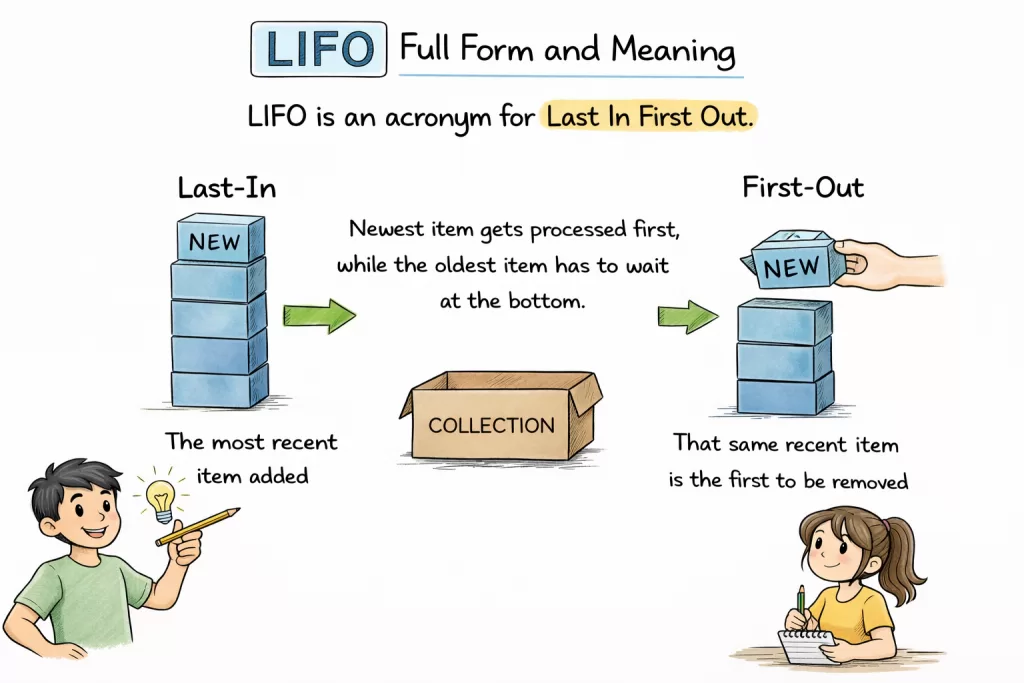
LIFO is an acronym for Last In First Out.
It’s a LIFO principle for managing a collection of items. It means that the very last item you add to the group is the very first item you have to remove. The newest item gets processed first, while the oldest item has to wait at the bottom.
Think of it this way:
- Last-In: The most recent item added to the collection.
- First-Out: That same recent item is the first to be removed.
Simple, right? Let’s see it in action.
The Best Real-World Analogy: A Stack of Plates 🥞
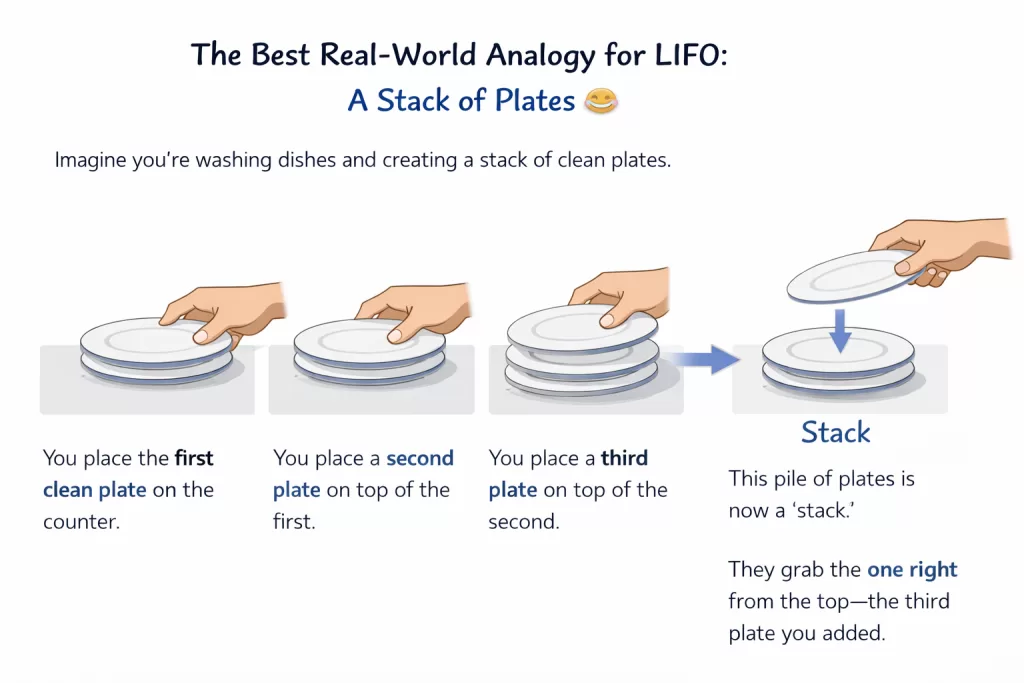
Imagine you’re washing dishes and creating a stack of clean plates.
- You place the first clean plate on the counter.
- You place a second plate on top of the first.
- You place a third plate on top of the second.
This pile of plates is now a “stack.”
Now, when someone wants a plate, which one do they take? They grab the one right from the top—the third plate you added. The last plate you put on the stack is the first one to be taken off.
That’s last in first out in action! You can’t get to the bottom plate without removing all the plates on top of it first.
Visual Representation of What is LIFO:
textStack of Plates (Top → Bottom)

    ┌─────────────┐
    │  Plate 3    │  ← First removed (Last-In)
    ├─────────────┤
    │  Plate 2    │
    ├─────────────┤
    │  Plate 1    │  ← Last removed (First-In)
    └─────────────┘
As you can see, Plate 3 (the last one you added) is the first one you remove. That’s the LIFO principle in its purest form. 📊
LIFO Principle Explained: The Stack Data Structure
In the world of programming, this “stack of plates” concept has an official name: a Stack data structure.
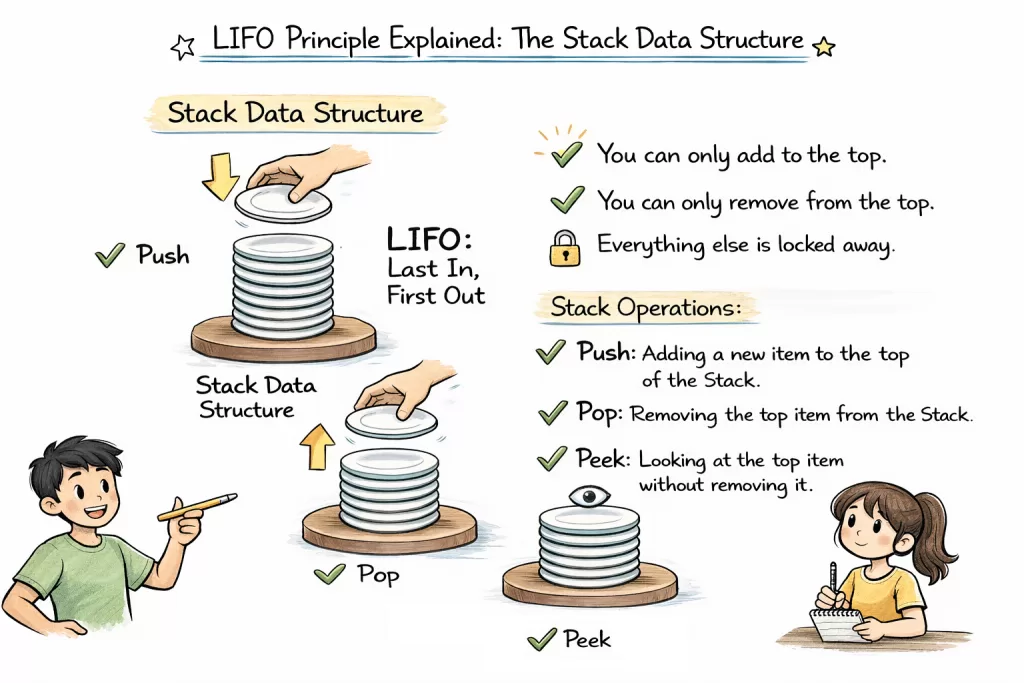
A Stack is a simple data structure that operates entirely on the LIFO method. You can’t add or remove items from the middle or the bottom; all the action happens at the top.
Think of it like a real-world stack:
- You can only add to the top.
- You can only remove from the top.
- Everything else is locked away.
Programmers use two main operations for a Stack:
| Operation | What It Means | Analogy |
|---|---|---|
| Push | Adding a new item to the top of the Stack. | Placing a new plate on top of the stack. |
| Pop | Removing the top item from the Stack. | Taking the top plate off. |
| Peek | Looking at the top item without removing it. | Checking which plate is on top without touching it. |
For a more detailed look at how this works in code and advanced concepts, you can read our comprehensive guide on the Stack Data Structure.
Quick Analogy: Elevator 🚪
Imagine three people entering an elevator one after another.
- Person A enters first
- Person B enters next
- Person C enters last
Now, if the elevator becomes crowded and someone has to step out first, who exits?
👉 The last person who entered—Person C.
Why? Because they are closest to the door. The earlier people are blocked behind them.
This is exactly how LIFO works—the most recent entry is the easiest (and first) to exit.
Simple LIFO Example (Code Snippet)
You don’t need to be a coding expert to see how this works. Here’s a super simple example using Python. Imagine our browser history is a stack:
Python# Our browser history starts as an empty stack
browser_history = []

# You visit a few pages. We "push" them onto the stack.
browser_history.append("google.com")        # 1st item in
browser_history.append("wikitechy.com")     # 2nd item in
browser_history.append("kaashivinfotech.com") # 3rd item in (Last-In)

print(f"Current History Stack: {browser_history}")
# Output: Current History Stack: ['google.com', 'wikitechy.com', 'kaashivinfotech.com']

# Now, you hit the "Back" button. We "pop" the last item off the stack.
last_page_visited = browser_history.pop() # First-Out

print(f"You went back from: {last_page_visited}")
# Output: You went back from: kaashivinfotech.com

print(f"Remaining History Stack: {browser_history}")
# Output: Remaining History Stack: ['google.com', 'wikitechy.com']

# Hit back again
last_page_visited = browser_history.pop()

print(f"You went back from: {last_page_visited}")
# Output: You went back from: wikitechy.com
As you can see, kaashivinfotech.com was the last page added, and it was the first one removed when we hit “back.” wikitechy.com was added second, and it was the second one removed. It’s a perfect LIFO example in real life! 💻
Real-Life LIFO Examples: Where You Use It Every Day
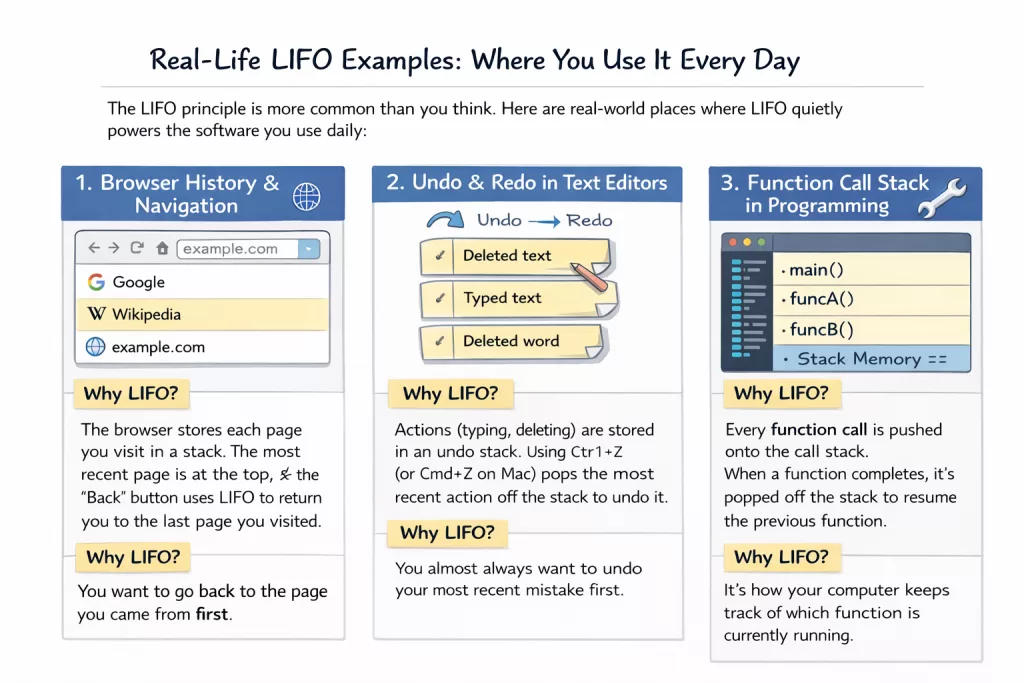
The LIFO principle is more common than you think. Here are real-world places where LIFO quietly powers the software you use daily:
1. Browser History & Navigation 🌐
When you browse the web, your browser stores each page you visit in a stack. Every time you click a link, it’s “pushed” onto the stack. When you hit the “Back” button, the most recent page is “popped” off and removed from the history. This is pure LIFO in action.
Why LIFO? Because you want to go back to the page you came from first, not to some random page you visited hours ago.
2. Undo & Redo in Text Editors ✏️
Open any text editor (Microsoft Word, Google Docs, VS Code, etc.). Every action you perform—typing, deleting, formatting—is pushed onto an “undo stack.”
When you press Ctrl+Z (or Cmd+Z on Mac), the last action is undone. It’s removed from the stack (popped). You can keep pressing undo, and each press removes the most recent action.
Why LIFO? Because you almost always want to undo your most recent mistake first, not something you did 20 minutes ago.
3. Function Call Stack in Programming 🔧
This is where LIFO becomes truly powerful for developers.
When a program runs, every function call is stored in a special area of memory called stack memory, which follows the LIFO principle.
When a program runs, every function call is “pushed” onto the call stack. When a function completes, it’s “popped” off. This is how your computer keeps track of which function is currently running and which functions are waiting.
For example:
Pythondef function_a():
    print("Starting function_a")
    function_b()
    print("Ending function_a")

def function_b():
    print("Starting function_b")
    function_c()
    print("Ending function_b")

def function_c():
    print("Starting function_c")
    print("Ending function_c")

function_a()
When this code runs, the call stack looks like this:
textStep 1: function_a() pushed onto stack
        Stack: [function_a]

Step 2: function_a calls function_b(), push function_b
        Stack: [function_a, function_b]

Step 3: function_b calls function_c(), push function_c
        Stack: [function_a, function_b, function_c]

Step 4: function_c finishes, pop it off
        Stack: [function_a, function_b]

Step 5: function_b finishes, pop it off
        Stack: [function_a]

Step 6: function_a finishes, pop it off
        Stack: []  ← Empty!
Why LIFO? Because the most recently called function must finish before the function that called it can continue. This is the essence of how programming works!
4. Memory Management & Recursion 🧠
When a recursive function calls itself, each new call is pushed onto the call stack. If the recursion goes too deep without returning, you get a “Stack Overflow” error—literally, your stack runs out of memory because too many function calls are waiting to complete.
Why LIFO? Because in recursion, you dive deeper and deeper, and you must unwind from the deepest call first before the outer calls can finish.
5. Expression Evaluation & Parsing 📐
Compilers and calculators use stacks to evaluate mathematical expressions. When converting from infix notation (like 3 + 5 * 2) to postfix notation (like 3 5 2 * +), LIFO stacks are essential.
Why LIFO? Because operators and operands must be processed in a specific reverse order to correctly evaluate the expression.
6. Backtracking Algorithms 🔀
In problems like solving a maze or exploring a game tree, backtracking algorithms use a stack. You move forward step by step, pushing each decision onto the stack. When you hit a dead end, you pop back to the previous decision and try a different path.
Why LIFO? Because you must backtrack to the most recent decision point first, not to some decision you made at the beginning.
LIFO vs. Other Principles: Why It Matters
You might be wondering: “Is LIFO always the right approach?”
The answer is no. There’s another principle called FIFO (First-In, First-Out), which is the exact opposite.
- LIFO: Last item in is the first out. (Stack behavior)
- FIFO: First item in is the first out. (Queue behavior)
Each is useful for different scenarios. For a detailed comparison and to see when you should use each, check out our guide on LIFO vs FIFO.
Key Takeaways About LIFO
Let’s recap what we’ve learned about the LIFO principle:
✅ LIFO = last in first out
✅ Best analogy: Stack of plates
✅ Main data structure: Stack
✅ Stack is lifo or fifo: LIFO
✅ Core operations: Push (add), Pop (remove), Peek (look)
✅ Real-world uses: Browser history, Undo/Redo, function calls, recursion, backtracking
✅ Key advantage: Perfect for reversing order and tracking state changes
Conclusion: Master LIFO and Level Up Your Coding 🚀
Now you understand LIFO—a simple but incredibly powerful concept that powers much of the software you use every day. From the “Back” button in your browser to the “Undo” feature in your text editor, LIFO is everywhere.
But understanding the theory is just the beginning. To truly master LIFO in data structures and become confident with the Stack data structure, you need hands-on practice and guidance.
That’s where structured learning comes in.
Ready to go deeper?
At Kaashiv Infotech, we offer comprehensive Pogramming courses that include Data Structures & Algorithms that cover LIFO, FIFO, Stacks, Queues, and all the core concepts you need to ace technical interviews and land your dream developer job. Plus, our internship programs give you real-world experience applying these concepts in actual projects.
👉 Check out our Full Stack Developer Course In Chennai programs and start your journey to becoming a confident, interview-ready developer today!
Not sure what to learn next? Explore our LIFO vs FIFO comparison guide to understand when to use each principle, or dive deeper into the Stack Data Structure for advanced implementation details.
FAQs
1. What is LIFO full form?
LIFO stands for Last In First Out. It’s a principle where the most recently added item to a collection is the first one to be removed or processed. This is how the Stack data structure operates.
2. What is a simple real-world example of LIFO?
A stack of plates is the perfect example. When you stack clean plates, you place the newest plate on top. When someone wants a plate, they take the one from the top—the last one you added. Other everyday examples include the “Back” button in browsers, the “Undo” feature in word processors, and how your computer manages function calls.
3. What data structure uses the LIFO method?
The Stack data structure is the primary implementation of the LIFO principle. It supports two main operations: push() (adding an item to the top) and pop() (removing an item from the top). All insertions and deletions happen at the same end—the “top” of the stack.
4. How is LIFO different from FIFO?
LIFO (Last In First Out) processes the newest item first, while FIFO (First-In, First-Out) processes the oldest item first. LIFO is used for tasks that require reversing order or undoing recent actions (like “Undo”). FIFO is used for tasks that require fairness and maintaining order (like a print queue or customer service line).
5. Why is LIFO important for programmers?
LIFO is fundamental to how computers execute code. The call stack—which manages function calls and recursion—operates on the LIFO principle. Understanding LIFO is essential for writing correct recursive functions, debugging stack overflow errors, and passing technical interviews.
6. Is a Stack LIFO or FIFO?
A Stack follows the LIFO (Last In First Out) principle. This means the most recently added element is the first one to be removed.
For example, when you push items onto a stack, each new item goes on top. When you pop an item, you remove the top element—which is the last one added.
This is different from FIFO (First-In, First-Out), where the oldest item is removed first, like a queue.