

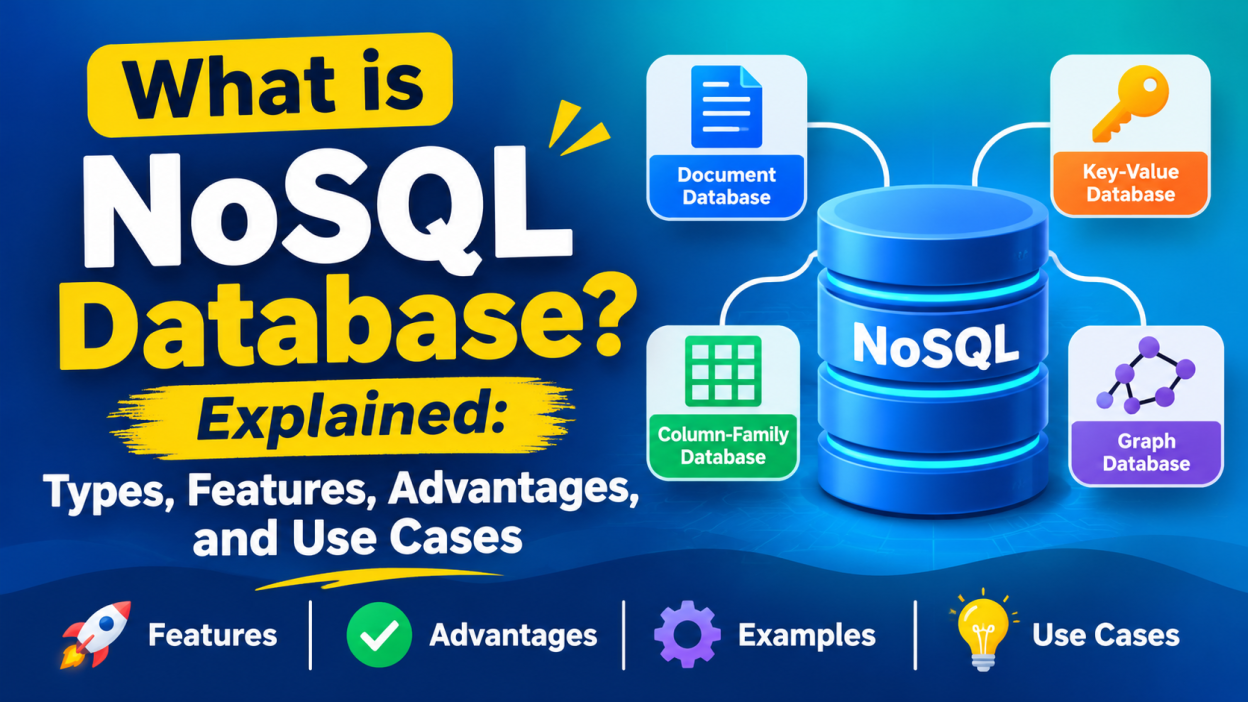
What is NoSQL Database? – As applications grow and generate large amounts of data, traditional databases may not always be the best choice for storing and managing information. Modern applications such as social media platforms, e-commerce websites, mobile applications, cloud services, and IoT systems require databases that can handle different types of data efficiently. This is where NoSQL databases become useful.
NoSQL stands for Not Only SQL. It refers to a category of databases designed to store, manage, and retrieve data without relying exclusively on the traditional relational database structure. NoSQL databases support flexible data models, high scalability, and fast data processing, making them suitable for modern application development.
Unlike relational databases, which store data in tables with rows and columns, NoSQL databases can store data as documents, key-value pairs, graphs, or wide-column structures.
What Is a NoSQL Database?
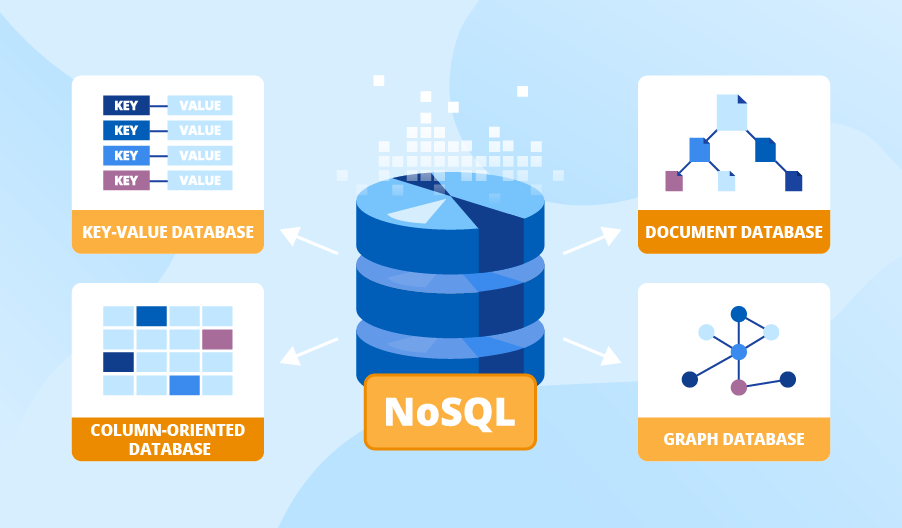
A NoSQL database is a non-relational database that stores data using different structures depending on the database type. It is designed to handle large volumes of structured, semi-structured, and unstructured data.
Traditional databases usually require a predefined schema, meaning developers must define the structure of the data before inserting records. NoSQL databases often provide more flexibility, allowing applications to store data with different structures.
For example, an online shopping application may store customer details, product information, shopping carts, payment records, and product reviews. A NoSQL database can manage these different types of information using flexible data models.
NoSQL databases are commonly used in applications that require real-time processing, distributed storage, high availability, and scalability.
How Does NoSQL Work?
NoSQL databases work by storing information in data structures other than traditional relational tables. The database architecture depends on the type of NoSQL database being used.
Instead of connecting multiple tables using relationships, some NoSQL databases store related information together in a single document. Others use key-value pairs or graph connections to organize data.
For example, a customer record in a document database may look like this:
{
  "customer_id": 101,
  "name": "Arun",
  "email": "arun@example.com",
  "orders": [
    {
      "product": "Laptop",
      "price": 55000
    },
    {
      "product": "Keyboard",
      "price": 1500
    }
  ]
}
This structure allows customer information and related orders to be stored together. Applications can retrieve the required information without always performing multiple table joins.
NoSQL databases can also distribute data across multiple servers. This helps applications handle increasing amounts of data and user requests.
Types of NoSQL Databases
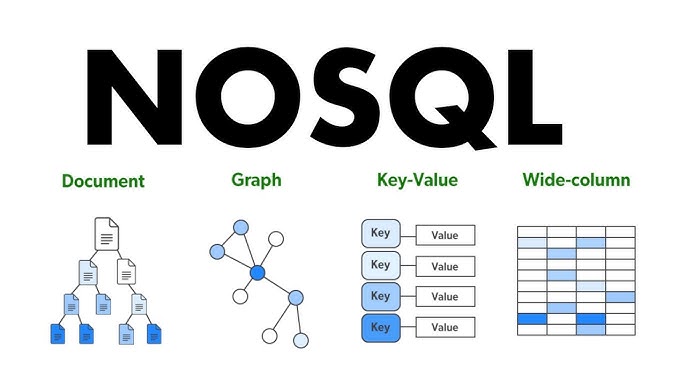
There are four major types of NoSQL databases. Each type is designed for different data storage requirements.
1. Document Databases
Document databases store data in documents, commonly using JSON, BSON, or similar formats. Each document can contain different fields and structures.
They are useful for applications where data changes frequently or has a flexible structure.
Examples: MongoDB, CouchDB.
Common use cases include e-commerce websites, content management systems, user profiles, product catalogs, and mobile applications.
2. Key-Value Databases
Key-value databases store information as a collection of keys and their corresponding values. Each key uniquely identifies a value.
For example:
Username: Arun
Age: 25
Location: Chennai
These databases are simple and provide fast data access when the application knows the required key.
Examples: Redis, Amazon DynamoDB.
They are commonly used for caching, session management, shopping carts, configuration storage, and real-time applications.
3. Column-Family Databases
Column-family databases organize data into column families rather than traditional rows and columns. They are designed to handle large distributed datasets and support high-volume data processing.
They are useful when applications need to store and retrieve large amounts of information across multiple servers.
Examples: Apache Cassandra, HBase.
Common use cases include analytics platforms, IoT systems, log management, and large-scale data applications.
4. Graph Databases
Graph databases store data using nodes, edges, and properties. Nodes represent entities, while edges represent relationships between those entities.
For example, in a social networking application, users can be represented as nodes, and friendships or connections can be represented as edges.
Examples: Neo4j, Amazon Neptune.
Graph databases are useful for social networks, recommendation systems, fraud detection, network analysis, and relationship-based applications.
Features of NoSQL Databases
NoSQL databases offer several important features that make them suitable for modern software development.
- Flexible Schema: Data can be stored without requiring a fixed table structure. Developers can add new fields or modify existing data structures easily.
- Scalability: NoSQL databases can scale horizontally by adding more servers to distribute data and workload.
- High Performance: Many NoSQL databases are optimized for fast read and write operations.
- High Availability: Distributed architecture helps maintain database availability even when certain servers experience failures.
- Large Data Handling: They can manage structured, semi-structured, and unstructured information.
- Distributed Storage: Data can be stored across multiple servers or locations to improve availability and performance.
NoSQL vs SQL Databases
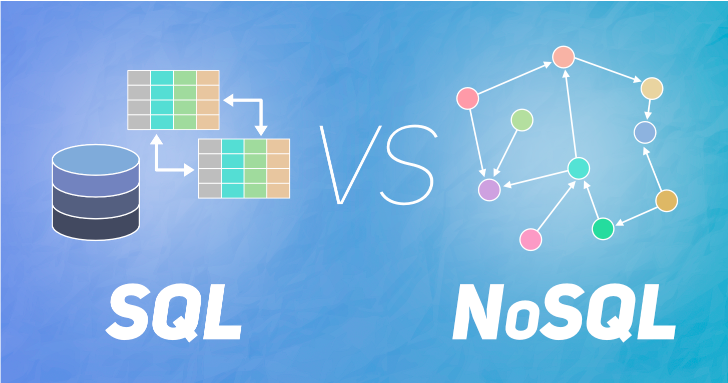
SQL and NoSQL databases are both used to store and manage data, but they differ in their architecture, data organization, and scalability approach.
| Feature | SQL Database | NoSQL Database |
|---|---|---|
| Data Structure | Tables, rows, columns | Documents, key-value, graphs, columns |
| Schema | Usually predefined | Often flexible |
| Query Language | SQL | Database-specific queries or APIs |
| Scalability | Commonly vertical scaling | Commonly horizontal scaling |
| Relationships | Supports table relationships and joins | Depends on database type |
| Data Type | Primarily structured data | Structured, semi-structured, and unstructured data |
| Examples | MySQL, PostgreSQL | MongoDB, Cassandra, Redis |
SQL databases are suitable for applications that require structured data and complex transactions, such as banking systems, payroll applications, and inventory management.
NoSQL databases are useful for applications that handle large datasets, flexible data structures, rapid development, and distributed workloads.
Advantages of NoSQL Databases
NoSQL databases provide several benefits for developers and organizations.
Flexible Data Structure: Developers can store different types of information without changing the entire database structure. This is useful when application requirements change frequently.
Easy Scalability: NoSQL databases support horizontal scaling, allowing organizations to add servers when data or user traffic increases.
Faster Development: Flexible schemas help developers build and modify applications more quickly without spending too much time designing complex table relationships.
Suitable for Big Data: NoSQL databases can handle large volumes of data generated by websites, mobile applications, sensors, and cloud services.
High Availability: Distributed database systems can replicate data across multiple servers, helping applications remain available during server failures.
Disadvantages of NoSQL Databases
Despite their advantages, NoSQL databases also have some limitations.
- Some NoSQL databases do not support complex joins as efficiently as relational databases.
- Data consistency and transaction support vary depending on the database.
- Different NoSQL databases use different query methods, making it difficult to switch between systems.
- Flexible data structures can sometimes create data duplication.
- Designing and managing distributed database systems can require additional technical knowledge.
Choosing the right database depends on the application’s requirements, data structure, performance expectations, and consistency needs.
Popular NoSQL Databases
Some widely used NoSQL database technologies include:
- MongoDB: A document-oriented database used in web applications, APIs, content management, and modern software development.
- Redis: An in-memory key-value database commonly used for caching, session storage, and real-time data processing.
- Apache Cassandra: A distributed wide-column database designed to handle large datasets across multiple servers.
- CouchDB: A document database that stores data in JSON format and supports distributed synchronization.
- Neo4j: A graph database used to manage connected data, relationships, recommendation systems, and network analysis.
Applications of NoSQL Databases
NoSQL databases are used in many industries and application types.
E-Commerce Applications: Product catalogs, customer profiles, shopping carts, and product recommendations.
Social Media Platforms: User profiles, posts, comments, messages, and social connections.
Internet of Things (IoT): Sensor data, device information, real-time monitoring, and connected devices.
Gaming Applications: Player profiles, game sessions, leaderboards, and real-time gaming data.
Big Data Analytics: Log files, user behavior, application monitoring, and large-scale data processing.
Mobile Applications: User preferences, offline data storage, synchronization, and application data management.
Conclusion
NoSQL databases have become an important part of modern application development because they provide flexible data storage, scalability, and efficient data processing. They support different data models, including document, key-value, column-family, and graph databases.
Understanding NoSQL databases helps developers choose the right database technology for their applications. While SQL databases remain useful for structured data and complex transactions, NoSQL databases are particularly valuable for applications that require flexibility, distributed architecture, and large-scale data handling.
Learning technologies such as MongoDB, Redis, and Cassandra can help developers build modern web applications, cloud-based systems, and data-driven software solutions.
Kaashiv Infotech Offers, SQL Course, SQL Internship & More Visit Our website www.kaashivinfotech.com.

