
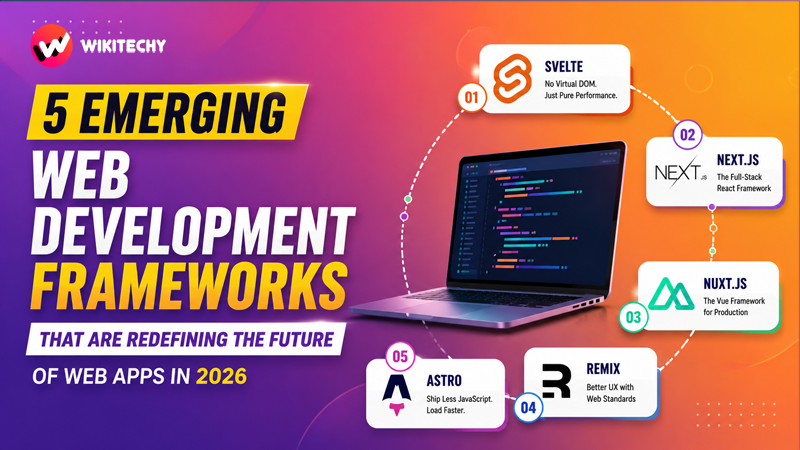
Web development in 2026 is no longer just about picking React or Angular and building something standard. The industry is shifting toward performance-first architectures, developer-friendly tools, and smarter rendering strategies.
What I’ve noticed recently is this: developers are moving away from heavy, complex setups and choosing frameworks that do more with less code, less JavaScript, and better user experience.
In this article, let’s explore five emerging and unique web development frameworks that are not just popular—but are actually changing how modern web apps are built.
5 Best Web Development Frameworks
1. Svelte – A Compiler That Rethinks Frontend Development

Svelte is one of those frameworks that completely breaks traditional thinking. Most frameworks like React or Vue do their work inside the browser using a virtual DOM. Svelte takes a completely different route—it shifts that work to the build step.
What does that mean in real-world terms? When you write Svelte code, it doesn’t ship a large runtime to the browser. Instead, it compiles your components into highly efficient vanilla JavaScript during build time. This leads to smaller bundle sizes and significantly faster applications.
From a developer perspective, Svelte feels incredibly clean. You write less boilerplate, and the reactivity system is intuitive—no need for complex hooks or state management patterns in simple cases.
The uniqueness of Svelte lies in how it eliminates unnecessary abstraction. Instead of adding layers, it removes them.
This makes it a strong choice for developers who want maximum performance without sacrificing simplicity.
2. Next.js – The Evolution of Full-Stack JavaScript 🌐
Next.js has evolved far beyond being “just a React framework.” In 2026, it has become a complete full-stack solution that allows developers to build frontend and backend logic in one unified environment.
What makes Next.js powerful is its flexibility in rendering. You can choose between server-side rendering, static generation, or even hybrid approaches depending on your use case. This gives developers full control over performance and SEO.
Another standout feature is the modern App Router architecture, which simplifies routing and improves scalability for large applications. It also integrates seamlessly with APIs, making backend development much more streamlined.
From my experience, Next.js shines when you’re building production-grade applications where performance, SEO, and scalability all matter equally.
It’s not just a framework—it’s an ecosystem that supports everything from small startups to enterprise-level platforms.
3. Nuxt.js – Simplifying Vue Development at Scale 💚
Nuxt.js brings structure and power to the Vue ecosystem. If Vue feels flexible and lightweight, Nuxt adds a layer of organization and automation that makes large-scale development much easier.
One of the biggest advantages of Nuxt is how much it handles automatically. Routing, server-side rendering, and optimization are built-in, so developers don’t need to spend time configuring everything from scratch.
This “convention over configuration” approach allows teams to focus more on building features rather than managing setup.
Nuxt also delivers excellent performance and SEO benefits, which makes it a great fit for modern web applications that need to rank well on search engines.
What makes Nuxt unique is how it balances simplicity with scalability. It’s beginner-friendly, but still powerful enough for complex applications.
4. Remix – A Framework Focused on Real User Experience 🎯
Remix is one of the most interesting frameworks to emerge in recent years because it doesn’t just focus on developers—it focuses heavily on end users.
Instead of relying on large amounts of client-side JavaScript, Remix leverages native browser capabilities like forms and HTTP caching. This results in faster load times and smoother interactions, especially on slower networks.
The framework introduces concepts like loaders and actions, which make data fetching and mutations more structured and efficient.
From a practical standpoint, Remix helps you build apps that feel instant and responsive, even without heavy frontend logic.
What sets Remix apart is its philosophy: rather than trying to do everything in JavaScript, it uses the web platform itself more effectively.
This makes it ideal for developers who care deeply about performance and user experience.
5. Astro – The Framework Built for Speed and Content 🌌
Astro is designed with a very clear goal: ship less JavaScript to the browser. And in 2026, that’s exactly what modern web apps need.
Its core concept, called Islands Architecture, allows you to load JavaScript only where it’s absolutely necessary. The rest of the page is rendered as static HTML, making it extremely fast.
This approach is perfect for content-heavy websites like blogs, portfolios, and documentation platforms. Pages load almost instantly, and SEO performance is excellent.
Another interesting feature of Astro is that it allows you to use multiple frameworks (React, Vue, Svelte) inside the same project. This gives developers flexibility without compromising performance.
Astro stands out because it challenges the idea that every website needs heavy interactivity. Instead, it focuses on delivering content quickly and efficiently.
Final Thoughts 💡
If you look closely at these frameworks, a clear trend emerges. The future of web development is not about adding more complexity—it’s about removing it intelligently.
Frameworks like Svelte and Astro are reducing the amount of JavaScript sent to the browser. Tools like Next.js and Nuxt.js are making full-stack development more seamless. Remix is pushing developers to think beyond code and focus on real user experience.
Choosing the right framework ultimately depends on what you’re building. If your goal is performance, Svelte and Astro are excellent choices. If you want a complete full-stack solution, Next.js or Nuxt.js will serve you well. And if your priority is user experience, Remix offers a fresh and powerful approach.
In 2026, the best developers are not just those who know frameworks—but those who understand when and why to use them.
Want to Learn More About Java ?, Kaashiv Infotech Offers, Full Stack Java Course, Java Course, Data Science Course, Internships & More, Visit Their Website www.kaashivinfotech.com.