7 Elements of Communication That Make or Break Every Conversation
The first time I heard the term elements in communication I thought it was one of those textbook-like items that you memorize to pass exams and down the line you forget. But honestly? As soon as I began to notice these parts in my daily dialogues, all this changed.
I no longer overthought texts, I was able to be more effective with feedback at work and most importantly I understood why certain conversations leave us smiling and others leave us feeling unheard.

That is why we are going to deconstruct the 7 major components of communication collectively–not in a dull, mechanical manner. I will tell you about stories, lessons and even about the wrong steps I took. Ready? Let’s go.
1. Sender – Where It All Begins
The initiation of the communication is the sender. That is what I am doing in writing this blog. That is when you write to your friend and ask him where he is.
I have sent an email to my professor one night at midnights and never gave a subject. Guess what happened? He ignored it. Why? This is due to the fact that I as a sender did not cast the message in a clear way.
👉 Lesson: Being a sender implies having ownership of the message. Speak clearly, honorably, and to the point.
2. Message – The Core of Communication 📝
Think of the message as the heart of the elements in communication process. Without a message, there’s nothing to share.
But here’s the thing—your message isn’t just words. It’s tone, body language, emojis, even silence.
Example? I once texted my best friend just a “…” after an argument. That tiny message spoke louder than an essay.
👉 So the next time, ask yourself: What exactly am I trying to say here?
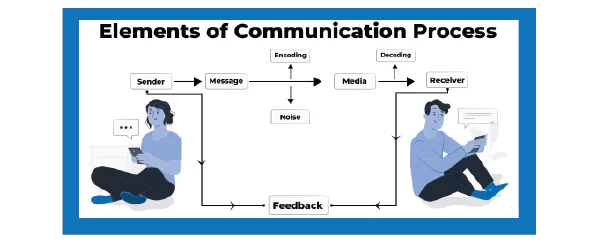
3. Encoding – Dressing Up Your Thoughts
Encoding is simply the process of stuffing your idea into words, symbols or gestures.
Have you ever cracked a joke, but nobody laughed? 😬 That’s failed encoding. You tried to wrap your thought in humor, but it didn’t land.
👉 Tip: Use simple language. Avoid jargon. (Trust me, I used “synergy” once in a family chat and immediately regretted it 😂).
4. Channel – The Bridge of Connection 🌉
The channel is the medium. Face-to-face, WhatsApp, Zoom calls, or even memes.
Funny story—I once sent a serious message via Instagram DM. The person thought it was a joke because, well, Instagram is usually memes and reels. Wrong channel = wrong perception.
👉 Use the right channel for the right message. If it’s serious, maybe not Snapchat.

5. Receiver – The One Who Gets It 🎧
The receiver is the person on the other end. But here’s the catch: just because they hear it doesn’t mean they get it.
I told my mom “I’ll be late” once, and she thought I meant five minutes. I meant two hours. Chaos followed. 😂
👉 Always consider who your receiver is and how they interpret things.
6. Decoding – The Magic of Understanding 🔍
Decoding is how the receiver interprets the message. This is where miscommunication often happens.
Ever sent a “K” text? For you, it might mean “Okay.” For the other person, it screams “I’m mad at you.” That’s decoding in action.
👉 Tip: If you’re unsure how someone decoded your message, just ask. Saves a lot of drama.
7. Feedback – Closing the Loop 🔄
Feedback is the final and most important elements in communication. Without it, conversations are just monologues.
Example: I once presented in class, and no one asked questions. My professor later told me, “No feedback means they probably didn’t understand.” Ouch.
👉 Always encourage feedback. A simple “Does this make sense?” can do wonders.
The importance of these 7 elements of communication

Here’s the truth: every relationship—be it friendship, family, or work—stands on how well we manage these elements of communication.
- Ignore the receiver? You’ll sound self-centered.
- Skip feedback? You’ll never improve.
- Use the wrong channel? Expect confusion.
Practical Tips to Improve Your Communication ✨
Here’s what worked for me:
- Listen actively. Communication isn’t just about talking.
- Be clear as a sender. Say it straight.
- Keep messages simple. No over-complicating.
- Match your channel. Don’t send essays over voice notes.
- Encourage feedback. “What do you think?” goes a long way.
Final Thoughts:
At the end of the day, the elements in communication are not just theory—they’re life skills. When you understand them, you don’t just talk better. You connect better. You listen better. You avoid unnecessary drama.
So, the next time you hit “send” on a message or sit across someone in a coffee shop, pause for a second. Think of the 7 elements in communication at play. Trust me, you’ll see conversations in a whole new light.
Related Reads: