


⭐ Introduction: – About Star Connection
Star connection, star connection, star connection—I still remember the first time my electrical engineering teacher drew that Y-shaped symbol on the board. I blinked at it like it was some ancient rune. And then, just when I thought I understood it, the teacher casually introduced delta connection and everything inside my head short-circuited.
If you’ve ever stared at those symbols and wondered,
“Why do these things even exist, and why should I care?”
So in this post, I want to walk you through star connection and delta connection the way I wish someone explained it to me — conversational, practical, and without the heavy jargon that usually makes people run away from electrical topics.
Whether you’re an engineering student, an electrician, or just someone who loves understanding how things work, I’ll help you get it. And you’ll walk away saying, “Okay, that actually made sense!”
⭐ What Is Star Connection?
Let me say it again — star connection is the heart of this article.
Why? Because understanding star connection makes everything else fall into place.
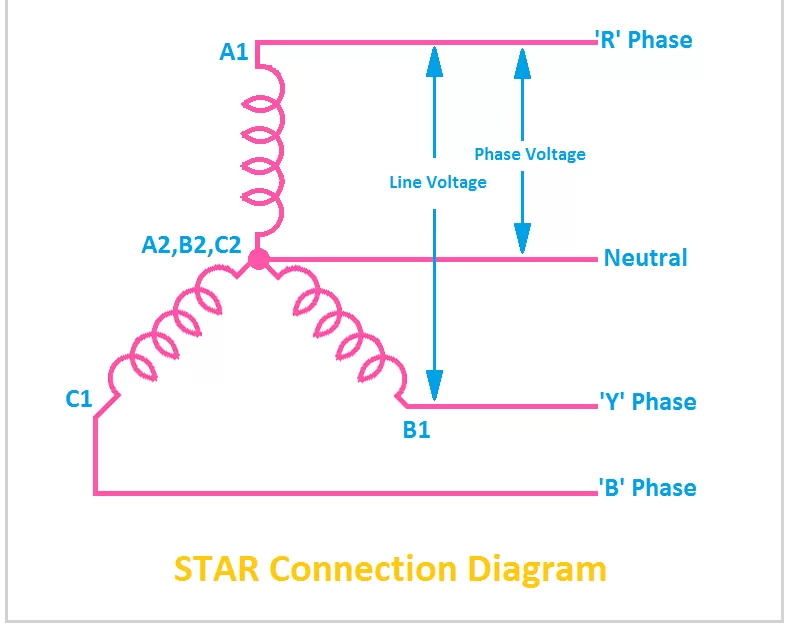
Imagine three electrical loads or coils. Instead of connecting them in a loop, you tie one end of each coil together, forming a shape like the letter Y. That junction point is called the neutral point.
Here’s the best mental image I use:
👉 Think of three friends holding one end of a rope each, while the other ends point outward.
The middle point (their connected hands) is neutral.
The three outer ends are the phases.
Applications of Star Connection
- Long-distance transmission lines
- Household electrical distribution
- Motors requiring smooth starting
- Neutral-based systems
- Step-up transformers
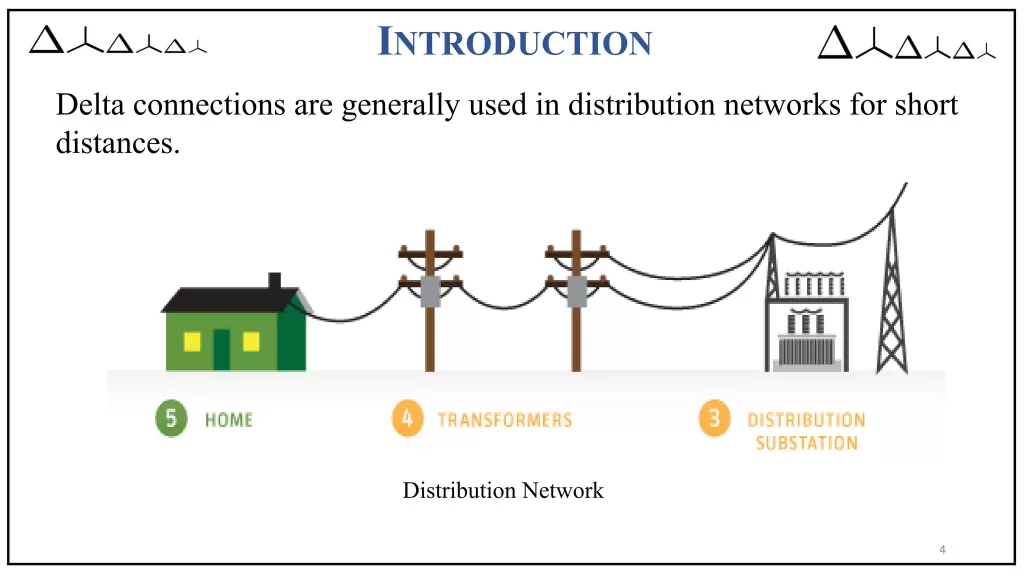
If you’ve ever looked at a pole-mounted transformer in your street, chances are the secondary is star-connected.
⭐ Why Do We Use Star Connection?
- It gives lower phase voltage, which is great for safety.
- It allows a neutral wire, so you can get two different voltages from the same supply (like 230V and 400V).
- Most household electricity systems across the world use star connection at the transformer secondary.
Not bad for a Y-shaped little thing, right?
🔺 What Is Delta Connection?
Now let’s talk about its energetic cousin — delta connection.
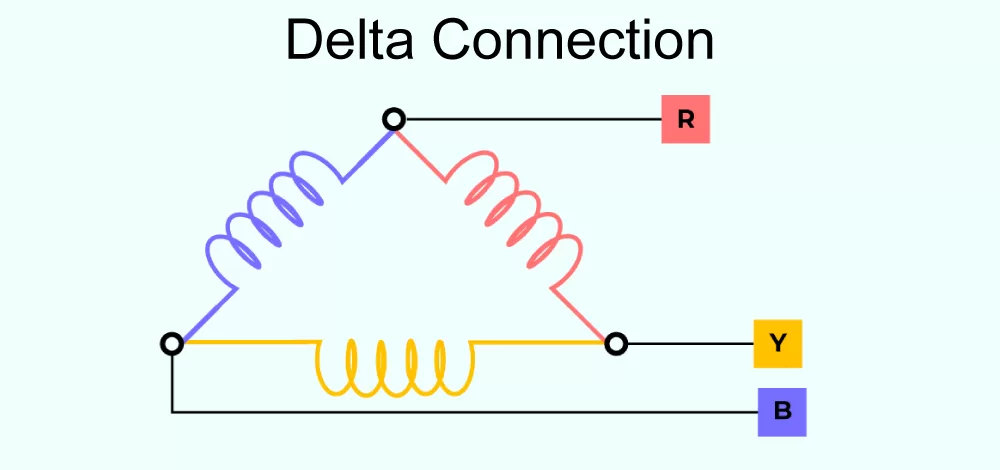
A delta connection ties the end of each coil to the beginning of the next one, forming a closed loop shaped like a triangle (Δ). No neutral point here — just three corners, three phases, and lots of power.
Here’s my favorite analogy:
👉 Think of three water pumps forming a closed loop pipeline.
Water flows continuously around the loop.
That’s delta connection for you.
⭐ Why Do We Use Delta Connection?
- It gives higher line current — meaning more power output.
- Perfect for running big motors, industrial machines, and heavy loads.
- It avoids neutral issues because… well… it has no neutral!
Advantages of Delta Connection
- Higher torque 💪
- No neutral required
- Better for high-load operations
- Works well even with unbalanced loads
- Delivers more power to the machine
⭐ How Star Connection and Delta Connection Actually Work
🌟 Star Connection Working
In star connection:
- Phase voltage = Line voltage / √3
- This reduced voltage helps protect appliances that don’t require high power.
Real-life example:
Your home AC, fridge, and washing machine run at 230V — delivered through a star-connected distribution transformer.
🔺 Delta Connection Working
In delta connection:
- Phase voltage = Line voltage
- Higher current flows through each phase.
Real-life example:
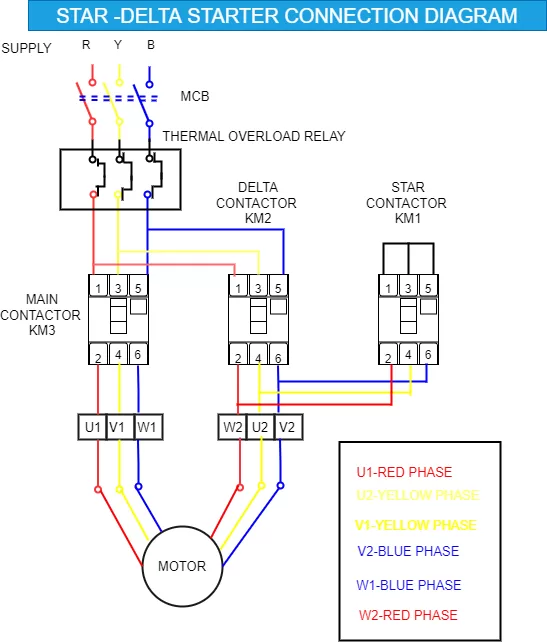
Big irrigation pumps, industrial motors, and even elevators often start in star connection (to avoid high starting current) and then shift to delta connection for full power.
This is called a Star-Delta Starter.
You’ve probably seen a mechanic or technician switch those modes in factories.
🔄 Star to Delta Conversion
This part scared me the most in college 😅
So let’s make it ridiculously simple.
When converting a star network to delta, imagine you’re “stretching” the Y and wrapping it into a triangle.
⭐ Formula
Each delta resistance is the sum of two star resistances plus the product of those two, divided by the third.
RAB=RCRARB+RBRC+RCRA
Looks scary? Sure.
Is it actually hard? Not at all.
You plug the values in, you’re done.
🔄 Delta to Star Conversion
Going from delta to star is like “shrinking” a triangle back into a Y.
⭐ Formula
Each star resistance is:
RA=RAB+RBC+RACRAB⋅RAC
If you ever get stuck, bookmark this article — or just check the formula on trusted references like All About Circuits or Electronics Tutorials (external links you can easily add when posting).
⭐ Star Connection vs Delta Connection:
I’ve used both in labs, projects, and real devices, and here’s how I explain the difference to anyone:
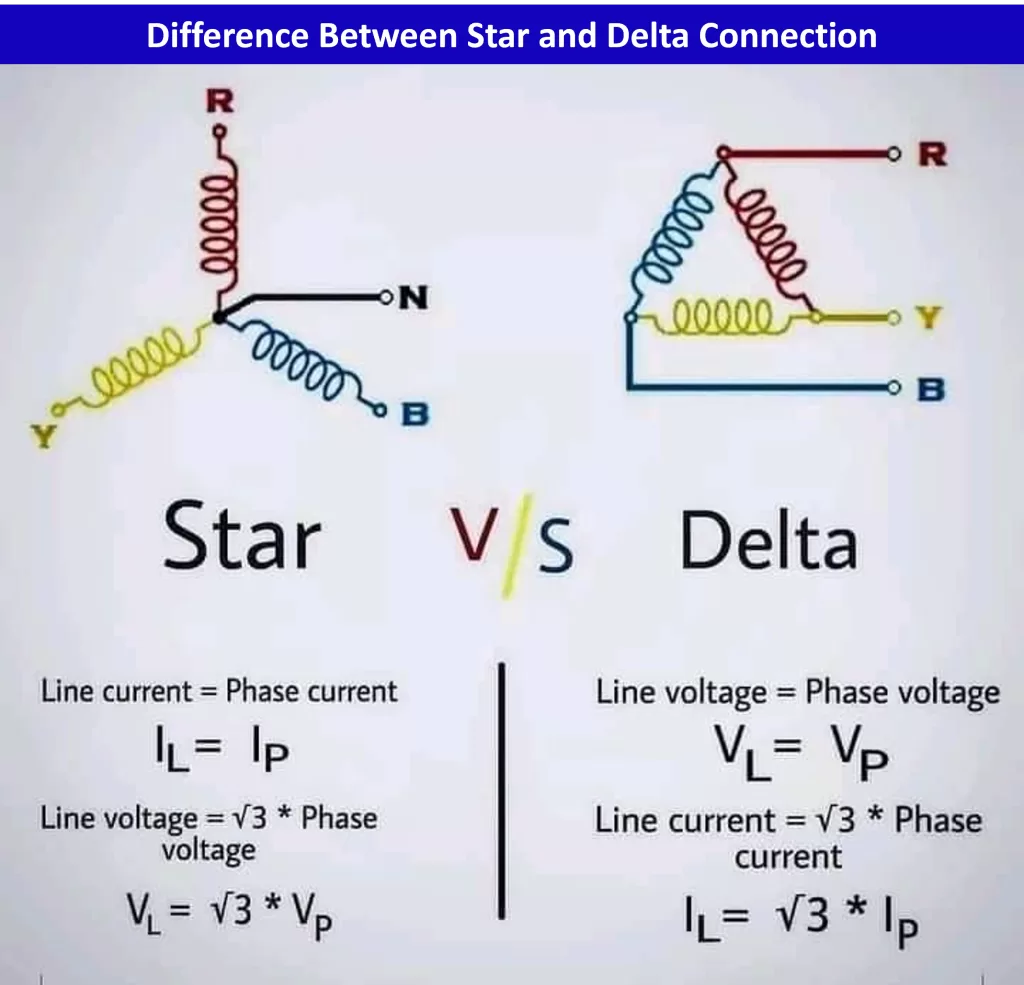
⭐ Star Connection (Y)
- Lower voltage
- Has neutral
- Safer
- Common in households
- Used for long-distance transmission (less power loss)
🔺 Delta Connection (Δ)
- Higher current
- No neutral
- More power
- Used in industries and big machinery
- Great for starting motors at full load.
⭐ Where Star Connection Is Used
- Home wiring systems
- Distribution transformers
- Long-distance power transmission
- Small and medium appliances
🔺 Where Delta Connection Is Used
- Industrial motors
- Pumps, blowers, compressors
- High-load machinery
- Short-distance high-power distribution
⭐ Conclusion: My Final Thoughts
After years of studying and working with three-phase systems, here’s the truth:
Star connection and delta connection are not just diagrams in textbooks.
They’re the backbone of everything powered around us — from your laptop charger to huge factory robots.
Once you understand the simple logic behind them:
- Star = safe + low voltage
- Delta = powerful + high current
…the entire world of electrical engineering becomes less intimidating and a lot more exciting.