
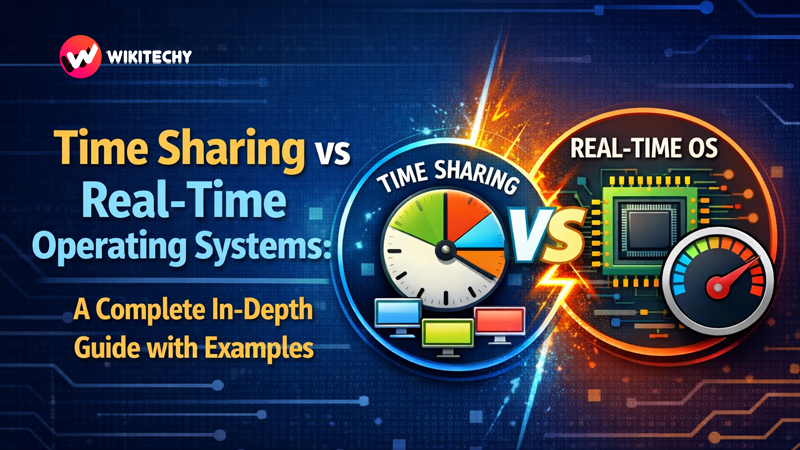
Time Sharing vs Real-Time Operating Systems – Operating systems play a crucial role in managing computer hardware and software resources. Among the many types of operating systems, Time Sharing Operating Systems and Real-Time Operating Systems (RTOS) stand out due to their unique design philosophies and application areas.
While both are designed to manage system resources efficiently, they serve entirely different purposes. Time sharing focuses on efficient multitasking and user interaction, whereas real-time systems emphasize strict timing and guaranteed execution.
Understanding the differences between these two systems is essential for students, developers, and professionals working in system design, embedded systems, or software engineering.
Understanding Time Sharing Operating System
A Time Sharing Operating System allows multiple users or processes to use a computer system simultaneously. It achieves this by dividing CPU time into very small intervals called time slices or time quantum.
Each process is executed for a short duration, and then the CPU switches to the next process. This happens so quickly that users feel all tasks are running at the same time.
How Time Sharing Works
The operating system uses scheduling techniques such as Round Robin Scheduling to allocate CPU time fairly among all processes. Each task gets a turn, ensuring no process is left waiting indefinitely.
This method improves responsiveness and makes systems suitable for environments where multiple users interact with the system at once.
Key Characteristics
- Multi-user and multitasking capability
- Fast switching between processes
- Interactive computing environment
- Fair allocation of CPU resources
- Reduced CPU idle time
Real-World Examples
- UNIX systems used in servers
- Linux-based multi-user environments
- Early systems like Multics
Understanding Real-Time Operating System (RTOS)
A Real-Time Operating System (RTOS) is designed for applications where time constraints are critical. The system must respond to inputs and complete tasks within a predefined time limit.
In RTOS, correctness depends not only on the logical result but also on the time at which the result is produced.
How RTOS Works
RTOS uses priority-based scheduling, where tasks with higher priority are executed before others. The system ensures minimal delay (latency) and guarantees predictable response times.
Types of Real-Time Systems
1. Hard Real-Time Systems
In these systems, missing a deadline can lead to catastrophic failure.
Example: Aircraft control systems
2. Soft Real-Time Systems
Deadlines are important but not strictly enforced. Occasional delays are acceptable.
Example: Multimedia streaming
Key Characteristics
- Deterministic behavior
- Guaranteed response time
- High reliability and stability
- Minimal interrupt latency
- Efficient handling of critical tasks
Real-World Examples
- VxWorks used in aerospace systems
- QNX in automotive systems
- FreeRTOS in embedded devices
Core Differences Between Time Sharing vs Real-Time Operating Systems
Although both systems manage processes, their objectives and performance metrics differ significantly.
1. Purpose and Design Philosophy
Time Sharing OS is designed to maximize CPU utilization and user convenience, while RTOS is built to meet strict timing constraints.
2. Response Time
Time sharing systems provide fast responses but do not guarantee timing. RTOS ensures that every task is completed within a fixed deadline.
3. Scheduling Mechanism
Time sharing uses algorithms like Round Robin, whereas RTOS uses priority-based scheduling to ensure critical tasks are handled first.
4. Reliability
RTOS is far more reliable in critical applications compared to time sharing systems, which are designed for general-purpose use.
Detailed Comparison Table
| Feature | Time Sharing Operating System | Real-Time Operating System |
|---|---|---|
| Main Objective | Efficient resource sharing | Timely task execution |
| Users | Multiple users | Usually single-purpose systems |
| Response Time | Fast but not fixed | Strict and predictable |
| Scheduling | Time-based (Round Robin) | Priority-based |
| System Type | General-purpose | Mission-critical |
| Failure Impact | Minor inconvenience | Can be catastrophic |
| Examples | Linux, UNIX | VxWorks, QNX |
| Usage Environment | Offices, servers, education | Robotics, aviation, medical |
Advantages of Time Sharing Operating System
Time sharing systems are widely used due to their flexibility and efficiency.
- Supports multiple users simultaneously
- Enhances CPU utilization
- Provides an interactive computing experience
- Reduces waiting time for users
- Cost-effective for shared environments
Limitations
- Security risks due to shared access
- Performance drops under heavy load
- Not suitable for critical timing applications
Advantages of Real-Time Operating System
RTOS is essential in environments where precision matters.
- Ensures guaranteed response time
- Highly reliable and stable
- Ideal for safety-critical systems
- Handles high-priority tasks efficiently
Limitations
- Complex system design
- Higher development cost
- Limited scalability
- Requires specialized knowledge
Applications of Time Sharing OS
Time sharing systems are commonly used in everyday computing environments:
- Banking and transaction systems
- Online servers and cloud platforms
- Educational institutions
- Office and enterprise systems
Applications of Real-Time Operating Systems
RTOS is used in systems where timing and reliability are critical:
- Air traffic control systems
- Medical devices (e.g., heart monitors)
- Industrial automation
- Robotics and embedded systems
- Automotive control systems
When to Choose Which? Time Sharing vs Real-Time Operating Systems
Choosing between a Time Sharing vs Real-Time Operating Systems depends entirely on the application requirements.
- If your system needs multiple users and interactive computing, go for a Time Sharing OS.
- If your system requires strict timing and guaranteed performance, RTOS is the right choice.
Final Thoughts
Time Sharing vs Real-Time Operating Systems represent two different approaches to system design. One prioritizes efficiency and usability, while the other focuses on precision and reliability.
Both are essential in modern computing, powering everything from everyday applications to life-critical systems. Understanding their differences helps in selecting the right system for the right purpose.
Kaashiv Infotech Offers Networking Course, Cyber Security Course, Cloud Computing Course Visit Their Website www.kaashivinfotech.com.