
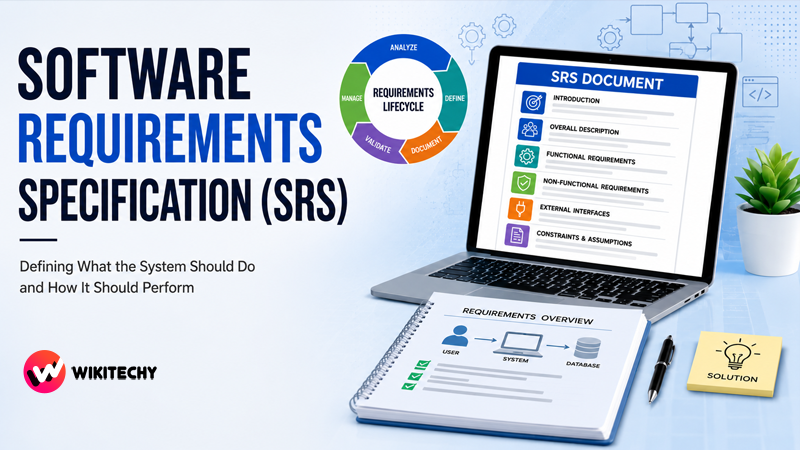
Building software without clearly defined requirements is like constructing a building without a blueprint. Teams may start with enthusiasm, but confusion quickly follows—features get misunderstood, timelines stretch, and budgets spiral out of control.
A Software Requirements Specification (SRS) eliminates this chaos. It acts as a single source of truth that aligns stakeholders, developers, designers, and testers. Instead of assumptions, decisions are driven by documented clarity.
In modern software engineering—especially in agile and cloud-driven environments—the SRS is no longer just a static document. It evolves with the product while still maintaining its core purpose: defining what needs to be built and how success is measured.
Understanding the Software Requirements Specification (SRS)
A Software Requirements Specification (SRS) is a detailed and structured document that describes a software system’s expected behavior, functionality, and constraints. It provides both high-level understanding and low-level details required to design and develop the system.
Unlike casual notes or informal discussions, an SRS is formal, precise, and testable. Every requirement written inside it should answer a critical question:
- What should the system do?
- How should it behave under different conditions?
- What limitations must it respect?
An effective SRS ensures that every stakeholder—from business executives to developers—shares the same understanding of the product.
The Role of SRS in the Software Development Lifecycle
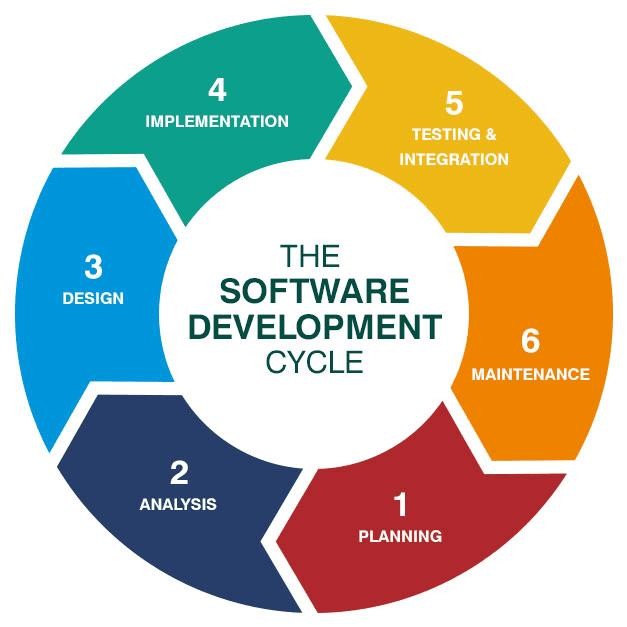
The SRS plays a central role across all phases of the Software Development Lifecycle (SDLC).
During the requirement analysis phase, it captures business needs and translates them into technical language. As the project moves into design and development, it becomes a reference point for system architecture and coding decisions.
In the testing phase, the SRS transforms into a validation tool. Test cases are derived directly from the requirements defined in the document. If a feature is not in the SRS, it should not exist in the system.
Even after deployment, the SRS helps in maintenance, upgrades, and onboarding new team members by serving as reliable documentation.
Deep Dive into the Structure of an SRS Document
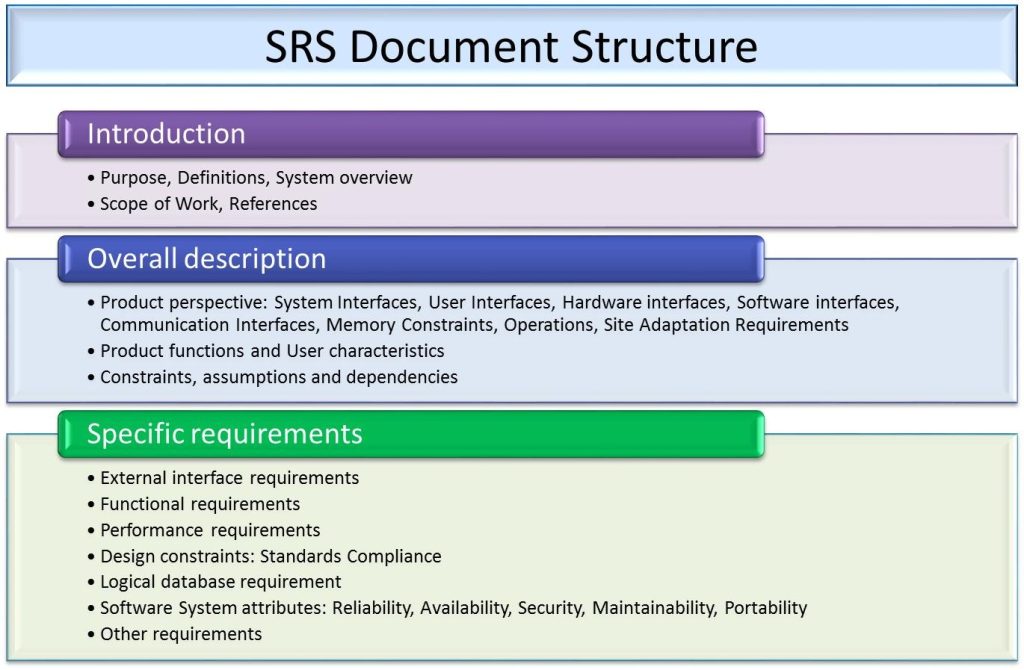
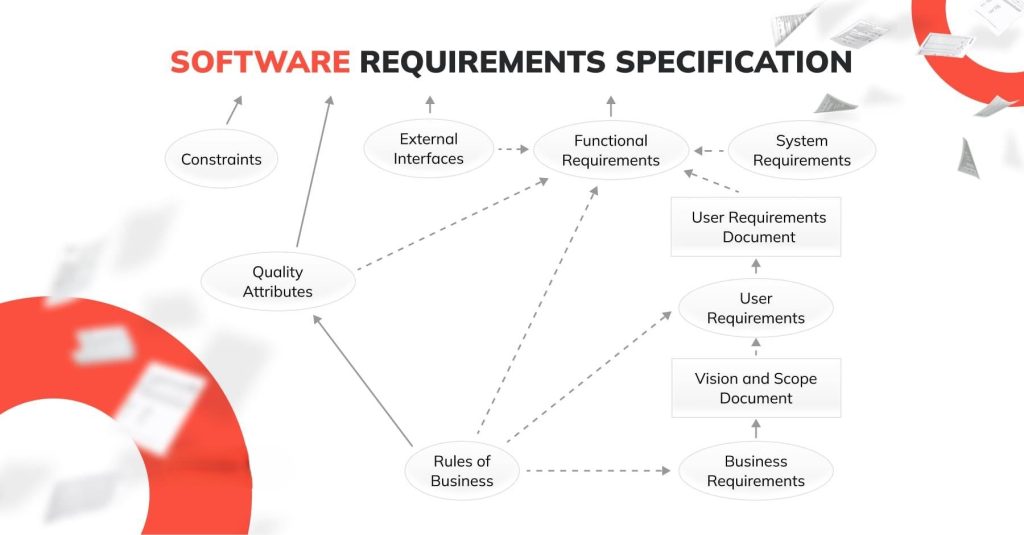
An SRS is not just a list of requirements—it follows a well-organized structure that ensures clarity and completeness.
Introduction Section
This section explains why the document exists and what system it describes. It defines the purpose, scope, and audience. It also includes definitions of technical terms so that everyone interprets the document consistently.
Overall Description
Here, the system is explained from a broader perspective. It describes how the product fits into a larger ecosystem, identifies different types of users, and outlines environmental conditions such as operating systems, hardware, or platforms.
Functional Requirements
This is the heart of the SRS. It describes system features in detail—what actions users can perform, how the system responds, and what outputs are generated.
Instead of vague statements, strong SRS documents include structured descriptions like:
- Inputs provided by users
- System processing steps
- Expected outputs
- Error conditions and handling
External Interface Requirements
This section focuses on how the system interacts with users and other systems. It includes UI expectations, API integrations, communication protocols, and hardware connections.
Non-Functional Requirements
These define the quality attributes of the system. While functional requirements define what the system does, non-functional requirements define how well it does it.
Performance, scalability, security, and usability all fall under this category.
Constraints and Assumptions
Every system operates under certain limitations. These could be technical (e.g., programming language restrictions), legal (compliance requirements), or operational (limited infrastructure).
Assumptions, on the other hand, are conditions considered true for the project to proceed smoothly.
Functional vs Non-Functional Requirements: A Clear Perspective
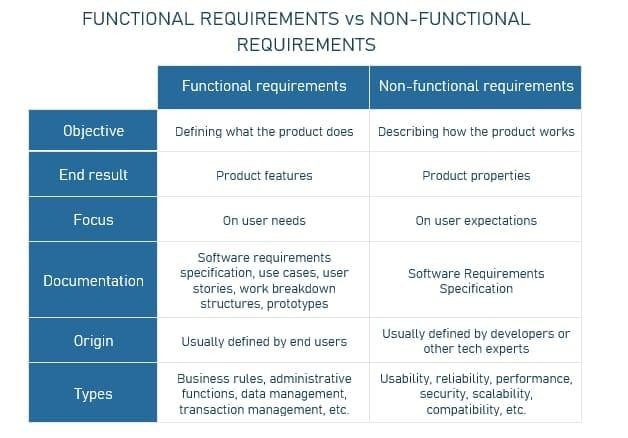
Understanding the difference between functional and non-functional requirements is essential for writing an effective SRS.
Functional requirements describe specific behaviors of the system. For example, an e-commerce platform allowing users to add products to a cart or complete a payment transaction.
Non-functional requirements focus on system quality and performance. For instance, the same e-commerce system should handle thousands of users simultaneously without crashing, and transactions must be processed securely.
A well-balanced SRS ensures that both aspects are equally emphasized. Ignoring non-functional requirements often leads to systems that technically work but fail in real-world usage.
Best Practices for Writing a High-Quality SRS

Writing an SRS is both a technical and communication skill. The goal is not just to document requirements, but to make them understandable, testable, and actionable.
Clarity is the most important factor. Each requirement should have only one interpretation. Ambiguity leads to implementation errors and project delays.
Consistency in terminology ensures that different sections of the document do not contradict each other. For example, if the term “user” is used in one section and “customer” in another, confusion may arise unless clearly defined.
Testability is another critical aspect. A requirement like “the system should be fast” is vague, whereas “the system should respond within 2 seconds” is measurable and verifiable.
Good SRS documents also evolve over time. As requirements change, the document must be updated and version-controlled to reflect the latest understanding.
Common Challenges and Mistakes in SRS Creation
Many teams underestimate the importance of requirement documentation and rush through the SRS phase. This often results in incomplete or unclear specifications.
One of the most common mistakes is writing requirements that are too vague. Statements without measurable criteria create confusion during development and testing.
Another issue is lack of stakeholder involvement. If business users, clients, or end-users are not consulted properly, the final product may not meet real-world needs.
Overloading the SRS with unnecessary technical jargon can also reduce its effectiveness. The document should be understandable to both technical and non-technical stakeholders.
Finally, failing to update the SRS as the project evolves can make it obsolete, reducing its usefulness as a reference.
Real-World Application: SRS in an E-Commerce System
To understand the practical value of an SRS, consider an e-commerce platform.
The SRS would clearly define features such as product browsing, user registration, shopping cart functionality, and payment processing. It would also include non-functional requirements like page load speed, data security, and system scalability during peak sales.
Developers rely on this document to build features accurately, while testers use it to verify that the system behaves as expected. Business stakeholders ensure that the platform aligns with organizational goals such as increasing sales or improving customer experience.
Without a well-defined SRS, such a system would likely suffer from inconsistent functionality and poor user experience.
Conclusion: The Backbone of Successful Software Development
A Software Requirements Specification (SRS) is more than just documentation—it is the foundation upon which successful software is built.
It bridges the gap between ideas and implementation, ensuring that every stakeholder shares a common vision. By clearly defining functionality, constraints, and expectations, an SRS minimizes risks and maximizes efficiency.
In an era where software systems are becoming increasingly complex, investing time in a well-crafted SRS is not optional—it is essential.
If You Want to study Software Testing Course, or any other course & Internship visit www.kaashivinfotech.com