

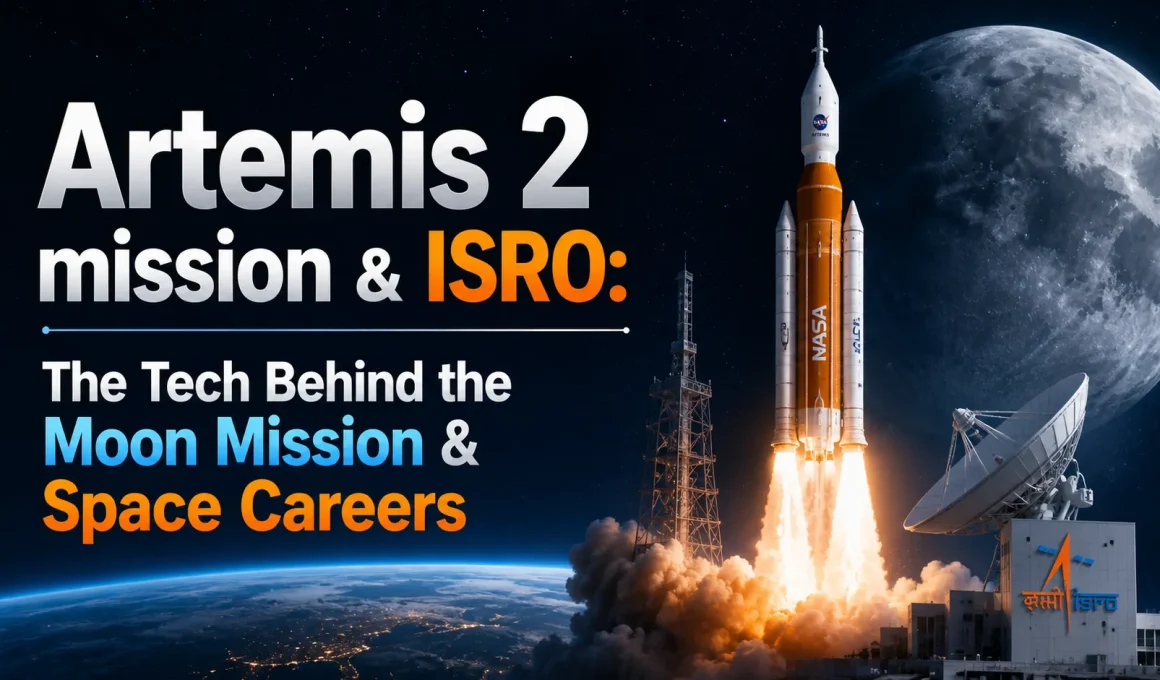
For the first time since 1972, human beings have officially left Earth’s orbit. Let that sink in.
On April 1, 2026, the massive Space Launch System (SLS) rocket roared to life, sending four brave astronauts on a 10-day, 250,000-mile journey around the Moon. They are currently shattering the previous distance record set by Apollo 13 back in 1970.
But why should tech enthusiasts and engineering students in India care about an American rocket launch? Because the connection between the Artemis 2 mission and ISRO is deeper than you think.
This historic flight isn’t just about planting flags. It is a masterclass in modern software engineering, data analytics, and global geopolitics. From a highly relatable (and expensive) plumbing disaster in zero gravity to the cutting-edge code powering the spacecraft, this mission is shaping the future of space exploration. More importantly, it is creating massive opportunities for space tech careers right here in India.
Let’s break down the tech, the drama, and how you can be a part of the next space age. 🚀
The Artemis 2 Astronauts & The $30 Million Space Toilet Glitch
Before we dive into the hardcore engineering, let’s talk about the humans inside the Orion capsule (which the crew beautifully named “Integrity”).
This is a crew of “firsts.” The team includes Reid Wiseman, Victor Glover (the first person of color on a lunar mission), Christina Koch (the first woman), and Jeremy Hansen (the first non-American/Canadian).
They are highly trained professionals. They are soaring through the cosmos. But on day one, they faced a universally relatable problem: the toilet broke.
Yes, a highly engineered, $30 million zero-gravity space toilet malfunctioned shortly after the capsule reached orbit.
Imagine being stuck in a cramped capsule, traveling at thousands of miles per hour, and having to resort to contingency urine storage bags. Not exactly glamorous, right?
Thankfully, astronaut Christina Koch stepped up. With guidance from mission control, she executed some clever plumbing tricks to warm up the equipment and get it running again, proudly earning the title of “space plumber.”
This hilarious yet tense moment highlights a vital engineering truth: hardware fails. Whether you are building a web app or a lunar lander, contingency planning and real-time problem-solving are what save the day.
Slingshotting Around the Moon: The Tech Behind the Flight
So, how exactly do you send humans 250,000 miles away and bring them back safely? The answer is mountains of data and flawless code.
The Artemis II crew isn’t landing on the Moon. They are executing a “translunar injection burn”—a precise six-minute engine firing that pushed them out of their 46,000-mile high Earth orbit and onto a “free return” trajectory. This means they will use the Moon’s gravity to slingshot right back to Earth without needing massive amounts of extra fuel.
Here are the developer insights into the tech making this possible:
- The Deep Space Network (DSN): The spacecraft communicates with Earth using NASA’s DSN. This is basically the ultimate wide-area network. It transmits vital telemetry data (temperature, radiation levels, engine performance) using giant radio antennas across the globe.
- Real-Time Data Analytics: Every second, millions of data points are beamed back to mission control. Data scientists use machine learning algorithms to instantly detect anomalies—like predicting a pressure drop before it becomes a disaster.
- Automated Orbital Mechanics: While the crew did a manual piloting test, the majority of the departure burns and trajectory corrections are handled by automated software written in languages like C++ and Python.
On Monday, April 6, the crew will perform a lunar flyby, taking high-resolution photos of the dark side of the Moon. Processing and transmitting these massive image files back to Earth requires incredible data compression algorithms.
The Space Race: NASA vs. China vs. ISRO
We are witnessing a brand-new space race. But this time, it isn’t just the US versus the Soviet Union.
NASA’s Artemis program aims to put boots back on the lunar surface by 2028 and build a permanent base. Why the rush? Because China has explicitly stated its goal to land humans on the Moon by 2030.
Both superpowers want to secure resources, particularly lunar water ice, which can be converted into rocket fuel for future missions to Mars. But where does India fit into this cosmic chess match?
What Artemis II Means for India & the Gaganyaan Mission
This brings us to the core connection between the Artemis 2 mission and ISRO.
In 2023, India strategically signed the Artemis Accords. This agreement promotes the peaceful and transparent exploration of outer space. By signing it, India ensured it gets a seat at the table.
As NASA tests the Orion spacecraft and its life-support systems, ISRO is closely watching. India is currently developing its own human spaceflight program, the Gaganyaan mission. Furthermore, India has set an ambitious goal to build its own space station by 2035 and land an Indian astronaut on the Moon by 2040.
Because of the Artemis Accords, ISRO doesn’t have to start from scratch. India can:
- Share critical safety data with NASA.
- Provide payloads and software experiments for future Artemis launches.
- Eventually co-develop lunar bases, blending the frugal engineering brilliance of ISRO with the massive budget of NASA.
Build a Career in Space Tech (And How to Start)
Reading about rockets is fun, but what if you could actually write the code that powers them?
You don’t need to be an astronaut to work in the space industry. In fact, space agencies and private companies (like SpaceX, Skyroot, and Agnikul Cosmos) are desperately hunting for software developers.
Here are the most in-demand space tech careers right now:
- Python Developers & Data Scientists: Needed to analyze massive datasets from satellites and rovers.
- AI & Machine Learning Engineers: Needed to build autonomous navigation systems for lunar landers.
- Cybersecurity Experts: Needed to protect satellite communications from being hacked or jammed.
- Embedded Systems Engineers: Needed to write the low-level C/C++ code that controls hardware sensors.
Your Launchpad: Kaashiv Infotech
If you want to break into these high-paying, evergreen space tech careers, you need practical, hands-on experience. Reading textbooks won’t teach you how to analyze real-time data streams.
This is where Kaashiv Infotech comes in.
Recognized as a premier tech training hub, Kaashiv Infotech offers industry-aligned internships and courses in the exact technologies powering the modern space race.
Kaashiv Infotech provides Artificial Intelligence Course in Chennai, Data Science Course in Chennai, Python Course in Chennai, or Cybersecurity, with real-world projects that mimic the challenges faced by engineers at top space agencies.
👉 Action Step: Don’t just watch history happen—build the skills to be a part of it. Check out the latest internships and tech courses offered by Kaashiv Infotech today and kickstart your tech journey!
Conclusion: One Planet, One Goal
As the Artemis II astronauts hurdle through the darkness of space at thousands of miles per hour, they offer a powerful reminder of our place in the universe.
When asked about the deep political divisions back on Earth, astronaut Victor Glover gave a profound answer. Looking back at our glowing blue planet from the window of the spacecraft, he said: “You look amazing. You look beautiful. From up here, you also look like one thing. We’re all one people.”
As NASA pushes the boundaries of human endurance, and ISRO prepares its Gaganyaan astronauts for their upcoming flights, the tech industry is evolving faster than ever. The tools being built today will define humanity’s survival tomorrow.
What do you think about India’s goal to land on the Moon by 2040? Do you think AI will eventually pilot all our spacecraft? Drop your thoughts in the comments below!
📌 Frequently Asked Questions
1. Are the Artemis 2 astronauts landing on the moon?
No, the Artemis II crew will not land on the lunar surface. They are flying on a “free return” trajectory that slingshots them around the far side of the Moon and brings them back to Earth. This mission is a crucial test flight to prepare for the Artemis III lunar landing planned for 2028.
2. Who are the 4 astronauts on the Artemis II mission?
The historic crew consists of NASA astronauts Reid Wiseman (Commander), Victor Glover (Pilot), Christina Koch (Mission Specialist), and Canadian Space Agency astronaut Jeremy Hansen (Mission Specialist).
3. What is the connection between the Artemis 2 mission and ISRO?
While ISRO is not directly launching the Artemis II rocket, India signed the Artemis Accords in 2023. This allows India to share data, collaborate on peaceful space exploration, and apply NASA’s findings to ISRO’s own upcoming Gaganyaan human spaceflight mission.
4. How far from Earth is Artemis 2 traveling?
The Orion spacecraft will carry the crew roughly 252,799 miles (406,840 km) from Earth. This shatters the previous farthest distance record set by the Apollo 13 mission (248,655 miles) in 1970.
5. How can I start a career in space technology in India?
You don’t need to be a rocket scientist! Space tech heavily relies on software. Learning skills like Python, Artificial Intelligence, Data Science, and Cybersecurity is the best way in. You can gain practical experience through internships and technical courses at institutes like Kaashiv Infotech to build a strong resume for the space sector.