
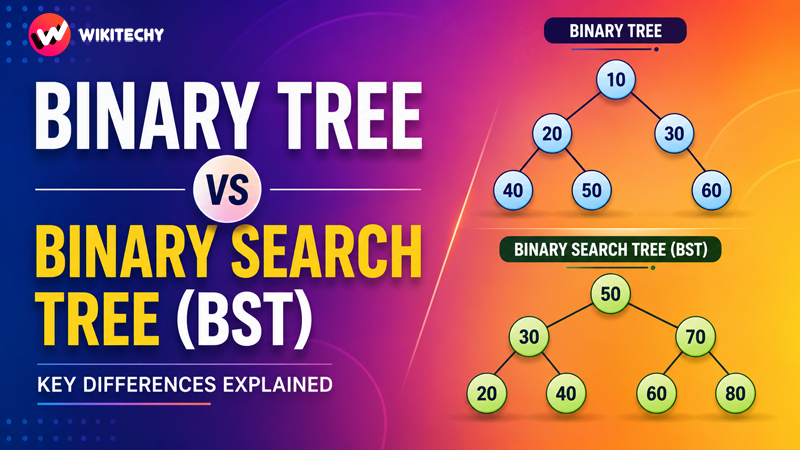
Understanding Binary Tree vs Binary Search Tree (BST) is essential for mastering data structures. Although they look similar at first glance, the way they organize data and perform operations is very different. This article gives you a deep, clear, and interview-ready understanding with minimal bullet points and strong conceptual explanations.
🌳 Understanding the Binary Tree
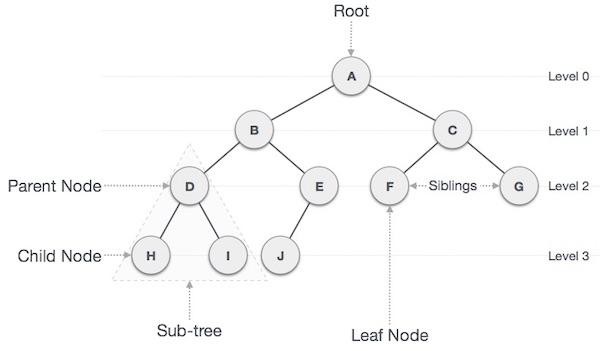
A Binary Tree is one of the most fundamental data structures in computer science. It consists of nodes arranged in a hierarchical manner where each node can have at most two children. These are typically referred to as the left child and right child.
Unlike many other structured data models, a binary tree does not impose any rule on how values should be arranged. This means that the value stored in a parent node can be greater than, smaller than, or equal to the values in its children. Because of this flexibility, binary trees are widely used in scenarios where structure matters more than order.
To better understand, imagine a family tree. A parent node connects to children, and those children may further connect to their own children. There is no inherent sorting—just relationships.
Structure Example
        15
       /  \
     10    25
    / \     \
   5  12     30
In this structure, there is no restriction on placement. For example, 10 is less than 15, but 25 is greater—yet this is not enforced by any rule.
Binary trees can take multiple forms depending on how nodes are arranged. A complete binary tree fills levels from left to right, while a skewed tree behaves more like a linked list. These variations influence performance but do not change the fundamental nature of the binary tree.
🌲 Understanding the Binary Search Tree (BST)
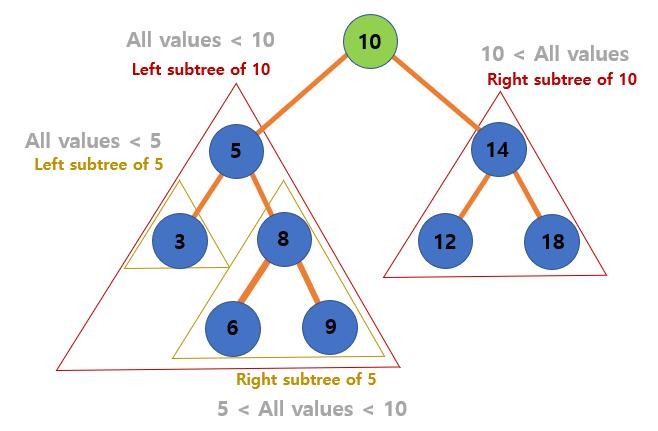
A Binary Search Tree (BST) is a specialized version of a binary tree that introduces a strict ordering rule. This rule is what makes BSTs extremely powerful for searching and sorting operations.
In a BST, every node follows this condition:
All values in the left subtree are smaller than the node, and all values in the right subtree are larger.
This property must be maintained at every level of the tree. As a result, BSTs automatically organize data in a way that allows efficient searching, much like binary search on arrays.
Structure Example
        50
       /  \
     30    70
    / \    / \
   20 40  60 80
Here, the structure is not random. Every placement is meaningful. If you want to search for a value, you simply compare it with the root and decide whether to move left or right. This drastically reduces the number of comparisons required.
Because of this ordered nature, performing an in-order traversal of a BST will always produce sorted output. This is one of the most important properties used in many real-world systems.
🔍 Core Difference Explained Deeply
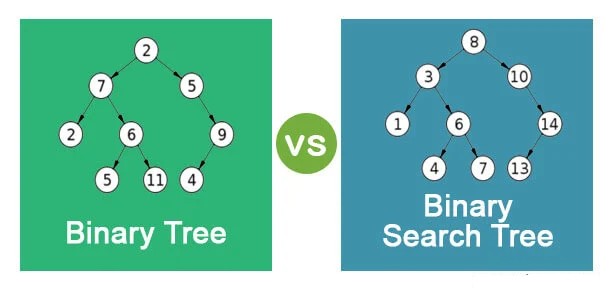
At a high level, the difference lies in freedom vs. discipline.
A binary tree gives you complete freedom in how nodes are arranged. This makes it versatile and useful in many structural applications, but inefficient for searching specific values because you may need to traverse the entire tree.
A BST, on the other hand, enforces discipline through ordering. This restriction might seem limiting, but it enables powerful operations like fast search, insertion, and deletion. In balanced conditions, these operations take logarithmic time, which is significantly faster than linear traversal.
Think of it like this:
- A Binary Tree is like an unsorted notebook
- A BST is like a well-organized dictionary
Both store information, but one helps you find things much faster.
⚙️ Working Mechanism Comparison
When you perform operations on these structures, the difference becomes even clearer.
Searching in a binary tree often requires checking each node one by one. There is no shortcut because values are not ordered. In contrast, a BST allows you to eliminate half of the remaining tree at every step, making the process efficient.
Insertion in a binary tree is straightforward—you can place a node wherever space is available. But in a BST, insertion must follow the ordering rule. This ensures that the structure remains valid and searchable.
Deletion is also more structured in BSTs. When removing a node, special care is taken to preserve the ordering property, often involving replacing the node with its inorder successor or predecessor.
🧠 Performance Perspective
The performance difference between these two structures is one of the main reasons BSTs are preferred in many applications.
In a general binary tree, operations like search can take O(n) time because there is no predictable path to follow. However, in a well-balanced BST, the same operation takes O(log n) time, which is much faster for large datasets.
However, this advantage comes with a caveat. If a BST becomes unbalanced (for example, inserting sorted data into it), it can degrade into a structure similar to a linked list. In such cases, performance falls back to O(n). This is why advanced variations like AVL trees and Red-Black trees are used in practice.
🌍 Real-World Applications
Binary trees are widely used in scenarios where hierarchical representation is important. Compilers use them to parse expressions, operating systems use them to manage hierarchical file systems, and machine learning models rely on tree structures for decision-making.
BSTs are heavily used in applications where fast data retrieval is critical. They form the backbone of database indexing, searching algorithms, and even features like autocomplete in search engines.
Whenever you need ordered data with quick lookup, BSTs become a natural choice.
⚖️ When Should You Use Each?
Choosing between a binary tree and a BST depends entirely on the problem you are solving.
If your goal is to represent hierarchical relationships without worrying about order, a binary tree is sufficient and simpler to implement.
If your application requires frequent searching, sorting, or maintaining ordered data, a BST is the better option due to its efficiency.
🏁 Final Thoughts
A Binary Tree is the foundation, offering flexibility and simplicity. A Binary Search Tree builds upon that foundation by adding order and efficiency.
In simple terms, every BST is a binary tree, but not every binary tree qualifies as a BST. The difference lies in the presence of structure versus the presence of rules.
Mastering both concepts is crucial for coding interviews, algorithm design, and real-world software development. Once you understand how they differ, choosing the right one becomes much easier.
Want to learn more ??, Kaashiv Infotech Offers Data Analytics Course, Data Science Course, Cyber Security Course & More Visit Their Website www.kaashivinfotech.com.