
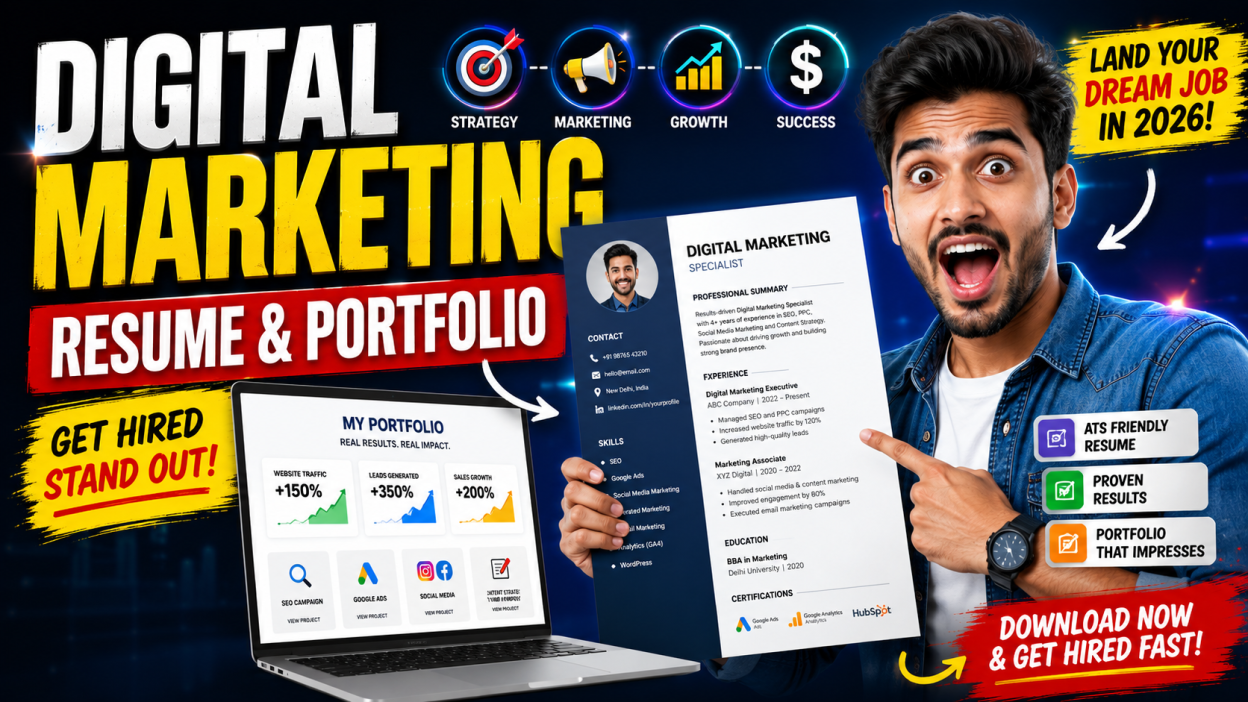
Digital Marketing Resume and Portfolio — if you build them strategically, they can get you interviews even without years of experience.
Digital Marketing Resume and Portfolio are not just documents. They are proof. Proof that you can drive traffic, generate leads, improve conversions, and understand real business growth.
If you’re confused about what to include, how to stand out, or how to build a portfolio without experience — this guide gives you clear, practical answers.
Let’s break it down step by step.
🚀 Key Highlights (Quick Answer Section)
- ✅ Recruiters spend 6–8 seconds scanning a resume (Eye-tracking study by Ladders)
- ✅ 75% of resumes never reach a human due to ATS filters (Jobscan data)
- ✅ Portfolios increase interview chances significantly in skill-based roles
- ✅ Metrics-driven resumes outperform generic resumes
- ✅ Even beginners can create strong portfolios using mock projects
You don’t need 5 years of experience.
You need proof of skill.
Why Your Digital Marketing Resume and Portfolio Matter More Than Ever
Digital marketing is performance-driven.
Companies don’t hire marketers because they “completed a course.” They hire them because they can:
- Increase website traffic
- Improve ROI
- Reduce cost per lead
- Optimize conversions
That’s why your Digital Marketing Resume and Portfolio must show measurable impact.
In hiring discussions across startups and agencies, one pattern appears repeatedly:
Not “Managed social media accounts.”
But “Increased Instagram engagement by 42% in 3 months.”
See the difference?
Step 1: Structure a Results-Driven Resume (Digital Marketing Resume Tips)
Let’s start with the resume.
✅ Best Resume Format for Digital Marketing
Use this structure:
- Professional Summary (2–3 lines)
- Core Skills
- Work Experience (with measurable results)
- Certifications
- Projects
- Tools & Platforms
Keep it clean. One page if entry-level. Two pages max for experienced roles.
✅ Professional Summary Example
Instead of:
“Passionate digital marketer seeking opportunities…”
Write:
“Data-driven digital marketer skilled in SEO and paid advertising, improving organic traffic by 60% and reducing ad spend by 25%.”
Recruiters look for value immediately.
✅ Add Metrics Everywhere
Here’s one of the most important Digital marketing resume tips:
Always include numbers.
Bad example:
- Managed Google Ads campaigns.
Strong example:
- Managed $5,000/month Google Ads budget and increased conversions by 38%.
Numbers create credibility.
Step 2: Highlight the Right Digital Marketing Skills
Your resume should include technical and analytical skills.
🔹 Technical Skills to Add
- SEO (on-page, off-page, technical)
- Google Ads & Meta Ads
- Google Analytics 4
- Keyword research
- Email automation
- Conversion rate optimization
- Content strategy
- Social media advertising
🔹 Tools Recruiters Love Seeing
- Google Analytics
- SEMrush / Ahrefs
- HubSpot
- Mailchimp
- Canva
- WordPress
You can verify in job listings on LinkedIn or Indeed — these tools appear repeatedly.
Step 3: Build a Powerful Digital Marketing Portfolio (Even as a Beginner)
Now let’s talk about the real differentiator.
Your Digital Marketing Resume and Portfolio must work together.
The resume tells.
The portfolio proves.
💡 What to Include in a Marketing Portfolio
- Case studies
- Campaign screenshots
- Analytics reports
- Before/after results
- Strategy explanations
Even beginners can create mock projects.
🧠 Real-World Use Case: No Experience Candidate
Imagine someone learning SEO.
They:
- Create a blog.
- Optimize 10 articles.
- Rank 3 articles on page 1.
- Document keyword growth.
That becomes a case study.
Recruiters care more about initiative than job titles.
Step 4: How to Create Case Studies That Impress
A strong portfolio case study should include:
- The problem
- The strategy
- The tools used
- The results
Example:
Client Problem: Low website traffic
Strategy: On-page SEO + blog content plan
Tools: Google Search Console, Ahrefs
Results: 70% organic traffic growth in 4 months
Clear. Measurable. Professional.
Step 5: Use the Right Platforms to Host Your Portfolio
Here are practical options:
- Personal website (WordPress or Webflow)
- Notion portfolio page
- Google Drive (organized folder)
- Behance (for creatives)
- LinkedIn Featured Section
Best practice?
Create your own website.
Why?
Because it demonstrates:
- Technical confidence
- Branding skills
- SEO knowledge
👉 Google’s SEO Starter Guide can help optimize your site:
https://developers.google.com/search/docs/fundamentals/seo-starter-guide
Step 6: Optimize Resume for ATS (Applicant Tracking Systems)
According to Jobscan research, over 75% of resumes fail ATS screening.
To pass:
✅ Use keywords from job descriptions
✅ Avoid fancy graphics
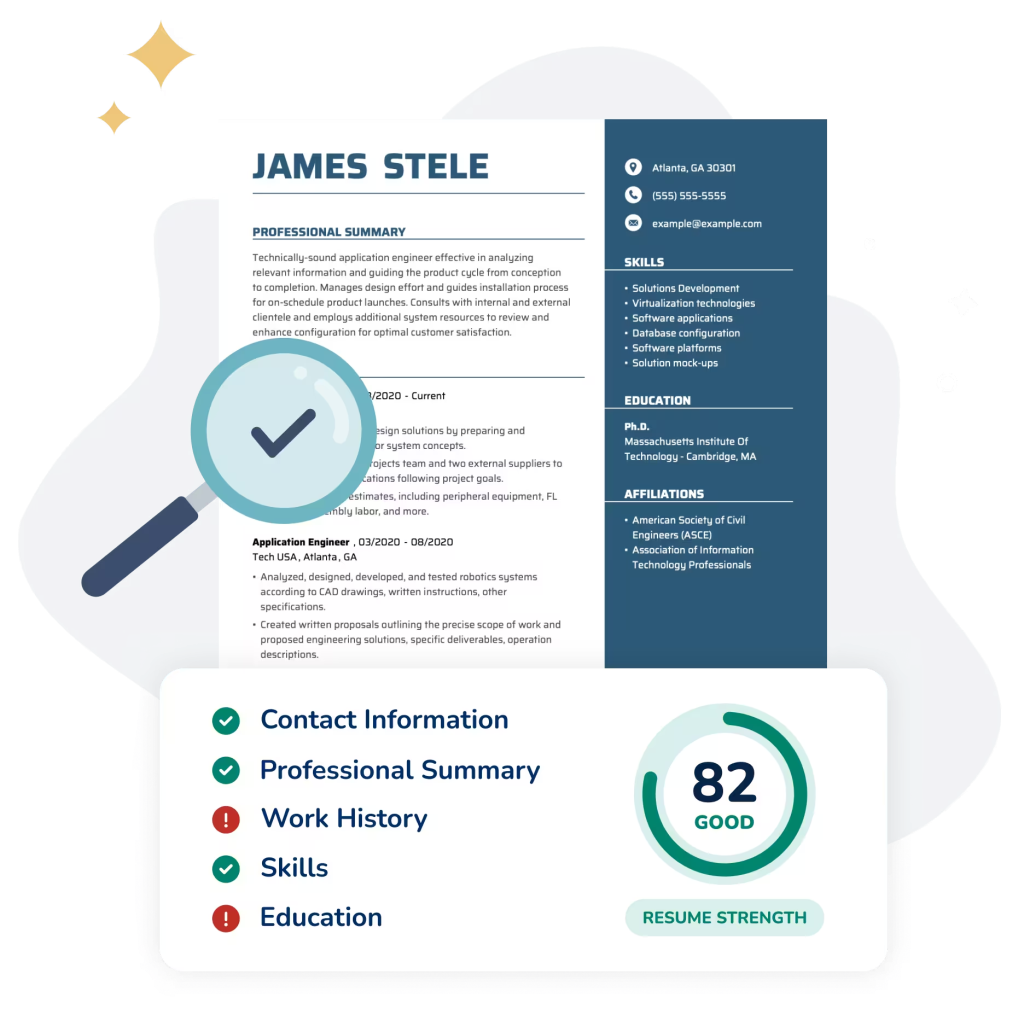
✅ Use standard headings (Experience, Skills, Education)
✅ Save as PDF (unless stated otherwise)
This single step dramatically improves response rate.
Step 7: Common Mistakes to Avoid
Avoid these at all costs:
❌ Listing every tool without depth
❌ No measurable results
❌ Generic objective statements
❌ No portfolio link
❌ Spelling errors
Digital marketing is detail-oriented.
Mistakes signal carelessness.
Step 8: Internal Linking Strategy (For Personal Website Portfolio)
If you build a website, link strategically:
- ✅ [How to Start a Career in Digital Marketing]
- ✅ [Best SEO Strategies for Beginners]
- ✅ [Scope of Digital Marketing in 2026]
Internal links improve SEO strength and showcase knowledge.
Step 9: Add Certifications Strategically
Relevant certifications boost credibility:
- Google Ads Certification
- Google Analytics Certification
- HubSpot Content Marketing Certification
Official Google Skillshop:
https://skillshop.withgoogle.com/
Certifications don’t replace experience — but they build trust.
Step 10: Tailor Resume for Each Job
Don’t send the same resume everywhere.
Customize:
- Keywords
- Highlighted skills
- Case studies
This increases interview rates dramatically.
Step 11: Freelancers — Portfolio Is Everything
If you freelance, your Digital Marketing Resume and Portfolio matter even more.
Clients don’t care about degrees.
They care about:
- Results
- Screenshots
- Testimonials
- ROI numbers
Add testimonials whenever possible.
Social proof increases trust instantly.
Step 12: Keep Updating Quarterly
Marketing changes fast.
Update your portfolio every 3–6 months:
- Add new campaigns
- Remove outdated projects
- Improve case study presentation
Consistency signals professionalism.
Frequently Asked Questions (FAQ)
What should a Digital Marketing Resume and Portfolio include?
It should include measurable results, key skills, tools used, case studies, and certifications relevant to the job role.
Can beginners build a digital marketing portfolio?
Yes. Beginners can create mock projects, personal blogs, or volunteer campaigns to demonstrate skills.
How long should a digital marketing resume be?
One page for entry-level roles. Two pages maximum for experienced professionals.
Is a portfolio necessary for digital marketing jobs?
In most cases, yes. Especially for SEO, paid ads, content marketing, and social media roles.
What are the most important Digital marketing resume tips?
Use measurable results, optimize for ATS, highlight tools, include a portfolio link, and tailor the resume for each job.
Final Thoughts
If you feel pressure about competition, that’s normal. Digital marketing attracts ambitious people.
But here’s the truth:
Most candidates submit generic resumes.
Few build strategic portfolios.
If you focus on measurable results, real projects, and clear case studies, you automatically stand ahead of the crowd.
A strong Digital Marketing Resume and Portfolio does more than get interviews — it builds confidence. And confidence shows during interviews.
Build proof. Show results. Stay consistent.
That’s how you win in 2026. 🚀