

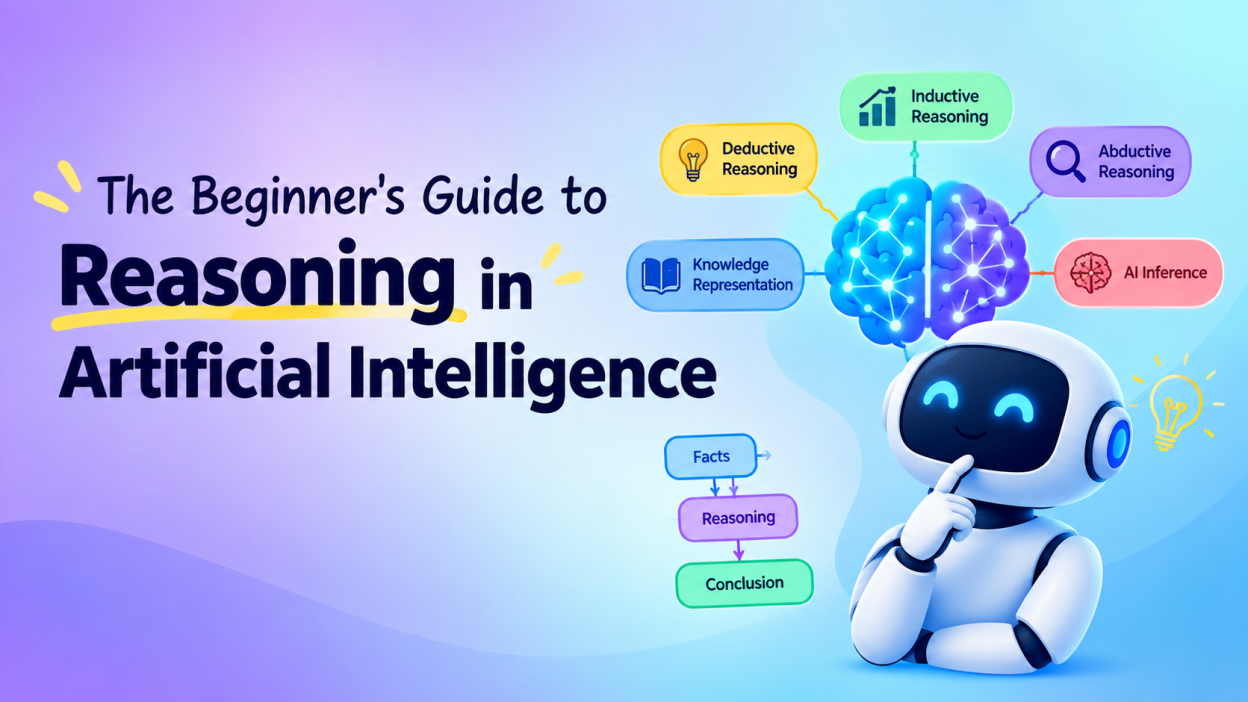
Artificial Intelligence is no longer something we only see in science-fiction movies. I use AI tools for writing, searching, coding, recommendations, and even learning new topics. But there is one part of Artificial Intelligence that I find especially interesting: reasoning.
How does a machine look at information and decide what to do next?
That is where AI reasoning comes in.
In simple words, reasoning in Artificial Intelligence means using available information, rules, patterns, or learned knowledge to reach a conclusion or make a decision. Modern AI systems can use different approaches to reasoning, while traditional AI systems often relied heavily on explicit rules and logic.
For a beginner, the topic can sound complicated at first. Terms such as inference, deduction, induction, knowledge representation, expert systems, machine learning, and reasoning models can quickly become confusing.
So, I want to break it down the way I would explain it to a friend who is learning Artificial Intelligence for the first time.
Key Highlights
Before we get into the details, here are the main things you should remember:
- 🧠 AI reasoning helps machines reach conclusions from information.
- 📚 A knowledge base stores facts, rules, relationships, or other useful information.
- ⚙️ An inference engine applies reasoning methods to that information.
- 🔍 Deductive reasoning moves from general rules to specific conclusions.
- 📊 Inductive reasoning uses observations to identify broader patterns.
- 💡 Abductive reasoning looks for the most likely explanation for an observation.
- 🤖 Modern reasoning models can be designed to handle complex, multi-step problems.
- ⚠️ AI reasoning is not the same as human thinking, and AI systems can still make mistakes.

What Is Reasoning in Artificial Intelligence?
Let me start with a simple example.
Imagine you see these two facts:
Fact 1: Every employee who has completed the training can access the internal system.
Fact 2: Ravi has completed the training.
So what can you conclude?
👉 Ravi can access the internal system.
You didn’t receive the answer directly. You used the available information to reach a conclusion.
That is the basic idea behind reasoning.
In Artificial Intelligence, reasoning allows a system to process information and arrive at conclusions, predictions, decisions, or actions. IBM describes AI reasoning as using available information to generate predictions, make inferences, and draw conclusions.
This is important because an intelligent system should not only store information.
It should also be able to use that information.
Why Is Reasoning Important in Artificial Intelligence?
Think about a navigation application.
You enter: “I want to reach the airport.”
The system has information about:
- Your current location
- Roads
- Traffic
- Distance
- Road closures
- Possible routes
- Estimated travel time
It then evaluates the information and recommends a route.
That’s more than simply storing a map.
The system needs to process information and make a decision.
This is why reasoning is an important part of Artificial Intelligence.
AI is broadly concerned with systems that can perform tasks associated with human intelligence, including learning, recognizing patterns, reasoning, solving problems, and making decisions.
How Does AI Reasoning Work?
A traditional AI reasoning system can be understood using two simple components:
1. Knowledge Base 📚
The knowledge base contains information that the system can use.
For example:
All cats are animals.
Tom is a cat.
The system now has two pieces of information.
2. Inference Engine ⚙️
The inference engine uses the available information and reasoning rules to reach a conclusion.
From:
All cats are animals.
Tom is a cat.
It can conclude:
Tom is an animal.
IBM explains this traditional structure using a knowledge base and an inference engine. Knowledge bases can contain facts, relationships, rules, knowledge graphs, ontologies, and other representations of knowledge.
A simplified view looks like this:
Input → Knowledge → Reasoning → Conclusion
That is the basic flow.
1. Deductive Reasoning in Artificial Intelligence
Let’s start with one of the easiest types to understand.
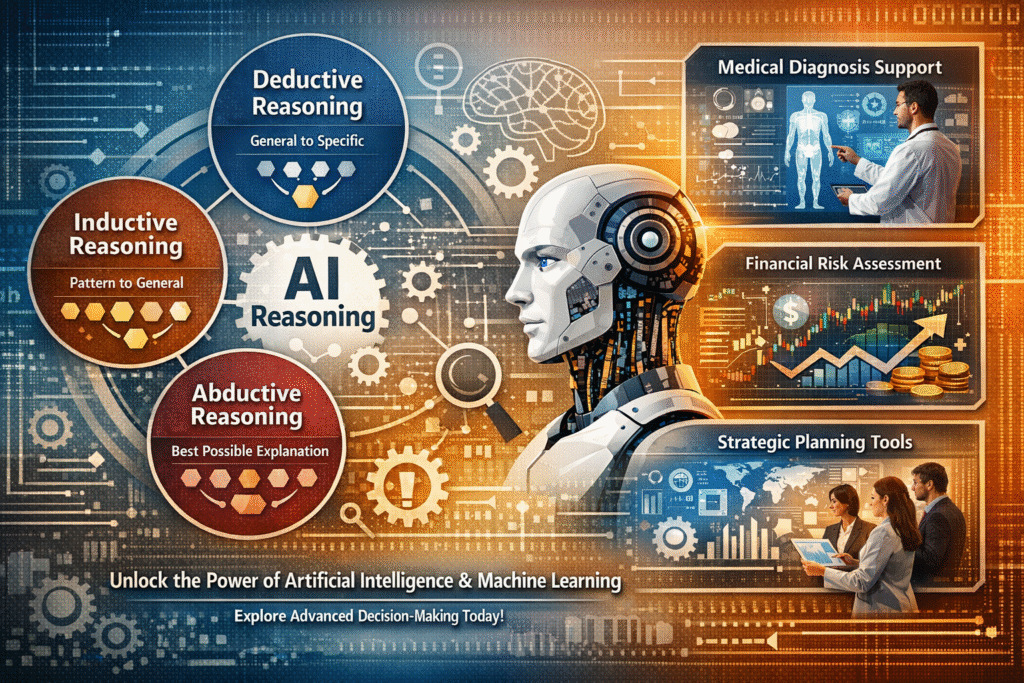
Deductive reasoning starts with a general rule and applies it to a specific situation.
For example:
Rule:
All humans need oxygen.

Fact:
Ravi is a human.

Conclusion:
Ravi needs oxygen.
We started with a general statement and reached a specific conclusion.
Another everyday example:
Rule:
If it rains, the road may become wet.

Fact:
It is raining.

Conclusion:
The road may become wet.
In rule-based Artificial Intelligence, this type of reasoning can be represented using if-then rules.
For example:
IF customer_payment_is_late
THEN send_payment_reminder
If the condition becomes true, the system can follow the corresponding rule.
Deductive reasoning is commonly associated with expert systems and rule-based AI.
2. Inductive Reasoning in Artificial Intelligence
Now let’s reverse the direction.
Suppose I observe the following:
Monday → The bus arrived late.
Tuesday → The bus arrived late.
Wednesday → The bus arrived late.
Thursday → The bus arrived late.
I might conclude: “This bus usually arrives late.”
Notice something important.
I don’t know with absolute certainty that the bus will be late tomorrow.
I am making a generalization from previous observations.
That’s inductive reasoning.
In Artificial Intelligence, inductive reasoning is useful when systems learn patterns from examples and use those patterns to make predictions.
This connects closely with Machine Learning, where algorithms learn patterns from data instead of relying only on explicitly written rules.
For example, a spam detection system may examine thousands of emails.
It may notice patterns such as:
- Certain suspicious words
- Unusual links
- Repeated messages
- Suspicious sender behavior
Then it predicts whether a new email is likely to be spam.
That’s a practical example of AI using learned patterns.

3. Abductive Reasoning: Finding the Most Likely Explanation
This one initially confused me because it sounds more complicated than it really is.
Imagine you wake up and see that the ground outside is wet.
What happened?
You might think: “It probably rained.”
But maybe someone washed the road.
Or perhaps a water pipe broke.
You don’t have complete information.
So you search for the most likely explanation.
That’s the basic idea of abductive reasoning.
A simple example:
Observation:
The patient's temperature is high.

Possible explanations:
- Infection
- Heat exposure
- Other medical causes
An AI system can use available evidence to evaluate possible explanations.
Abductive reasoning is especially useful when information is incomplete or uncertain.
4. Fuzzy Reasoning in Artificial Intelligence
Computers traditionally work very well with clear values such as:
True
False
0
1
But real life isn’t always that clean.
Consider this question: “Is today’s weather hot?”
What exactly does hot mean?
For one person, 28°C may feel hot.
For another person, it may feel comfortable.
This is where fuzzy reasoning can be useful.
Instead of saying something is simply:
100% hot
or
0% hot
a fuzzy system can work with degrees.
For example:
Temperature = 28°C

Hot = 0.6
Warm = 0.8
Cold = 0.0
The exact values depend on how the system is designed.
Fuzzy reasoning is useful when we deal with vague concepts such as:
- Hot
- Cold
- Fast
- Slow
- High
- Low
- Near
- Far
IBM identifies fuzzy reasoning as an approach that works with degrees of truth rather than only absolute true/false values.
5. Knowledge Representation in Artificial Intelligence
Here’s something beginners often miss.
Before an AI system can reason effectively, information needs to be represented in a way the system can work with.
This is called knowledge representation.
Imagine I tell you: “A dog is an animal. Animals need food. Bruno is a dog.”
As a human, you can easily connect these ideas.
An AI system needs information represented in a structured or machine-processable form.
Knowledge can be represented using things such as:
- Rules
- Facts
- Knowledge graphs
- Ontologies
- Semantic networks
- Relationships
For example:
Bruno → is a → Dog

Dog → is a → Animal

Animal → needs → Food
Now the relationships are easier for a system to process.
Knowledge representation has been an important part of AI reasoning for decades, although modern AI systems can use very different techniques from traditional symbolic systems.
6. AI Inference and Reasoning
You will often see the word inference when learning Artificial Intelligence.
So what does it mean?
Simply put:
Inference is the process of using available information to produce an output or conclusion.
For example:
Input:
The email contains suspicious links and unusual sender information.

AI:
Analyzes the available patterns.

Output:
This email may be spam.
In machine learning, inference generally refers to using a trained model on new data to generate a prediction or solve a task.
This is an important distinction:
Training
The model learns patterns from data.
Inference
The trained model uses what it learned to process new input.
A simple way I remember it is: Training = learning , Inference = using what was learned
7. Reasoning Models in Modern Artificial Intelligence
This is where things get especially interesting.
Modern Artificial Intelligence includes models designed to handle more complex, multi-step problems.
Instead of immediately producing an answer, a reasoning-oriented model can spend additional computation working through a difficult task before producing its response.
For example, consider a programming problem:
A program has three conditions.
Condition A affects B.
B affects C.
C changes the final output.
What should the program return?
A system needs to keep track of multiple relationships before reaching the final answer.
Modern reasoning models are specifically designed to improve performance on complex reasoning tasks, although they can still make errors and should not automatically be treated as perfectly reliable.
This is also why you may hear terms such as:
- AI reasoning models
- Reasoning AI
- Reasoning LLMs
- Agentic AI
- AI inference
They are related, but they don’t all mean exactly the same thing.
Artificial Intelligence Reasoning vs Machine Learning
This is another common beginner question.
Are Artificial Intelligence and Machine Learning the same thing?
No.
Think of it like this:
Artificial Intelligence
        ↓
    Machine Learning
        ↓
   Deep Learning
This is an oversimplification because AI contains many approaches beyond machine learning, but it is a useful starting point.
Artificial Intelligence is the broader field.
Machine Learning is a branch of AI that allows systems to learn patterns from data.
Reasoning can appear in both traditional symbolic AI and modern machine-learning-based systems.
For example:
Traditional AI
IF temperature > 38°C
THEN flag possible fever
Machine Learning
The model learns patterns from many examples and predicts an outcome for new data.
Modern AI system
A system may combine learned models, retrieved information, tools, rules, and planning techniques to solve a more complicated task.
So, Artificial Intelligence reasoning isn’t limited to one single technique.

Real-Life Applications of AI Reasoning
You might be wondering: “Okay, but where do I actually see this?”
Almost everywhere.
🏥 Healthcare
AI can help analyze medical information, identify patterns, and support clinical decision-making.
🚗 Self-Driving and Driver-Assistance Systems
Systems can combine information from cameras, sensors, maps, and other inputs to decide how to respond to the environment.
💳 Banking
AI can help identify unusual transaction patterns and support fraud detection.
🛒 Recommendation Systems
When an online store recommends products based on your activity, AI systems can use learned patterns to predict what you may be interested in.
💬 Chatbots
Chatbots process your question, interpret context, and generate an appropriate response.
🤖 AI Agents
Modern agentic systems can interpret goals, plan actions, interact with tools, and respond to changing information. NIST describes agentic AI as systems capable of autonomous or semi-autonomous decision-making and interaction with users, systems, and environments.
A Simple Example of Artificial Intelligence Reasoning
Let’s imagine an online shopping website.
You search for: “Laptop for programming under ₹60,000.”
The system could consider:
- Your budget
- Product specifications
- Previous searches
- Available products
- Customer ratings
- Your preferred screen size
- Processor requirements
Then it may recommend several laptops.
The system isn’t necessarily following one simple rule.
Modern recommendation systems can combine different models and sources of information.
This is why Artificial Intelligence has become so useful in applications where there is a lot of information to process.
Limitations of AI Reasoning ⚠️
Now for an important reality check.
AI reasoning sounds impressive, but it isn’t magic.
An AI system can still:
- Make incorrect assumptions
- Use incomplete information
- Produce incorrect conclusions
- Misinterpret context
- Generate confident but wrong answers
- Struggle with unusual situations
- Reflect problems present in its data or design
This matters because we sometimes assume: “If AI gives an answer confidently, it must be correct.”
That’s not a safe assumption.
Research and current AI evaluations continue to show that even advanced AI systems have failure modes that can be difficult to predict or explain.
So when I use AI for an important decision, I don’t treat the output as the final authority.
I verify it.
That’s a habit worth developing early.
How Should Beginners Learn Artificial Intelligence Reasoning?
If you’re completely new to Artificial Intelligence, don’t jump directly into complicated research papers.
I would suggest this order:
Step 1: Learn the basics of AI
Understand:
- What is AI?
- What is Machine Learning?
- What is Deep Learning?
- What is Generative AI?
Step 2: Learn basic programming
Python is a popular starting point for AI and machine learning.
Learn:
- Variables
- Conditions
- Loops
- Functions
- Lists
- Dictionaries
- Basic object-oriented programming
Step 3: Learn basic mathematics
You don’t need advanced mathematics on day one.
Start with:
- Percentages
- Probability
- Statistics
- Basic algebra
Then gradually move toward linear algebra and calculus if your AI path requires them.
Step 4: Learn Machine Learning
Understand:
- Training data
- Features
- Labels
- Models
- Predictions
- Classification
- Regression
Step 5: Learn AI reasoning concepts
Then explore:
- Deductive reasoning
- Inductive reasoning
- Abductive reasoning
- Inference
- Knowledge representation
- Expert systems
- Knowledge graphs
- Planning
- Reasoning models
This order makes the subject much less intimidating.
Final Thoughts on Reasoning in Artificial Intelligence
When I first think about Artificial Intelligence, it is tempting to imagine a computer that simply “thinks like a human.”
But that’s not really the best way to understand it.
AI systems use different combinations of data, algorithms, rules, learned patterns, representations, models, and computational methods to perform tasks that we associate with intelligence.
Reasoning is one important piece of that larger picture.
Sometimes the system follows rules.
Sometimes it learns patterns from data.
Sometimes it combines information to reach a conclusion.
And modern AI systems are increasingly being designed to handle more complex, multi-step tasks.
The key lesson I would give any beginner is simple:
Don’t try to memorize every AI term at once.
Start with one question: “How does the machine go from information to a decision?”
Once you understand that basic idea, concepts such as inference, deduction, induction, knowledge representation, machine learning, and reasoning models start making much more sense.
And honestly, that’s when Artificial Intelligence becomes much less scary—and much more interesting. 🚀
Frequently Asked Questions
What is reasoning in Artificial Intelligence?
Reasoning in Artificial Intelligence is the process of using information, rules, patterns, or learned knowledge to reach conclusions, make predictions, or choose actions.
What are the main types of AI reasoning?
Common reasoning approaches include deductive, inductive, abductive, and fuzzy reasoning. Different AI systems may use different combinations of these approaches.
Is reasoning the same as machine learning?
No. Machine Learning is a branch of Artificial Intelligence that learns patterns from data. Reasoning is a broader concept involving how a system uses information to reach conclusions or make decisions.
What is AI inference?
AI inference is the process of using a trained model with new input to generate a prediction, output, or decision.
Are AI reasoning systems always correct?
No. AI systems can make mistakes because of incomplete information, poor data, model limitations, or incorrect assumptions. Important AI-generated information should be verified.
Is AI reasoning difficult to learn?
The advanced mathematics and research behind AI reasoning can be difficult, but the basic concepts are beginner-friendly. Start with simple examples of rules, facts, patterns, and conclusions before moving to advanced AI models.
Want to Learn More About Python & Artificial Intelligence ?, Kaashiv Infotech Offers Full Stack Python Course, Artificial Intelligence Course, Data Science Course & More Visit Their Website course.kaashivinfotech.com.
Related Reads:
Artificial Intelligence vs Human Intelligence: A Deep Dive into Minds Made and Minds Born
Top 10 AI Tools for Content Creation in 2026 You Shouldn’t Miss.

