

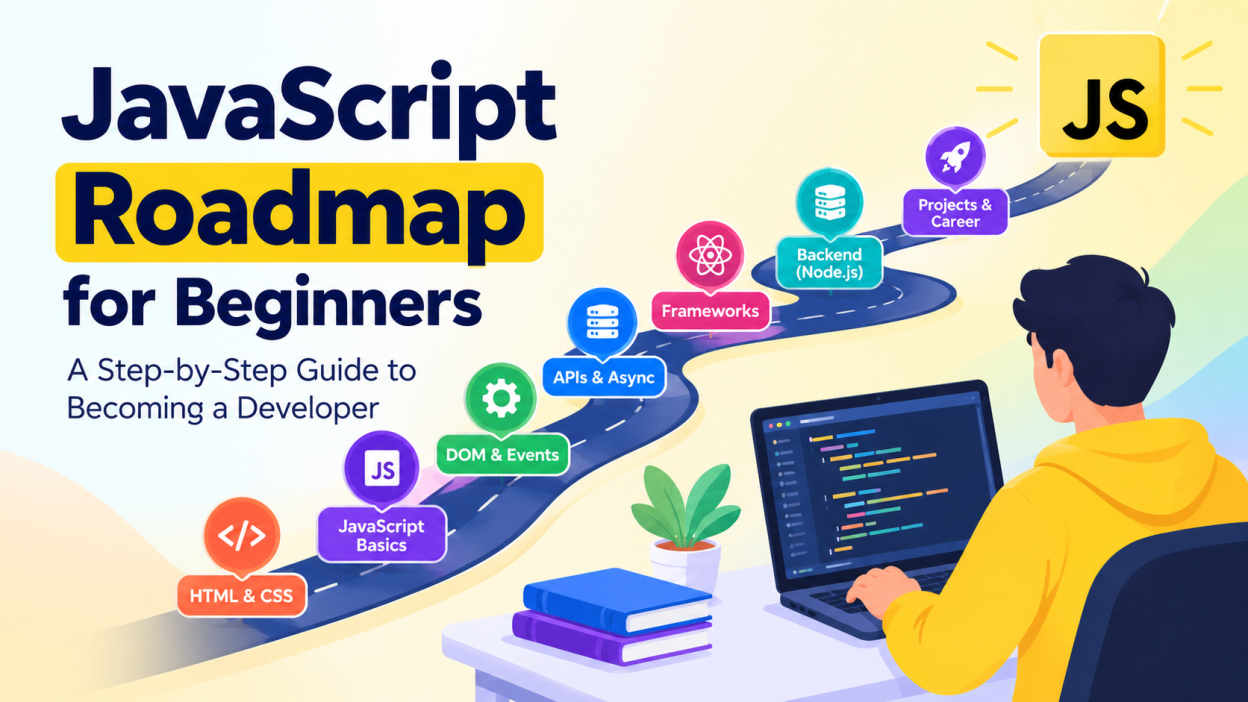
JavaScript is one of the most popular programming languages for building modern websites and web applications. It is used to create interactive web pages, dynamic user interfaces, backend applications, mobile apps, and even desktop software. For beginners, learning JavaScript can seem confusing because there are many concepts, tools, and frameworks to explore.
A clear JavaScript roadmap for beginners can make the learning process easier. Instead of trying to learn everything at once, beginners should follow a step-by-step approach, starting with programming fundamentals and gradually moving toward advanced JavaScript, frontend frameworks, backend development, and real-world projects.
Start With HTML and CSS
Before learning JavaScript, beginners should understand the basics of HTML and CSS. HTML provides the structure of a webpage, while CSS controls its appearance and layout.
You do not need to become an expert in either technology before starting JavaScript. However, you should understand common HTML elements, forms, links, images, tables, classes, IDs, and semantic elements.
For CSS, learn selectors, colors, fonts, box model, positioning, Flexbox, Grid, responsive design, and media queries.
Once you understand HTML and CSS, JavaScript becomes easier because you can use it to add behavior and interaction to the pages you create.
Learn JavaScript Fundamentals

The next step in the roadmap is learning JavaScript fundamentals. These concepts form the foundation for everything you will learn later.
Start with variables and data types. Learn how to use let, const, strings, numbers, booleans, arrays, objects, null, and undefined.
Then move to operators and expressions. You should understand arithmetic, comparison, logical, assignment, and ternary operators.
After that, learn conditional statements such as if, else if, and else. These allow your programs to make decisions based on different conditions.
Loops are another important topic. Practice for, while, and do...while loops and understand when each one is useful.
Understand Functions
Functions are one of the most important concepts in JavaScript. They allow you to organize reusable blocks of code.
Start with regular functions and parameters. Then learn return values and function expressions. Once you are comfortable, move to arrow functions.
For example, you might create a function that calculates the total price of products, validates a form, or converts temperatures.
Understanding functions properly will also make advanced JavaScript concepts much easier to learn.
Learn Arrays and Objects

Arrays and objects are used extensively in JavaScript applications.
Arrays allow you to store collections of values, such as product names, student marks, or customer information. Learn how to add, remove, search, and modify array elements.
You should also become comfortable with methods such as map(), filter(), reduce(), find(), forEach(), and includes().
Objects allow you to represent structured information using key-value pairs. Learn how to create objects, access properties, update values, add methods, and work with nested objects.
These concepts are particularly important when working with APIs and databases.
Learn the DOM
After understanding JavaScript fundamentals, start learning the Document Object Model (DOM).
The DOM allows JavaScript to interact with HTML elements. You can use JavaScript to change text, modify styles, create elements, remove elements, and respond to user actions.
Important topics include selecting elements, changing content, modifying attributes, manipulating classes, creating elements, and handling events.
Practice events such as click, submit, change, input, and keydown.
At this stage, build small projects such as a calculator, to-do list, digital clock, image slider, or form validation application.
Understand Modern JavaScript
Once you understand the basics, move to modern JavaScript features, commonly associated with ES6 and later versions.
Learn template literals, destructuring, spread and rest operators, default parameters, modules, classes, optional chaining, and nullish coalescing.
You should also understand how JavaScript handles scope and understand concepts such as global scope, function scope, and block scope.
Modern JavaScript syntax is widely used in professional development, so becoming comfortable with it will help you work with modern frameworks and libraries.
Learn Asynchronous JavaScript
Asynchronous programming is another important part of your JavaScript roadmap.
Start by understanding callbacks and then learn Promises. After that, focus on async and await.
You should understand how JavaScript handles tasks that do not complete immediately, such as API requests and file operations.
Learn how to use the Fetch API to retrieve data from web services. Practice working with JSON and handling successful responses and errors.
Building a weather application or movie search application using a public API is a good way to practice asynchronous JavaScript.
Learn Git and GitHub
Learning JavaScript is not only about writing code. Beginners should also learn basic development tools.
Git helps you track changes in your projects, while GitHub allows you to store and share your code online.
Learn basic commands such as creating repositories, committing changes, creating branches, pushing code, pulling updates, and working with remote repositories.
Maintaining projects on GitHub can also help you create a portfolio that demonstrates your skills.
Choose a JavaScript Framework
After becoming comfortable with JavaScript fundamentals, you can start learning a frontend framework or library.
React is a popular option, but you can also explore Angular or Vue depending on your career goals.
If you choose React, learn components, props, state, events, hooks, conditional rendering, forms, routing, and API integration.
Do not start with a framework before understanding JavaScript fundamentals. A strong JavaScript foundation makes learning frameworks considerably easier.
Explore Backend JavaScript
If you want to become a full-stack developer, the next step is learning backend development with Node.js.
Learn how Node.js works and then explore Express.js for creating web servers and APIs.
You should understand HTTP methods such as GET, POST, PUT, PATCH, and DELETE. Then learn routing, middleware, authentication, error handling, and database integration.
You can also learn databases such as MongoDB, MySQL, or PostgreSQL depending on your project requirements.
Build Real-World Projects
Projects are one of the most important parts of a JavaScript learning roadmap. Reading tutorials alone is not enough. You need to apply what you learn.
Start with simple projects such as:
- Calculator
- To-do list
- Digital clock
- Quiz application
- Expense tracker
- Weather application
- Notes application
- Movie search application
- E-commerce website
- Portfolio website
As your skills improve, create larger applications that combine frontend, APIs, authentication, and databases.
Final Thoughts
Following a structured JavaScript roadmap for beginners can make learning much more manageable. Start with HTML and CSS, learn JavaScript fundamentals, practice functions, arrays, objects, and DOM manipulation, and then move toward modern JavaScript and asynchronous programming.
After building a strong foundation, learn Git and GitHub, explore a frontend framework, and consider Node.js for backend development. Most importantly, keep building projects throughout the learning process.
JavaScript offers opportunities in frontend development, backend development, full-stack development, mobile applications, and more. With consistent practice and a project-based approach, beginners can gradually develop the skills needed to work on real-world web applications.
Want to Learn More About Java ?, Kaashiv Infotech Offers, Full Stack Java Course, Java Course, Data Science Course, Internships & More, Visit Their Website www.kaashivinfotech.com.